Cooling Tower Fan Blade Balancing: Causes, Methods and Benefits
Cooling tower fan blade balancing is an important maintenance procedure for improving equipment stability, controlling vibration, and supporting reliable industrial cooling operations. When cooling tower fan blades are not properly balanced, the rotating assembly may experience excessive vibration, increased bearing loads, unusual noise, and premature wear of mechanical components.
For industrial cooling towers operating in power plants, chemical facilities, manufacturing plants, and HVAC systems, fan balance can directly affect maintenance costs and operational reliability. However, vibration does not always indicate blade imbalance. Problems such as shaft misalignment, damaged bearings, loose fasteners, gearbox defects, and structural resonance can produce similar symptoms.
Understanding the causes, methods, and benefits of cooling tower fan blade balancing helps maintenance teams identify problems accurately and choose the right corrective action.
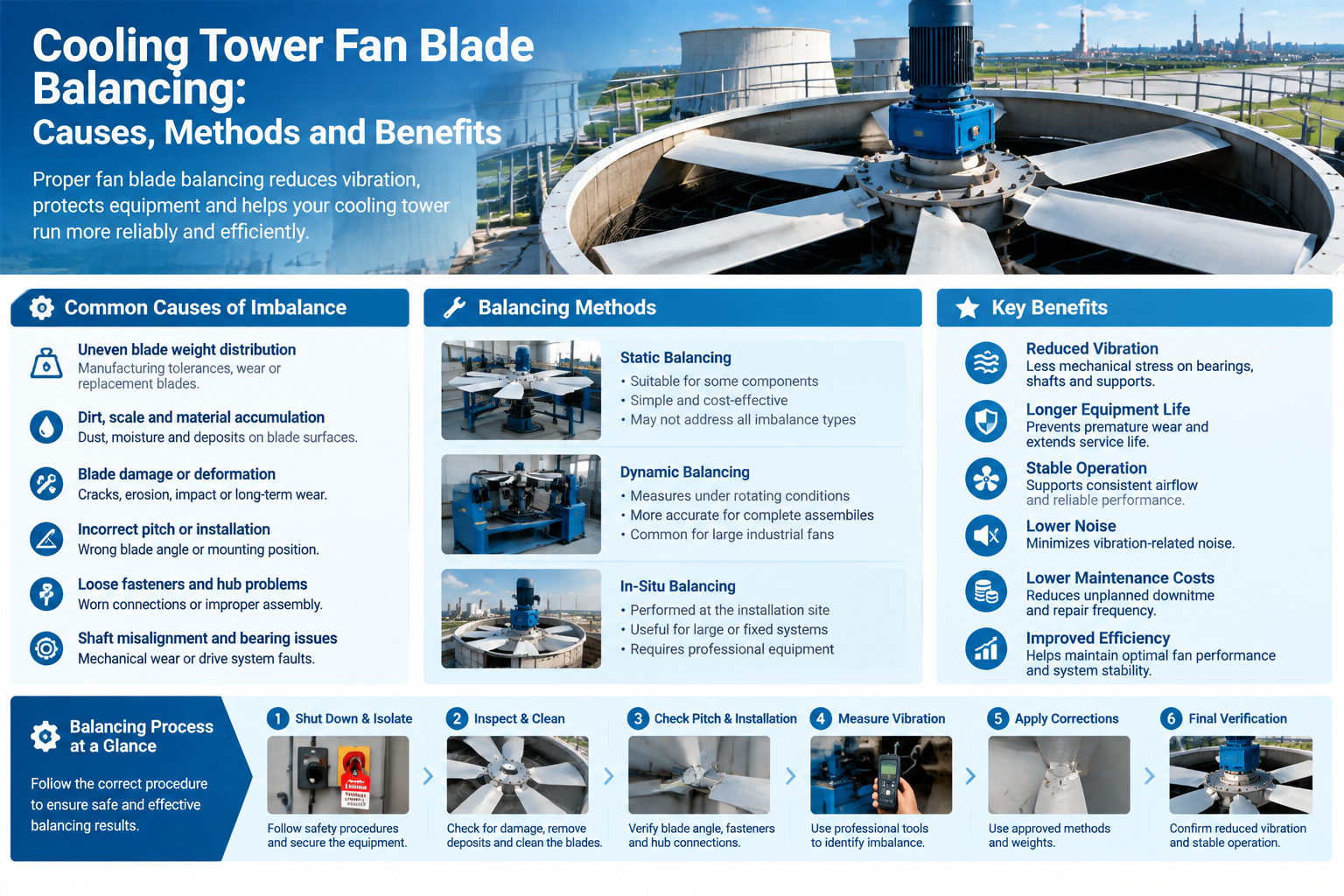
What Is Cooling Tower Fan Blade Balancing?
Cooling tower fan blade balancing is the process of assessing and correcting mass imbalance in the rotating fan assembly. The goal is to reduce the centrifugal forces generated by uneven mass distribution as the fan rotates.
A cooling tower fan may contain several blades attached to a hub. If the mass distribution around the rotational axis is uneven, the resulting centrifugal forces can cause vibration during operation.
Why Is Fan Blade Balance Important?
A properly balanced fan assembly helps reduce unnecessary mechanical stress and supports stable operation. It also makes it easier to identify other developing equipment problems because excessive vibration caused by imbalance is reduced.
Main Objectives of Cooling Tower Fan Blade Balancing
Reduce vibration associated with rotating mass imbalance.
Help protect bearings, shafts, gearboxes, and motor supports from excessive dynamic loads.
Improve the stability of fan operation.
Reduce noise caused by imbalance-related vibration.
Support longer equipment service life when combined with proper maintenance.
Help reduce unplanned shutdowns caused by vibration-related problems.
Balancing does not correct every source of vibration. A fan with damaged bearings, bent blades, loose mounting hardware, or incorrect installation may continue to vibrate even after its mass distribution has been corrected.
Which Cooling Tower Fans Need Balancing?
Fan balancing may be required for several types of cooling tower fans, including:
Axial-flow cooling tower fans
FRP cooling tower fan assemblies
Aluminum cooling tower fans
Adjustable-pitch fan systems
Fixed-pitch fan systems
Industrial induced-draft cooling tower fans
Large mechanical-draft cooling tower fans
The balancing requirements depend on fan diameter, rotational speed, assembly design, operating conditions, and the manufacturer's specifications.
What Causes Cooling Tower Fan Blade Imbalance?
Cooling tower fan imbalance can develop gradually during normal operation or appear suddenly after maintenance, impact damage, or component failure. Identifying the root cause is essential because correcting only the visible symptom may lead to repeated vibration problems.
1. Uneven Blade Weight Distribution
Manufacturing tolerances, material variations, repairs, or differences between replacement blades can create uneven mass distribution.
Even when blades appear identical, small differences in mass and the distance of that mass from the rotational axis may affect the balance of a rotating assembly.
How to Prevent Uneven Blade Weight Distribution
Use blades that meet the fan manufacturer's specifications. For replacement projects, verify the blade model, material, geometry, mass characteristics, and compatibility with the existing hub.
Avoid mixing incompatible blades or replacing only one blade without following the manufacturer's balancing and installation procedure.
2. Dirt, Scale, and Material Accumulation
Cooling towers operate in environments where airborne dust, mineral deposits, moisture, and other contaminants may accumulate on fan blades.
If deposits form unevenly, the mass distribution can change and contribute to vibration.
Recommended Cleaning Practices
Inspect blade surfaces for uneven deposits.
Clean blades using methods approved for the blade material.
Avoid aggressive tools that may damage FRP or protective coatings.
Check for cracks, erosion, deformation, and surface deterioration after cleaning.
Verify the condition of the complete fan assembly before returning it to service.
Cleaning can remove an imbalance caused by contamination, but it will not correct permanent blade deformation or damaged structural components.
3. Blade Damage or Deformation
Fan blades may become damaged by impact, improper handling, excessive mechanical stress, chemical exposure, ultraviolet degradation, or long-term environmental wear.
A bent, cracked, or deformed blade can change both mass distribution and aerodynamic performance.
Why Damaged Blades Should Not Simply Be Rebalanced
Balancing cannot restore the structural integrity of a damaged blade. Adding correction weights to a cracked or deformed blade may conceal the symptom while leaving a serious mechanical risk unresolved.
Damaged blades should be assessed according to the manufacturer's repair criteria. Blades with unacceptable structural damage should be repaired by an approved process or replaced.
4. Incorrect Blade Pitch or Installation
Cooling tower fan blades may use fixed-pitch or adjustable-pitch designs. If blade pitch settings differ from the specified configuration, airflow distribution and aerodynamic loading may become uneven.
Incorrect blade positioning can also create operational vibration that resembles imbalance.
How to Check Blade Pitch
Measure each blade angle using the procedure and reference points specified by the fan manufacturer. Check blade orientation, hub assembly, fasteners, and installation dimensions.
Do not increase blade pitch simply to improve cooling performance. Excessive pitch can increase motor load, cause vibration, and exceed the design limits of the fan system.
5. Loose Fasteners and Hub Problems
Loose bolts, worn hub connections, damaged mounting surfaces, or incorrect tightening procedures may allow movement within the fan assembly.
Such movement can produce vibration and may become more severe during operation.
Inspection Points
Check hub fasteners, blade mounting points, locking devices, and accessible structural connections. Use the manufacturer's specified tightening sequence and torque values.
If a hub or blade connection is damaged, repair it according to the approved procedure before conducting a balancing assessment.
6. Shaft Misalignment and Bearing Problems
Not every cooling tower fan vibration issue originates from the blades. Misalignment between connected components, worn bearings, a bent shaft, or gearbox defects can produce similar symptoms.
For gearbox-driven cooling towers, problems involving the gearbox, coupling, motor, or fan shaft should be included in the investigation.
How to Distinguish Imbalance from Other Problems
A vibration analysis can help identify patterns associated with different mechanical faults. Technicians may compare vibration frequency, amplitude, phase, operating speed, and measurements taken at multiple locations.
No single symptom is sufficient to confirm blade imbalance. A qualified technician should assess the complete rotating system.
What Are the Main Methods of Cooling Tower Fan Blade Balancing?
The appropriate balancing method depends on the fan assembly, operating speed, manufacturer requirements, and the nature of the imbalance.
1. Static Balancing
Static balancing assesses whether a component's center of mass is aligned with its rotational axis when the component is stationary or supported in a suitable balancing fixture.
It is commonly associated with individual rotating components and specific fan designs.
When Is Static Balancing Appropriate?
Static balancing may be suitable for certain components when the manufacturer's procedure permits it. However, it may not adequately address all imbalance conditions in a large rotating assembly.
For multi-blade cooling tower fans, individual blade weight checks alone do not necessarily establish that the complete assembled fan is properly balanced.
2. Dynamic Balancing
Dynamic balancing evaluates the rotating assembly under specified balancing conditions. Depending on the equipment and procedure, it can identify imbalance effects that cannot be fully addressed through static balancing alone.
For large industrial fans, specialized balancing equipment may be used to measure vibration and determine appropriate correction requirements.
Benefits of Dynamic Balancing
Evaluates the rotating assembly under defined test conditions.
Helps identify imbalance-related vibration.
Supports more precise correction when required.
Can be useful for large or high-speed rotating equipment.
Provides measurements that can be documented for maintenance records.
Dynamic balancing should be conducted using equipment and procedures appropriate to the fan design. The required balancing quality and acceptance criteria should come from the manufacturer or applicable engineering standards.
In-Situ Fan Balancing
In-situ balancing, also called field balancing, is performed on equipment installed at its operating location. It may be considered when the complete fan assembly is difficult to remove or when operating vibration needs to be corrected after installation.
What Is Checked Before Field Balancing?
Before field balancing begins, technicians should verify:
The structural integrity of the fan blades and hub.
The condition of bearings and shafts.
The security of mounting hardware.
The alignment of connected drive components.
The condition of the motor and gearbox, where fitted.
Whether vibration is caused by resonance or other mechanical faults.
Field balancing should not be used to compensate for unsafe structural conditions or defective mechanical components.
Blade Matching and Assembly Balancing
Some cooling tower fan systems require blades to be matched according to manufacturer-defined mass, geometry, and installation requirements.
For multi-blade assemblies, the complete configuration—including the hub and all blades—must be considered.
Why Blade Matching Matters
Using compatible blades helps maintain the intended aerodynamic characteristics and mass distribution. This is especially important when replacing damaged blades or upgrading older fan systems.
Blade matching is not a substitute for assembly balancing when the manufacturer requires a final balancing check.
How to Balance Cooling Tower Fan Blades Step by Step
Cooling tower fan balancing requires suitable instruments, technical knowledge, and strict safety controls. The following process outlines a general maintenance workflow rather than a universal procedure for every fan model.
Step 1: Shut Down and Isolate the Equipment
Before inspection or physical work, shut down the cooling tower fan and follow the site's lockout/tagout and energy-isolation procedures.
Verify that the fan cannot restart automatically through a control system or variable-frequency drive. Wait for all rotating components to stop and follow the manufacturer's access and safety instructions.
Essential Safety Precautions
Prevent accidental startup.
Use appropriate fall protection and access equipment.
Follow confined-space or restricted-access procedures where applicable.
Keep personnel clear of rotating equipment during testing.
Never install or remove correction weights while the fan is rotating unless an approved specialized procedure specifically permits the operation.
Step 2: Inspect and Clean the Fan Assembly
Inspect the blades, hub, fasteners, shaft, and accessible drive components. Remove deposits using an approved cleaning method.
Look for cracks, erosion, deformation, loose connections, and signs of impact.
Determine Whether Repair or Replacement Is Needed
If a blade is structurally damaged, follow the manufacturer's repair or replacement requirements before balancing. Do not attempt to balance a damaged blade merely by adding mass to another part of the assembly.
Step 3: Verify Blade Installation and Pitch
Confirm that all blades are installed in the correct positions and orientations. For adjustable-pitch systems, check the blade angles against the specified setting.
Verify fastener condition, mounting integrity, and the required tightening procedure.
Why Consistent Pitch Matters
Differences in blade pitch can create unequal aerodynamic loading and uneven airflow. Correcting the pitch may reduce performance problems, but it does not replace a mass-balancing assessment if imbalance remains.
Step 4: Check the Complete Drive System
Inspect the motor, gearbox, coupling, shaft, bearings, supports, and mounting structure as applicable.
Look for signs of misalignment, loose fasteners, excessive shaft movement, bearing wear, or other faults that could contribute to vibration.
Avoid Unnecessary Balancing Corrections
If the actual cause is a defective bearing or misaligned shaft, adding correction weights will not resolve the underlying fault. Diagnose and correct mechanical problems before proceeding.
Step 5: Measure Vibration and Assess Imbalance
Qualified technicians may use vibration analyzers, tachometers, phase measurements, and appropriate balancing equipment to assess the rotating assembly.
Measurements should be taken at suitable locations and compared with relevant baseline data, manufacturer limits, and applicable acceptance criteria.
What Should Be Recorded?
Useful records include operating speed, vibration measurements, measurement locations, phase information where applicable, equipment condition, and the corrective actions taken.
These records help technicians determine whether the vibration has improved and provide a reference for future maintenance.
Step 6: Apply Approved Corrections
When imbalance is confirmed, corrections must follow the manufacturer's approved method. Depending on the fan design, this may involve approved correction weights, replacement of incompatible components, or other specified adjustments.
Why Unapproved Weights Are Dangerous
Improperly installed weights can detach during operation, damage the fan or cooling tower structure, and create serious safety hazards. Drilling, grinding, welding, or modifying blades without authorization may also weaken the assembly.
Only use approved correction methods, locations, materials, and attachment systems.
Step 7: Conduct a Final Verification
After corrective work, follow the approved startup and testing procedure. Verify vibration, noise, operating speed, and mechanical stability under the specified test conditions.
If vibration remains excessive, investigate other potential causes rather than repeatedly applying balancing corrections.
What Are the Benefits of Cooling Tower Fan Blade Balancing?
Properly executed balancing can support several operational benefits when imbalance is a significant contributor to vibration.
Reduced Vibration and Mechanical Stress
Mass imbalance creates centrifugal forces during rotation. Reducing that imbalance can lower the associated vibration and dynamic loads transmitted to the fan shaft, bearings, supports, and connected drive equipment.
The degree of improvement depends on the original condition and whether other faults are present.
Longer Service Life of Bearings and Drive Components
Excessive vibration may contribute to premature wear of bearings, couplings, fasteners, and other mechanical components.
Correcting imbalance can help reduce unnecessary vibration-related stress. However, balancing alone cannot reverse existing damage or eliminate problems caused by poor lubrication, misalignment, or incorrect installation.
More Stable Cooling Tower Operation
A balanced fan assembly can operate more smoothly, supporting reliable airflow and reducing the risk of vibration-related shutdowns.
Stable fan operation is especially important in industrial facilities where cooling capacity affects production equipment, refrigeration systems, and process temperatures.
Lower Maintenance and Downtime Costs
Identifying and correcting imbalance early may reduce repeated maintenance interventions and prevent some secondary mechanical problems.
Maintenance teams can also use vibration trends to identify changes in fan condition before they develop into more serious faults.
Improved Noise Control
Imbalance-related vibration may contribute to mechanical noise. Correcting the imbalance can reduce this source of noise, although other sources—including airflow turbulence, bearing defects, gear noise, and structural resonance—may remain.
Better Maintenance Planning
A documented balancing process provides useful information about the condition of the fan assembly. When combined with regular inspections and vibration monitoring, it supports more informed decisions about repairs, replacement blades, and future maintenance schedules.
How Often Should Cooling Tower Fan Blades Be Balanced?
There is no single balancing interval suitable for every cooling tower. The required frequency depends on fan size, operating speed, duty cycle, environmental exposure, vibration history, and the manufacturer's recommendations.
Situations That May Require Balancing
Consider a balancing assessment when:
A new fan assembly has been installed and the manufacturer requires verification.
Blades or the hub have been replaced.
The fan has been dismantled and reassembled.
Unusual vibration develops after maintenance.
The fan experiences an impact or other damage.
Vibration trends show a significant change.
Contamination or corrosion has caused uneven blade conditions.
A technician identifies evidence of rotating mass imbalance.
Preventive Maintenance Recommendations
Include fan condition inspections in the cooling tower maintenance plan. Record vibration trends where suitable, inspect blade surfaces, verify fasteners, and investigate changes in noise or operating behavior.
Avoid balancing solely according to a fixed calendar if there is no technical basis for doing so. Follow the fan manufacturer's instructions and use condition-based inspections where appropriate.
Cooling Tower Fan Blade Balancing for Different Blade Materials
Blade material affects inspection, repair, and replacement requirements. Balancing procedures must be compatible with the material and construction of the fan.
Fiber-reinforced plastic (FRP) blades are widely used in industrial cooling towers because of their corrosion resistance and relatively low weight.
However, FRP blades can be affected by impact damage, delamination, resin deterioration, and environmental exposure.
FRP Blade Balancing Considerations
Inspect for cracks, surface damage, delamination, and signs of structural deterioration. Use manufacturer-approved repair procedures and correction methods suitable for the composite construction.
Do not drill, grind, or modify FRP blades to correct imbalance unless explicitly permitted by the manufacturer.
Aluminum Cooling Tower Fan Blades
Aluminum blades are used in some industrial fan systems because of their structural properties and relatively low mass.
Inspection should focus on deformation, corrosion, fatigue-related damage, mounting integrity, and compatibility with the original fan design.
Aluminum Blade Maintenance
Verify blade geometry and mounting dimensions. Replace blades that fall outside the manufacturer's repair limits, and use approved balancing methods for the complete assembly.
Adjustable-Pitch Cooling Tower Fan Blades
Adjustable-pitch fans allow blade angle to be set within a specified range to meet design requirements.
Although pitch adjustment can affect airflow and motor load, it is not the same as balancing.
Important Adjustable-Pitch Checks
Confirm that blade angles match the approved configuration and that adjustment mechanisms are secure. If vibration remains after pitch and installation checks, assess the assembly for imbalance and other mechanical faults.
Common Cooling Tower Fan Balancing Mistakes to Avoid
Incorrect balancing practices can waste maintenance time and create additional mechanical risks.
Assuming All Vibration Comes from Imbalance
Vibration can originate from multiple sources. Repeatedly adding correction weights without diagnosis may leave the real problem unresolved.
Better approach: Inspect the complete drive system and use appropriate vibration analysis before deciding on a corrective action.
Ignoring Blade Damage
A damaged or deformed blade may remain unsafe even if the measured vibration improves.
Better approach: Assess blade integrity and follow the manufacturer's repair or replacement criteria before balancing.
Changing Blade Pitch to Reduce Vibration
Changing pitch without a defined procedure may affect airflow, motor loading, and aerodynamic forces.
Better approach: Restore the approved blade pitch and use a separate balancing assessment to investigate confirmed mass imbalance.
Installing Unapproved Correction Weights
Improperly attached weights can detach during operation and cause serious damage.
Better approach: Use only manufacturer-approved correction methods and verify the installation before returning the fan to service.
Failing to Check the Gearbox and Bearings
A defective gearbox, worn bearing, or misaligned shaft may continue to generate vibration after the fan blades have been balanced.
Better approach: Include the motor, gearbox, bearings, coupling, shaft, and support structure in the diagnostic process.
When Should You Replace Cooling Tower Fan Blades Instead of Balancing Them?
Balancing is appropriate for correcting confirmed mass imbalance when the components remain structurally sound and meet the manufacturer's requirements. It is not a universal solution for damaged or unsuitable blades.
Signs That Blade Replacement May Be Necessary
Structural cracks or unacceptable composite damage
Significant deformation
Severe erosion or corrosion
Damaged blade mounting points
Repeated failures after approved repairs
Incompatible replacement blades
Blade condition outside the manufacturer's acceptance criteria
How to Select Replacement Fan Blades
Confirm the fan manufacturer, model, blade diameter, material, profile, pitch range, hub connection, operating speed, and design requirements.
For customized industrial projects, provide the supplier with existing blade drawings, photographs, dimensions, operating conditions, and relevant fan data. Confirm that replacement blades are compatible with the complete assembly and its balancing requirements.
How to Choose a Reliable Cooling Tower Fan Blade Manufacturer
A qualified manufacturer can help customers select compatible blades and understand the inspection, installation, and balancing requirements of their cooling tower fan systems.
Check Product Compatibility
The manufacturer should be able to review blade dimensions, material, profile, pitch, hub configuration, and operating conditions. This is especially important for replacement projects involving older or customized cooling towers.
Review Quality Control Procedures
Ask about dimensional inspection, material quality control, manufacturing consistency, assembly compatibility, and balancing documentation where applicable.
For critical applications, clarify the testing method and acceptance criteria used for the specific fan model.
Evaluate Technical Support and Spare Parts Availability
A reliable supplier should provide clear technical information, suitable replacement options, installation guidance, and access to compatible spare parts.
For international buyers, also evaluate packaging, delivery schedules, documentation, warranty conditions, and after-sales support.
FAQ About Cooling Tower Fan Blade Balancing
What Is the Main Purpose of Cooling Tower Fan Blade Balancing?
The main purpose is to correct rotating mass imbalance that causes vibration. Proper balancing can reduce imbalance-related forces and help protect bearings, shafts, supports, and connected drive components.
Is Static Balancing Enough for Cooling Tower Fan Blades?
Not always. Static balancing may be suitable for certain components, but some fan assemblies require dynamic or in-situ balancing. The appropriate method depends on the fan design, operating speed, and manufacturer requirements.
Can Fan Blade Balancing Reduce Gearbox Vibration?
It can reduce vibration transmitted to the gearbox when fan imbalance is a significant cause. However, gearbox defects, shaft misalignment, bearing wear, and structural problems require separate diagnosis.
Does Cooling Tower Fan Blade Balancing Improve Cooling Efficiency?
Balancing primarily addresses rotating mass imbalance and vibration. It may help maintain reliable fan operation, but it does not automatically increase airflow or cooling capacity. Fan pitch, speed, motor power, airflow resistance, water distribution, and fill condition also affect cooling performance.
Can I Balance Cooling Tower Fan Blades Without Special Equipment?
Visual inspection and basic maintenance checks can identify some problems, but accurate balancing may require specialized equipment and trained personnel. Follow the manufacturer's procedures and do not improvise correction weights or modify blades without approval.
Should Fan Blades Be Balanced After Replacement?
Follow the manufacturer's requirements for the specific fan system. Replacement may require checking blade compatibility, pitch, assembly configuration, and final balance. Replacing one blade does not guarantee that the complete assembly remains correctly balanced.
What Is the Difference Between Fan Blade Balancing and Blade Pitch Adjustment?
Balancing corrects uneven mass distribution in a rotating assembly. Pitch adjustment changes the blade angle to control aerodynamic performance. These procedures address different issues and should not be treated as interchangeable.
Conclusion
Cooling tower fan blade balancing is an important part of industrial cooling tower maintenance. When vibration is caused by rotating mass imbalance, proper balancing can reduce unnecessary mechanical stress, support stable operation, and help protect bearings, shafts, gearboxes, and fan supports.
The most effective approach begins with accurate diagnosis. Inspect blade condition, verify installation and pitch, check the complete drive system, and use an appropriate balancing method based on manufacturer requirements.
For long-term reliability, combine balancing with regular cleaning, vibration monitoring, lubrication checks, fastener inspections, and timely replacement of damaged components. A systematic maintenance strategy helps cooling tower operators improve equipment reliability, control downtime, and maintain dependable industrial cooling performance.


