How to Source PP Cooling Tower Fill from a Manufacturer?
Sourcing PP cooling tower fill manufacturer can be an effective way to control purchasing costs, obtain customized products, and build a stable supply chain for industrial cooling projects. Compared with buying through multiple intermediaries, direct sourcing allows buyers to communicate specifications with the production team and better understand material, manufacturing, packaging, and delivery requirements.
Polypropylene, commonly called PP, is widely considered for cooling tower fill because of its lightweight structure, chemical resistance, durability, and flexibility in manufacturing. It can be produced in different configurations for crossflow and counterflow cooling towers.
However, finding a suitable manufacturer is not simply a matter of searching for the lowest quotation. Buyers need to evaluate material quality, production capabilities, fill design, customization, quality control, logistics, and after-sales support.
This guide explains how to source PP cooling tower fill directly from a manufacturer and what industrial buyers should check before placing an order.
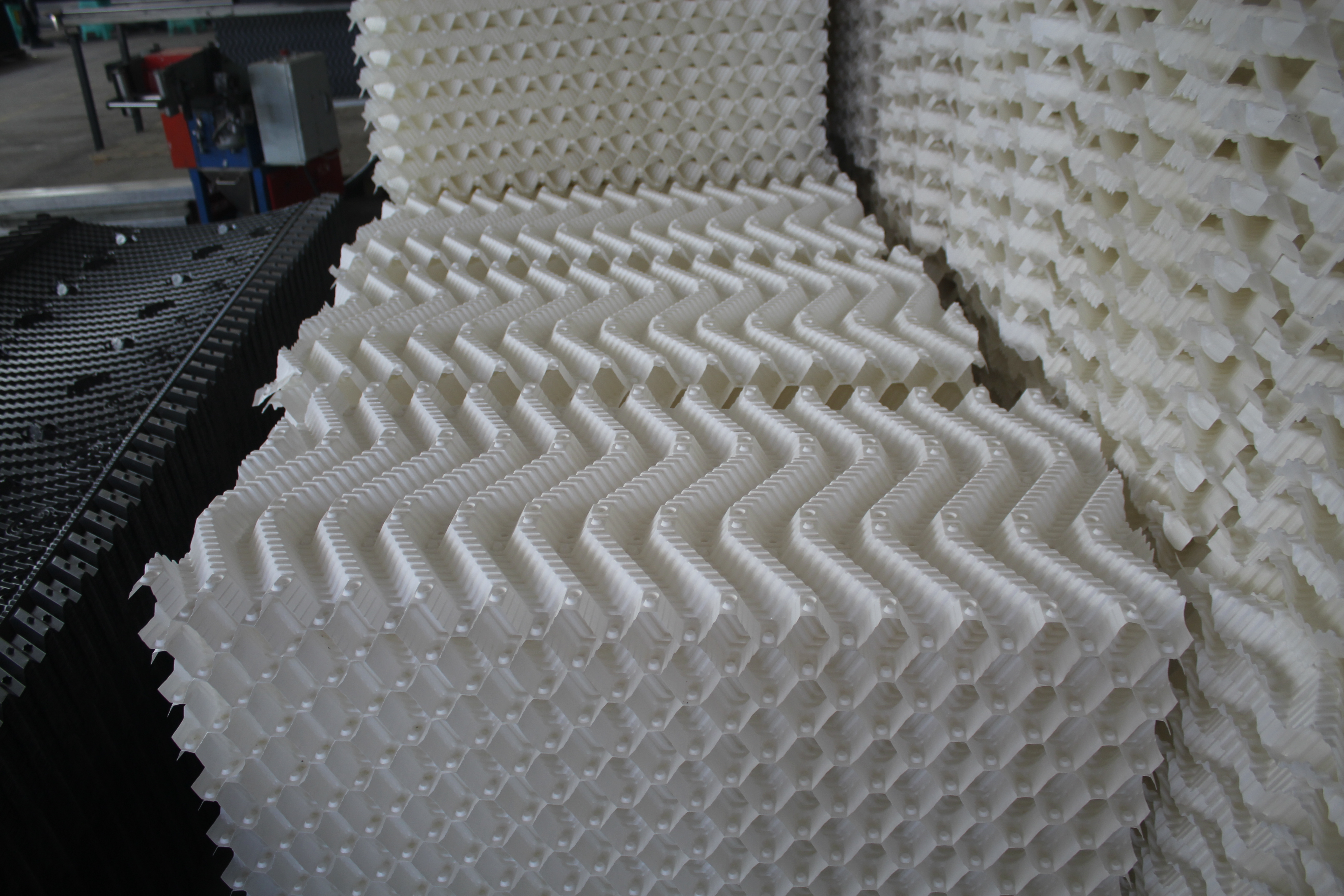
Why Source PP Cooling Tower Fill Directly from a Manufacturer?
Direct sourcing can provide several advantages for distributors, contractors, cooling tower companies, and industrial users.
Can Direct Purchasing Reduce the Cost of PP Cooling Tower Fill?
Potentially, yes. Buying directly from a manufacturer can reduce the number of intermediaries involved in the supply chain.
The final cost of PP cooling tower fill may include:
When buyers communicate directly with a manufacturer, they may have more opportunities to negotiate production quantities, packaging, customization, and long-term supply arrangements.
Is the Lowest Factory Price Always the Best Deal?
Not necessarily.
A lower quotation may reflect differences in material grade, sheet thickness, production standards, packaging, or product design. Buyers should compare the complete specification rather than comparing only the price per sheet or kilogram.
A more useful approach is to evaluate:
Product Cost + Logistics + Installation + Expected Service Life + Maintenance
This provides a more realistic view of total purchasing value.
What Should You Know About PP Cooling Tower Fill Before Sourcing?
Before contacting manufacturers, buyers should understand the basic technical requirements of their cooling tower.
What Is PP Cooling Tower Fill?
PP cooling tower fill is a structured or film-type heat transfer medium manufactured from polypropylene. It increases the effective contact area between water and air inside a cooling tower.
The fill encourages water to spread across its surface while air passes through the fill assembly. This increases air-water contact and supports evaporative heat transfer.
Why Is Polypropylene Used for Cooling Tower Fill?
PP can offer useful properties for cooling tower applications, including:
Chemical resistance
Moisture resistance
Lightweight construction
Good mechanical strength
Manufacturing flexibility
Resistance to many common water-treatment chemicals
Potential suitability for customized designs
The actual suitability of PP depends on operating temperature, water chemistry, mechanical requirements, and the specific fill design.
What Types of PP Cooling Tower Fill Are Available?
Manufacturers may supply different PP fill configurations depending on the cooling tower design.
Common categories include:
Film-Type PP Fill
Film fill creates thin water films over a large surface area. It is commonly used when high heat-transfer efficiency and compact fill arrangements are required.
Splash-Type PP Fill
Splash fill breaks falling water into droplets or smaller streams through repeated contact with the fill surface.
It may be considered for applications where water quality or fouling characteristics make film fill less suitable.
Crossflow and Counterflow Fill
The cooling tower configuration also matters.
In a crossflow cooling tower, air generally moves horizontally through the fill while water flows downward.
In a counterflow cooling tower, air travels upward against the downward movement of water.
The fill geometry should therefore match the tower's airflow and water-distribution configuration.
How Do You Find a Reliable PP Cooling Tower Fill Manufacturer?
Finding manufacturers requires more than searching for "PP cooling tower fill supplier" online.
Where Can You Search for PP Fill Manufacturers?
Potential sources include:
Manufacturer websites
Industrial directories
B2B marketplaces
Cooling tower industry networks
Engineering contractors
Trade exhibitions
Existing industry suppliers
Referrals from cooling tower companies
Searching by specific technical terms can produce more relevant results.
Instead of using only:
PP cooling tower fill
buyers can search combinations such as:
PP cooling tower fill manufacturer
PP cooling tower fill supplier
PP cooling tower fill factory
custom PP cooling tower fill
industrial PP cooling tower fill
PP cooling tower fill replacement
bulk PP cooling tower fill
How Can You Tell Whether a Supplier Is a Real Manufacturer?
This is an important step when sourcing internationally.
Ask the supplier for information about:
What Should You Look for During Factory Verification?
A genuine manufacturing operation should normally be able to explain how the product moves through different production stages.
For PP cooling tower fill, buyers can ask about:
Raw material → extrusion → forming → cutting → inspection → assembly or packing → shipment
The manufacturer's answers should be technically consistent with the product being offered.
What Technical Information Should You Send to a Manufacturer?
A detailed RFQ can make supplier comparison much easier.
Which PP Fill Specifications Should Be Included?
When requesting a quotation, provide as many of the following details as possible:
Why Are Exact Dimensions Important?
Cooling tower fill is often supplied for a specific tower configuration.
If the dimensions are incorrect, installers may need to cut or modify the fill on site. In some cases, incorrect dimensions may affect installation efficiency or water and airflow distribution.
What If You Do Not Know the Exact Fill Specifications?
A manufacturer may be able to help identify a suitable replacement based on:
Existing fill dimensions
Cooling tower model
Photos
Old fill samples
Fill block dimensions
Cooling tower drawings
Nameplate information
Providing photographs with measurements can be especially useful during the initial technical discussion.
How Should You Compare PP Cooling Tower Fill Manufacturers?
Once several manufacturers provide quotations, create a structured comparison.
Which Factors Matter Most?
Consider comparing manufacturers according to:
| Factor | What to Check |
| Material | PP grade and material specification |
| Design | Film or splash configuration |
| Dimensions | Length, width and thickness |
| Quality | Production and inspection procedures |
| Capacity | Ability to handle bulk orders |
| Customization | Special dimensions and designs |
| Price | Product and total landed cost |
| Packaging | Pallet and export protection |
| Lead Time | Production and shipping schedule |
| Service | Technical and after-sales support |
This approach helps avoid choosing a supplier based purely on price.
Why Is Manufacturing Capacity Important?
A manufacturer may be suitable for a small sample order but unable to support a large project.
Before placing a large order, ask:
What is the normal monthly production capacity?
How many production lines are available?
What is the current production schedule?
Can production be completed within the required timeframe?
Can the factory support repeat orders?
Why Does Capacity Matter for Distributors?
Distributors often need consistent supply rather than a one-time shipment.
A manufacturer capable of maintaining stable production can be more useful for long-term purchasing programs.
How Do You Check PP Cooling Tower Fill Quality?
Quality verification should begin before mass production.
Should You Request a Sample?
For new suppliers, requesting a sample can be a practical step.
The sample can be checked for:
Material appearance
Dimensions
Sheet thickness
Surface structure
Forming quality
Rigidity
Flatness
Overall workmanship
If possible, compare the sample against your existing fill or approved specification.
What Should Be Checked During Mass Production?
For larger orders, buyers can agree with the manufacturer on inspection requirements before production begins.
Potential inspection points include:
Dimensional Inspection
Verify length, width, thickness, and other agreed dimensions.
Appearance Inspection
Check for obvious deformation, cracks, damaged surfaces, or forming defects.
Packaging Inspection
Ensure pallets or other packaging methods are suitable for long-distance transportation.
Quantity Inspection
Confirm the actual quantity before shipment.
How Does PP Cooling Tower Fill Price Work?
There is no universal price for PP cooling tower fill because many factors affect the final quotation.
What Influences the Manufacturer's Price?
Key factors may include:
PP raw material cost
Product thickness
Fill design
Order quantity
Customization
Packaging
Production complexity
Delivery terms
Freight costs
How Can You Request a More Accurate Quotation?
Instead of asking:
"What is your price for PP cooling tower fill?"
provide complete information.
For example:
We require PP cooling tower fill for a counterflow cooling tower. Please quote based on the specified dimensions, thickness, quantity, packaging requirements, and delivery destination.
This allows manufacturers to calculate the quotation more accurately.
Should You Ask for FOB, CIF or Other Terms?
International buyers should clarify the required Incoterms during the quotation process.
Depending on the purchasing model, buyers may compare:
The important point is to compare quotations on the same commercial basis.
How Can You Negotiate with a PP Cooling Tower Fill Manufacturer?
Good negotiation starts with accurate technical information.
Can Larger Orders Improve Pricing?
Often, larger production quantities can improve manufacturing efficiency.
However, buyers should avoid ordering more material than necessary simply to obtain a lower unit price.
Consider:
Can Repeat Orders Improve Supplier Cooperation?
Long-term purchasing relationships may make it easier to establish consistent specifications and production procedures.
For example, a distributor purchasing PP cooling tower fill regularly may agree on:
Standard product dimensions
Fixed packaging requirements
Quality specifications
Regular production schedules
Forecast-based purchasing
This can make future orders easier to manage.
What About Custom PP Cooling Tower Fill?
Customization is particularly valuable for replacement projects.
What Can Manufacturers Customize?
Depending on the factory's capabilities, customization may include:
When Is Customization Necessary?
Customization may be useful when:
Existing fill is no longer commercially available
The cooling tower has unusual dimensions
A replacement fill must match existing supports
The project requires a specific fill thickness
The buyer has an established internal specification
Can Manufacturers Produce Replacement Fill from Drawings?
Many manufacturers can evaluate drawings or technical specifications to determine whether a customized solution is possible.
Providing drawings, photographs, dimensions, and samples can significantly improve communication.
How Should PP Cooling Tower Fill Be Packed for International Shipping?
Packaging is often overlooked during purchasing but can have a major impact on delivery quality.
Why Is Packaging Important?
Cooling tower fill occupies a large volume relative to its weight. Improper stacking or protection may result in deformation during transportation.
Export packaging should consider:
Pallet strength
Stacking height
Protective wrapping
Strapping
Moisture protection
Container loading
Unloading requirements
Can Manufacturers Optimize Container Loading?
Yes. Experienced manufacturers may optimize pallet sizes and stacking methods according to container dimensions.
For high-volume orders, ask the supplier to provide an estimated loading plan before finalizing the order.
This can help buyers estimate freight costs and warehouse requirements.
How Long Does PP Cooling Tower Fill Take to Produce?
Production lead time varies according to order quantity, customization, production schedules, and packaging requirements.
What Can Affect Lead Time?
Common factors include:
Should Buyers Order Earlier for Large Projects?
Yes. For large industrial projects, it is generally safer to confirm specifications and production schedules before the required installation date.
A project schedule should account for:
Technical confirmation → Sampling → Order confirmation → Production → Inspection → Packing → Loading → Shipping → Delivery
This provides greater visibility throughout the purchasing process.
What Are Common Mistakes When Sourcing PP Cooling Tower Fill?
Even experienced buyers can encounter problems when purchasing a new cooling tower fill.
Mistake 1: Choosing Only by Price
A low quotation does not automatically mean lower total cost.
Mistake 2: Not Confirming Material
Buyers should confirm whether the product is PP and clarify the material specification.
Mistake 3: Ignoring Thickness
Two fills with similar dimensions can have different thicknesses and therefore different material consumption and performance characteristics.
Mistake 4: Not Checking Cooling Tower Type
A fill designed for one airflow configuration may not be appropriate for another.
Mistake 5: Ordering Without a Sample
For a new manufacturer, samples can help verify product dimensions and workmanship before mass production.
Mistake 6: Forgetting Packaging
A competitive factory price may become less attractive if packaging and logistics are poorly planned.
Mistake 7: Not Confirming Delivery
Always confirm the expected production completion date and shipping schedule before placing an order.
What Is the Best Way to Source PP Cooling Tower Fill?
A practical sourcing process can be divided into several stages.
Step 1: Define the Requirement
Prepare dimensions, quantity, fill type, cooling tower configuration, and application information.
Step 2: Find Multiple Manufacturers
Contact several qualified PP cooling tower fill manufacturers rather than relying on a single supplier.
Step 3: Send the Same RFQ
Use consistent specifications so that quotations can be compared fairly.
Step 4: Verify Samples
Check dimensions, material, appearance, and design.
Step 5: Compare Total Cost
Evaluate product price, packaging, freight, and other costs.
Step 6: Confirm Production
Agree on specifications, quality requirements, packaging, and delivery schedule.
Step 7: Inspect Before Shipment
For large orders, conduct or arrange appropriate pre-shipment inspection.
Step 8: Establish a Long-Term Supply Plan
For distributors and recurring projects, discuss forecast orders and standard specifications with the manufacturer.
Final Checklist for Sourcing PP Cooling Tower Fill
Before placing an order, buyers can use this checklist:
Product
Manufacturer
Production capability verified
Quality control reviewed
Sample evaluated
Customization capability confirmed
Previous experience reviewed
Commercial Terms
Delivery
Production lead time confirmed
Packing method confirmed
Loading plan confirmed
Shipment schedule confirmed
Required documents confirmed
Conclusion
Sourcing PP cooling tower fill from a manufacturer requires more than finding a competitive quotation. Buyers should evaluate the complete supply chain, from raw material and fill design to manufacturing quality, customization, packaging, and delivery.
For industrial users, contractors, cooling tower companies, and distributors, direct communication with a qualified PP cooling tower fill manufacturer can make it easier to confirm technical requirements and develop a reliable purchasing process.
The most effective sourcing strategy is to define your specifications clearly, compare several manufacturers on the same requirements, verify product samples, evaluate total landed cost, and confirm production and delivery schedules before placing a bulk order.
Whether you need standard PP cooling tower fill, customized fill sheets, or replacement fill for an existing cooling tower, choosing a manufacturer with suitable production capabilities and technical support can help make procurement more predictable and efficient.


