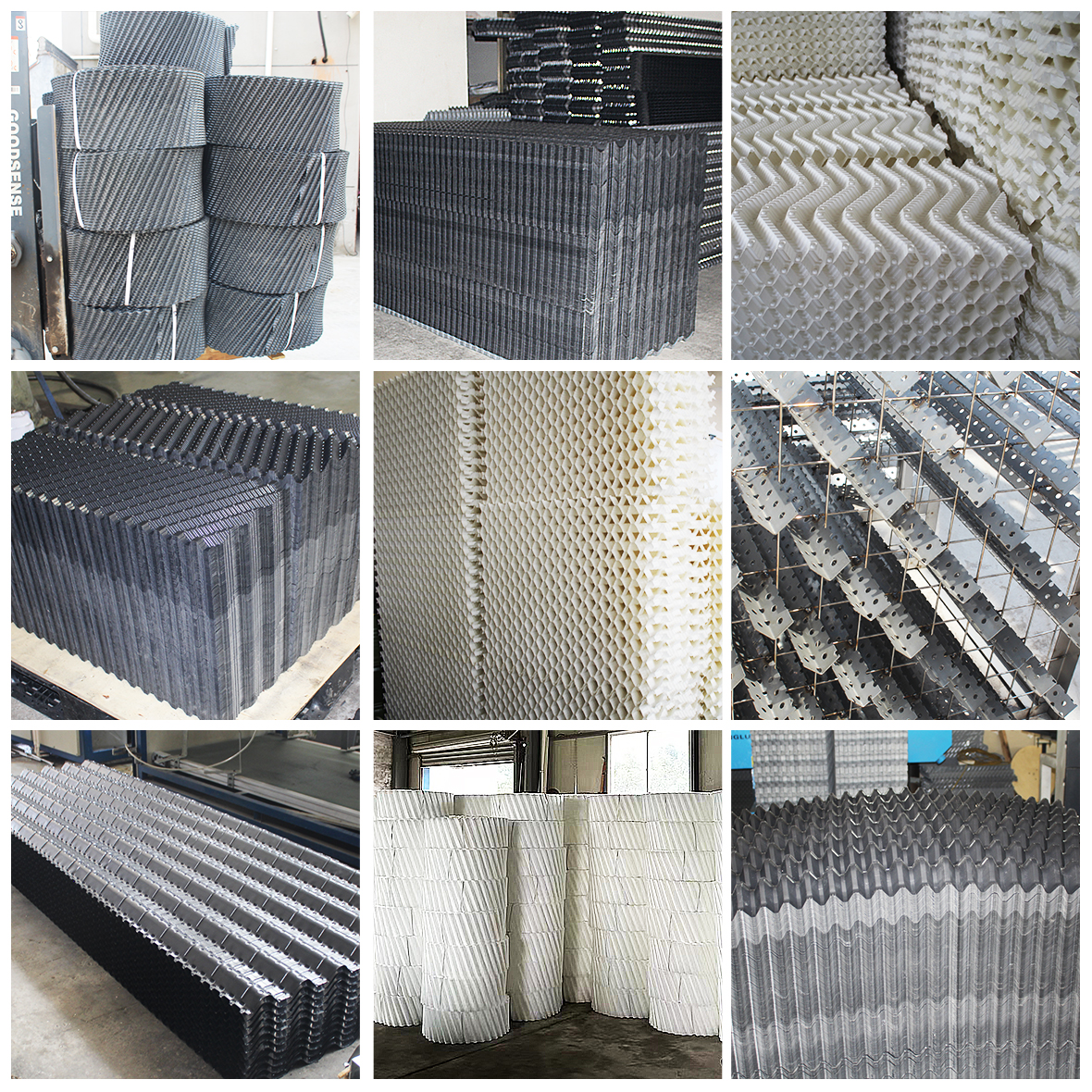
Cooling Tower Drift Eliminators vs Fill: Key Differences, Functions, and Selection Guide
Cooling tower drift eliminators vs fill is a common topic when designing, upgrading, or maintaining an industrial cooling tower. Although both components are installed inside a cooling tower and come into direct contact with the air and water flow, they perform completely different functions.
Cooling tower fill is primarily designed to increase heat transfer between hot water and air, while drift eliminators are designed to reduce water droplets carried out of the cooling tower with the exhaust air.
Understanding the difference between cooling tower drift eliminators and fill can help engineers, maintenance teams, and purchasing managers select the right components, improve cooling tower performance, reduce water consumption, and control operating costs.
What Is Cooling Tower Fill?
Cooling tower fill, also called cooling tower packing or cooling tower filler, is one of the most important heat-transfer components inside a wet cooling tower.
Its main purpose is to increase the contact area and contact time between circulating water and air.
How Does Cooling Tower Fill Work?
Hot water is distributed over the surface of the fill. As water flows downward, air moves through the fill in either a counterflow or crossflow direction.
The fill creates a large wetted surface area, allowing heat to transfer from the water to the air.
Main Functions of Cooling Tower Fill
Increase water-air contact area
Improve heat and mass transfer
Increase cooling tower thermal efficiency
Reduce required tower size for a given cooling capacity
Help achieve the required cold-water temperature
Support efficient evaporative cooling
Common cooling tower fill materials include PVC, PP, and other engineered plastics, depending on the operating temperature, water quality, and tower design.
What Is a Cooling Tower Drift Eliminator?
A cooling tower drift eliminator is a component installed near the air outlet of a wet cooling tower.
Its primary function is to capture and redirect water droplets that are entrained in the exhaust air before they leave the tower.
Unlike cooling tower fill, drift eliminators are not primarily designed for heat transfer.
How Does a Drift Eliminator Work?
When air passes through the cooling tower, some small water droplets can become suspended in the airflow.
The drift eliminator forces the airflow to change direction through specially designed profiles or passages. Water droplets have greater inertia than air, causing them to impact the eliminator surfaces and coalesce into larger droplets.
The collected water then drains back into the cooling tower.
Main Functions of Drift Eliminators
Reduce water loss caused by drift
Prevent excessive water droplets from escaping the tower
Help protect surrounding equipment and structures
Improve cooling tower water retention
Reduce the potential transport of dissolved substances in drift
Support more environmentally responsible tower operation
Cooling Tower Drift Eliminators vs Fill: What Is the Difference?
The biggest difference is their primary purpose.
| Feature | Cooling Tower Fill | Drift Eliminator |
| Main function | Heat transfer | Drift control |
| Primary objective | Cool circulating water | Prevent water droplets from escaping |
| Location | Heat-transfer section | Usually near air outlet |
| Air-water contact | Maximized | Controlled |
| Heat transfer contribution | Very high | Limited |
| Water recovery | Indirect | Direct |
| Typical materials | PVC, PP, etc. | PVC, PP, PP/PVC profiles |
| Effect on airflow | Creates contact area and resistance | Separates water droplets from air |
| Replacement reason | Fouling, scaling, degradation | Damage, fouling, aging, poor drift performance |
Therefore, cooling tower fill and drift eliminators cannot normally replace each other. They are complementary components that perform different jobs.
Cooling Tower Fill vs Drift Eliminator: Design Differences
1. Different Performance Objectives
Cooling tower fill is optimized for heat and mass transfer.
Its design focuses on maximizing the effective contact area between water and air while maintaining acceptable pressure drop.
Drift eliminators are optimized for droplet separation.
Their design focuses on removing entrained water from the air stream while minimizing pressure loss.
2. Different Installation Positions
Cooling tower fill is generally located in the main heat-transfer zone.
Depending on the tower configuration, water flows across or through the fill while air passes through the same region.
Drift eliminators are generally positioned above the water distribution or fill section, close to the exhaust air path.
Their position allows them to capture droplets before the air exits the tower.
3. Different Hydraulic and Aerodynamic Requirements
Fill must provide sufficient surface area for effective evaporation and heat transfer.
However, excessive airflow resistance can reduce fan performance and increase energy consumption.
Drift eliminators also create pressure drop, so their geometry must balance high droplet removal efficiency with low airflow resistance.
Types of Cooling Tower Fill
Choosing the right cooling tower fill depends on the tower design, water quality, operating temperature, and cooling requirements.
Film Fill
Film fill spreads water into thin films over a large surface area.
Advantages of Film Fill
High heat-transfer efficiency
Large effective surface area
Compact design
Suitable for relatively clean water
Commonly used in modern cooling towers
Film fill is particularly suitable when maximizing thermal performance is the primary objective.
Splash Fill
Splash fill breaks falling water into smaller droplets through repeated splashing.
Advantages of Splash Fill
Better resistance to suspended solids
Suitable for poorer water quality
More tolerant of certain fouling conditions
Available in different configurations and materials
Splash fill is often considered when water quality makes conventional film fill more susceptible to blockage.
Types of Cooling Tower Drift Eliminators
Drift eliminators can be classified according to their profile, material, and design.
PVC Drift Eliminators
PVC drift eliminators are widely used because PVC offers a good balance of cost, chemical resistance, durability, and processability.
They are suitable for many standard industrial and HVAC cooling tower applications.
PP Drift Eliminators
Polypropylene drift eliminators can provide excellent chemical resistance and are useful in applications where operating conditions require a more chemically resistant material.
Multi-Pass Drift Eliminators
Multi-pass designs force the air to change direction several times.
Why Multi-Pass Designs Are Effective
The changes in airflow direction increase the probability that entrained droplets will collide with the eliminator surfaces.
This can provide high drift removal efficiency while maintaining reasonable airflow resistance when properly designed.
Why Are Drift Eliminators Important?
A cooling tower naturally produces some amount of water drift because air leaving the tower can carry small water droplets.
Without effective drift eliminators, these droplets may escape into the surrounding environment.
Reduced Water Consumption
Drift represents a direct loss of circulating water.
An efficient drift eliminator can significantly reduce this loss, particularly in large industrial cooling towers with high airflow and water circulation rates.
Protection of Nearby Equipment
Water droplets may contain dissolved minerals or treatment chemicals.
If drift reaches nearby equipment, buildings, roads, or other structures, it can contribute to wetting, staining, corrosion, or deposits.
Better Environmental Control
Reducing drift helps control the movement of water droplets outside the cooling tower.
This is particularly important when the circulating water contains chemicals or other substances that should not be dispersed outside the tower.
Why Is Cooling Tower Fill Important?
While drift eliminators control water carryover, cooling tower fill determines much of the tower's heat-transfer performance.
Improved Heat Transfer
A properly selected fill provides a large surface area for water-air contact.
This improves evaporation and sensible/latent heat transfer, helping the tower achieve the desired outlet water temperature.
Improved Cooling Capacity
If the fill is properly designed and maintained, the cooling tower can achieve greater thermal performance within the available tower volume.
Lower Operating Costs
Efficient heat transfer can help reduce the amount of airflow or tower size required for a particular cooling duty.
However, the relationship between fill design, fan power, water flow, and thermal performance must be evaluated as a complete system.
Can Drift Eliminators Replace Cooling Tower Fill?
No.
Cooling tower drift eliminators and cooling tower fill are designed for different purposes.
Fill creates and maintains a large heat-transfer area, while drift eliminators remove water droplets from the air stream.
Replacing fill with drift eliminators would dramatically reduce the cooling tower's effective heat-transfer capability.
Likewise, using fill as a substitute for a properly designed drift eliminator would not provide reliable droplet separation.
Why Both Components Are Needed
A typical wet cooling tower may use the following sequence:
Hot water → Distribution system → Cooling tower fill → Drift eliminator → Fan/air outlet
The fill performs the primary heat-transfer function, while the drift eliminator helps retain water before the air exits the tower.
Cooling Tower Drift Eliminators vs Fill: Which Is More Important?
It is not useful to consider one component universally more important than the other.
Their importance depends on the performance objective.
When Fill Performance Is the Priority
Fill becomes particularly important when:
The tower cannot achieve the required cold-water temperature
Cooling capacity has decreased
Fill is fouled or scaled
Fill has become brittle or damaged
The tower is being upgraded for higher thermal performance
When Drift Eliminator Performance Is the Priority
Drift eliminators deserve particular attention when:
Water consumption from drift is excessive
Visible droplets are escaping from the tower
Nearby structures show water deposits
Drift eliminators are damaged or missing
Airflow resistance has increased because of fouling
How to Choose the Right Cooling Tower Fill
Consider Water Quality
Water containing high levels of suspended solids, biological growth, or scale-forming minerals can affect fill performance.
For relatively clean water, high-efficiency film fill may be appropriate.
For dirtier water, splash fill or a more fouling-resistant design may be preferable.
Consider Operating Temperature
Different fill materials and configurations have different temperature limitations.
Always check the manufacturer's recommended operating temperature before selecting a fill.
Consider Airflow and Pressure Drop
High-performance fill should not be evaluated only by heat-transfer efficiency.
Pressure drop is also important because excessive resistance can increase fan energy consumption.
Consider Maintenance Requirements
A fill design that provides excellent thermal performance but is difficult to clean may not be suitable for challenging industrial applications.
How to Choose the Right Drift Eliminator
Evaluate Drift Removal Efficiency
The primary performance indicator is the ability to remove entrained droplets from the exhaust air.
The required performance depends on the tower design, airflow velocity, water circulation rate, and applicable project requirements.
Check Pressure Drop
An overly restrictive drift eliminator can increase fan energy requirements.
The best design provides effective droplet separation without creating unnecessary airflow resistance.
Select the Right Material
PVC and PP are common choices, but the appropriate material depends on:
Water chemistry
Operating temperature
UV exposure
Chemical exposure
Expected service life
Maintenance conditions
Check Compatibility With the Existing Tower
Replacement drift eliminators should match the available installation space and airflow configuration.
Important factors include dimensions, profile, support structure, air velocity, and installation method.
Common Problems With Cooling Tower Fill and Drift Eliminators
Problems With Cooling Tower Fill
Common issues include:
Scaling
Biological fouling
Blockage
Cracking
Deformation
Material aging
Poor water distribution
These problems can reduce the effective heat-transfer area and increase cooling tower approach temperature.
Problems With Drift Eliminators
Common drift eliminator problems include:
Broken profiles
Excessive fouling
Incorrect installation
Gaps between modules
Excessive pressure drop
Poor droplet separation
Material degradation
A damaged drift eliminator can allow more water droplets to escape with the exhaust air.
Maintenance Tips for Cooling Tower Fill and Drift Eliminators
Inspect the Fill Regularly
During scheduled maintenance, inspect the fill for:
Inspect Drift Eliminators
Check for:
Cracks
Missing sections
Warped profiles
Excessive deposits
Loose supports
Gaps between modules
Maintain Proper Water Treatment
Good water treatment can reduce scaling, corrosion, and biological fouling.
This can extend the service life of both cooling tower fill and drift eliminators.
Monitor Cooling Tower Performance
Track operating parameters such as:
Changes in these parameters can help identify problems before they become serious.
Cooling Tower Drift Eliminators vs Fill: Key Takeaways
The difference between cooling tower drift eliminators vs fill can be summarized simply:
Cooling tower fill is mainly responsible for heat transfer, while drift eliminators are mainly responsible for water droplet removal.
Fill increases the contact area between water and air to improve evaporative cooling. Drift eliminators capture water droplets carried by the exhaust air and return the recovered water to the tower.
A properly designed cooling tower should therefore use both components as part of an integrated system.
FAQ
Are cooling tower fill and drift eliminators the same thing?
No. Cooling tower fill is primarily a heat-transfer component, while drift eliminators are designed to remove entrained water droplets from the exhaust air.
Does cooling tower fill reduce drift?
Fill may influence droplet formation and airflow characteristics, but it should not be considered a substitute for a dedicated drift eliminator.
Where are drift eliminators installed?
They are typically installed in the air outlet path, above the fill and water distribution area, so they can capture droplets before the air leaves the cooling tower.
What is the best material for cooling tower fill?
There is no single best material for every application. PVC and PP are common choices, and the selection should consider water quality, temperature, chemical exposure, thermal requirements, and expected service life.
How often should cooling tower fill be replaced?
Replacement intervals vary significantly depending on water quality, operating temperature, chemical treatment, maintenance, and material degradation. Inspection and measured thermal performance are better indicators than a fixed replacement schedule.
How often should drift eliminators be replaced?
Drift eliminators should be inspected regularly and replaced when they become cracked, deformed, excessively degraded, or unable to provide the required drift-control performance.
Conclusion
Understanding cooling tower drift eliminators vs fill is essential for selecting the right cooling tower components.
Cooling tower fill focuses on maximizing heat and mass transfer, while drift eliminators focus on minimizing water droplet carryover. They work together to improve cooling tower efficiency, water conservation, environmental control, and overall operating reliability.
When replacing or upgrading either component, consider the complete cooling tower system rather than evaluating a single component in isolation. Proper selection of fill, drift eliminators, water distribution, fans, and water treatment can significantly improve cooling tower performance and service life.