A Complete Guide to PVC Cooling Tower Fills for Industrial Evaporative Cooling
PVC cooling tower fills are one of the most important components in modern evaporative cooling systems. They increase the contact area between water and air, allowing heat to transfer more efficiently before the cooled water returns to the industrial process.
For HVAC systems, power plants, manufacturing facilities, data centers, chemical plants, and other industrial applications, selecting the right cooling tower fill can directly affect cooling performance, water consumption, maintenance requirements, and equipment life.
This complete guide explains what PVC cooling tower fills are, how they work, the main cooling tower fills types, their advantages, installation requirements, maintenance methods, and how to select the right PVC fill for an industrial cooling tower.
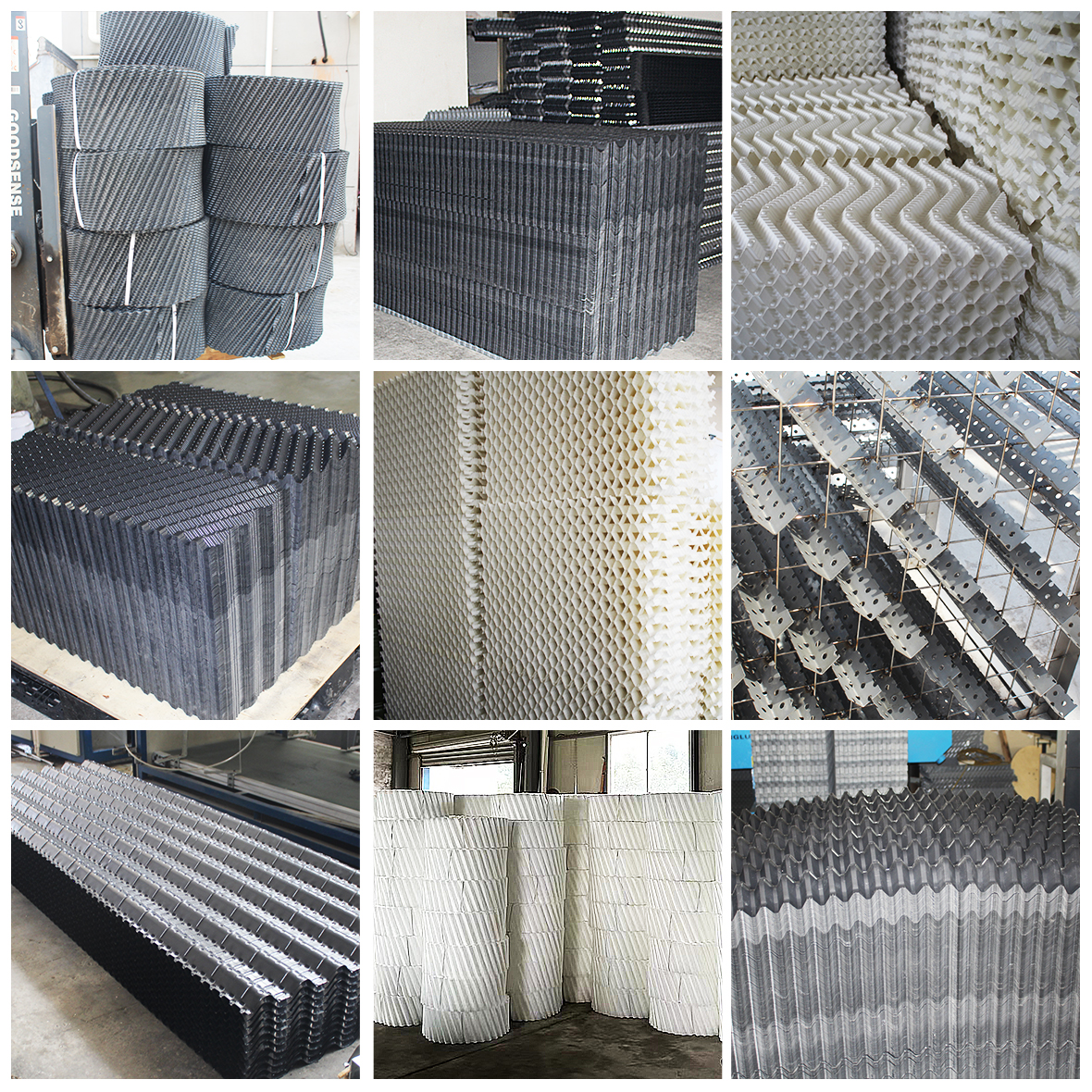
What Are PVC Cooling Tower Fills?
PVC cooling tower fills are structured heat-transfer media installed inside evaporative cooling towers. They are commonly manufactured from polyvinyl chloride (PVC) sheets that are formed into specific patterns to increase the surface area available for air-water contact.
Instead of allowing water to fall directly through the tower, the fill distributes water into thin films or droplets. Air moving through the fill removes heat from the water through evaporation.
The Main Purpose of Cooling Tower Fill
The primary purpose of a cooling tower fill is to improve the heat-transfer process.
A well-designed cooling tower filler can:
Increase air-water contact area
Extend water contact time
Improve evaporative heat transfer
Reduce the required tower size
Improve cooling efficiency
Support lower operating costs
Help achieve the required cold-water temperature
Why PVC Is Commonly Used
PVC is widely used because it provides a practical combination of cost, durability, processability, and chemical resistance.
PVC cooling tower fills can be manufactured into different corrugation patterns and surface designs, allowing manufacturers to optimize the fill for different water temperatures, airflow conditions, and cooling tower configurations.
How Do PVC Cooling Tower Fills Work?
The working principle of PVC cooling tower fill is based on increasing the contact between circulating water and air.
Step 1: Hot Water Enters the Tower
Hot process water enters the cooling tower through the distribution system. Nozzles or other water distribution components spread the water across the upper section of the fill.
Step 2: Water Flows Across the Fill
The water travels downward over the surfaces of the PVC fill sheets.
Creating a Thin Water Film
The corrugated surface encourages water to spread into a relatively thin film. This increases the effective surface area of the water exposed to moving air.
Step 3: Air Passes Through the Fill
At the same time, air moves through the cooling tower.
Depending on the tower design, airflow can be:
Cross-flow
Counter-flow
Natural draft
Mechanical draft
The air absorbs heat and a small amount of water evaporates.
Step 4: Cooled Water Returns to the Basin
After passing through the fill, the cooled water collects in the cooling tower basin and is pumped back to the industrial process.
Cooling Tower Fills Types
Different cooling tower fills types are designed for different operating environments. Choosing the correct type is essential because water quality, temperature, airflow, and tower design can all affect fill performance.
Film Fill
Film fill is one of the most common types of PVC cooling tower fills.
It uses closely spaced corrugated sheets to create a large surface area for water distribution and air contact.
Advantages of Film Fill
High heat-transfer efficiency
Compact design
Large effective surface area
Suitable for many HVAC and industrial systems
Relatively low material consumption
Film fill is particularly suitable for applications with relatively clean circulating water.
Splash Fill
Splash fill uses a series of bars, grids, or specially shaped elements to break falling water into smaller droplets.
When Splash Fill Is Preferred
Splash fill can be a better choice when circulating water contains suspended solids or when the cooling tower requires greater resistance to fouling.
It is commonly considered for applications where conventional film fill could become blocked by dirt, scale, algae, or other contaminants.
Cross-Flow PVC Fill
Cross-flow cooling towers generally allow air to move horizontally through the fill while water flows vertically downward.
Cross-flow PVC fills are designed to provide effective water distribution while maintaining appropriate airflow resistance.
Counter-Flow PVC Fill
In counter-flow towers, air moves upward while water flows downward.
Counter-flow PVC cooling tower fills are designed to maximize contact between opposing air and water streams.
Key Benefits of PVC Cooling Tower Fills
PVC cooling tower fills offer several advantages for industrial evaporative cooling applications.
High Heat-Transfer Efficiency
The main advantage is the ability to provide a large effective surface area in a relatively compact volume.
A properly designed cooling tower fill allows more water to interact with air, improving evaporation and heat transfer.
Lightweight Construction
PVC sheets are relatively lightweight compared with many traditional fill materials.
This can simplify:
Corrosion Resistance
PVC is resistant to many common chemicals found in cooling water systems.
However, actual chemical compatibility depends on water chemistry, operating temperature, concentration, and exposure conditions.
Cost-Effective Performance
PVC cooling tower fills can provide a favorable balance between purchase cost and thermal performance, making them widely used in commercial and industrial cooling towers.
Flexible Design
Manufacturers can produce PVC fill with different:
Sheet thicknesses
Corrugation angles
Sheet spacing
Surface patterns
Block dimensions
Flute heights
This allows the cooling tower filler to be matched to specific thermal and hydraulic requirements.
PVC vs PP Cooling Tower Fill
PVC and polypropylene (PP) are two commonly used plastics for cooling tower fill applications.
PVC Cooling Tower Fill
PVC is widely used for standard industrial and HVAC applications.
Its advantages include:
Good dimensional stability
Good chemical resistance
Competitive cost
Mature manufacturing technology
Good heat-transfer performance
PP Cooling Tower Fill
PP can offer improved temperature resistance compared with standard PVC in certain applications.
It may be considered when cooling water temperatures are relatively high or when specific chemical conditions require a different material.
Which Material Should You Choose?
The choice between PVC and PP should not be based on material price alone.
Consider:
Operating water temperature
Water chemistry
Fouling potential
Required thermal performance
Tower configuration
Expected service life
Maintenance conditions
For many standard evaporative cooling systems, PVC remains an economical and effective choice.
How to Choose PVC Cooling Tower Fills
Selecting the right PVC cooling tower fills requires an understanding of both the cooling tower and operating conditions.
Check the Cooling Tower Type
First determine whether the tower is:
Cross-flow
Counter-flow
Open-circuit
Closed-circuit
Induced-draft
Forced-draft
The fill geometry must be compatible with the tower configuration.
Evaluate Water Quality
Water quality is one of the most important factors.
Clean Water Applications
Film fill can provide excellent performance when circulating water is relatively clean and properly treated.
Dirty Water Applications
For water containing significant suspended solids, splash fill or a more open fill design may be preferable.
Consider Operating Temperature
PVC cooling tower fills have temperature limitations that should be checked before installation.
Higher water temperatures can affect the mechanical properties and long-term stability of PVC.
High-Temperature Applications
For high-temperature industrial processes, engineers should evaluate whether PVC, PP, or another material is more appropriate.
Check Fill Thickness and Geometry
Fill thickness and geometry influence both thermal performance and airflow resistance.
A higher surface area does not automatically mean better overall performance if the fill causes excessive pressure drop or becomes difficult to maintain.
PVC Fill Design and Performance Factors
Several technical parameters influence the performance of a cooling tower filler.
Surface Area
A larger effective surface area generally provides more opportunity for heat transfer.
However, surface area must be balanced with water distribution and airflow requirements.
Flute Angle
The corrugation angle influences water flow paths and air-water mixing.
Different manufacturers use different flute geometries to achieve specific thermal and hydraulic characteristics.
Sheet Spacing
Tighter spacing can increase surface area, but it may also increase the risk of blockage when water quality is poor.
Pressure Drop
Cooling tower fill creates resistance to airflow.
A good design should provide sufficient heat transfer without creating unnecessary air pressure loss.
Common PVC Cooling Tower Fill Problems
Even high-quality PVC cooling tower fills can experience performance problems when the cooling tower is poorly operated or maintained.
Scaling
Mineral deposits can accumulate on the fill surface.
Causes of Scaling
Common causes include:
High mineral concentration
Poor water treatment
High cycles of concentration
Inadequate blowdown
Improper chemical control
Scaling reduces the effective heat-transfer area and can restrict airflow and water flow.
Biological Growth
Algae, bacteria, and other biological contaminants can accumulate inside cooling tower fill.
This is particularly common when water treatment and tower cleaning are inadequate.
Clogging
Debris, dirt, scale, and biological growth can block the channels between fill sheets.
Signs of Blocked Fill
Typical warning signs include:
Reduced cooling capacity
Higher approach temperature
Uneven water distribution
Increased fan energy consumption
Higher pressure drop
Visible deposits on the fill
Fill Deformation
Excessive operating temperatures, mechanical damage, improper installation, or chemical exposure can cause deformation of PVC fill.
Damaged fill should be inspected and replaced when it can no longer maintain proper water and airflow distribution.
How to Clean PVC Cooling Tower Fills
Regular cleaning can help maintain the performance of PVC cooling tower fills.
Step 1: Inspect the Fill
Before cleaning, inspect the fill for:
Scale
Sludge
Algae
Debris
Cracks
Deformation
Step 2: Remove Loose Debris
Loose dirt and debris should be removed before deeper cleaning.
Step 3: Use Appropriate Cleaning Methods
Depending on the contamination, cleaning may involve controlled water flushing or an appropriate chemical treatment.
Avoid Excessive Water Pressure
Very high-pressure cleaning can damage PVC sheets or separate fill layers.
The cleaning method should follow the fill manufacturer's recommendations.
Step 4: Check Water Distribution
After cleaning, inspect the distribution nozzles and ensure water is evenly distributed across the fill.
When Should PVC Cooling Tower Fill Be Replaced?
The service life of cooling tower fill depends heavily on operating conditions and maintenance.
There is no single replacement interval that applies to every tower.
Common Reasons for Replacement
PVC fill may need replacement when:
Sheets become brittle
Fill blocks remain severely clogged
Thermal performance declines significantly
Fill becomes deformed
Structural damage occurs
Biological or mineral deposits cannot be effectively removed
Performance-Based Replacement
Instead of replacing fill only according to age, operators should monitor actual cooling performance.
Important indicators include:
Cold-water temperature
Hot-water temperature
Wet-bulb temperature
Approach temperature
Water flow
Airflow
Pressure drop
Installation Tips for PVC Cooling Tower Fills
Correct installation is essential for achieving the expected performance.
Match the Fill to the Tower
The fill dimensions should match the available installation space.
Maintain Proper Support
PVC fill blocks should be supported properly to prevent sagging or deformation.
Ensure Uniform Water Distribution
Water should reach the fill evenly.
Inspect Nozzles Before Installation
Blocked or damaged cooling tower nozzles can create dry areas and overloaded sections within the fill.
Avoid Mechanical Damage
During transportation and installation, avoid dropping, bending, or compressing PVC fill blocks.
Even small structural changes can affect water flow and airflow.
PVC Cooling Tower Fills for Industrial Applications
PVC fills are used in a wide range of industrial evaporative cooling systems.
HVAC Cooling Towers
Commercial buildings, hospitals, hotels, and large air-conditioning systems commonly use cooling towers equipped with PVC film fill.
Power Generation
Power plants require large-scale heat rejection systems where properly selected fill can contribute to efficient cooling tower operation.
Manufacturing Plants
Industrial facilities use cooling towers to remove heat from process water used in manufacturing equipment.
Chemical Processing
Chemical plants may require cooling towers to control process temperatures.
Water chemistry should be carefully evaluated before selecting PVC fill.
Data Centers
Data centers increasingly require reliable heat-rejection systems.
Efficient cooling tower fill can help support stable cooling performance while managing water and energy consumption.
How to Improve PVC Cooling Tower Fill Performance
Using high-quality fill is only one part of achieving good cooling performance.
Maintain Good Water Treatment
Proper water treatment helps control:
Scale
Corrosion
Biological growth
Suspended solids
Keep Fill Surfaces Clean
Regular inspection and cleaning help maintain the effective heat-transfer area.
Optimize Water Distribution
Uneven distribution can reduce the actual performance of otherwise high-quality cooling tower fill.
Monitor Airflow
Fan performance, fan blade condition, fan stack condition, and airflow resistance can all influence the overall cooling process.
Inspect Other Cooling Tower Parts
The fill should be evaluated together with other components such as:
A cooling tower is an integrated system, and fill performance cannot be considered independently from these components.
Choosing a PVC Cooling Tower Fill Supplier
Selecting a reliable PVC cooling tower fills supplier is important for both new tower projects and replacement applications.
Evaluate Product Quality
Check whether the supplier can provide consistent:
Ask for Technical Data
A professional supplier should be able to provide technical information related to:
Fill type
Operating temperature
Material
Dimensions
Thermal performance
Air pressure drop
Water loading range
Consider Replacement Compatibility
If you are replacing existing cooling tower fill, provide the supplier with the original fill dimensions whenever possible.
Important information includes:
Fill block length
Fill block width
Fill block height
Sheet thickness
Flute angle
Existing tower type
Water temperature
Water flow rate
PVC Cooling Tower Fill Replacement Checklist
Before ordering replacement fill, check the following:
Technical Requirements
Installation Requirements
Supplier Requirements
Product specifications
Manufacturing capability
Quality control
Packaging method
Replacement experience
Export capability
Frequently Asked Questions About PVC Cooling Tower Fills
What is PVC cooling tower fill?
PVC cooling tower fill is a structured heat-transfer medium installed inside evaporative cooling towers. It increases air-water contact and improves evaporative heat transfer.
How long does PVC cooling tower fill last?
Service life varies according to water quality, operating temperature, UV exposure, chemical conditions, cleaning, and maintenance. Regular inspection is more reliable than using a fixed replacement period.
Is PVC fill better than PP fill?
Neither material is universally better. PVC is widely used for standard applications because of its cost and performance, while PP may be advantageous in some higher-temperature applications.
Can PVC cooling tower fill be cleaned?
Yes. PVC fill can often be cleaned using suitable water flushing or chemical cleaning methods. The cleaning procedure should be selected according to the type of contamination and the manufacturer's recommendations.
What is the difference between film fill and splash fill?
Film fill spreads water into thin films over corrugated sheets, providing a large heat-transfer area. Splash fill breaks falling water into droplets and is often more tolerant of suspended solids and fouling.
How do I choose the right cooling tower filler?
Consider tower configuration, water temperature, water quality, water flow, airflow, required cooling capacity, fouling potential, and available installation space.
Final Thoughts
PVC cooling tower fills play a central role in the performance of industrial evaporative cooling systems. By increasing the contact area between air and water, they help improve heat transfer while allowing cooling towers to achieve effective temperature reduction within a relatively compact space.
The best cooling tower fill is not necessarily the product with the highest surface area or lowest price. Proper selection requires consideration of water quality, operating temperature, tower configuration, airflow, water distribution, maintenance conditions, and expected service life.
For new cooling tower projects and cooling tower fill replacement, choosing the correct PVC fill design and maintaining it properly can help improve thermal performance, reduce operating problems, and extend the useful life of the cooling system.
If you are comparing cooling tower fills types, evaluating PVC fills for cooling tower applications, or looking for a suitable cooling tower filler for an industrial project, always match the fill specifications to the actual operating conditions of the tower.


