Choosing the right cooling tower fan manufacturer is an important step in building, upgrading, or maintaining an industrial cooling system. Although a cooling tower fan may look like a relatively simple component, its performance directly affects airflow, heat rejection, energy consumption, operating noise, and overall system efficiency.
Whether you are replacing damaged fan blades, upgrading an existing cooling tower, or purchasing components for a new industrial project, working with a reliable manufacturer can make a significant difference.
Today, the global market offers many cooling tower fan manufacturers with different product ranges, engineering capabilities, and manufacturing strengths. Some specialize in complete cooling tower systems, while others focus on industrial axial fans, replacement fan blades, and customized cooling tower components.
In this article, we introduce six cooling tower fan manufacturers worth knowing, including Power Tower Cooling Technology (Shaoxing) Co.,Ltd. We will explore their products, advantages, and technical capabilities to help you find the right supplier for your cooling tower project.
1. Why Choosing the Right Cooling Tower Fan Manufacturer Matters
A cooling tower fan is responsible for moving air through the cooling tower. This airflow allows heat to transfer from circulating water into the surrounding atmosphere.
If the fan cannot deliver the required air volume, the entire cooling tower may struggle to achieve its designed cooling performance.
Think about it this way: even if your cooling tower has excellent fill media, an efficient water distribution system, and a powerful motor, poor airflow can still become a major bottleneck.
That's why choosing a capable cooling tower fan manufacturer is about much more than finding the lowest quotation.
The Role of Cooling Tower Fans in Industrial Cooling
Cooling tower fans are widely used in power plants, chemical processing facilities, steel mills, petrochemical plants, manufacturing factories, commercial HVAC systems, and refrigeration installations.
Their primary function is to create sufficient airflow through the cooling tower's heat exchange section.
A properly selected fan helps maintain stable cooling performance while controlling electricity consumption. An incorrectly selected fan, however, may cause:
Insufficient airflow and reduced cooling capacity.
Excessive vibration during operation.
Higher electricity consumption.
Increased operating noise.
Premature wear of bearings and mechanical components.
For industrial users, these problems can lead to higher maintenance expenses and unexpected production interruptions.
What Makes a Reliable Cooling Tower Fan Manufacturer?
Before contacting a supplier, look beyond product photographs and prices.
A reliable manufacturer should understand fan aerodynamics, blade materials, fan diameter, operating speed, and the requirements of different cooling tower designs.
It should also be able to provide technical drawings, dimensional information, balancing details, and practical replacement recommendations.
Manufacturing consistency matters just as much. A well-designed fan with poor production quality may develop vibration or mechanical problems after installation.
2. Top 6 Cooling Tower Fan Manufacturers You Should Know
The following six companies represent different segments of the cooling tower fan industry. Some manufacture complete cooling tower systems and their associated fan assemblies, while others specialize in industrial fan technology or replacement components.
This is a practical buyer's guide rather than an official performance ranking.
1. Power Tower Cooling Technology (Shaoxing) Co.,Ltd
Website: https://www.coolingtowerpart.com
Company: Power Tower Cooling Technology (Shaoxing) Co.,Ltd
Power Tower Cooling Technology (Shaoxing) Co.,Ltd is a Chinese manufacturer and supplier specializing in cooling tower parts and replacement components for industrial cooling systems.
The company focuses on providing cooling tower components for customers involved in industrial cooling tower manufacturing, maintenance, refurbishment, and distribution.
Its product range covers cooling tower fans, fan blades, fan hubs, cooling tower fill, motors, speed reducers, drift eliminators, spray nozzles, and other replacement parts.
For buyers who need more than a standalone fan, this broader product range can be particularly useful.
Instead of sourcing every cooling tower component from a different supplier, customers can explore multiple product categories through one manufacturer.
Main Products and Manufacturing Capabilities
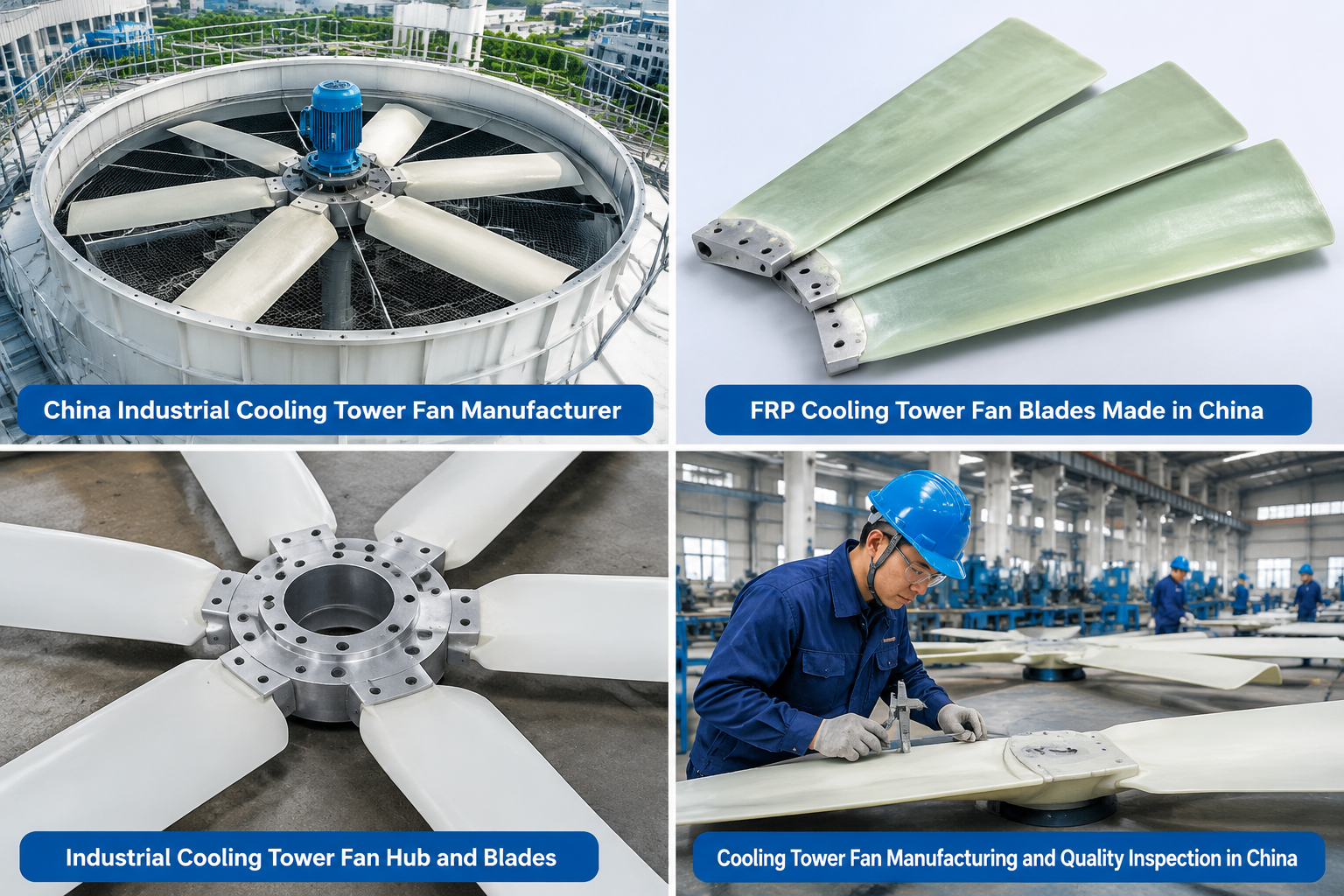
Power Tower offers different cooling tower fan and component solutions for industrial applications.
Its product categories include:
Aluminum alloy cooling tower fans.
FRP cooling tower fan blades.
Axial flow cooling tower fans.
Cooling tower fan hubs.
Cooling tower fan drive components.
Cooling tower fill and replacement media.
Cooling tower motors and speed reducers.
Drift eliminators and water distribution components.
Different industrial applications require different fan configurations.
For example, FRP fan blades may be worth considering in corrosive or humid environments, while aluminum alloy blades can be suitable when lightweight construction and mechanical strength are important.
The correct selection still depends on actual operating conditions, fan dimensions, and engineering requirements.
Why Consider Power Tower?
There are several reasons why buyers may consider Power Tower when sourcing cooling tower fans.
1. Multiple product categories
Customers can source cooling tower fans and other important replacement components from one supplier. This can simplify purchasing and spare parts management.
2. OEM and ODM support
Customized manufacturing services can help distributors, equipment manufacturers, and industrial customers meet specific project requirements.
3. Replacement applications
Its range of cooling tower components is relevant to existing cooling tower maintenance and refurbishment projects.
4. Different material options
Aluminum alloy and FRP options provide flexibility for different operating environments and application requirements.
5. International sourcing support
The company's website provides product information and inquiry channels for overseas customers.
For buyers looking for a cooling tower parts manufacturer rather than only a complete cooling tower brand, Power Tower is a company worth contacting.
Before ordering, provide the original fan dimensions, blade quantity, hub configuration, rotational speed, and required airflow so that product compatibility can be evaluated.
Visit the official website to explore its products:
https://www.coolingtowerpart.com
2. SPX Cooling Technologies (Marley)
Website: https://spxcooling.com
SPX Cooling Technologies is a well-established name in the global cooling industry. Its Marley brand is particularly recognized in industrial and commercial cooling tower applications.
The company manufactures cooling towers, evaporative fluid coolers, evaporative condensers, and replacement components.
Its fan portfolio includes several purpose-designed cooling tower fan models.
Main Products and Advantages
Marley offers cooling tower fan products such as the H3, X7, HP7000, HP7i, and Ultra Quiet fan ranges.
These products are designed to provide suitable airflow and pressure characteristics while considering operating noise and energy efficiency.
One advantage of choosing a manufacturer with a complete cooling tower product portfolio is the availability of equipment-specific engineering information.
This can be helpful when maintaining existing Marley installations or specifying replacement components.
If you are considering a Marley fan for a non-Marley cooling tower, make sure the mounting arrangement, fan diameter, operating speed, and performance requirements are checked rather than assuming direct compatibility.
3. Baltimore Aircoil Company (BAC)
Website: https://www.baltimoreaircoil.com
Baltimore Aircoil Company, commonly known as BAC, is another major manufacturer in the evaporative cooling industry.
The company supplies cooling towers, evaporative condensers, and related heat rejection equipment for commercial and industrial applications.
BAC also offers factory-authorized replacement parts and fan drive components.
Main Products and Advantages
BAC offers axial fans and centrifugal fans for different cooling tower configurations.
Its axial fan products include aluminum construction, factory-balanced assemblies, and low-sound options.
The company lists available axial fan diameters from 24 to 156 inches, with configurations ranging from four to twelve blades.
BAC's ENDURADRIVE fan system is another notable offering for applications where direct-drive technology and reduced maintenance requirements are important.
For owners of BAC cooling towers, purchasing manufacturer-authorized replacement parts can help maintain the intended equipment configuration.
4. EVAPCO
Website: https://www.evapco.com
EVAPCO is an international manufacturer of evaporative cooling equipment.
Its product portfolio includes cooling towers, closed-circuit coolers, and evaporative condensers. The company is also known for developing fan options that address operating noise and performance requirements.
Main Products and Advantages
One of EVAPCO's distinguishing features is its range of standard, low-sound, and super-low-sound fan options.
Its Super Low Sound Fan uses a wide-chord blade design and heavy-duty FRP construction.
Depending on the selected equipment and measurement conditions, EVAPCO documentation describes sound reductions of approximately 9–15 dB(A) compared with standard fans.
These options can be useful for installations near residential areas, offices, hospitals, and other noise-sensitive locations.
However, sound performance should always be evaluated together with thermal performance, fan speed, and system operating conditions.
5. COFIMCO
Website: https://www.cofimco.com
COFIMCO is an Italian manufacturer specializing in axial fans for industrial applications.
Its products are used in cooling towers, air-cooled condensers, air-cooled heat exchangers, and other air movement systems.
The company has developed a broad range of fan solutions for both package cooling towers and large industrial installations.
Main Products and Advantages
COFIMCO supplies FRP and aluminum fan solutions.
Its published application information describes G and AX series fans for large field-erected cooling towers, with diameters ranging from 16 to 40 feet.
For package cooling towers, its M and B series are available in FRP and aluminum configurations, with diameters from 4 to 18 feet.
The company also offers adjustable-pitch fan designs.
Its TANDEM fan series uses a specialized blade profile intended to improve aerodynamic performance, reduce drag, and lower power consumption.
COFIMCO may be worth considering for large industrial projects where fan engineering, diameter, and airflow performance require detailed evaluation.
6. Moore Fans
Website: https://moorefans.com
Moore Fans is a US-based industrial fan manufacturer with a long history in axial fan technology.
The company has supplied fans for cooling towers, air-cooled heat exchangers, radiators, refineries, power plants, and processing facilities.
Its experience in large industrial fan applications makes it an important name for buyers researching replacement and upgrade options.
Main Products and Advantages
Moore Fans offers different industrial axial fan series for cooling tower applications.
Its published product information includes Class 10000 fans for diameters between 3 and 24 feet and Class 20000 fans for diameters between 24 and 40 feet.
These products are designed for a range of industrial operating conditions.
The company also highlights lightweight fan blade construction and resilient mounting features designed to help manage vibration and resonant frequency.
These characteristics are important in large cooling tower installations, where fan imbalance or excessive vibration can affect the entire mechanical structure.
3. Comparison of the Six Cooling Tower Fan Manufacturers
Every manufacturer has a different market focus.
Some focus on complete cooling tower equipment, while others specialize in industrial axial fans or replacement components.
The following table provides a practical overview to help narrow down your options.
| Manufacturer | Country | Main Focus | Notable Capabilities |
| Power Tower | China | Cooling tower parts and replacement fans | FRP and aluminum fans, OEM/ODM, replacement components |
| SPX / Marley | USA | Complete cooling tower systems and components | H3, X7, HP7000, HP7i and Ultra Quiet fans |
| BAC | USA | Evaporative cooling equipment and parts | Axial and centrifugal fans, direct-drive fan systems |
| EVAPCO | USA | Evaporative cooling equipment | Standard, low-sound and super-low-sound fans |
| COFIMCO | Italy | Industrial axial fans | FRP and aluminum fans, large-diameter and adjustable-pitch designs |
| Moore Fans | USA | Industrial axial fan technology | Large-diameter fans and vibration-conscious designs |
The comparison is based on publicly described product ranges, not independently verified performance rankings.
A manufacturer's suitability depends on the specific project, operating conditions, and technical requirements.
4. How to Choose the Right Cooling Tower Fan Manufacturer
Now that you know six cooling tower fan manufacturers, how do you decide which one is right for your project?
The answer depends on your cooling tower design, operating environment, maintenance requirements, and budget.
Here are five important factors to check before placing an order.
Check Fan Diameter and Airflow Capacity
Fan diameter is one of the first specifications to confirm.
However, diameter alone cannot determine whether a fan is suitable.
You also need to consider:
Ask the manufacturer for performance information at your actual operating point.
A fan that physically fits the cooling tower may still deliver insufficient airflow or consume more power than expected.
Compare Cooling Tower Fan Blade Materials
Cooling tower fans commonly use aluminum alloy, fiberglass-reinforced plastic (FRP), and other engineered materials.
Aluminum alloy fan blades
Aluminum alloy blades offer a useful combination of strength and relatively low weight. They are widely used in industrial cooling tower applications.
FRP fan blades
FRP blades can provide corrosion resistance and design flexibility, making them attractive for demanding industrial environments.
The best material depends on temperature, humidity, chemical exposure, mechanical loading, and maintenance conditions.
Don't select a blade simply because it looks stronger or costs less.
Consider Energy Efficiency
A cooling tower fan can operate for thousands of hours every year.
Even a small improvement in fan efficiency may create meaningful electricity savings over time.
When comparing manufacturers, request:
Fan performance curves.
Required airflow and static pressure.
Motor power requirements.
Fan efficiency information.
Recommended operating speed.
Consider whether variable-frequency drive operation is appropriate for your system.
Also remember that the fan, motor, gearbox, transmission, and tower airflow resistance work together.
Optimizing only one component may not deliver the expected energy savings.
Evaluate Noise and Vibration
Noise is an important consideration for cooling towers installed near offices, residential buildings, and populated industrial areas.
Ask whether the manufacturer offers low-noise blade profiles or other sound-control options.
Vibration is equally important.
Fan assemblies should be properly balanced, and the complete drive system should be inspected for alignment, bearing condition, and mounting integrity.
Excessive vibration can damage bearings, loosen fasteners, and shorten equipment service life.
Check Compatibility with Existing Cooling Towers
If you are buying a replacement fan, compatibility should be one of your biggest priorities.
Confirm the following specifications:
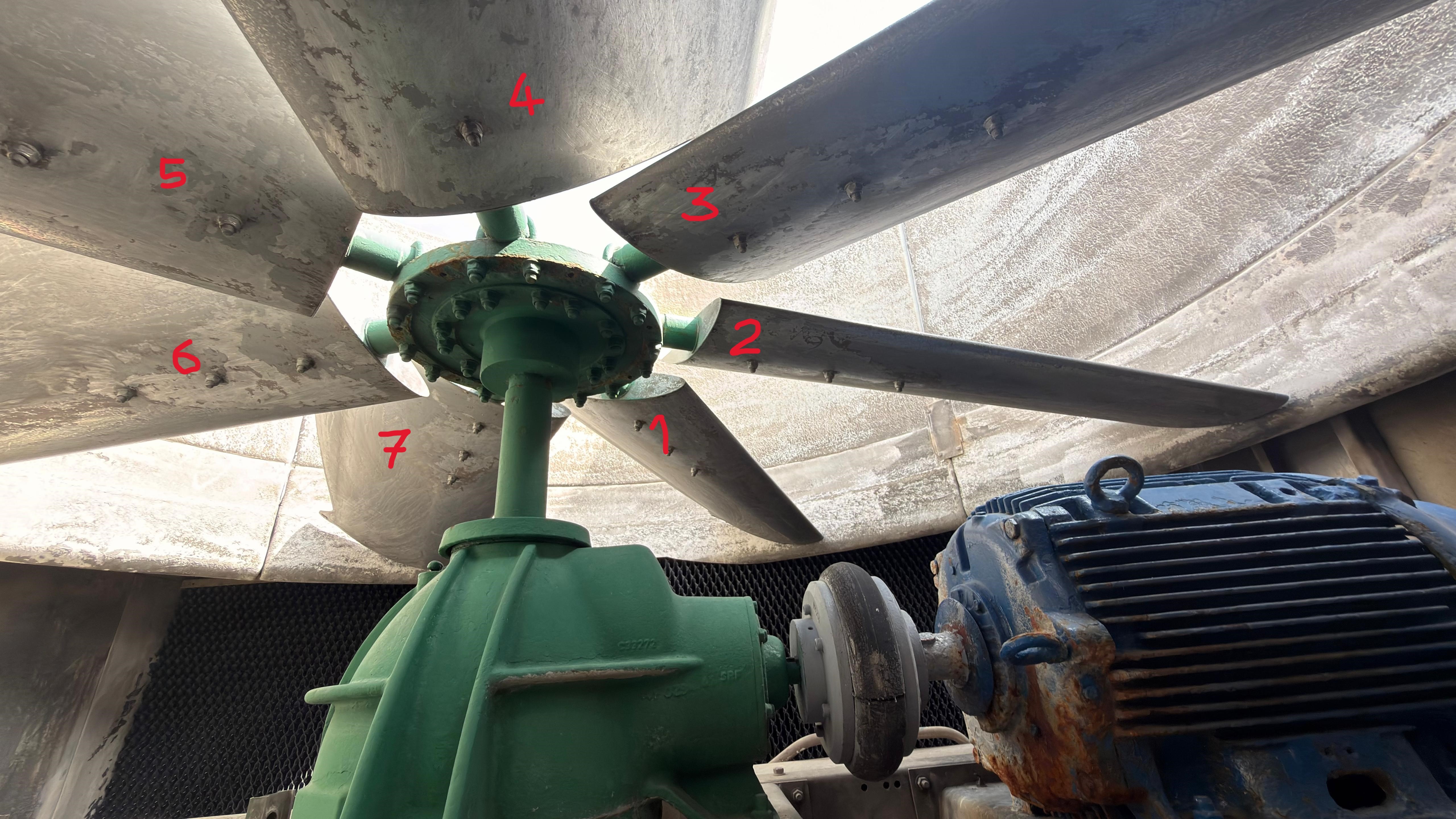
For replacement projects involving Marley, BAC, EVAPCO, Liang Chi, Spindle, or other cooling tower brands, provide the original equipment model and clear photographs to the supplier.
A professional manufacturer should review the technical information before confirming the replacement model.
5. Common Cooling Tower Fan Types
Understanding fan types can help you communicate more effectively with manufacturers and avoid ordering the wrong equipment.
Although different designs are available, axial and centrifugal fans are two major categories used in mechanical cooling towers.
Axial Flow Cooling Tower Fans
Axial fans move air approximately parallel to the fan shaft.
They are widely used in induced-draft cooling towers because they can move large air volumes with relatively low power requirements.
Their compact airflow arrangement makes them suitable for many industrial and commercial installations.
They are commonly available in aluminum and FRP blade configurations.
Blade pitch, diameter, and rotational speed all influence the fan's performance.
Centrifugal Cooling Tower Fans
Centrifugal fans draw air into the fan and discharge it in a direction approximately perpendicular to the inlet.
They can be suitable for applications that require greater static-pressure capability, including certain ducted or indoor installations.
Compared with axial fans, their performance and energy requirements can differ significantly.
The selection should be based on actual system resistance and required airflow rather than a general assumption that one type is always better.
6. Why Customization Matters When Buying Cooling Tower Fans
Standard products are convenient, but industrial cooling tower projects do not always follow standard dimensions.
An older cooling tower may use a special hub arrangement, while a retrofit project may require a different blade material or operating configuration.
This is where customization becomes valuable.
A manufacturer offering OEM and ODM services may be able to adapt:
Fan diameter.
Blade profile and pitch.
Blade material.
Hub structure.
Number of blades.
Mounting dimensions.
Branding and packaging.
For distributors, customized branding and packaging can also be important.
Power Tower, for example, presents OEM and ODM services as part of its cooling tower parts business.
Still, customization must be supported by engineering calculations.
Changing blade pitch or diameter without checking motor capacity and tower resistance can create serious operating problems.
7. Questions to Ask Before Ordering Cooling Tower Fans
Before confirming a purchase order, ask the manufacturer these practical questions:
Can you provide a fan performance curve?
What blade materials and diameters are available?
Is the fan factory-balanced?
Can you manufacture a replacement based on an existing fan sample or technical drawing?
What are the recommended operating speed and motor power?
Can you provide installation instructions and maintenance recommendations?
What quality inspection documents are available?
What is the production lead time and warranty coverage?
These questions help you evaluate not only the product but also the manufacturer's technical support and ability to deliver consistently.
8. Final Thoughts
Finding the right cooling tower fan manufacturer is about matching engineering capabilities with your actual operating requirements.
SPX Marley, BAC, and EVAPCO are established cooling equipment brands with their own fan technologies. COFIMCO and Moore Fans are worth considering when industrial axial fan engineering is a priority.
Power Tower Cooling Technology (Shaoxing) Co.,Ltd is another option, particularly for buyers seeking cooling tower replacement fans, FRP and aluminum fan components, and a broader range of cooling tower spare parts.
Its website, https://www.coolingtowerpart.com, provides product information and a channel for inquiries.
Don't make your final decision based on price alone.
Compare airflow, efficiency, material, compatibility, quality control, and after-sales support.
A correctly selected fan can help your cooling tower operate more reliably and economically for years.
If you are sourcing cooling tower fans or looking for replacement components, contact Power Tower Cooling Technology (Shaoxing) Co.,Ltd to discuss your requirements and explore suitable solutions.
Frequently Asked Questions
1. What Is the Best Cooling Tower Fan Manufacturer?
There is no single best manufacturer for every project.
SPX Marley, BAC, and EVAPCO are established cooling equipment brands. COFIMCO and Moore Fans specialize in industrial fan solutions.
Power Tower is worth considering for cooling tower replacement fans and associated spare parts.
The best choice depends on your equipment, budget, and performance requirements.
2. Which Material Is Best for Cooling Tower Fan Blades?
Aluminum alloy and FRP are both widely used.
Aluminum offers strength and relatively low weight, while FRP offers corrosion resistance and design flexibility.
The appropriate material depends on the operating environment and mechanical requirements.
3. Can I Replace My Original Cooling Tower Fan with Another Manufacturer's Product?
Yes, in some cases.
However, you must verify the fan diameter, hub connection, blade pitch, rotational speed, airflow, motor power, and mechanical clearances.
A replacement should be approved through technical evaluation rather than physical dimensions alone.
4. Are FRP Cooling Tower Fans Better Than Aluminum Fans?
Neither material is universally better.
FRP may be suitable for corrosive environments, while aluminum can be attractive for applications requiring lightweight, strong blades.
Compare the complete design and operating conditions before choosing.
5. How Can I Reduce Cooling Tower Fan Energy Consumption?
Start by checking fan condition, blade pitch, airflow resistance, motor efficiency, and drive-system alignment.
Variable-frequency drives may help when cooling demand changes.
A professional fan performance assessment can identify opportunities for improvement.
6. Does Power Tower Supply Customized Cooling Tower Fans?
Power Tower's website describes OEM and ODM services and customized cooling tower fan solutions.
Buyers can contact the company with their required dimensions, fan type, material, and operating specifications to discuss a suitable product.
Visit https://www.coolingtowerpart.com for product details and inquiries.


