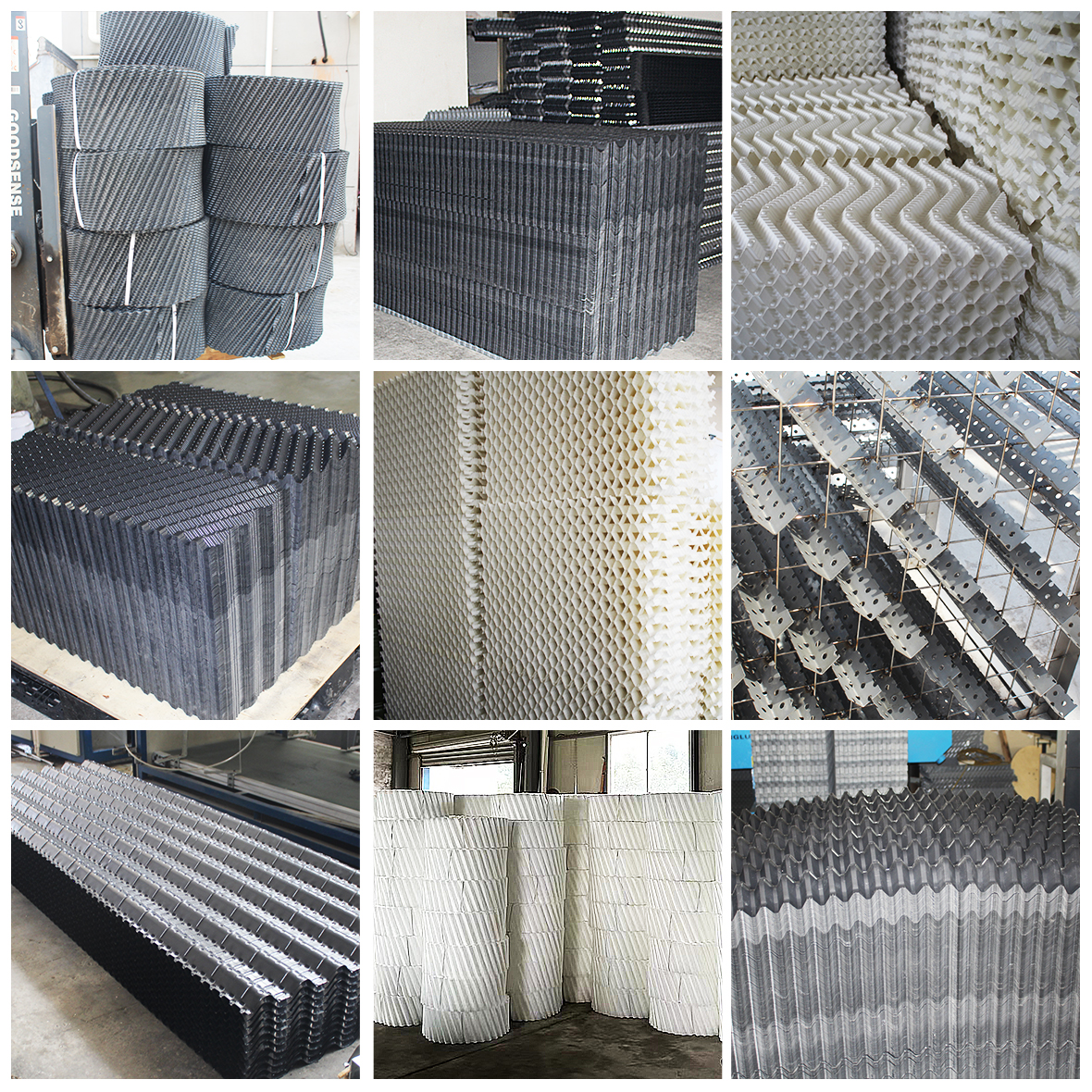
Cooling Tower Infills and Drift Eliminators for Global Supply
Cooling towers play an essential role in industrial process cooling, HVAC systems, power generation, manufacturing, chemical processing, and many other applications. Inside these systems, cooling tower infills and drift eliminators are two critical components that directly influence heat transfer, water distribution, airflow, and water loss.
Cooling tower infills increase the contact area between air and water, helping the tower transfer heat efficiently. Drift eliminators perform a different but equally important function by reducing the amount of water droplets carried out of the tower with the exhaust air.
For international buyers, selecting a reliable supplier is about more than finding a competitive price. Material quality, dimensions, tower compatibility, customization, packaging, shipping, and technical support can all affect the success of a cooling tower project.
This guide explains how cooling tower infills and drift eliminators work, what types are available, how to select them, and what global buyers should consider when sourcing these components.
What Are Cooling Tower Infills and Drift Eliminators?
Cooling tower infills and drift eliminators are installed in different sections of an evaporative cooling tower and serve different functions.
What Is Cooling Tower Fill?
Cooling tower fill, also called cooling tower infill, cooling tower packing, or fill media, is installed in the heat-transfer section.
Its primary purpose is to increase water-air contact.
Hot water is distributed over the fill while air moves through the fill section. The increased contact area allows a portion of the water to evaporate, removing heat from the circulating water.
What Is a Drift Eliminator?
A drift eliminator is normally installed above the water distribution system or fill section.
Its purpose is to capture and redirect small water droplets entrained in the outgoing air.
Why Is Drift Reduction Important?
Reducing drift can help:
• Reduce water loss
• Limit chemical loss
• Reduce surrounding wetting
• Improve water conservation
• Minimize the discharge of airborne droplets
Although both components are located inside the cooling tower, cooling tower infills and drift eliminators should not be considered interchangeable components. Their designs and functions are fundamentally different.
How Do Cooling Tower Infills Improve Heat Transfer?
The performance of a cooling tower depends heavily on how effectively water and air interact.
How Does Film Fill Work?
Film fill spreads water across thin surfaces, creating a large effective contact area.
As air passes across or through these surfaces, heat and moisture transfer occur.
What Are the Advantages of Film Fill?
Film-type cooling tower infills can provide:
• High effective surface area
• Efficient water distribution
• Compact fill volume
• Good heat-transfer performance
• Efficient use of tower space
Film fill is widely used in HVAC and industrial cooling applications where water quality is suitable.
What Is Splash Fill?
Splash fill uses specially shaped bars, sheets, or modules to break falling water into droplets.
When Is Splash Fill Useful?
Splash fill may be considered for applications where water contains higher levels of suspended solids or where fouling resistance is particularly important.
Typical applications can include:
• Industrial process cooling
• Dirty-water applications
• Heavy industrial environments
• Cooling towers exposed to airborne debris
The choice between film fill and splash fill should be based on tower design, water quality, thermal requirements, and maintenance conditions.
What Types of Cooling Tower Infills Are Available?
Different cooling tower applications require different fill designs.
Cross-Fluted Cooling Tower Fill
Cross-fluted fill uses angled channels that promote water spreading and air-water contact.
Why Is Cross-Fluted Fill Popular?
It can provide a high surface area in a relatively compact volume.
Common applications include:
• HVAC cooling towers
• Industrial cooling towers
• Counterflow towers
• Replacement projects
Vertical-Fluted Cooling Tower Fill
Vertical-fluted fill provides relatively open passages for water and air.
What Is the Main Benefit?
The open configuration can make some vertical-fluted designs suitable for applications where fouling resistance and easier passage cleaning are important considerations.
Offset-Fluted Fill
Offset-fluted designs use a structured surface to increase turbulence and water-air interaction.
They can be used where the cooling tower requires a balance between heat-transfer performance and airflow.
What Materials Are Used for Cooling Tower Infills?
Material selection affects temperature resistance, chemical compatibility, durability, and cost.
Why Is PVC Widely Used?
PVC is one of the most common materials for cooling tower film fill.
PVC cooling tower infills offer a combination of:
• Good thermal performance
• Lightweight construction
• Chemical resistance
• Good thermoforming properties
• Competitive cost
When Is PP Cooling Tower Fill Used?
Polypropylene can be considered for applications requiring different temperature or chemical-resistance characteristics.
The appropriate material should be selected according to the actual operating conditions.
Can Cooling Tower Infills Be Customized?
Yes.
A professional supplier can often provide customized:
• Length
• Width
• Height
• Sheet thickness
• Flute pattern
• Fill block dimensions
• Hanging configuration
Customized fill is particularly useful for older towers and replacement projects.
What Are the Main Types of Drift Eliminators?
Drift eliminators are designed to change the direction of airflow and remove entrained water droplets.
PVC Drift Eliminators
PVC is commonly used because it is lightweight, corrosion-resistant, and relatively easy to form.
PVC drift eliminators can be produced in different profiles and blade configurations.
PP Drift Eliminators
PP drift eliminators may be considered when higher temperature resistance or specific chemical compatibility is required.
What Is a Blade-Type Drift Eliminator?
Blade-type designs use a series of specially shaped passages.
As moist air travels through the eliminator, its direction changes several times. Water droplets collide with the surfaces and are redirected back toward the cooling tower.
Why Does Blade Geometry Matter?
The blade angle, spacing, depth, and profile influence:
• Drift removal
• Airflow resistance
• Water recovery
• Pressure drop
• Maintenance requirements
Therefore, simply increasing the number of blades does not automatically create a better drift eliminator.
How Do Cooling Tower Infills and Drift Eliminators Work Together?
Although they have different functions, both components influence overall cooling tower performance.
What Happens Inside the Fill Section?
Water flows through the cooling tower infills while air moves through the same area.
The fill promotes heat and mass transfer.
What Happens Above the Fill?
Air leaving the fill can contain small water droplets.
The drift eliminator captures many of these droplets before the air exits the tower.
Why Is the Combination Important?
A cooling tower requires both effective heat transfer and controlled water loss.
The combination of suitable cooling tower infills and drift eliminators can help the tower achieve these objectives while supporting stable operation.
How Should Global Buyers Choose Cooling Tower Infills?
International buyers should evaluate more than material and price.
What Tower Information Should Be Provided?
A supplier should ideally receive:
• Cooling tower manufacturer
• Tower model
• Tower type
• Crossflow or counterflow configuration
• Fill dimensions
• Water flow rate
• Operating temperature
• Cooling range
• Water quality
Why Is Water Quality Important?
Water containing high levels of suspended solids, biological contaminants, or scale-forming minerals can affect fill performance.
What Can Poor Water Quality Cause?
Potential problems include:
• Scaling
• Biological growth
• Blocked passages
• Reduced water distribution
• Reduced airflow
• Lower heat-transfer efficiency
Therefore, fill selection should always consider the water-treatment system.
How Should You Choose the Right Drift Eliminator?
Drift eliminators should be selected according to the tower configuration and required airflow.
What Specifications Should Be Checked?
Important specifications can include:
• Overall dimensions
• Blade profile
• Blade spacing
• Material
• Airflow direction
• Installation configuration
• Pressure drop
• Drift performance
Why Is Pressure Drop Important?
The cooling tower fan must move air through the system.
An overly restrictive drift eliminator can increase airflow resistance and potentially increase fan energy requirements.
A suitable design should therefore balance drift reduction with acceptable airflow resistance.
Why Is Customization Important for Global Supply?
Cooling towers around the world are built with different dimensions and internal configurations.
Can Standard Components Fit Every Cooling Tower?
Not always.
Older equipment and customized industrial towers may require non-standard components.
A professional supplier should be able to provide customized cooling tower infills and drift eliminators according to drawings, measurements, samples, or photographs.
What Can Be Customized?
Depending on manufacturing capabilities, customization may include:
• Fill dimensions
• Drift eliminator dimensions
• PVC sheet thickness
• PP material
• Flute geometry
• Blade geometry
• Fill block configuration
• Support configuration
• Packaging method
What Quality Standards Should Buyers Look For?
Quality control is especially important when purchasing components for large cooling towers.
How Should Cooling Tower Fill Be Inspected?
Inspection can include:
Dimensional Inspection
Check:
• Length
• Width
• Height
• Thickness
• Block dimensions
Appearance Inspection
Look for:
• Cracks
• Deformation
• Uneven forming
• Surface damage
• Contamination
Structural Inspection
Check whether the fill maintains the required geometry and whether assembled blocks are properly bonded or supported.
How Should Drift Eliminators Be Inspected?
Check:
• Blade spacing
• Blade profile
• Overall dimensions
• Assembly quality
• Surface condition
• Fit with existing supports
Consistent manufacturing is particularly important for large replacement projects.
How Can Buyers Evaluate a Cooling Tower Fill Supplier?
Selecting a supplier should involve both technical and commercial evaluation.
Does the Supplier Have Cooling Tower Experience?
A manufacturer with experience in cooling tower components should understand the relationship between fill geometry, water distribution, airflow, and heat transfer.
Can the Supplier Provide Customized Products?
Customization capability is valuable when standard products cannot match the existing tower.
Can the Supplier Provide Samples?
Samples allow buyers to confirm:
• Material
• Dimensions
• Surface structure
• Fill geometry
• Drift eliminator profile
Can the Supplier Handle International Orders?
Global customers should also evaluate:
• Production capacity
• Lead time
• Packaging
• Export experience
• Container loading
• Shipping documentation
• After-sales communication
What Packaging Is Suitable for Global Cooling Tower Fill Supply?
Cooling tower infills are lightweight but occupy significant volume.
Packaging must therefore balance protection with shipping efficiency.
Why Is Packaging Important?
Poor packaging can cause:
• Deformation
• Crushing
• Surface damage
• Contamination
• Difficult unloading
How Can Suppliers Optimize Shipping?
For international shipments, suppliers may optimize:
• Fill block arrangement
• Pallet dimensions
• Stack height
• Container utilization
• Protective packaging
Efficient loading can reduce transportation costs for large-volume cooling tower fill orders.
What Should Be Included in a Global Cooling Tower Fill RFQ?
A detailed RFQ can make communication between international buyers and suppliers much easier.
Recommended Fill Information
Provide:
• Product type
• Material
• Dimensions
• Thickness
• Flute pattern
• Quantity
• Tower type
• Existing fill photographs
Recommended Drift Eliminator Information
Provide:
• Material
• Dimensions
• Blade profile
• Blade spacing
• Quantity
• Installation method
• Existing sample or drawing
What Additional Information Is Useful?
If available, provide:
• Cooling tower drawings
• Tower model
• Water flow
• Airflow
• Operating temperature
• Water quality
• Previous fill specifications
The more complete the information, the easier it is for the supplier to recommend a suitable product.
What Are Common Cooling Tower Fill Replacement Problems?
Replacement projects can involve several challenges.
Incorrect Dimensions
A fill block that is too large may not fit the support system.
A fill block that is too small may leave unwanted gaps.
Incorrect Flute Direction
The orientation of fill channels can affect water distribution and airflow.
Incompatible Drift Eliminators
Even if a drift eliminator has the correct length and width, its support configuration may not match the tower.
Material Mismatch
The replacement material should be suitable for the tower's temperature and water chemistry.
How Can Cooling Tower Infills Improve Long-Term Efficiency?
The objective of cooling tower fill is not simply to maximize surface area.
What Is the Ideal Balance?
A well-selected fill should provide an appropriate balance between:
Heat Transfer + Water Distribution + Airflow + Fouling Resistance + Service Life
Why Is Maintenance Important?
Even high-quality cooling tower infills can lose performance if they become heavily scaled or contaminated.
Regular inspection and water treatment can help maintain the designed operating conditions.
How Can Drift Eliminators Help Reduce Water Loss?
Drift represents small droplets of circulating water carried out with exhaust air.
Why Does Drift Matter?
Drift can result in:
• Water loss
• Chemical loss
• Wetting around the tower
• Potential environmental concerns
• Increased makeup-water requirements
A suitable drift eliminator redirects water droplets back into the tower.
Can Better Drift Control Reduce Operating Costs?
Potentially, yes.
Reducing unnecessary water and chemical losses can support more efficient tower operation.
However, actual savings depend on tower design, operating conditions, water chemistry, and the quality of the existing drift eliminator.
What Trends Are Shaping Cooling Tower Infills and Drift Eliminators?
The cooling tower component market is evolving toward more efficient and application-specific designs.
Are Manufacturers Focusing More on Fouling Resistance?
Yes, especially for industrial systems where water quality can vary.
Designers are increasingly looking for fill configurations that maintain open passages and simplify maintenance.
Is Lightweight Design Becoming More Important?
Lightweight plastic components can simplify transportation, handling, and installation.
PVC and PP are particularly useful because they combine relatively low weight with corrosion resistance.
Will Customized Cooling Tower Components Become More Common?
Customized replacement components are increasingly relevant as aging cooling towers remain in service.
Instead of replacing an entire tower, owners may replace internal components such as:
• Cooling tower infills
• Drift eliminators
• Nozzles
• Louvers
• Fan blades
• Fill supports
This can provide a practical approach to tower refurbishment.
FAQ About Cooling Tower Infills and Drift Eliminators
What Is the Difference Between Cooling Tower Infills and Drift Eliminators?
Cooling tower infills increase water-air contact for heat transfer, while drift eliminators capture water droplets carried by the outgoing air.
What Material Is Commonly Used for Cooling Tower Infills?
PVC is widely used for film-type cooling tower fill. PP is another option for specific temperature or chemical conditions.
What Material Is Commonly Used for Drift Eliminators?
PVC and PP are both used. The appropriate material depends on operating temperature, water chemistry, mechanical requirements, and project specifications.
Can Cooling Tower Infills Be Customized?
Yes. Dimensions, thickness, flute design, and fill configuration can often be customized according to the cooling tower.
Can Drift Eliminators Be Customized?
Yes. Suppliers can often customize dimensions, blade profiles, spacing, and installation configurations.
How Often Should Cooling Tower Fill Be Replaced?
There is no universal replacement schedule. Replacement depends on water quality, scaling, biological growth, physical damage, operating conditions, and maintenance practices.
How Do I Find a Reliable Cooling Tower Fill Supplier?
Evaluate the supplier's manufacturing experience, product range, customization capabilities, quality-control procedures, production capacity, export experience, technical support, and sample quality.
How to Build a Long-Term Global Supply Partnership?
For distributors, contractors, and cooling tower maintenance companies, choosing a supplier should be viewed as a long-term sourcing decision.
What Makes a Supplier Suitable for Repeat Orders?
A dependable supplier should maintain consistency in:
• Material
• Dimensions
• Fill geometry
• Drift eliminator profiles
• Packaging
• Quality inspection
Why Does Consistency Matter?
Cooling tower maintenance companies may purchase replacement components repeatedly.
If every batch has different dimensions or specifications, installation and inventory management become more complicated.
A stable manufacturing partner can help simplify future procurement.
Conclusion
Cooling tower infills and drift eliminators perform different but complementary functions inside an evaporative cooling tower. Cooling tower infills provide the surface area needed for effective heat and mass transfer, while drift eliminators help capture water droplets before they leave the tower with exhaust air.
For global buyers, selecting the right supplier requires careful consideration of material, dimensions, fill geometry, drift eliminator design, water quality, operating conditions, customization, production capacity, packaging, and technical support.
Whether you are purchasing PVC cooling tower fill, PP fill, splash fill, film fill, or customized drift eliminators, the right product should be matched to the actual cooling tower rather than selected solely by price.
A capable cooling tower fill supplier should be able to provide accurate specifications, customized solutions, reliable quality, efficient packaging, and responsive technical support for international projects.
With the right combination of cooling tower infills and drift eliminators, cooling tower owners can support efficient heat transfer, better water management, reliable operation, and long-term maintenance performance.
Target SEO Keywords: cooling tower infills, cooling tower infill, drift eliminators, cooling tower fill, cooling tower fills, cooling tower fill supplier, cooling tower fill manufacturer, PVC cooling tower fill, PVC cooling tower infills, cooling tower replacement parts, cooling tower drift eliminator, cooling tower fill replacement, industrial cooling tower fill.