Selecting the right cooling tower fill is not just about finding a product that fits inside your cooling tower. Water quality plays a major role in determining whether the fill will deliver reliable cooling performance or become a source of recurring maintenance problems. If your circulating water contains suspended solids, minerals, algae, or industrial contaminants, the wrong fill can clog quickly, reduce heat-transfer efficiency, and increase operating costs.
So, how should you choose cooling tower fill under different water quality conditions?
The answer depends on understanding the relationship between fill structure, water chemistry, operating temperature, and cooling requirements. In this guide, we explain how to select suitable cooling tower fill for clean water, hard water, high-turbidity water, wastewater, and other industrial applications. We also compare PVC film fill and PP splash fill to help you make a practical decision.
Power Tower Cooling Technology (Shaoxing) Co., Ltd. is the manufacturer identified for this article, with its website at Coolingtowerpart.com.
1. Why Water Quality Matters When Selecting Cooling Tower Fill
Cooling tower fill increases the contact area between circulating water and air, allowing heat to transfer efficiently. However, different fill designs respond differently to contaminants.
Film fill uses closely spaced surfaces to spread water into thin films. This arrangement can provide excellent thermal performance, but deposits may obstruct its narrow passages. Splash fill breaks falling water into droplets using bars, grids, or similar structures. Its relatively open design can make it more suitable for some fouling-prone applications.
Imagine trying to push muddy water through a narrow filter compared with letting it fall over a series of open platforms. The second arrangement may be less vulnerable to certain blockages, although it is not immune to deposits.
Water quality therefore influences not only fill selection but also cleaning frequency, water-treatment requirements, service life, and total ownership cost.
Choosing the right fill from the beginning can help reduce maintenance interruptions and improve the reliability of your cooling system.
2. Understanding the Main Types of Cooling Tower Fill
Before choosing a fill, it helps to understand the main options available. The two common categories are film fill and splash fill. Special-material designs may also be necessary when water temperature or chemical exposure falls outside standard operating conditions.
2.1 PVC Film Fill
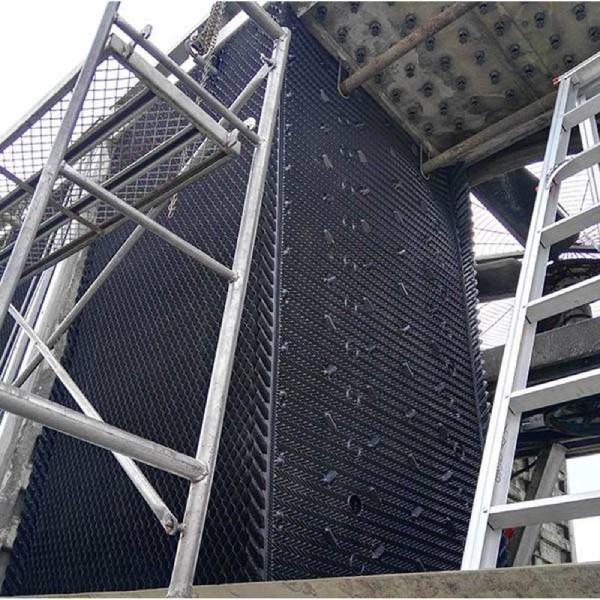
PVC film fill is widely used in cooling towers because its formed surfaces distribute water into thin layers, creating substantial air-water contact. It is often a strong choice for HVAC systems, commercial buildings, and industrial applications where water quality is reasonably well controlled.
Its principal advantage is effective heat transfer within a relatively compact space.
The limitation is that closely spaced passages can accumulate scale, biofilm, fibers, and suspended solids. When contamination is significant, these deposits may restrict airflow and water distribution.
PVC film fill is therefore generally best considered for applications where filtration, water treatment, and routine maintenance can keep fouling under control.
2.2 PP Splash Fill
Polypropylene (PP) splash fill distributes water by repeatedly breaking it into droplets as it falls across bars or grids. Compared with many film-fill designs, splash fill has a more open structure that may tolerate suspended solids and certain fouling conditions better.
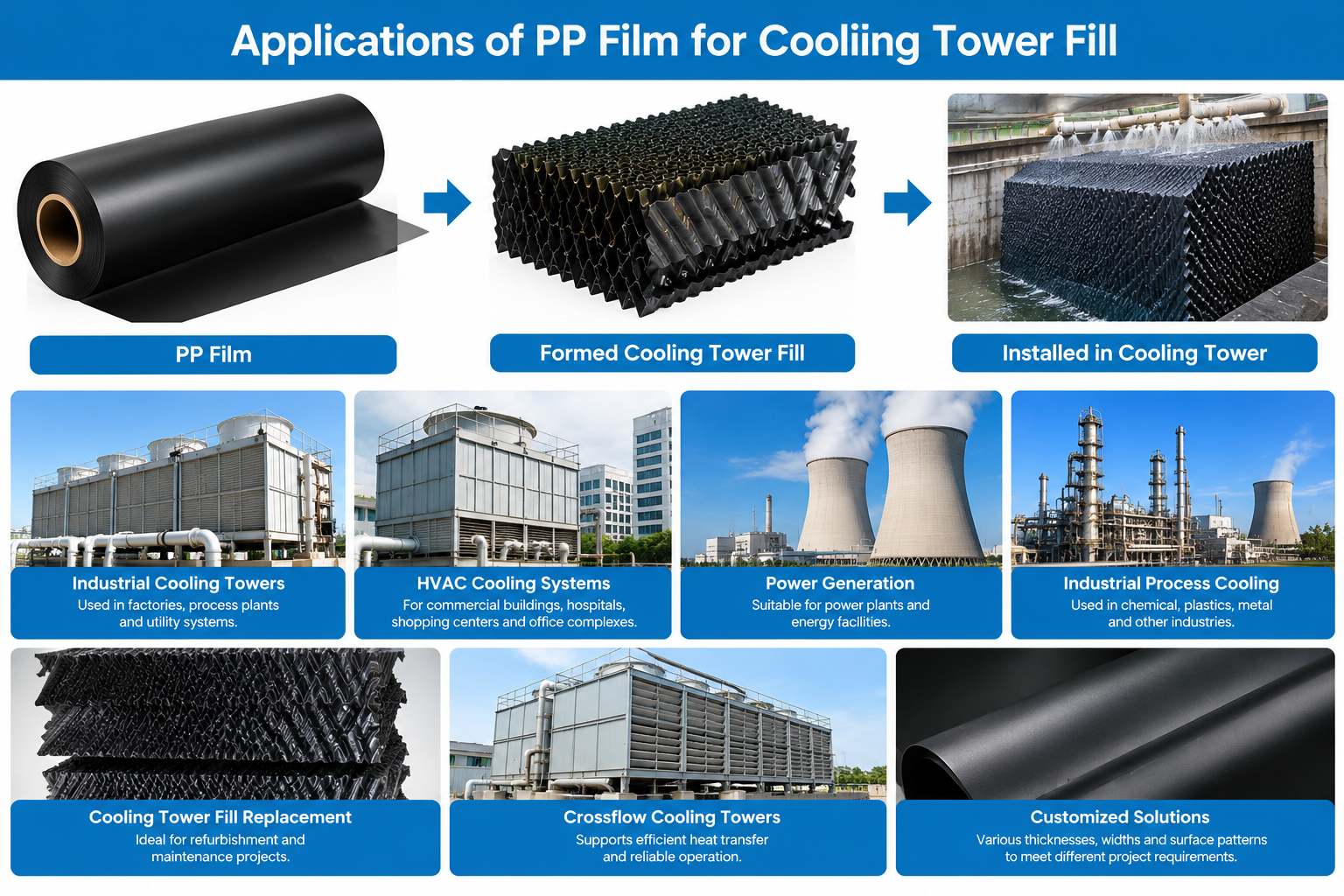
This makes it worth considering for steel plants, mining operations, process cooling, and some wastewater-related applications.
However, splash fill does not automatically outperform film fill. Depending on its geometry and the cooling tower design, it may require different operating conditions or more space to achieve the required thermal performance.
PP also has specific temperature and chemical compatibility limits, so the grade must match the application.
2.3 High-Temperature and Special-Material Fill
Some industrial cooling systems operate with elevated water temperatures or unusual chemical exposure. In these situations, standard PVC or PP products may not be suitable.
The correct choice depends on continuous operating temperature, peak temperature, chemical concentration, mechanical loading, and expected service life.
Never select a fill simply because its material is described as heat-resistant or chemically resistant. Request the manufacturer's technical specifications and confirm that the proposed product is appropriate for the actual operating conditions.
3. How to Evaluate Cooling Water Quality
Water analysis provides a useful starting point for fill selection. Instead of relying on descriptions such as "clean water" or "dirty water," examine measurable characteristics and operating history.
Important factors include suspended solids, turbidity, hardness, alkalinity, pH, conductivity, biological activity, and chemical contaminants. The relative importance of each factor depends on the water source and the cooling process.
A water sample may appear clear but still contain dissolved minerals that create scaling problems. Likewise, water with visible particles may not necessarily require splash fill if effective filtration removes those particles before they reach the tower.
A proper assessment helps you identify the actual risk rather than paying for a solution you may not need.
3.1 Suspended Solids and Turbidity
Suspended solids include particles such as sand, rust, sediment, fibers, and process residues. Turbidity measures how cloudy water is, but it does not identify every particle or fully describe the risk of blockage.
High suspended-solids levels can accelerate fouling and create deposits in the fill, distribution system, and cold-water basin.
If the water contains substantial solids, investigate filtration, settling, and other pretreatment options. Splash fill may be preferable when residual solids cannot be eliminated economically, but particle size and composition still matter.
3.2 Hardness and Scaling Potential
Hard water contains dissolved calcium and magnesium that may contribute to mineral scale under suitable conditions. In cooling towers, evaporation concentrates dissolved substances, potentially increasing the likelihood of precipitation and deposits.
Scale can form on fill surfaces, heat-transfer equipment, nozzles, and basin components.
Fill selection should therefore consider hardness alongside alkalinity, pH, conductivity, temperature, and the overall water-treatment program.
Splash fill may reduce some narrow-channel blockage concerns, but it cannot prevent mineral scale from forming.
3.3 Biological Growth and Organic Contamination
Warm circulating water can support algae, bacteria, and biofilm when environmental and treatment conditions allow. Organic matter and biological deposits can accumulate on both film fill and splash fill.
Film fill may experience restricted passages, while splash fill can develop coatings that interfere with water breakup and heat transfer.
Effective biological control, basin cleaning, and regular inspection are essential regardless of the fill type. If the water contains oils or sticky organic residues, assess their compatibility with the fill material and determine whether upstream treatment is necessary.
3.4 pH, Corrosion, and Chemical Compatibility
Water pH and chemical composition influence scaling, corrosion, and material compatibility. A cooling tower may also receive process chemicals or cleaning agents that affect plastic components.
Before selecting PVC or PP fill, review the expected chemical exposure, concentration, temperature, and duration.
Do not assume that a material suitable for ordinary circulating water will also withstand concentrated cleaning chemicals or unusual process contaminants. When conditions are uncertain, request a compatibility review from the supplier.
4. Fill Selection Recommendations for Different Water Quality Conditions
Different water conditions call for different strategies. The following recommendations provide a practical starting point, but the final selection should also consider thermal performance, tower design, water treatment, and the manufacturer's specifications.
4.1 Clean Water with Low Suspended Solids
Recommended starting point: PVC film fill, provided the operating temperature and chemical conditions are suitable.
Clean, well-treated water generally presents a lower risk of blockage, allowing the high heat-transfer capability of film fill to be used effectively. This option is often worth considering for HVAC systems, commercial cooling, and industrial processes with reliable filtration and water treatment.
Before purchasing, confirm the required cooling capacity, water distribution pattern, operating temperatures, and fill dimensions.
Clean water does not eliminate scaling or biological risks, so regular monitoring remains necessary.
4.2 Water with Moderate Suspended Solids
Recommended approach: evaluate film fill alongside splash fill and improve pretreatment where practical.
If suspended solids fluctuate but remain manageable, filtration may allow film fill to perform reliably. If the solids are persistent and cause repeated blockage, splash fill may offer a more maintainable alternative.
The decision should consider particle size, concentration, fouling history, and cleaning costs.
Do not switch fill types based only on a single water sample. Review seasonal changes and actual tower operating records before making a long-term investment.
4.3 Water with High Suspended Solids
Recommended starting point: consider PP splash fill, especially when solids cannot be adequately removed before water enters the tower.
Its relatively open structure can reduce the risk associated with narrow film-fill passages. Applications may include certain mining, steelmaking, manufacturing, and process-cooling systems.
However, high suspended-solids levels can still cause sediment accumulation, abrasion, and fouling. Where possible, combine a suitable splash-fill design with settling, screening, filtration, and effective basin cleaning.
Confirm that the fill geometry and material are appropriate for the actual contaminant load.
4.4 Hard Water with a High Scaling Risk
Recommended approach: select fill according to scaling severity and water-treatment capability rather than hardness alone.
PVC film fill can work in hard-water systems when chemistry is well controlled and scale formation is managed. If mineral deposits repeatedly block narrow passages, splash fill may be worth evaluating.
Nevertheless, splash fill does not eliminate scale. Review hardness, alkalinity, pH, conductivity, cycles of concentration, and treatment performance.
Improve blowdown control and scale prevention where appropriate. If deposits remain severe, consult a water-treatment specialist before replacing the fill, since the underlying chemistry may continue to damage the new product.
4.5 Water with High Biological Activity
Recommended approach: evaluate the source of biological fouling and choose a fill that supports effective cleaning.
Film fill may be appropriate when biological growth is controlled, while splash fill may be advantageous where deposits repeatedly block narrow passages.
Neither option prevents biofilm formation.
The cooling tower should have a suitable biological-control program, regular inspection, and appropriate cleaning procedures. Because cooling towers can create exposure risks from harmful microorganisms, biological control must be managed under applicable safety requirements rather than relying on fill replacement alone.
4.6 Industrial Wastewater and Process Water
Recommended starting point: evaluate PP splash fill when suspended solids or clogging risks are significant.
Industrial wastewater varies widely, so no single fill is suitable for every application. Some process waters contain abrasive particles, oils, fibers, corrosive compounds, or sticky organic matter. These contaminants may require pretreatment or specialized material selection.
Obtain a representative water analysis and share it with the manufacturer. For particularly challenging water, confirm material compatibility, cleanability, and the expected maintenance requirements before deciding between splash fill and film fill.
4.7 High-Temperature Circulating Water
Recommended approach: prioritize verified temperature resistance before choosing the fill configuration.
Both PVC film fill and PP splash fill have application limits that depend on product design and material grade. Elevated temperatures can cause softening, deformation, or accelerated deterioration.
Where fouling risk is also high, a suitable high-temperature splash-fill product may be worth evaluating.
Ask for the maximum recommended continuous temperature and any restrictions on short-term peaks. Consider chemical exposure as well, since temperature and chemical effects can interact.
5. PVC Film Fill vs. PP Splash Fill
Choosing between PVC film fill and PP splash fill requires balancing heat-transfer performance with fouling tolerance and operating conditions.
PVC film fill is often favored for clean, well-treated water because its thin water films provide effective heat transfer in a compact arrangement.
PP splash fill is often considered when suspended solids, fouling, or narrow-channel blockage create recurring maintenance challenges.
However, these are general selection principles, not universal performance guarantees. A well-designed film-fill system may work successfully with moderately challenging water when treatment is effective. Likewise, splash fill may perform poorly if water distribution is uneven or its material is unsuitable.
Compare the specific products' thermal performance, airflow resistance, temperature limits, dimensions, and cleaning requirements before making a final decision.
6. How Water Treatment Affects Fill Selection
Fill selection and water treatment should be planned together. Even the most suitable fill can become fouled if water chemistry is poorly managed.
Filtration and screening can remove suspended particles, while appropriate chemical treatment can help control scaling and biological growth. Blowdown management helps limit the accumulation of dissolved solids as water evaporates. Basin cleaning removes sediment before it builds up and circulates through the system.
The right treatment program depends on the water source, process requirements, environmental regulations, and cooling tower design.
When pretreatment can reliably improve water quality, film fill may become a viable option. When contamination remains difficult to control, splash fill may provide a more practical maintenance strategy.
7. Common Mistakes When Choosing Cooling Tower Fill
One common mistake is choosing fill based solely on its purchase price. A cheaper product may lead to more frequent cleaning, greater downtime, or premature replacement.
Another mistake is assuming that splash fill can handle any dirty water. Its open structure can help with certain fouling conditions, but it does not eliminate deposits, corrosion, or material incompatibility.
Buyers also sometimes overlook temperature limits, select replacement fill without checking the tower structure, or ignore the effects of airflow resistance on fan operation.
Finally, some operators replace clogged fill without investigating the underlying water-treatment problem.
A better decision considers the complete cooling system, including water quality, thermal requirements, maintenance access, and lifecycle cost.

8. Installation and Maintenance Recommendations
Proper installation and maintenance help extend fill service life and preserve cooling performance.
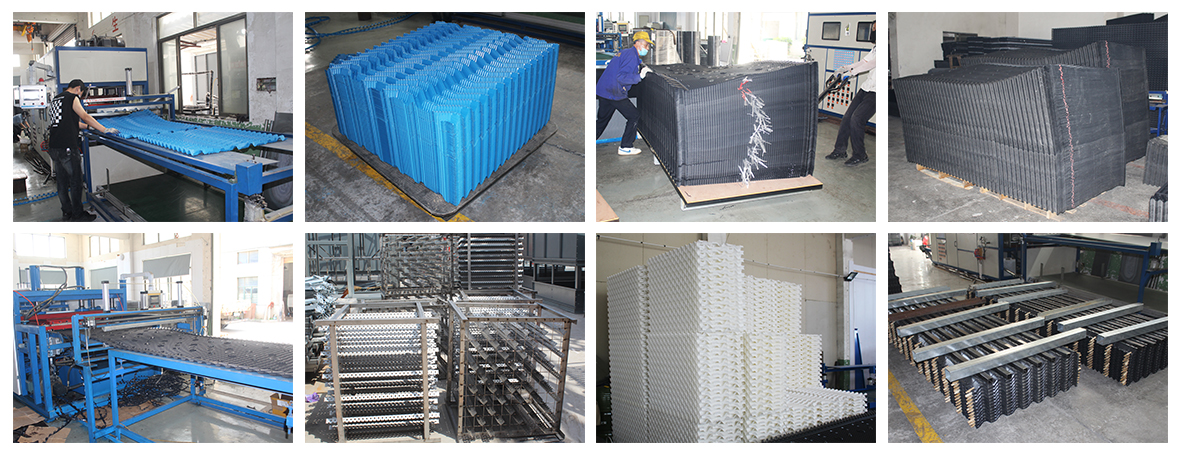
Before installation, inspect support beams, water-distribution nozzles, drift eliminators, and the cold-water basin. Remove accumulated debris and check that the new fill matches the required dimensions and configuration.
Follow the manufacturer's installation instructions, including spacing, orientation, and support requirements. After installation, verify that water is distributed evenly and that airflow paths remain unobstructed.
During operation, monitor cooling performance and inspect for deposits, deformation, broken components, and uneven water loading.
Use cleaning methods compatible with the fill material, and avoid aggressive chemicals or mechanical force unless specifically approved.
8.1 Inspection and Cleaning
Inspection frequency should reflect water quality, operating hours, seasonal conditions, and previous fouling rates.
Systems with high suspended solids may need more frequent checks than systems using clean, treated water. Look for blocked passages, mineral deposits, biological growth, loose components, and damaged support structures.
Clean the fill using an appropriate method recommended by the manufacturer.
If fouling returns quickly after cleaning, investigate filtration and water treatment rather than repeatedly treating the symptom.
8.2 Monitoring Water Quality
Routine water testing can identify developing problems before they seriously affect cooling performance.
Depending on the system, monitor suspended solids, hardness, alkalinity, pH, conductivity, and biological-control indicators.
Record changes over time and compare them with cooling performance and maintenance findings. This information helps operators distinguish between fill-design problems and water-treatment problems.
It also provides a better basis for deciding whether a future replacement should use film fill, splash fill, or a different material.
9. A Practical Fill Selection Checklist
Before requesting a quotation, prepare the following information:
Water quality: Suspended solids, turbidity, hardness, pH, conductivity, and known contaminants.
Operating temperature: Normal inlet temperature, target outlet temperature, and maximum temperature.
Cooling duty: Circulating-water flow rate, required heat rejection, and ambient design conditions.
Existing configuration: Cooling tower type, fill dimensions, support spacing, and current fill material.
Maintenance history: Frequency of clogging, scale buildup, biological fouling, and cleaning.
Material requirements: Chemical compatibility, temperature resistance, and expected operating life.
Project requirements: Fill quantity, replacement schedule, delivery location, and installation constraints.
Providing these details helps the supplier assess whether film fill or splash fill is more appropriate. It also reduces the risk of purchasing a product that fits physically but cannot meet the required cooling performance.
10. Why Choose Power Tower Cooling Technology (Shaoxing) Co., Ltd.?
Choosing a cooling tower fill manufacturer is an important step in building a reliable cooling system or planning a replacement project. Buyers need more than a product quotation; they need accurate specifications and a clear understanding of whether the proposed fill matches their operating conditions.
Power Tower Cooling Technology (Shaoxing) Co., Ltd. is the manufacturer identified for this article, with its website at Coolingtowerpart.com.
When discussing a project, provide details about water quality, operating temperature, cooling requirements, existing fill dimensions, and recurring maintenance problems.
Ask the supplier to confirm the available material options, product compatibility, technical specifications, and installation requirements.
For applications involving wastewater, high temperatures, or severe fouling, make sure the actual operating conditions are reviewed before choosing a product.
Visit www.coolingtowerpart.com to discuss cooling tower fill requirements and explore suitable options for your project.
11. Frequently Asked Questions
11.1 Which Cooling Tower Fill Is Best for Dirty Water?
PP splash fill is often worth considering when circulating water contains substantial suspended solids or creates recurring clogging problems. However, the best choice depends on the type and concentration of contaminants, operating temperature, and tower design. Filtration and pretreatment should also be evaluated.
11.2 Is PVC Film Fill Suitable for Hard Water?
Yes, PVC film fill can be suitable for hard-water systems when scaling is properly controlled. Hardness alone does not determine the choice. Alkalinity, pH, conductivity, cycles of concentration, temperature, and water-treatment performance all influence scale formation.
11.3 Can Splash Fill Eliminate Scaling?
No. Splash fill may reduce certain narrow-channel blockage problems, but mineral scale can still accumulate on its surfaces and support structure. Proper water chemistry control, blowdown management, cleaning, and inspection remain necessary.
11.4 When Should Cooling Tower Fill Be Replaced?
Replace fill when it has deteriorated, deformed, cracked, become persistently blocked, or can no longer support the required cooling performance. The replacement interval depends on water quality, material, temperature, maintenance, and operating conditions. Inspect the system regularly and follow the manufacturer's recommendations.
11.5 Does Better Water Quality Always Mean Better Cooling Performance?
Not necessarily. Clean water can reduce fouling and maintenance requirements, but cooling performance also depends on water flow, air distribution, fill design, ambient wet-bulb temperature, and tower capacity. Water treatment and correct fill selection must work together.
12. Conclusion
Selecting cooling tower fill under different water quality conditions requires a clear understanding of both the water and the cooling system.
PVC film fill is often a good starting point for clean, well-treated water where efficient heat transfer and compact design are priorities. PP splash fill deserves consideration when suspended solids, fouling, or recurring blockage make conventional film fill difficult to maintain.
Hard water, biological activity, wastewater, and high-temperature operation each require additional assessment of water treatment and material compatibility.
There is no single fill type that works best for every application. The most reliable choice balances thermal performance, fouling tolerance, maintenance requirements, and total lifecycle cost.
Before purchasing, collect representative water-quality data, confirm the operating temperature and cooling duty, and check the product specifications with the manufacturer.
Power Tower Cooling Technology (Shaoxing) Co., Ltd., through www.coolingtowerpart.com, is the company identified for inquiries about cooling tower fill requirements.
A carefully selected fill, supported by effective water treatment and routine maintenance, can help your cooling tower operate more reliably and deliver consistent performance over time.


