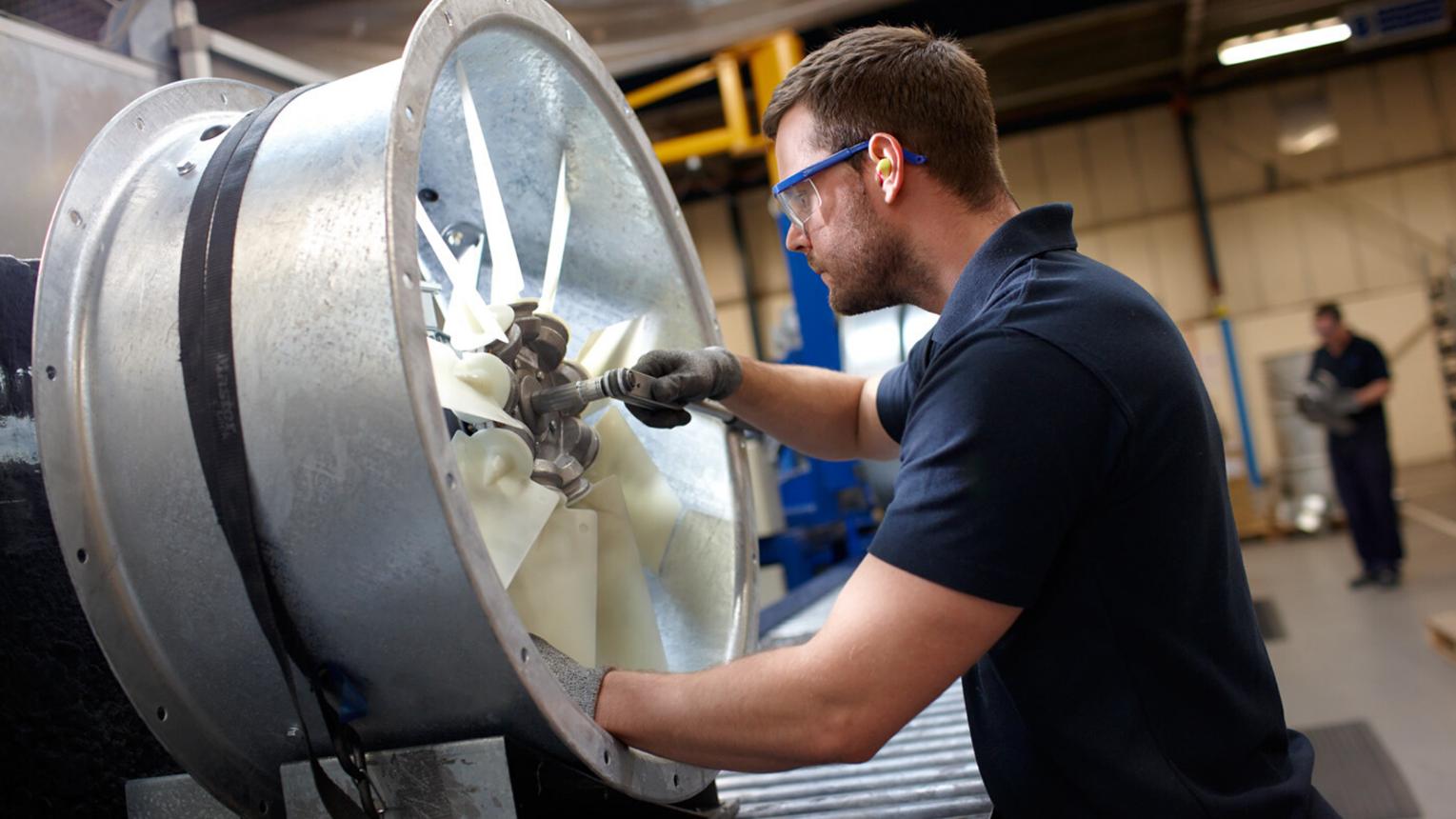
An industrial cooling tower fan is a critical component of an industrial cooling system. It moves air through the cooling tower to support heat transfer and water evaporation, helping remove excess heat from circulating water. Without sufficient airflow, a cooling tower cannot achieve its designed cooling performance.
Industrial cooling tower fans are widely used in power plants, petrochemical facilities, steel mills, manufacturing plants, refineries, and large HVAC systems. Their performance directly affects cooling efficiency, energy consumption, and equipment reliability.
But what exactly is an industrial cooling tower fan, and how does it work? This guide explains its structure, working principle, main components, fan types, and practical applications.
1. What Is an Industrial Cooling Tower Fan?
An industrial cooling tower fan is a mechanical air-moving device installed in a cooling tower. Its primary function is to create controlled airflow through the tower, allowing warm circulating water to release heat into the atmosphere.
Most large industrial cooling towers use axial flow fans because they can move large volumes of air at relatively low static pressure. These fans generally consist of fan blades, a hub, a drive system, and supporting structural components.
Depending on the cooling tower design, the fan may be installed at the top of the tower or near an air inlet.
Common industrial cooling tower fan materials include:
FRP (fiberglass reinforced plastic): Lightweight, corrosion-resistant, and suitable for large fan blades.
Aluminum alloy: Offers a good strength-to-weight ratio and is relatively easy to handle.
Stainless steel: Provides high mechanical strength and corrosion resistance in suitable environments.
Composite materials: Can be engineered for specific strength, weight, and operating requirements.
2. How Does an Industrial Cooling Tower Fan Work?
An industrial cooling tower fan works by creating airflow through the cooling tower. This airflow increases contact between ambient air and circulating water, supporting evaporative cooling.
The cooling process generally follows these steps.
Step 1: Warm Water Enters the Cooling Tower
Hot water from industrial equipment, heat exchangers, condensers, or production processes enters the cooling tower through the water distribution system.
Step 2: Water Is Distributed Over the Fill Media
The distribution system spreads warm water across the cooling tower fill. Film fill creates thin water films, while splash fill breaks water into droplets.
Both designs increase the contact area between water and air.
Step 3: The Fan Generates Airflow
The cooling tower fan rotates and moves air through the tower.
In an induced-draft cooling tower, the fan pulls air upward through the fill and discharges warm, moist air at the top. In a forced-draft cooling tower, the fan pushes ambient air into the tower through the air inlet.
Step 4: Heat Is Transferred Through Evaporation
As air contacts the water, a small portion of the water evaporates. This evaporation removes heat from the remaining water.
Sensible heat transfer also occurs as the warmer water transfers heat to cooler air.
Step 5: Cooled Water Returns to the Process
The cooled water collects in the cold-water basin and is pumped back to the industrial equipment. The cycle then repeats continuously.
industrial mechanical induced draft cooling tower cutaway diagram showing axial fan airflow upward fill water distribution warm water inlet cold water basin and exhaust air labeled technical illustration"

3. Main Components of an Industrial Cooling Tower Fan
A cooling tower fan system contains several components that work together to generate stable airflow.
3.1 Fan Blades
Fan blades convert rotational energy into airflow. Their shape, pitch angle, diameter, and number influence airflow volume, pressure, noise, and power consumption.
FRP and aluminum alloy blades are commonly used in industrial cooling towers.
3.2 Fan Hub
The hub connects the blades to the rotating shaft or drive assembly. It supports the blades and transfers rotational force from the drive system.
A properly designed hub helps maintain mechanical stability and blade alignment.
3.3 Electric Motor
The motor supplies the power required to rotate the fan. Industrial cooling tower motors must be selected according to fan load, operating speed, voltage, frequency, and environmental conditions.
3.4 Gearbox or Drive System
Some large cooling tower fans use a gearbox to reduce motor speed and provide the required fan operating speed. Other systems use belt drives or direct-drive arrangements.
The correct drive configuration depends on fan design and operating requirements.
3.5 Fan Stack
The fan stack surrounds and guides airflow around the fan. It helps reduce airflow losses and directs discharged air away from the cooling tower.
FRP fan stacks are commonly selected for their lightweight construction and corrosion resistance.
industrial cooling tower axial fan assembly close up showing FRP blades central hub gearbox motor fan stack engineering equipment
4. Main Types of Industrial Cooling Tower Fans
Different cooling tower designs require different fan configurations.
4.1 Axial Flow Cooling Tower Fan
Axial fans move air parallel to the fan shaft. They are widely used in industrial cooling towers because they provide high airflow volumes with relatively low power requirements under suitable operating conditions.
Typical applications include power plants, petrochemical facilities, and large industrial cooling systems.
4.2 Centrifugal Cooling Tower Fan
Centrifugal fans draw air into the fan and discharge it in a direction generally perpendicular to the inlet. They can generate higher static pressure and may be suitable for cooling systems with greater air resistance.
4.3 Induced-Draft Cooling Tower Fan
An induced-draft fan is normally installed at the top of the cooling tower. It pulls air through the fill and discharges warm, moist air into the atmosphere.
This configuration is widely used in large industrial cooling towers.
4.4 Forced-Draft Cooling Tower Fan
A forced-draft fan is generally installed near the air inlet. It pushes ambient air into the tower and through the cooling section.
The fan and motor arrangement can offer convenient maintenance access, depending on the tower design.
5. What Factors Affect Cooling Tower Fan Performance?
Several operating and design factors determine how efficiently an industrial cooling tower fan works.
Airflow volume: Insufficient airflow can reduce cooling capacity.
Fan blade pitch: Incorrect pitch may cause insufficient airflow or excessive motor loading.
Fan speed: Operating speed affects airflow, power consumption, and noise.
Blade condition: Cracks, corrosion, and deformation can affect aerodynamic performance and balance.
Motor efficiency: An appropriately selected motor helps reduce electrical consumption.
Air resistance: Blocked fill, drift eliminators, and air inlets can increase system resistance.
Ambient conditions: Air temperature, humidity, and wet-bulb temperature influence cooling tower performance.
Correct fan selection must consider the entire cooling tower system rather than the fan alone.
6. Applications of Industrial Cooling Tower Fans
Industrial cooling tower fans are essential in facilities that need continuous heat rejection.
| Industry | Main cooling applications |
| Power generation | Condenser and auxiliary cooling systems |
| Petrochemical | Heat exchangers and process cooling |
| Oil and gas | Refinery and gas-processing equipment |
| Steel manufacturing | Furnace and production equipment cooling |
| Chemical processing | Reactor and process-water temperature control |
| HVAC | Chiller condenser-water systems |
| General manufacturing | Machinery and industrial process cooling |
7. How to Maintain an Industrial Cooling Tower Fan
Regular maintenance helps prevent fan failure, reduce vibration, and maintain stable airflow.
Recommended maintenance practices include:
Inspect blades for cracks, corrosion, erosion, and deformation.
Check blade pitch angles and ensure consistent adjustment.
Inspect the fan hub, bolts, and blade connections.
Monitor vibration and investigate unusual noise.
Check motor bearings, electrical connections, and operating temperature.
Inspect gearbox oil levels and drive components where applicable.
Clean accumulated dirt and debris from fan blades.
Check fan stack condition and ensure there are no airflow obstructions.
Always follow the manufacturer's maintenance procedures and isolate electrical power before carrying out inspections or repairs.
8. Industrial Cooling Tower Fan Replacement
When fan blades become damaged, the motor consumes excessive power, or vibration problems continue despite maintenance, replacement may be necessary.
However, selecting a replacement fan requires more than matching the original fan diameter. Buyers should verify:
Fan diameter and blade quantity
Hub dimensions and mounting arrangement
Blade material and pitch adjustment range
Rotation direction and operating speed
Required airflow and static pressure
Motor power and gearbox specifications
Fan stack and structural clearance
CoolingTowerPart.com provides industrial cooling tower fan blades and related replacement components for maintenance and retrofit projects. Custom FRP and aluminum fan solutions can be evaluated using original equipment drawings, dimensions, photographs, and operating data.
9. Frequently Asked Questions
Q1: What is the main function of an industrial cooling tower fan?
Its main function is to move air through the cooling tower, supporting evaporation and heat transfer so that circulating water can be cooled.
Q2: How does a cooling tower fan reduce water temperature?
The fan generates airflow across the water and fill media. A portion of the water evaporates, removing heat from the remaining water.
Q3: Which fan is commonly used in industrial cooling towers?
Axial flow fans are widely used because they can move large volumes of air at relatively low static pressure.
Q4: Does a cooling tower fan consume a lot of electricity?
Fan power consumption depends on airflow requirements, fan diameter, speed, blade design, and system resistance. Efficient fan selection and proper maintenance can help reduce energy use.
Q5: How long does an industrial cooling tower fan last?
Service life depends on material quality, operating conditions, maintenance, vibration, and environmental exposure. Regular inspection helps identify damage before it leads to major failure.
Conclusion
An industrial cooling tower fan creates the airflow needed for effective heat rejection. By moving air through the fill media, it supports evaporation, improves heat transfer, and helps maintain the required cooling-water temperature.
Understanding the fan's working principle, components, and operating conditions makes it easier to select suitable equipment and plan maintenance or replacement projects. For industrial users, choosing reliable fan blades, hubs, motors, and drive components is an important step toward improving cooling tower performance and reducing operating costs.
Power Tower Cooling Technology supports industrial cooling tower maintenance and retrofit projects with replacement fan components and customized supply solutions.
Recommended internal links for CoolingTowerPart.com:


