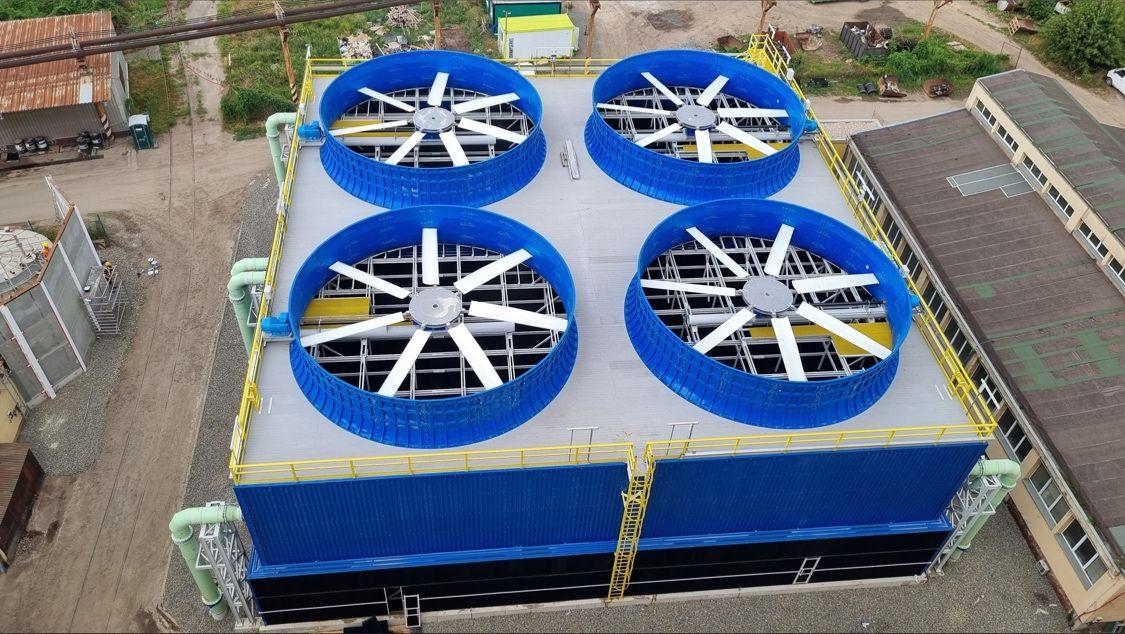
Industrial cooling tower fans are essential components in industrial cooling systems. They move large volumes of air through cooling towers, helping remove heat from circulating water and maintain stable operating temperatures. Power plants, chemical plants, refineries, HVAC systems, and manufacturing facilities all depend on reliable cooling tower fan performance.
Understanding the different types of industrial cooling tower fans, their functions, and applications helps engineers and maintenance teams select the right equipment, improve energy efficiency, and reduce operating costs.
This guide explains how industrial cooling tower fans work, their main types, common applications, and important selection factors.
1. What Is an Industrial Cooling Tower Fan?
An industrial cooling tower fan is a mechanical device designed to move air through a cooling tower. It creates airflow that supports heat and mass transfer between warm circulating water and cooler ambient air.
As warm water enters the cooling tower, it is distributed over the fill media. The fan moves air through the tower, allowing a small portion of the water to evaporate. This evaporation removes heat from the remaining water, which is then collected in the cold-water basin and returned to the industrial process.
Industrial cooling tower fans are typically driven by electric motors through direct-drive or gearbox systems. Their size, blade design, and operating speed depend on the cooling tower's capacity and airflow requirements.
2. Main Functions of Industrial Cooling Tower Fans
Cooling tower fans perform several important functions in industrial cooling systems.
2.1 Generate Airflow
The primary function is to move sufficient air through the cooling tower. Proper airflow helps maintain effective contact between air and water, supporting the cooling process.
2.2 Improve Heat Transfer
By maintaining airflow across the fill media, cooling tower fans support evaporation and heat exchange. Consistent airflow helps the tower achieve its required cooling capacity.
2.3 Maintain Stable Water Temperature
Industrial processes often require cooling water within a specific temperature range. A properly selected fan helps the cooling tower maintain stable outlet-water temperatures under changing operating conditions.
2.4 Improve Energy Efficiency
Fan energy consumption can represent a significant part of cooling tower operating costs. Efficient fan blades, correct pitch angles, suitable motors, and properly maintained drive systems can reduce unnecessary power consumption.
2.5 Support Continuous Industrial Operation
Reliable airflow is important in facilities that operate around the clock. Proper fan selection and maintenance help reduce unexpected shutdowns and production interruptions.
3. Main Types of Industrial Cooling Tower Fans
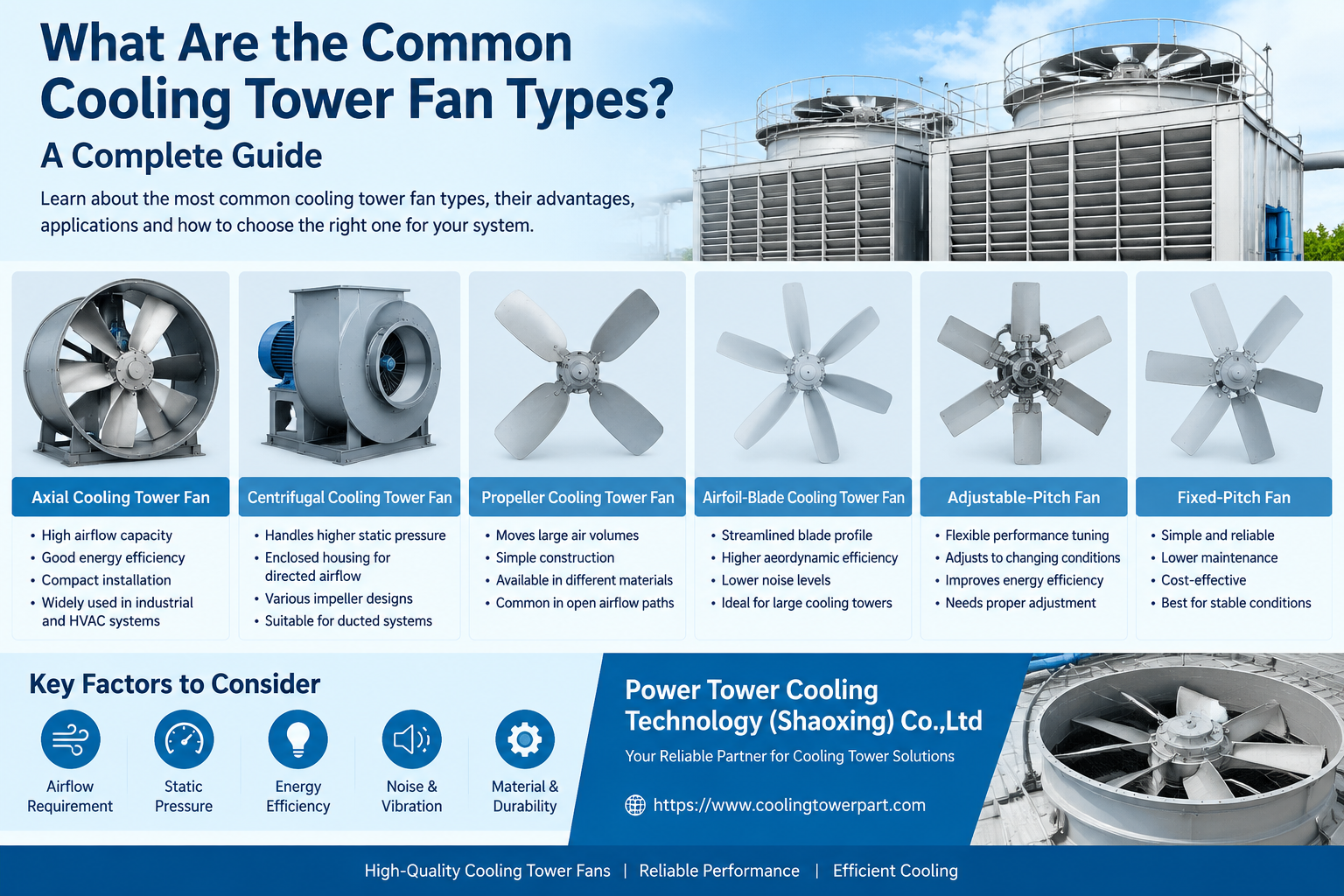
Industrial cooling tower fans can be classified by airflow direction, fan design, and drive arrangement.
3.1 Axial Flow Cooling Tower Fans
<image-placeholder>
Axial flow fans move air parallel to the fan shaft. They are widely used in industrial cooling towers because they can handle large airflow volumes at relatively low pressure.
Common features include:
Large-diameter fan blades
High airflow capacity
Relatively low operating pressure
Suitable for induced-draft and forced-draft cooling towers
Available in FRP, aluminum alloy, and other materials
Axial fans are commonly installed in large industrial cooling towers, power plants, petrochemical facilities, and HVAC systems.
3.2 Centrifugal Cooling Tower Fans
Centrifugal fans draw air into the fan housing and discharge it in a direction generally perpendicular to the inlet airflow.
Compared with axial fans, centrifugal fans can generate higher static pressure. They are suitable for systems with greater airflow resistance, although their energy requirements and installation arrangements differ.
Typical applications include smaller cooling towers, enclosed ventilation systems, and installations with higher air-side resistance.
3.3 Induced Draft Cooling Tower Fans
<image-placeholder>
Induced-draft fans are installed at the top of the cooling tower. They pull air upward through the tower and discharge warm, moist air into the atmosphere.
Advantages include:
More uniform airflow through the tower
Reduced risk of warm, moist exhaust air recirculating into the air inlet
Good suitability for large industrial cooling towers
Flexible capacity control through variable-speed drives
Induced-draft axial fans are widely used in power generation, chemical processing, and large industrial cooling systems.
3.4 Forced Draft Cooling Tower Fans
<image-placeholder>
Forced-draft fans are usually installed near the air inlet at the side or bottom of the cooling tower. They push ambient air into the tower, where it passes through the fill and interacts with circulating water.
Their advantages include accessible fan and motor arrangements in many designs. However, engineers must consider airflow distribution and the possibility of warm, moist air recirculation when planning the installation.
3.5 Crossflow and Counterflow Cooling Tower Fan Applications
Crossflow and counterflow describe the relationship between air and water movement inside the cooling tower, rather than separate fan designs.
Both configurations commonly use axial fans, depending on the tower design and airflow requirements.
4. Industrial Cooling Tower Fan Materials
Fan blade materials influence strength, weight, corrosion resistance, and service life.
| Material | Main characteristics | Typical applications |
| FRP | Lightweight, corrosion-resistant, and customizable | Large industrial cooling towers |
| Aluminum alloy | Lightweight, good mechanical strength, and easy handling | Industrial and HVAC cooling towers |
| Stainless steel | High strength and corrosion resistance in suitable grades | Specialized industrial environments |
| Composite materials | Designed for specific strength, weight, and environmental requirements | Modern industrial fan systems |
FRP cooling tower fan blades are popular because they combine low weight with good corrosion resistance. Material selection should consider operating temperature, chemical exposure, humidity, UV exposure, and mechanical loading.
5. Applications of Industrial Cooling Tower Fans
Industrial cooling tower fans are used in facilities where large amounts of process heat must be removed.
5.1 Power Plants
Power stations use cooling towers to reject heat from condensers and auxiliary cooling systems. Large axial fans help maintain the airflow needed for continuous operation.
5.2 Petrochemical and Chemical Plants
Chemical production processes generate substantial heat. Cooling tower fans help maintain cooling-water temperatures for heat exchangers, reactors, and other process equipment.
5.3 Oil and Gas Facilities
Refineries and gas processing plants use industrial cooling systems to control process temperatures and protect equipment from overheating.
5.4 Steel and Metallurgical Industries
Steel production requires cooling for furnaces, casting equipment, hydraulic systems, and other machinery. Reliable cooling tower airflow supports stable production.
5.5 HVAC and Commercial Industrial Buildings
Large factories, data centers, hospitals, and commercial buildings use cooling towers to reject heat from central air-conditioning systems.
5.6 Manufacturing Facilities
Food processing, plastics, paper, textiles, and general manufacturing operations use cooling towers to remove heat from production equipment and process water.
6. How to Select the Right Industrial Cooling Tower Fan
Selecting the correct fan requires more than comparing blade diameter or motor power. Buyers should evaluate the complete operating conditions.
Airflow requirements: Confirm the required airflow volume and the cooling tower's thermal performance requirements.
Fan diameter and speed: Match the fan dimensions and operating speed to the tower structure and design conditions.
Blade pitch angle: Correct blade pitch helps achieve the required airflow without excessive motor loading.
Motor and drive system: Check motor power, voltage, frequency, protection rating, gearbox ratio, and transmission arrangement.
Material and corrosion resistance: Select blade materials based on water quality, ambient conditions, and chemical exposure.
Noise and vibration: Consider noise limits, dynamic balance, structural vibration, and fan operating stability.
Replacement compatibility: For retrofit projects, verify the original fan diameter, hub configuration, blade count, rotation direction, pitch range, shaft arrangement, and mounting dimensions before ordering replacement parts.
7. Industrial Cooling Tower Fan Maintenance
Regular maintenance helps extend fan service life and reduce unexpected downtime.
Recommended maintenance tasks include:
Inspect fan blades for cracks, erosion, deformation, and corrosion.
Check blade pitch angles and ensure all blades are adjusted consistently.
Inspect the hub, bolts, and mounting connections.
Check motor bearings, gearbox oil levels, and drive components.
Monitor vibration and investigate unusual noise.
Clean fan blades to prevent dirt buildup and airflow imbalance.
Check electrical connections and motor operating conditions.
Always follow the manufacturer's maintenance instructions and isolate electrical power before inspection or repair.
8. Industrial Cooling Tower Fan Replacement and Custom Supply
When an industrial cooling tower fan becomes damaged, inefficient, or difficult to maintain, replacement may be more economical than repeated repairs.
A replacement fan should match the cooling tower's airflow requirements, mechanical dimensions, and drive configuration. Simply installing a fan with the same diameter does not guarantee equivalent performance.
CoolingTowerPart.com supplies industrial cooling tower fan components and replacement solutions for maintenance, repair, and retrofit projects. Buyers can discuss FRP and aluminum fan blades, fan hubs, motors, and related drive components according to project drawings and operating requirements.
For custom or aftermarket replacement projects, provide the original fan model, dimensions, photographs, operating speed, motor power, and required airflow where available. This information helps suppliers evaluate compatibility and recommend an appropriate solution.
9. Frequently Asked Questions
Q1: What is the most common type of industrial cooling tower fan?
Axial flow fans are widely used in industrial cooling towers because they provide large airflow volumes at relatively low pressure.
Q2: What is the difference between induced-draft and forced-draft fans?
Induced-draft fans pull air through the cooling tower and are usually installed at the top. Forced-draft fans push air into the tower and are generally installed near the air inlet.
Q3: Which material is best for industrial cooling tower fan blades?
FRP is a popular choice because it is lightweight and corrosion-resistant. Aluminum alloy and stainless steel may also be suitable depending on operating conditions.
Q4: How often should cooling tower fans be inspected?
Inspection frequency depends on operating hours, environmental conditions, and manufacturer recommendations. Regular visual checks and scheduled vibration and mechanical inspections are important.
Q5: Can an aftermarket cooling tower fan replace an original fan?
Yes, provided that the replacement is properly engineered and verified against the original fan's dimensions, performance requirements, rotation direction, hub design, and drive system.
Conclusion
Industrial cooling tower fans are critical to heat rejection, water-temperature control, and reliable industrial operation. Axial flow, centrifugal, induced-draft, and forced-draft configurations serve different airflow and installation requirements.
Choosing the right fan requires careful consideration of airflow, fan speed, blade materials, motor and gearbox specifications, and operating conditions. Regular inspection and correctly engineered replacement components can also improve reliability and reduce long-term operating costs.
For industrial cooling tower fan blades and replacement components, CoolingTowerPart.com can help buyers evaluate suitable solutions for cooling tower maintenance and retrofit projects.
Recommended internal links for CoolingTowerPart.com:


