Industrial Cooling Tower Fan Blade Balancing: Methods And Best Practices
Views: 0 Author: Lisa Publish Time: 2026-11-24 Origin: Site
Industrial Cooling Tower Fan Blade Balancing: Methods and Best Practices
Unbalanced fan blades are the leading cause of excessive vibration, premature bearing failure, gearbox damage, noise complaints and unplanned cooling tower shutdowns. FRP, aluminum and stainless steel axial fan blades drift out of balance over time from scaling, erosion, fouling, uneven wear and pitch drift. Proper balancing, following standardized methods and industry best practices, extends fan service life and keeps cooling performance stable for power, chemical, data center and manufacturing facilities.
Main Cooling Tower Fan Blade Balancing Methods
1. Static Balancing
Static balancing checks mass balance at rest, without running the fan.
The fan rotor is placed on low-friction knife edges or rollers. Heavy points will naturally settle downward.
Technicians add or remove mass to eliminate the tendency for the heavy spot to rotate down.
Best for: Small-diameter fans, new blade sets before installation, workshop pre-balancing.
Limitations: Static balancing only corrects single-plane mass imbalance. It cannot detect couple imbalance common on large, long-span cooling tower fans. Static balancing alone is not enough for most in-service industrial cooling towers.
2. On-Site Dynamic Balancing (Field Balancing)
Dynamic balancing is the primary method for installed cooling tower fans and is recommended for nearly all large-diameter fan assemblies.
Vibration sensors and a phase trigger are mounted on bearing housings.
The fan runs at normal operating speed to capture baseline vibration amplitude and phase.
Trial weights are securely attached to the hub to calculate the influence coefficient.
The analyzer computes the exact correction weight mass and angular position.
Final balancing weights are installed, then vibration is rechecked until the target ISO balance grade is achieved.
Advantages: No need to remove the fan or ship it to a workshop; saves downtime. It fixes both single-plane and couple imbalance.
Application: After blade replacement, pitch adjustment, blade cleaning, FRP repair, or when vibration rises above alarm limits.
3. Workshop Dynamic Balancing
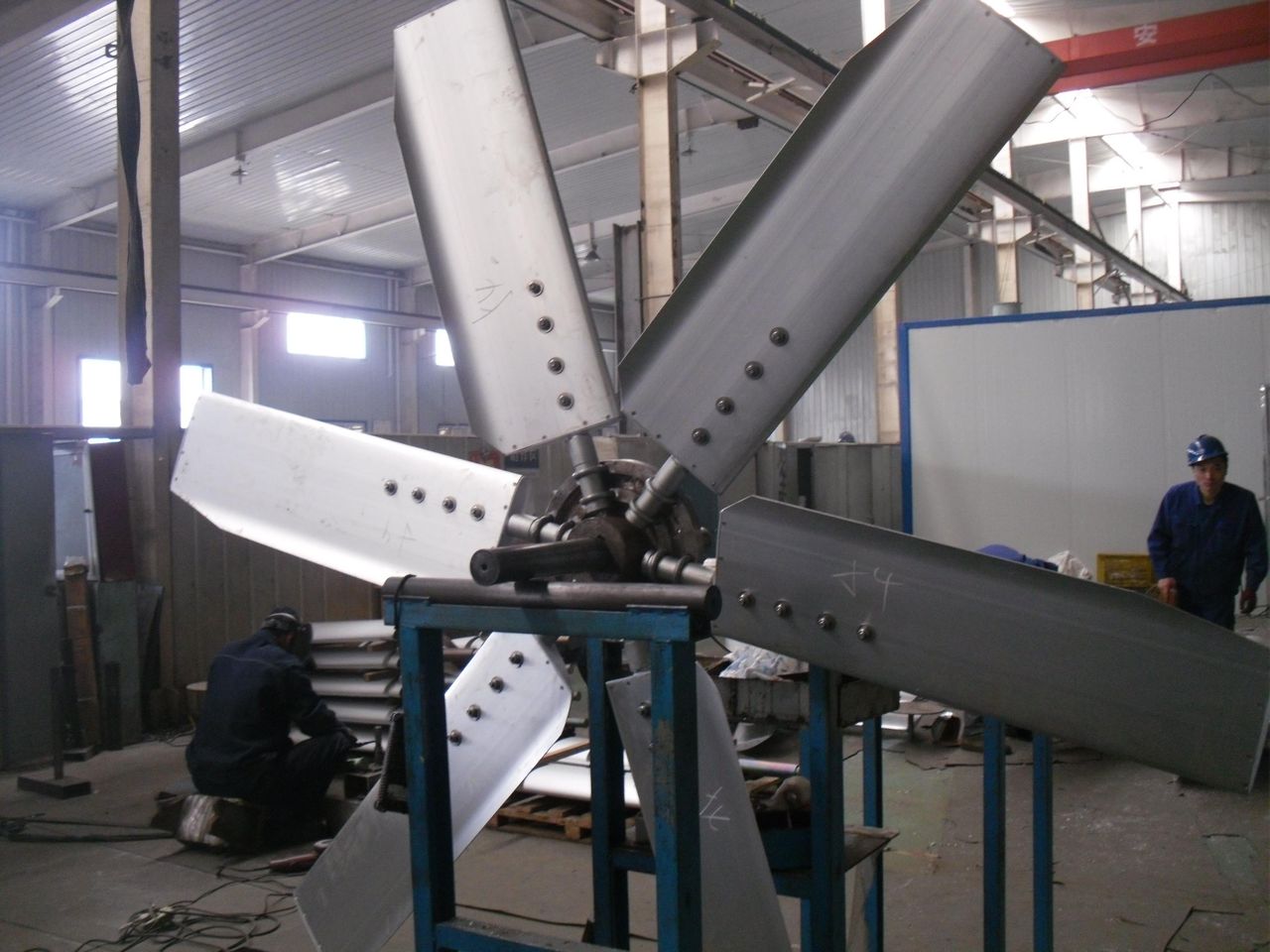
The full fan blade and hub assembly is removed and mounted on a dedicated balancing machine in a shop.
This delivers the highest precision for new custom blade sets or severely damaged rotors.
After balancing, the matched blade set is shipped and installed as a complete unit.
Drawback: Longer downtime and extra lifting, disassembly and reinstallation cost.
Critical Pre‑Balancing Checks (Must Complete Before Balancing)
Balancing weights cannot fix non‑balance issues. Resolve these first, or vibration will return quickly:
Confirm all blade pitch angles are identical, within ±0.5° tolerance. Uneven pitch creates aerodynamic imbalance that weights cannot eliminate.
Inspect blades for cracks, delamination, erosion, trapped water inside hollow FRP blades or heavy uneven scaling.
Check hub bolts for proper torque; loose blades will shift and ruin balancing results.
Verify shaft alignment, bearing health, fan stack rubbing and structural looseness of the tower frame.
Clean all blades thoroughly to remove uneven mineral scale and biological slime before balancing.
ISO 1940 Balance Grades for Cooling Tower Fans
ISO 1940 sets the international standard for rotor balancing quality.
G6.3: General standard for many industrial cooling tower fans.
G2.5: Preferred target for critical, 24/7 operation towers, large diameter fans and sites with strict noise and reliability requirements. Always confirm the target grade with your OEM or blade supplier before starting balancing work.
Best Practices for Cooling Tower Fan Balancing
Follow LOTO safety rules: Lock out and tag power before attaching sensors, trial weights or correction weights. Use fall protection for rooftop cooling towers.
Secure balancing weights permanently: Weld, bolt or clamp weights firmly. Loose weights flying off during operation create major safety hazards. Never use tape or temporary fasteners.
Balance at actual operating speed: Cooling tower fan imbalance response changes with RPM. Balancing at a test speed different from normal running speed will not deliver accurate results.
Document the full report: Record baseline vibration, trial weight data, correction weight size and position, final vibration readings and balance grade for future maintenance records.
Do not mix new and old blades: Mismatched blade weight and aerodynamic shape make consistent balancing nearly impossible. Replace the full set when required.
Re‑balance after major changes: Any blade repair, pitch adjustment, blade cleaning or blade replacement requires rebalancing.
Schedule periodic vibration trending: Log vibration monthly for critical towers to catch slow imbalance drift before it causes component failure.
Common Balancing Mistakes to Avoid
❌ Trying to balance a fan with uneven blade pitch or cracked blades
❌ Using insufficiently secured trial or correction weights
❌ Only performing static balancing on large field‑erected cooling tower fans
❌ Balancing while the fan stack rubs or bearings are already damaged
❌ Overlooking aerodynamic imbalance and expecting weights to fix everything
❌ Balancing before cleaning heavy, uneven deposits from blade surfaces
Frequently Asked Questions
Q: Can static balancing replace dynamic balancing for cooling tower fans?
A: No. Static balancing is only a pre‑installation check. Large cooling tower fans operate with dynamic forces, and couple imbalance can only be corrected by dynamic balancing.
Q: How often should a cooling tower fan be balanced?
A: Balance when vibration exceeds OEM limits, after blade service, cleaning or replacement. For critical 24/7 towers, perform vibration trending monthly.
Q: Why does vibration come back shortly after balancing?
A: The most common reasons are pitch drift, loose hub bolts, ongoing erosion, scaling buildup or hidden FRP delamination. These issues must be fixed before rebalancing.
Q: Can I balance a fan with FRP blades the same way as metal blades?
A: Yes, the dynamic balancing process is identical. But FRP blades are more sensitive to uneven pitch and over‑torque, so pre‑inspection is extra important.
Conclusion
Dynamic field balancing is the gold standard for industrial cooling tower fan blades, while static balancing serves only as a preliminary workshop check. Successful balancing starts with eliminating underlying problems such as uneven pitch, blade damage and fouling. Following ISO 1940 standards and proven safety and documentation best practices reduces vibration, extends bearing and gearbox life, cuts noise and prevents unexpected outages for Marley, BAC, Evapco and custom retrofit cooling tower fans.
Recommended internal links for CoolingTowerPart.com: