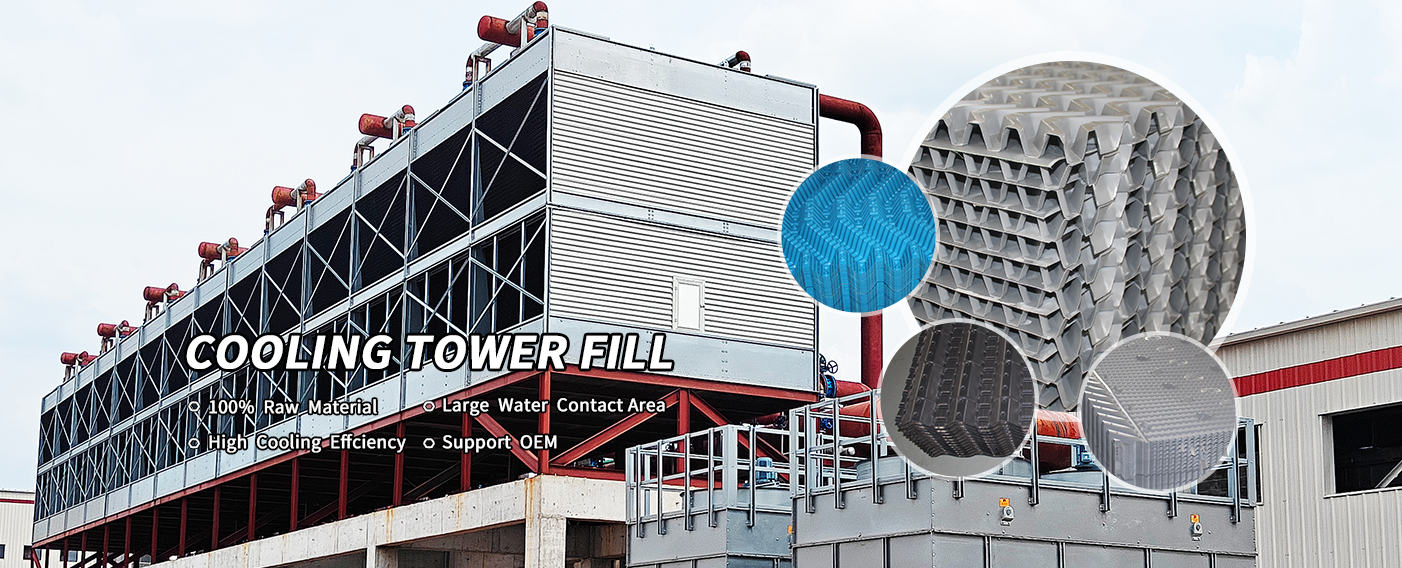
Choosing the right cooling tower fill media sounds simple. After all, isn't fill basically just plastic material installed inside a cooling tower?
Not quite.
The fill is one of the most important heat-transfer components in a wet cooling tower. It controls how water spreads, how long water stays in contact with air, how much heat can be rejected, and how easily the tower can maintain its design performance.
Choose well, and your cooling tower can operate efficiently for years.
Choose poorly, and you may end up with clogging, excessive pressure drop, poor water distribution, higher fan energy consumption, and disappointing cooling performance.
So, how do you choose the right cooling tower fill?
The answer depends on several factors, including tower configuration, water quality, operating temperature, water flow, airflow, thermal requirements, fouling risk, material, and fill dimensions.
This guide walks you through each one in practical terms. It also explains how Power Tower Cooling Technology (Shaoxing) Co., Ltd. can help customers select cooling tower fill for new installations and replacement projects.
What Is Cooling Tower Fill Media?
Cooling tower fill media is the internal heat-transfer material installed inside a wet cooling tower.
Its main job is to increase the contact area between circulating water and moving air.
Imagine pouring a bucket of water onto the floor. The water spreads, but the interaction with air is relatively limited.
Now imagine spreading that same water over hundreds of thin surfaces while air flows through them.
Suddenly, the contact area becomes much larger.
That is essentially what cooling tower fill does.
The hot circulating water is distributed over or through the fill. Air passes through the fill, allowing sensible and evaporative heat transfer to take place. The cooled water then collects in the basin and returns to the process.
SPX Cooling Technologies describes PVC fill as being at the heart of a cooling tower's heat-transfer system, with film fill creating substantial water-air exposure.
Why Does Cooling Tower Fill Matter?
Why spend so much time choosing a piece of plastic?
Because the fill can influence almost every important aspect of cooling tower performance.
A properly selected fill can help provide:
Better heat transfer
More effective water-air contact
Stable cooling performance
Appropriate airflow resistance
Better use of tower volume
Lower fouling risk
Longer service life
More predictable maintenance
On the other hand, unsuitable fill can create problems surprisingly quickly.
For example, fill with passages that are too small for a dirty-water application may become clogged. Once those passages become restricted, water distribution and airflow can suffer.
Likewise, a fill with excellent thermal characteristics may not be suitable if the operating temperature exceeds its material limitations.
The lesson is simple:
The highest-performance fill on paper is not necessarily the best fill for your cooling tower.
How Cooling Tower Fill Media Works
Cooling tower fill works by creating a controlled environment where water and air can interact efficiently.
In a typical wet cooling tower, hot water enters the tower and is distributed across the fill. Air moves through the fill either upward, downward, or horizontally depending on the tower design.
As water travels through the fill, heat transfers from the water to the air.
At the same time, some water evaporates. That evaporation removes a significant amount of heat from the circulating water.
The fill therefore acts like a three-dimensional heat-transfer stage.
The better the water distribution, surface area, airflow, and contact time are balanced, the more effectively the tower can reject heat.
Film Fill vs. Splash Fill
One of the first decisions you will face is choosing between film fill and splash fill.
Film Fill
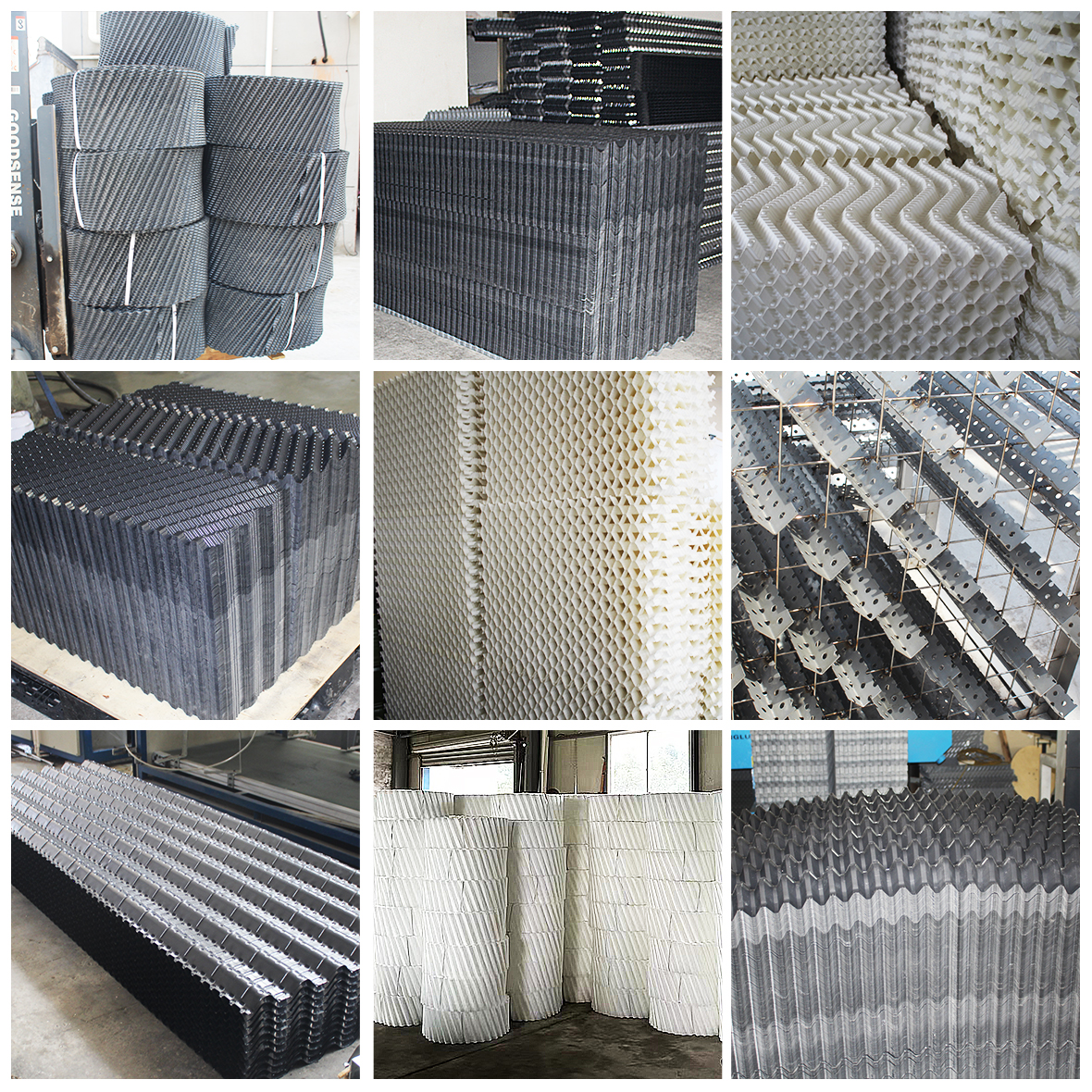
Film fill spreads water into thin films over the surface of structured sheets.
Because the water forms a relatively large wetted surface, film fill can deliver high heat-transfer performance in a compact volume.
This makes it particularly attractive when:
Water quality is well controlled
High thermal performance is important
Space is limited
The tower is designed specifically for film fill
SPX's fill selection guide notes that film fill provides significantly more water-air exposure per cubic foot than splash-type fill.
Splash Fill
Splash fill works differently.
Instead of encouraging water to form a thin film over sheets, splash fill repeatedly breaks falling water into droplets.
The result is a different type of air-water interaction.
Splash fill can be attractive when water contains more suspended solids or when clogging resistance is more important than achieving the highest possible heat-transfer density.
So which is better?
Neither universally wins.
The right answer depends on your water and your tower.
The 8 Factors to Consider Before Choosing Fill
Let's get to the part that really matters.
If you're requesting a quotation for cooling tower fill media, these are the eight factors you should discuss with your supplier.
1. Cooling Tower Type
First, identify the tower configuration.
Is it:
Counterflow?
Crossflow?
Mechanical draft?
Natural draft?
Factory-assembled?
Field-erected?
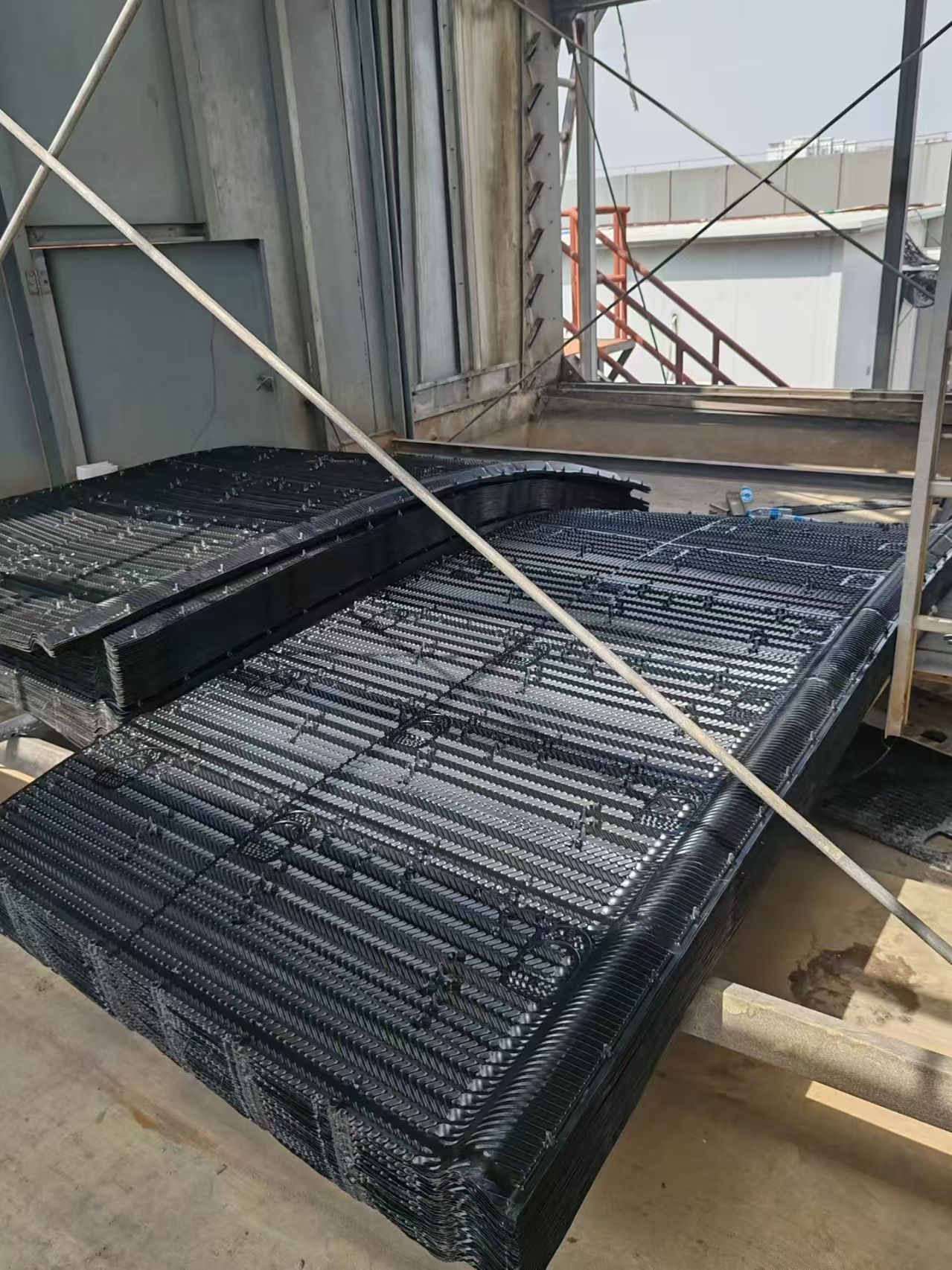
The answer matters because different tower designs use different fill arrangements.
Counterflow Cooling Towers
In a counterflow tower, water generally moves downward while air moves upward.
Structured film fill is commonly used because it can create strong air-water interaction within a relatively compact space.
Crossflow Cooling Towers
In a crossflow tower, air moves horizontally across water flowing downward through the fill.
The fill arrangement must work with the tower's water distribution system and airflow path.
This means you should never order fill based only on its length and width.
Tower configuration comes first.
2. Water Quality
If you remember only one thing from this article, remember this:
Water quality can make or break your fill selection.
Why?
Because cooling tower water can contain:
Suspended solids
Scale-forming minerals
Algae
Biological growth
Oil
Dirt
Sediment
Treatment chemicals
Clean, well-treated water gives you more flexibility.
Dirty or heavily contaminated water demands more attention to fouling resistance.
SPX specifically states that thermal performance and water quality/clog resistance should both be considered when selecting counterflow fill.
Clean Water vs. Dirty Water
For relatively clean water, high-efficiency film fill may be an excellent option.
For water with significant suspended solids or a history of clogging, a more open fill design may make more sense.
This is one reason why there is no universal “best cooling tower fill.”
The best fill is application-specific.
3. Operating Temperature
Temperature is another critical consideration.
Different plastic materials have different temperature capabilities.
Standard PVC is widely used for cooling tower fill because it provides a useful combination of thermal performance, cost, durability, and chemical resistance.
However, higher-temperature applications may require specialized PVC, CPVC, PP, or another material.
For example, EVAPCO's EVAPAK fill is made from PVC and is designed for water temperatures up to a specified range, with higher-temperature fill available for specific applications.
So don't simply tell your supplier:
“I need PVC fill.”
Tell them:
“My normal water temperature is X°C, and the maximum temperature is Y°C.”
That information can completely change the recommendation.
4. Water Flow Rate
Fill must also handle the required water loading.
Water flow is typically expressed in units such as:
Too little fill for the application can create poor distribution and insufficient heat-transfer capacity.
Too much fill may increase cost without delivering proportional benefits.
The goal is to match the fill arrangement to the actual water loading and tower design.
This is particularly important when replacing fill in an older tower.
The tower may have been modified over the years, and its current operating conditions may no longer match the original design.
5. Airflow and Pressure Drop
Here's a common mistake: buyers focus entirely on heat transfer and forget airflow resistance.
Don't do that.
Fill creates resistance to airflow.
If the fill geometry produces excessive pressure drop, the cooling tower fan may need to work harder to move the required amount of air.
That can increase energy consumption.
So when evaluating cooling tower fill media, consider both:
Thermal performance + pressure drop
A fill that looks excellent in a thermal-performance table may not be the right choice if it creates excessive resistance for your existing fan system.
In other words, don't make your fan fight an unnecessary uphill battle.
6. Thermal Performance
Thermal performance is obviously important.
But “high efficiency” should always be interpreted in the context of the application.
A supplier may offer a fill with very high surface area, but that does not automatically mean it will produce the best overall result in your tower.
You need to consider:
Water loading
Airflow
Fill depth
Water temperature
Wet-bulb temperature
Approach temperature
Tower configuration
Water distribution
These variables work together.
The fill is one part of the cooling system—not the entire system.
7. Fouling and Clogging Resistance
Fouling is one of the biggest enemies of cooling tower fill.
Over time, contaminants can accumulate inside the fill passages.
Scale can reduce the available opening.
Algae can form biological deposits.
Sediment can physically block channels.
Once enough material accumulates, both airflow and water movement can be affected.
This is why some applications benefit from more open or anti-fouling fill designs.
For example, engineered vertical-fluted fills are specifically marketed for applications where poor water quality creates a high plugging risk.
The important point is that fouling resistance should be considered before installation, not after the tower starts clogging.
8. Fill Dimensions and Installation
Finally, don't forget the physical fit.
Your supplier needs accurate information about:
Fill length
Fill width
Fill height
Sheet thickness
Block dimensions
Flute configuration
Support spacing
Installation orientation
This becomes particularly important for replacement projects.
You cannot assume that two fills with similar dimensions will perform identically.
The geometry matters.
And installation matters, too.
Incorrect fill orientation can affect water flow, airflow, and heat transfer.
PVC vs. PP Cooling Tower Fill Media
PVC and PP are two materials frequently considered for cooling tower fill.
PVC Cooling Tower Fill
PVC is popular because it offers a practical balance of:
Cost
Thermal performance
Chemical resistance
Availability
Fabrication flexibility
It is commonly used in commercial and industrial cooling towers.
PP Cooling Tower Fill
PP can be attractive when the application requires greater temperature capability or specific chemical-resistance characteristics.
However, PP is not automatically better than PVC.
The correct question is:
Which material matches my operating conditions?
Consider temperature, chemical exposure, water quality, and mechanical requirements before deciding.
For specialized applications, Power Tower Cooling Technology offers different fill-material options and evaluates operating conditions rather than selecting material based solely on price.
When Should You Choose Film Fill?
Film fill is usually a strong candidate when you want high thermal performance and your water quality is suitable for the fill design.
It can be especially useful when tower space is limited because it can provide substantial air-water contact within a relatively compact volume.
Film fill may be appropriate for:
But again, water quality matters.
If your tower has a history of severe clogging, you should discuss fouling-resistant fill designs with your supplier.
When Is Splash Fill a Better Choice?
Splash fill deserves serious consideration when water quality is challenging.
Its larger and more open geometry can be useful where suspended solids or debris create a higher clogging risk.
Splash fill may be considered for:
Industrial cooling systems
Poor-quality water
High suspended solids
Certain process applications
Towers where fouling resistance is a priority
That doesn't mean splash fill is only for dirty water.
It simply means its characteristics may make it a practical choice in applications where clogging resistance deserves extra attention.
How to Choose Fill for Dirty or Poor-Quality Water
Suppose your cooling tower water contains a lot of suspended solids.
Would you still choose the smallest, densest film-fill passages available?
Probably not.
In a dirty-water application, you need to consider the entire operating environment.
Look at:
Suspended solids
Biological activity
Scaling tendency
Oil contamination
Water-treatment quality
Cleaning frequency
Existing clogging history
Then select the fill geometry accordingly.
For some industrial applications, an open splash design may provide a better balance between cooling and maintenance.
For others, a specialized low-fouling film fill may still work.
There is no shortcut here.
Water analysis is often more valuable than guessing.
How to Choose Replacement Cooling Tower Fill
Replacement projects require a slightly different mindset.
You're not designing a tower from scratch.
You're working with an existing structure.
Before ordering replacement fill, inspect the current system.
Check:
Existing fill dimensions
Support structure
Spray nozzles
Distribution pipes
Drift eliminators
Air inlets
Tower casing
Water basin
Also record operating data.
If possible, document:
A recent Power Tower guide similarly recommends considering tower dimensions, heat load, water quality, operating temperature, fouling risk, airflow, fill configuration, and material compatibility when selecting replacement fill.
Why Existing Dimensions Matter
Imagine buying replacement floor tiles without measuring the room.
They might be high quality.
They might even look great.
But if they don't fit, what good are they?
Cooling tower fill works the same way.
Correct fit is part of performance.
Common Mistakes When Selecting Cooling Tower Fill
Let's look at some mistakes that can turn a straightforward replacement into an expensive problem.
Mistake 1: Choosing Only by Price
The cheapest fill may not have the thermal performance, durability, or fouling resistance your tower needs.
Always compare total lifecycle cost.
Mistake 2: Ignoring Water Quality
This is one of the biggest mistakes.
If the water is dirty, fill selection must reflect that.
Mistake 3: Choosing Material Without Checking Temperature
PVC and PP have different characteristics.
Always provide both normal and maximum operating temperatures.
Mistake 4: Ignoring Pressure Drop
High thermal performance means little if airflow resistance becomes excessive.
Mistake 5: Replacing Fill Without Checking Nozzles
A new fill cannot compensate for a badly blocked or damaged distribution system.
Mistake 6: Assuming All Film Fill Is the Same
It isn't.
Different flute patterns, sheet thicknesses, depths, and configurations can produce very different performance characteristics.
Mistake 7: Measuring Only the Tower
Measure the existing fill itself whenever possible.
How Power Tower Helps You Choose the Right Fill
Power Tower Cooling Technology (Shaoxing) Co., Ltd. specializes in cooling tower components and replacement solutions, including cooling tower fill media.
Power Tower Cooling Technology (Shaoxing) Co., Ltd.
The company's approach is particularly useful for replacement projects because the goal is not simply to sell a generic block of fill.
The real goal is to find a fill solution that matches the application.
Power Tower's published guidance recommends considering factors such as tower dimensions, water flow, operating temperature, water quality, fill configuration, and material when selecting replacement fill.
For buyers, that means you can prepare your project information before requesting a quotation.
A useful inquiry should include:
The more information you provide, the easier it becomes to recommend the right solution.
A Practical Cooling Tower Fill Selection Checklist
Before placing an order, run through this checklist.
| Parameter | What to Check |
| Tower type | Crossflow or counterflow |
| Fill type | Film or splash |
| Material | PVC, PP, or other |
| Water temperature | Normal and maximum |
| Water quality | TSS, hardness, scale, biological growth |
| Water flow | m³/h, GPM, etc. |
| Airflow | Fan capacity and air velocity |
| Pressure drop | Acceptable tower resistance |
| Fill dimensions | Length, width, height |
| Flute design | Existing or proposed geometry |
| Fouling risk | Low, medium, or high |
| Installation | Support and orientation |
| Quantity | Total blocks or volume |
| Application | HVAC, industrial, process, power, etc. |
If you can provide this information to your cooling tower fill supplier, you are already ahead of many buyers.
Frequently Asked Questions
What Is the Best Cooling Tower Fill Media?
There is no single best cooling tower fill media for every application.
Film fill is often selected for high thermal performance with properly treated water, while splash fill can be attractive for applications with higher fouling or suspended-solid risks.
The best choice depends on tower design, water quality, temperature, airflow, and required cooling performance.
Is PVC or PP Better for Cooling Tower Fill?
Neither material is universally better.
PVC is widely used because of its balance of cost, thermal performance, and chemical resistance.
PP may be preferred for applications involving higher temperatures or specific chemical conditions.
The operating environment should determine the choice.
How Long Does Cooling Tower Fill Last?
There is no universal service life.
Fill longevity depends on water quality, temperature, chemical exposure, biological growth, scaling, cleaning, airflow, and mechanical condition.
A well-maintained cooling tower can keep its fill effective for many years, while severe fouling or high-temperature operation can shorten its useful life considerably.
The best approach is to inspect actual condition and performance rather than replacing fill simply because it has reached a certain age.
Can Cooling Tower Fill Be Customized?
Yes.
Replacement cooling tower fill can be specified according to dimensions, material, fill geometry, operating temperature, tower configuration, and water-quality conditions.
Customization is particularly useful for older towers where the original fill is discontinued or where standard replacement products do not match the existing installation.
Final Thoughts
Choosing cooling tower fill media is not simply a matter of picking PVC or PP, film or splash, or the lowest-priced product.
It is an engineering decision.
You need to look at the entire picture:
Tower + water + air + temperature + flow + fill geometry + maintenance.
Get those pieces working together, and your cooling tower has a much better chance of delivering stable, efficient performance.
If you are selecting replacement fill, start by collecting your tower model, fill dimensions, water flow, temperatures, water quality, and photographs.
Then talk to a manufacturer that understands the application.
For customized cooling tower fill media and replacement solutions, Power Tower Cooling Technology (Shaoxing) Co., Ltd. is one supplier worth putting on your shortlist. Its published technical guidance emphasizes application-specific factors rather than treating cooling tower fill as a one-size-fits-all product.
In the end, the right cooling tower fill isn't necessarily the one with the most impressive specification sheet.
It's the one that performs reliably in your tower, with your water, under your operating conditions.


