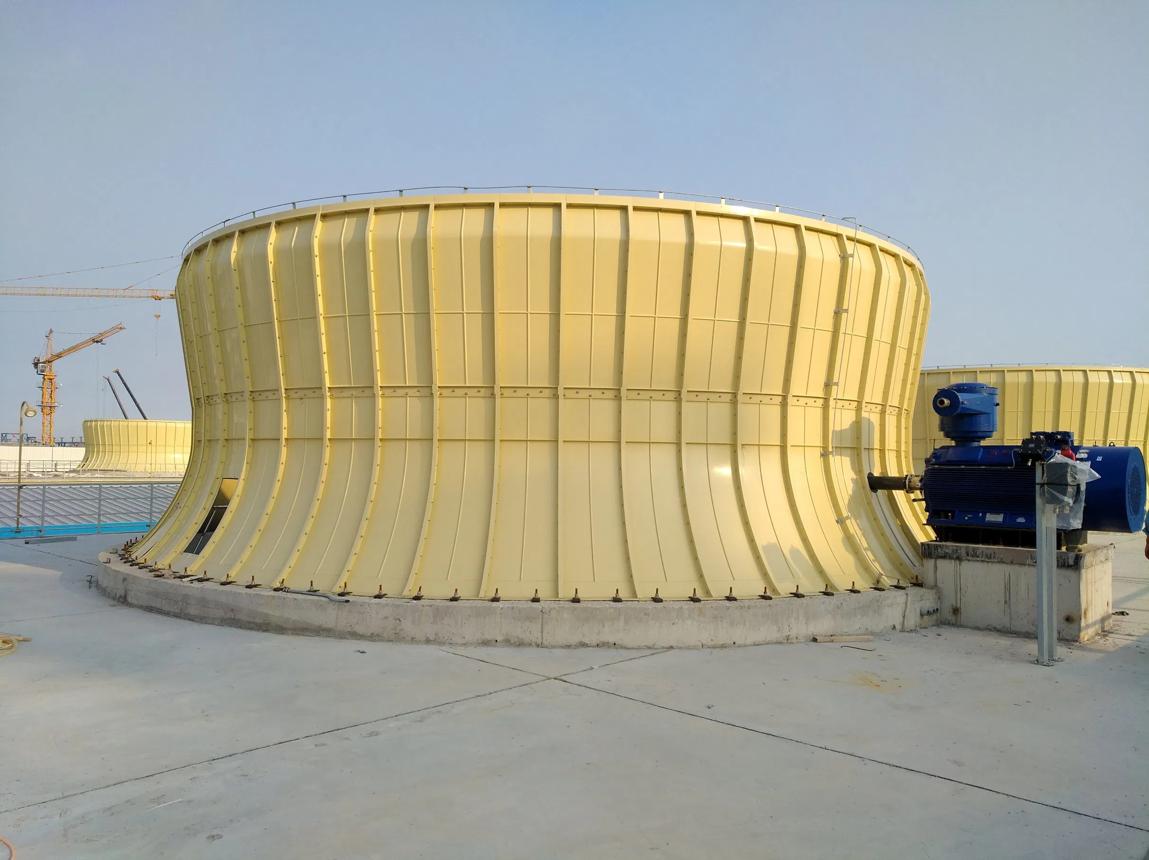
Industrial cooling towers operate in demanding environments where reliable airflow, structural stability, and corrosion resistance are essential. One important component supporting these requirements is the fiberglass cooling tower fan stack, also known as an FRP cooling tower fan cylinder.
For cooling tower manufacturers, maintenance contractors, distributors, and industrial plant operators, standard fan stack dimensions may not always meet project requirements. Different cooling tower models, fan diameters, installation conditions, and replacement requirements often call for customized designs.
A custom fiberglass cooling tower fan stack provides a flexible solution for both OEM manufacturing and aftermarket replacement projects. With customized dimensions, material specifications, flange configurations, and mounting arrangements, FRP fan stacks can be manufactured to match different cooling tower designs.
This article explores custom FRP fan stack manufacturing, OEM and aftermarket applications, material selection, important specifications, and purchasing considerations.
1. What Is a Custom Fiberglass Cooling Tower Fan Stack?
A fiberglass cooling tower fan stack is a cylindrical structure installed around the cooling tower fan. Its primary function is to guide warm exhaust air upward and away from the cooling tower.
FRP (fiberglass reinforced plastic) fan stacks are manufactured using glass fiber reinforcement combined with resin materials. This composite construction provides a combination of lightweight design, structural strength, and corrosion resistance.
Unlike standard products, custom FRP fan stacks are manufactured according to specific project requirements.
Customization may include:
Fan stack inside and outside diameters.
Overall stack height.
Wall thickness and laminate construction.
Flange dimensions and connection designs.
Mounting hole positions.
Resin and fiberglass reinforcement systems.
UV-resistant surface finishes.
Special installation requirements.
These options make customized fan stacks suitable for new cooling tower production and existing equipment replacement.
2. Custom FRP Fan Stacks for OEM Cooling Tower Projects
OEM cooling tower manufacturers require components that match their engineering drawings, production standards, and equipment configurations.
Custom fiberglass fan stacks can be developed to meet these requirements.
Matching OEM Design Specifications
Every cooling tower model may have different fan diameters, stack heights, mounting structures, and airflow requirements.
An experienced FRP manufacturer can produce fan stacks according to OEM drawings, technical specifications, or approved samples.
Consistent Manufacturing Quality
For OEM projects, dimensional consistency is important because fan stacks must fit correctly during tower assembly.
Manufacturers should establish inspection procedures for:
Custom Material Selection
Different industrial environments require different FRP material systems.
Manufacturers can select suitable fiberglass reinforcement and resin systems according to operating temperature, moisture exposure, chemical conditions, and outdoor UV exposure.
For OEM buyers, confirming material specifications before production helps maintain consistent product quality.
3. Custom Fiberglass Fan Stacks for Aftermarket Replacement Projects
Aftermarket replacement projects have different requirements from new OEM production.
Industrial cooling towers may operate for many years, and their original fan stacks can eventually suffer from corrosion, cracking, deformation, or structural deterioration.
A customized FRP replacement fan stack can provide an alternative to replacing the entire cooling tower.
Common aftermarket applications include:
Replacing Corroded Metal Fan Stacks
FRP structures offer corrosion resistance and can replace deteriorated metal fan cylinders when the support structure and design requirements are suitable.
Replacing Damaged Fiberglass Fan Stacks
Old FRP structures may develop cracks, delamination, damaged flanges, or UV-related surface deterioration. Custom manufacturing allows replacement dimensions to match the existing installation.
Cooling Tower Retrofit Projects
When upgrading an existing cooling tower, a custom fan stack can be designed around the available installation space and existing support arrangement.
Replacement for Different Cooling Tower Brands
Aftermarket suppliers may manufacture replacement fan stacks compatible with different cooling tower configurations. Compatibility should be verified through drawings, measurements, and technical evaluation rather than brand names alone.
4. Important Specifications for Custom FRP Fan Stack Manufacturing
Before requesting a quotation, buyers should prepare the necessary technical information.
| Specification | Description |
| Material | FRP / fiberglass reinforced plastic |
| Inside diameter | Internal fan stack diameter |
| Outside diameter | Overall external diameter |
| Stack height | Total cylinder height |
| Wall thickness | Required laminate thickness |
| Resin system | Polyester, vinyl ester, or other suitable resin |
| Fiberglass reinforcement | Reinforcement type and laminate design |
| Flange design | Top and bottom connection details |
| Mounting holes | Hole diameter, quantity, and spacing |
| Surface protection | UV-resistant finish where required |
| Fan clearance | Required blade-tip clearance |
Accurate measurements are essential. Buyers should provide technical drawings whenever possible.
The fan stack should also be evaluated for wind loads, vibration, support conditions, and other project-specific structural requirements.
5. Advantages of Customized Fiberglass Cooling Tower Fan Stacks
Corrosion Resistance
FRP materials resist moisture and many industrial chemicals, making them suitable for cooling tower environments.
Lightweight Construction
Fiberglass structures generally weigh less than comparable traditional metal structures. This can simplify transportation, lifting, and installation.
Flexible Dimensions
Custom manufacturing supports different fan diameters, stack heights, wall thicknesses, and mounting configurations.
Reduced Maintenance Requirements
FRP does not experience conventional metal rusting, helping reduce corrosion-related maintenance.
Suitable for Industrial Retrofit Projects
Customized fan stacks can be designed to fit existing cooling tower structures, helping avoid unnecessary equipment replacement.
6. Custom Fiberglass Fan Stack Manufacturing Process
A professional manufacturing process helps ensure that the finished product meets project requirements.
Step 1: Technical Drawing Review
The manufacturer reviews customer drawings, dimensions, installation requirements, and operating conditions.
Step 2: Engineering and Design
The engineering team determines the fan stack geometry, laminate construction, flange design, and structural requirements.
Step 3: Mold Preparation
Suitable production molds are prepared according to the specified dimensions.
Step 4: Fiberglass and Resin Application
Fiberglass reinforcement and the selected resin system are combined to produce the composite structure.
Step 5: Curing and Finishing
The fan stack is cured, trimmed, and finished according to the manufacturing process.
Step 6: Quality Inspection
The finished product undergoes dimensional, visual, and other specified quality checks.
Step 7: Packaging and Delivery
The product is protected for transportation and prepared for domestic or international shipment.
7. How to Choose a Custom FRP Fan Stack Manufacturer
Selecting the right manufacturer is important for OEM and aftermarket projects.
Consider these factors before placing an order:
Manufacturing experience: Choose a supplier with experience in industrial FRP and cooling tower components.
Customization capability: Confirm that the manufacturer can produce non-standard diameters, heights, and flange designs.
Material knowledge: Ask about fiberglass reinforcement, resin selection, and UV protection.
Engineering support: Check whether technical drawing review and design assistance are available.
Quality control: Request dimensional inspection records and product photographs.
Export capability: For international projects, confirm packaging, documentation, and shipping arrangements.
A reliable manufacturer should understand both new equipment production and replacement requirements.
8. What Affects the Price of Custom Fiberglass Fan Stacks?
Custom FRP fan stack prices depend on several factors:
| Cost Factor | Effect on Price |
| Diameter and height | Larger structures generally require more materials |
| Wall thickness | Thicker laminate construction increases material usage |
| Resin selection | Specialized resin systems may increase costs |
| Custom tooling | Special dimensions may require additional tooling |
| Flange configuration | Complex connections increase manufacturing work |
| Order quantity | Larger orders may reduce unit costs |
| Packaging and shipping | Export requirements affect total purchasing costs |
When comparing suppliers, consider the complete specification rather than choosing the lowest quotation.
9. Why Source Custom Fiberglass Fan Stacks from Power Tower Cooling Technology (Shaoxing) Co.,Ltd?
Power Tower Cooling Technology supplies cooling tower replacement components and customized solutions for industrial maintenance, repair, and retrofit applications.
Our custom fiberglass cooling tower fan stack solutions are intended for:
OEM cooling tower manufacturers.
Industrial cooling tower contractors.
Aftermarket replacement distributors.
EPC engineering companies.
Industrial maintenance and renovation projects.
Buyers can provide existing fan stack drawings, measurements, photographs, or samples for technical evaluation.
Whether you need a custom FRP fan stack for new cooling tower production or a replacement structure for an existing industrial tower, selecting the correct dimensions and material specifications is essential.
Contact Power Tower Cooling Technology with your fan diameter, stack height, flange dimensions, and project requirements to request a customized quotation.
10. Conclusion
Custom fiberglass cooling tower fan stacks provide flexible solutions for OEM manufacturing and aftermarket replacement projects.
With customized dimensions, corrosion-resistant materials, lightweight construction, and adaptable mounting configurations, FRP fan stacks are suitable for a wide range of industrial cooling tower applications.
Successful purchasing depends on accurate technical drawings, appropriate material selection, reliable manufacturing quality, and proper installation.
Working with an experienced custom FRP fan stack manufacturer helps OEM buyers and industrial contractors obtain replacement components that meet their specific project requirements.
Frequently Asked Questions (FAQs)
1. Can fiberglass cooling tower fan stacks be customized?
Yes. Manufacturers can customize diameter, height, wall thickness, flange dimensions, mounting holes, and material specifications according to project requirements.
2. Are custom FRP fan stacks suitable for aftermarket replacement?
Yes. Custom FRP fan stacks can replace existing metal or fiberglass structures after checking dimensions, structural conditions, fan clearance, and mounting compatibility.
3. What information is needed for a custom fan stack quotation?
Provide inside diameter, outside diameter, stack height, wall thickness, flange details, mounting hole positions, material requirements, and technical drawings if available.
4. What materials are used in FRP cooling tower fan stacks?
Common construction materials include glass fiber reinforcement and polyester or vinyl ester resin systems. The appropriate material depends on operating conditions and project specifications.
5. Can custom FRP fan stacks replace OEM cooling tower components?
Yes. Replacement fan stacks can be manufactured to match existing equipment dimensions and installation arrangements, subject to engineering verification.
6. Are fiberglass fan stacks better than metal fan stacks?
FRP fan stacks offer advantages in corrosion resistance and weight. The best material depends on structural requirements, operating conditions, project costs, and maintenance expectations.
Recommended internal links for CoolingTowerPart.com:


