When choosing cooling tower fill, one question comes up again and again: Which type of cooling tower fill is best for my application?
It sounds simple, but there is no single answer.
A cooling tower operating with clean, well-treated water may perform extremely well with high-efficiency film fill. On the other hand, a tower handling dirty process water, suspended solids, or heavy fouling may need splash fill instead. Choosing the wrong type can lead to clogging, poor heat transfer, higher maintenance costs, and shorter service life.
That is why understanding different cooling tower fills types is so important.
In this guide, we will compare film fill, splash fill, hybrid options, PVC fill, PP fill, and different cooling tower configurations. More importantly, we will explain how to choose the right fill based on water quality, temperature, cooling duty, maintenance requirements, and tower design.
So, let's get started.
What Is Cooling Tower Fill?
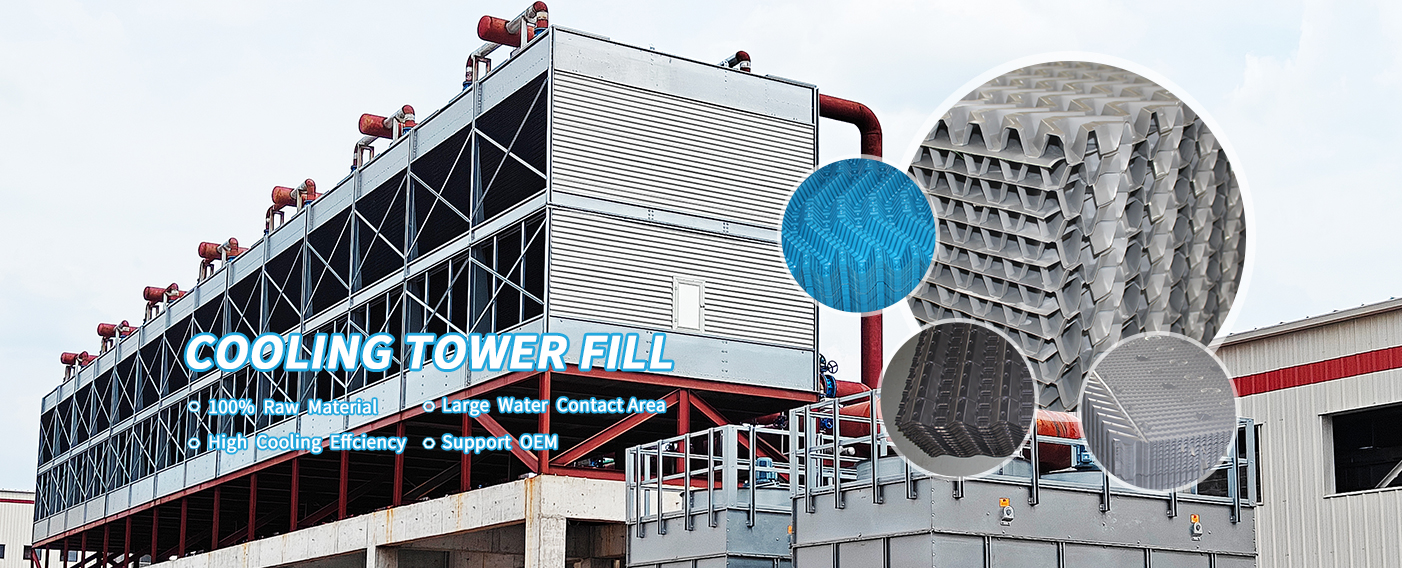
Cooling tower fill, also called cooling tower packing or cooling tower fill media, is the internal material installed inside a wet cooling tower.
Its main job is to increase the contact area between hot circulating water and air.
Hot water enters the tower through a distribution system and flows through the fill. At the same time, air moves through the tower. The fill slows, spreads, breaks, or redirects the water so that more water can interact with the air.
This improves evaporation and heat transfer.
In simple terms, cooling tower fill creates more opportunities for hot water and air to exchange heat.
Without properly designed fill, a cooling tower would need much more space to achieve the same cooling effect.
How Does Cooling Tower Fill Work?
There are two basic approaches.
Film fill spreads water across specially shaped sheets, creating a thin layer of water over a large surface area.
Splash fill takes a different approach. It repeatedly breaks falling water into smaller droplets as the water hits bars, grids, or other structures.
Both methods have the same goal: maximize effective air-water contact.
However, they achieve that goal differently. This difference is the reason why choosing between film fill and splash fill matters so much.
Why Does Cooling Tower Fill Type Matter?
Think of cooling tower fill as the engine room inside the tower.
The tower shell, fan, basin, and piping are all important, but the fill is where a large part of the actual air-water heat exchange takes place.
A good fill selection can help provide:
Better heat-transfer performance
More compact tower design
Stable cooling capacity
Lower maintenance requirements
Better resistance to fouling
Longer service life
Lower total operating cost
But high thermal efficiency alone does not make a fill suitable.
A fill that performs extremely well with clean water may become heavily clogged when exposed to suspended solids or biological growth.
So the real question is not:
“Which cooling tower fill has the highest efficiency?”
The better question is:
“Which cooling tower fill provides the best balance of efficiency, reliability, maintenance, and durability for my operating conditions?”
Current industry guidance similarly emphasizes that fill selection should consider water quality, operating temperature, cooling duty, airflow, and maintenance—not efficiency alone.
Main Cooling Tower Fills Types
Most wet cooling towers use one of two major fill categories:
Film fill
Splash fill
There are also specialized and hybrid designs intended to balance thermal performance and fouling resistance.
Let's look at each type.
Film Fill
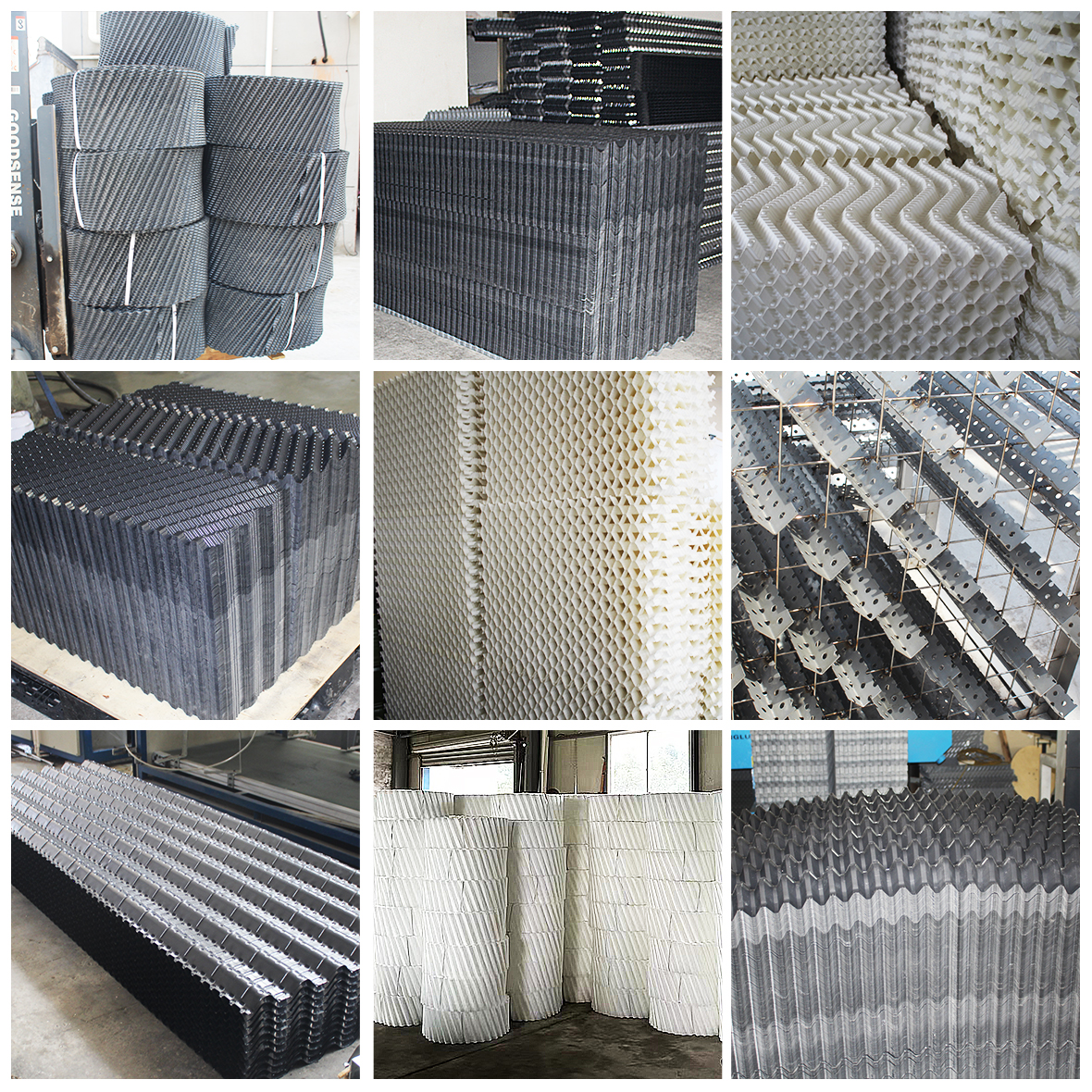
Film fill is one of the most widely used cooling tower fill types.
It consists of thin sheets, usually formed from PVC or PP, with corrugated or specially engineered surfaces.
Water flows over the sheets and spreads into a thin film. Air passes through the channels between the sheets.
Because the water is spread over a large surface area, film fill can provide excellent heat-transfer performance in a relatively compact volume.
Advantages of Film Fill
The biggest advantage of film fill is its high effective surface area.
A properly designed film fill can provide:
High heat-transfer efficiency
Compact installation
Large water-air contact area
Efficient use of tower volume
Good performance with properly treated water
Suitability for many HVAC and industrial applications
This makes film fill particularly attractive when the project has limited space or requires high cooling efficiency.
For clean and properly treated water, film fill can be an excellent choice.
Limitations of Film Fill
Film fill also has an important weakness: fouling.
The channels between the sheets can be relatively narrow. If the circulating water contains excessive suspended solids, scale-forming minerals, algae, biological deposits, or other contaminants, those passages can gradually become blocked.
Once fouling begins, several problems can follow:
Reduced airflow
Poor water distribution
Lower heat-transfer efficiency
Increased pressure drop
Higher cleaning requirements
Shorter fill service life
In other words, film fill works beautifully when the water quality supports it. If water treatment is poor, its high-surface-area structure can become a disadvantage.
Splash Fill
Splash fill uses a completely different cooling principle.
Instead of spreading water into a thin film, splash fill causes falling water to break into droplets repeatedly.
The fill may consist of bars, grids, blocks, or other open structures.
As water hits the fill, it changes direction and breaks into smaller droplets. These droplets then interact with the moving air.
Advantages of Splash Fill
The open structure of splash fill gives it an important advantage: fouling resistance.
Because the passages are generally more open than those of high-density film fill, splash fill can be more tolerant of suspended solids and difficult water conditions.
Typical advantages include:
Good resistance to clogging
Better tolerance of suspended solids
Suitable for difficult industrial water
Easier inspection
Relatively easy cleaning
Good structural durability
For industrial applications where water quality is inconsistent, splash fill can sometimes provide better long-term reliability than a highly compact film-fill design.
Limitations of Splash Fill
Splash fill is not automatically better.
Its open structure generally provides less effective surface area per unit volume than high-performance film fill.
As a result, achieving the same cooling duty may require more fill volume or a larger tower.
That means splash fill can involve a trade-off:
Lower thermal efficiency per unit volume in exchange for greater fouling resistance and durability.
For dirty industrial water, that trade-off can be worthwhile.
Hybrid and Specialized Cooling Tower Fill
Between conventional film fill and splash fill, there are specialized designs intended to provide a balance between efficiency and fouling resistance.
Examples include:
These products can be useful when the water is not perfectly clean but the project still requires relatively high thermal performance.
A hybrid approach may be especially attractive when the operating conditions fall somewhere between the typical film-fill and splash-fill applications.
Cooling Tower Fill Types by Material
Fill type and fill material are not the same thing.
For example, film fill can be made from PVC or PP. Splash fill can also use polypropylene and other engineered plastics.
The most common materials include:
Material selection should consider operating temperature, chemical exposure, mechanical stress, expected service life, and cost.
PVC Cooling Tower Fill
PVC is one of the most common materials used for cooling tower film fill.
Why?
Because it offers a practical balance of:
Cost
Weight
Thermal performance
Corrosion resistance
Processability
Availability
PVC film fill is widely used in HVAC systems and many general industrial cooling applications.
However, PVC is not suitable for every application.
If the cooling water operates at elevated temperatures or contains aggressive chemicals, the material compatibility must be evaluated carefully before selection.
PP Cooling Tower Fill
Polypropylene, commonly known as PP, is another important cooling tower fill material.
PP can be attractive for demanding industrial applications because of its temperature and chemical-resistance characteristics.
It can be manufactured into both film-fill and splash-fill designs.
PP is therefore worth considering when the operating environment is more demanding than a conventional HVAC cooling tower.
However, PP should not simply be chosen because it sounds “stronger.” The correct material still depends on the actual water temperature and chemical environment.

Film Fill vs Splash Fill: Which Is Better?
This is probably the most important comparison when discussing cooling tower fills types.
There is no universal winner.
| Factor | Film Fill | Splash Fill |
| Thermal efficiency | High | Moderate to high |
| Surface area | Very high | Moderate |
| Fouling resistance | Lower | Higher |
| Suspended solids tolerance | Lower | Higher |
| Water quality requirement | Better water quality preferred | More tolerant |
| Tower compactness | Excellent | Generally lower |
| Cleaning | Can be more difficult | Generally easier |
| Typical application | HVAC and clean industrial water | Difficult industrial water |
If your water is clean and well treated, film fill is often the logical starting point.
If your water contains significant suspended solids or has a history of severe fouling, splash fill deserves serious consideration.
The correct decision should ultimately be based on thermal calculations and actual operating conditions.
Counterflow vs Crossflow Cooling Tower Fill
Tower configuration is another important consideration.
In a counterflow cooling tower, water generally moves downward while air travels upward through the fill.
In a crossflow cooling tower, air moves horizontally across the falling water.
Because airflow and water-flow patterns differ, fill geometry and installation requirements can also differ.
When replacing existing fill, never select a product based only on its material or appearance.
You should confirm:
Tower type
Fill dimensions
Fill height
Block arrangement
Flute direction
Sheet spacing
Water loading
Airflow requirements
Support structure
The replacement fill needs to work with the original tower's hydraulic and airflow design.
How Water Quality Affects Cooling Tower Fill Selection
Water quality can make or break your fill selection.
Imagine using a fine kitchen strainer to filter muddy water. The strainer may work perfectly with clean water, but it will clog quickly when exposed to heavy debris.
Film fill can face a similar challenge.
Important water-quality factors include:
Suspended solids
Hardness
Scaling tendency
Biological growth
Algae
Oil contamination
Dissolved solids
Chemical exposure
pH
For clean, well-treated water, film fill can deliver excellent performance.
For dirty or highly contaminated water, an open splash design may be more reliable.
Industry guidance consistently identifies water quality as one of the most important factors in deciding between film and splash fill.
How to Choose the Right Cooling Tower Fill Type
So how do you actually make the decision?
Start with the application—not the product catalog.
Step 1: Check Your Water Quality
First, understand the water going through the tower.
If your system has clean water and an effective treatment program, high-efficiency film fill may be appropriate.
If you regularly experience:
High suspended solids
Scale
Algae
Biological fouling
Process contamination
then splash fill or a wider-channel fill may be a better option.
Step 2: Check Operating Temperature
Temperature affects material selection.
PVC is widely used for conventional applications, while PP may be considered for higher-temperature or more demanding industrial conditions.
Never select the material based only on a general temperature assumption.
Check the actual entering-water temperature and the manufacturer's recommended operating range.
Step 3: Check Cooling Duty
Next, determine what the cooling tower needs to accomplish.
Important parameters include:
A fill that looks impressive on a product sheet still needs to deliver the required thermal performance in your specific tower.
Step 4: Consider Maintenance Requirements
Ask yourself a practical question:
How much time and money can your team spend cleaning the fill?
If frequent cleaning is difficult because of production schedules or limited maintenance resources, fouling resistance may deserve more weight in the decision.
The theoretically highest-performing fill is not always the most economical option over ten years.
Step 5: Confirm Fill Dimensions
For replacement projects, measurement is critical.
Before ordering, confirm:
Length
Width
Height
Fill block dimensions
Sheet thickness
Flute configuration
Spacing
Support dimensions
Installation direction
A high-quality fill that does not fit your tower is still the wrong product.
Common Cooling Tower Fill Problems
Even the correct fill can eventually develop problems.
The most common issues include:
The key is to find the root cause.
If film fill repeatedly becomes clogged, simply replacing it with identical fill may not solve the underlying problem.
The water-treatment system may need improvement.
Clogging and Scaling
Clogging is particularly common in film fill when water quality is poorly controlled.
Mineral deposits can build up on the fill surface. Suspended solids can accumulate inside the channels. Biological growth can further reduce the available passage area.
The result?
Less airflow, poorer water distribution, and reduced cooling performance.
Regular inspection and appropriate water treatment are therefore essential.
Cracking and Deformation
Fill can also suffer from physical damage.
Excessive temperature, unsuitable chemicals, improper installation, aging, or rough maintenance can cause fill sheets or blocks to crack, sag, or deform.
Once the geometry changes, water and air may no longer move through the fill as designed.
Minor localized damage may be manageable, but widespread deformation usually means replacement should be considered.
When Should Cooling Tower Fill Be Replaced?
There is no universal replacement interval for every cooling tower.
Fill service life depends on:
Water quality
Operating temperature
Chemical exposure
Cleaning frequency
UV exposure
Mechanical stress
Installation quality
Material quality
Instead of replacing fill simply because it has reached a certain age, monitor its actual condition and cooling performance.
Signs that replacement may be necessary include:
If cleaning no longer returns the system to acceptable performance, replacing the fill may be more economical than continuing to repair it.
How to Reduce Cooling Tower Fill Maintenance Costs
The cheapest fill is not necessarily the lowest-cost fill.
A better approach is to calculate total lifecycle cost.
Consider:
Purchase price + installation + cleaning + water treatment + downtime + energy + replacement cost
For example, spending less on the original fill may seem attractive. But if that fill clogs frequently and requires repeated cleaning, the apparent saving can disappear quickly.
Good water treatment is one of the best ways to protect fill.
Regularly inspect:
Fill condition
Spray nozzles
Water distribution
Basin
Air inlets
Fans
Drift eliminators
Keeping the entire cooling tower system healthy helps the fill perform as intended.
Why Choose Power Tower Cooling Technology?
Choosing the right cooling tower fill is easier when you work with a manufacturer that understands different tower configurations and operating conditions.
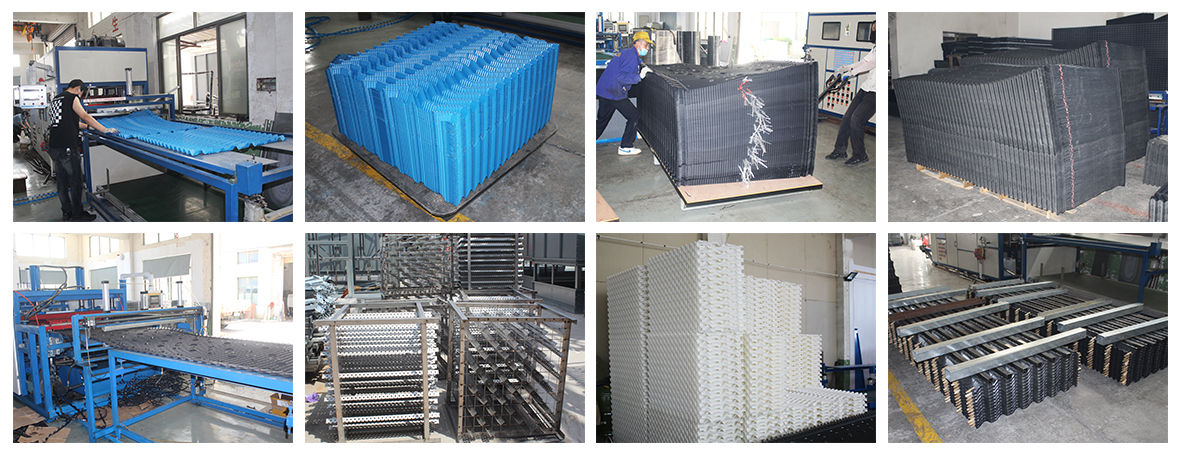
Power Tower Cooling Technology (Shaoxing) Co., Ltd. specializes in cooling tower fill and related cooling tower components, serving customers who need replacement fill and cooling solutions for different applications.
Power Tower Cooling Technology (Shaoxing) Co., Ltd.

For a replacement project, a good supplier should not simply ask, “How many pieces do you need?”
The supplier should also understand:
That application-based approach can help customers avoid buying fill that looks suitable but performs poorly after installation.
Frequently Asked Questions About Cooling Tower Fills Types
What Is the Most Efficient Cooling Tower Fill?
Film fill is generally associated with high heat-transfer efficiency because it creates a large effective contact area between water and air.
However, the most efficient fill for your application depends on water quality, airflow, water loading, tower design, and required cooling duty.
A high-efficiency film fill that becomes heavily fouled may perform worse in practice than a more open splash fill.
Is PVC or PP Cooling Tower Fill Better?
Neither material is universally better.
PVC is widely used because it provides a good balance of cost and performance for many standard cooling applications.
PP can be attractive for higher-temperature or more demanding industrial applications.
The final choice should be based on actual operating temperature, water chemistry, and manufacturer recommendations.
Is Splash Fill Better for Dirty Water?
In many cases, yes.
Splash fill has a relatively open structure and is generally more tolerant of suspended solids and fouling than closely spaced film fill.
That makes it a strong candidate for industrial cooling systems where water quality is difficult to control.
How Long Does Cooling Tower Fill Last?
There is no fixed lifespan that applies to every installation.
Properly treated water, suitable operating temperatures, regular inspection, and correct maintenance can significantly improve fill service life.
Severe fouling, chemical exposure, high temperatures, and physical damage can shorten it.
Can I Replace Cooling Tower Fill Without Replacing the Whole Tower?
Yes, in many cases.
Cooling tower fill is a replaceable internal component, so an aging or damaged fill system does not automatically mean the entire tower needs replacement.
However, the new fill must be correctly matched to the existing tower design, dimensions, water distribution system, and thermal requirements.
Final Thoughts: Which Cooling Tower Fill Type Is Best?
When comparing cooling tower fills types, it is tempting to search for one universal winner.
There isn't one.
Film fill is often the better choice when high thermal efficiency, compact design, and good water quality are the priorities.
Splash fill can be a better choice when the system handles suspended solids, dirty water, severe fouling, or difficult industrial conditions.
PVC fill is widely used for conventional cooling applications because of its balance of cost and performance.
PP fill can be considered when higher temperature resistance or more demanding chemical conditions are involved.
The smartest approach is to look at the complete picture.
Check your water quality. Review the operating temperature. Calculate the cooling duty. Understand your tower configuration. Consider maintenance. Measure the existing fill if you are planning a replacement.
Then choose the fill type that provides the best combination of thermal performance, fouling resistance, durability, maintenance, and total lifecycle cost.
In other words, don't simply ask, “Which cooling tower fill is the best?”
Ask:
“Which cooling tower fill is the best for my application?”
That is the question that leads to a better cooling tower—and a better long-term investment.


