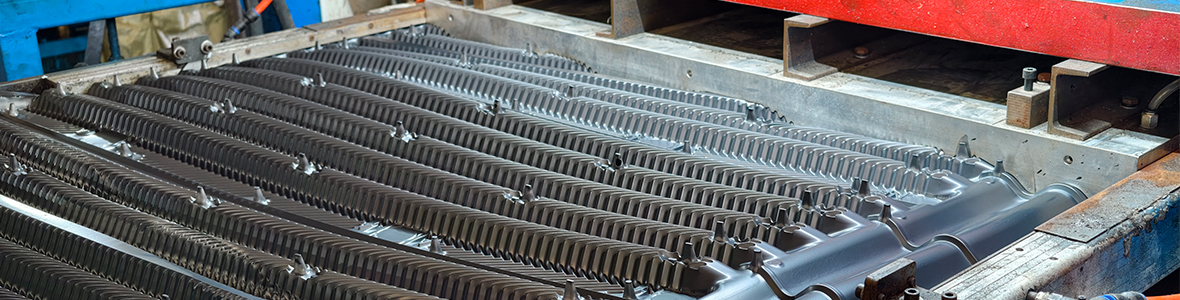
If you are buying cooling tower fill, you already know that this seemingly simple component can have a surprisingly large impact on cooling tower performance.
Tower fill is where hot circulating water meets moving air. Its geometry, material, surface area, spacing, and resistance to fouling all influence how efficiently heat can be rejected from the water. But with so many tower fill manufacturers and suppliers available around the world, how do you know which supplier is suitable for your project?
This guide introduces five notable companies in the tower fill market:
Power Tower Cooling Technology (Shaoxing) Co., Ltd.
Brentwood Industries
SPX Cooling Technologies / Marley
Baltimore Aircoil Company (BAC)
EVAPCO
This is an editorial buyer's guide rather than an official global ranking by revenue or market share. Each company has different products, technologies, application experience, and replacement capabilities.
Before choosing a supplier, however, it is worth understanding what tower fill actually does and which factors determine whether a particular fill will work well in your cooling tower.
What Is Tower Fill?
Tower fill, also called cooling tower fill, cooling tower packing, or fill media, is the heat-transfer material installed inside a wet cooling tower.
Its basic purpose is straightforward: increase the contact between water and air.
Hot process water enters the cooling tower and is distributed over the fill. At the same time, air moves through the fill. Depending on the type of fill, the water either spreads into thin films across specially shaped surfaces or breaks into droplets as it moves through splash media.
This creates a much larger effective contact area than a simple stream of falling water could provide.
Think of tower fill as the "working stage" inside the cooling tower. The fan moves air, the pump moves water, and the fill creates the environment where efficient heat and mass transfer can occur.
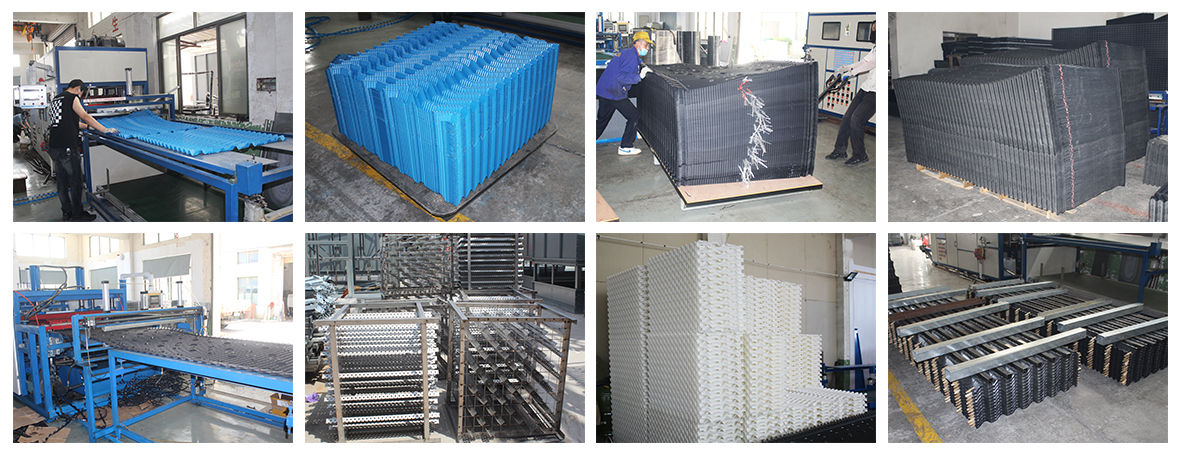
Why Does Tower Fill Matter?
Imagine pouring one bucket of hot water into a swimming pool. The water will eventually cool, but the process is relatively slow.
Now imagine spreading that same water into thousands of thin layers while air flows across the surface.
The cooling process becomes much more effective.
That is essentially what tower fill accomplishes.
Well-designed fill can:
Increase effective heat-transfer area
Improve water-air contact
Support more uniform water distribution
Promote evaporation
Improve cooling tower thermal performance
Help reduce the required tower footprint
Support efficient operation under the design conditions
However, there is an important catch.
More surface area does not automatically mean better performance.
If a tower operates with poor water quality, high suspended solids, biological growth, or heavy scaling, a tightly spaced film fill can become clogged. Once the passages become restricted, airflow and water distribution can suffer.
Therefore, the best tower fill is not necessarily the fill with the highest theoretical performance.
It is the fill that provides an appropriate balance between thermal performance, fouling resistance, pressure drop, durability, cost, and service life.
Film Fill vs. Splash Fill
The two major tower fill categories are film fill and splash fill.
Film Fill
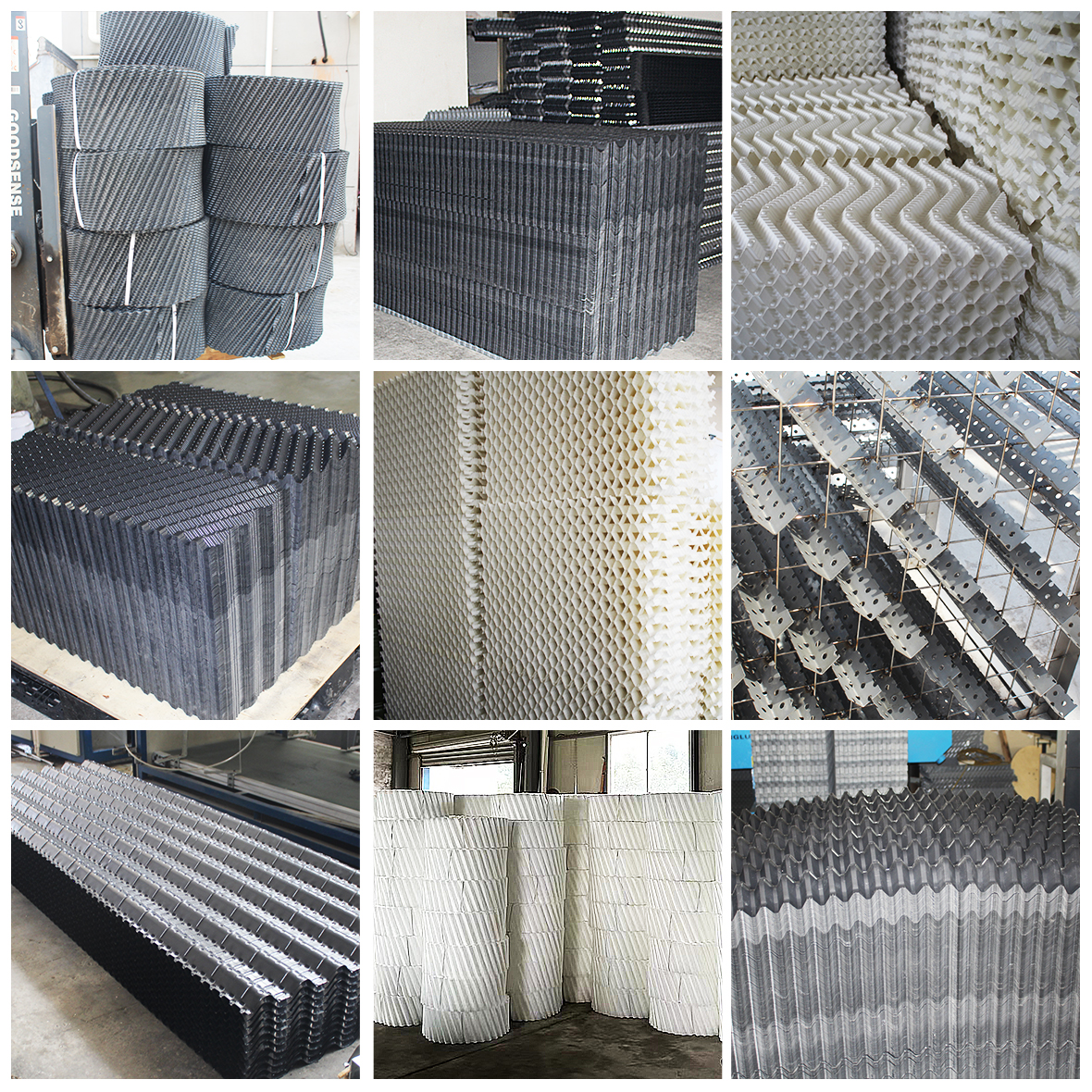
Film fill uses sheets with specially formed surfaces to spread water into thin films.
PVC is one of the most common materials used for film fill because it offers a practical combination of cost, durability, weight, and manufacturing flexibility.
Film fill can provide a large effective surface area in a relatively compact volume, making it widely used in many industrial and commercial cooling tower applications.
Splash Fill
Splash fill works differently.
Instead of maintaining a continuous water film, splash fill repeatedly breaks falling water into smaller droplets. The resulting droplets provide water-air contact for heat and mass transfer.
Splash fill often has more open passages than tightly spaced film fill, making certain splash configurations suitable for applications where suspended solids or fouling are concerns.
So which one is better?
There is no universal answer.
The correct choice depends on water quality, tower configuration, thermal requirements, airflow, operating conditions, maintenance practices, and the specific fill design.
How to Evaluate Tower Fill Manufacturers
Before looking at individual suppliers, it helps to understand what separates a capable tower fill manufacturer from a simple reseller.
A reliable supplier should be able to discuss more than price.
Consider these factors:
Material quality
Fill geometry
Thermal performance
Fouling resistance
Dimensional accuracy
Manufacturing capability
Customization
Replacement experience
Packaging
Delivery capability
Technical support
After-sales service
A professional manufacturer should also ask questions about your cooling tower.
What type of tower do you have?
What are the existing fill dimensions?
What is the circulating water flow?
What are the hot-water and cold-water temperatures?
How clean is the circulating water?
What type of water distribution system is installed?
These questions matter because tower fill is not a universal plastic component.
It is part of a larger thermal system.
Material Quality
Material selection is one of the first things industrial buyers should examine.
PVC is widely used in conventional cooling tower fill applications because it offers good manufacturability, relatively low weight, chemical resistance, and cost effectiveness.
PP, or polypropylene, may be considered for applications where higher temperature capability or specific chemical-resistance characteristics are required.
But material selection should always be based on the actual operating environment.
Important considerations include:
The cheapest material is not necessarily the most economical option if it results in premature replacement.
Thermal Performance
Tower fill performance depends heavily on its geometry.
Flute shape, spacing, fill depth, sheet thickness, orientation, water distribution, and airflow all influence heat transfer.
For example, structured film fill uses its corrugated surface to spread water and increase contact with air.
The challenge is finding the right balance.
If passages are extremely narrow, the available surface area may be high, but fouling can become a serious issue.
If passages are too open, fouling resistance may improve, but the required heat-transfer volume could increase.
This is why experienced tower fill manufacturers offer different designs rather than trying to sell one product for every application.
Fouling and Clogging Resistance
For many industrial cooling towers, fouling is one of the most important considerations.
Water may contain:
Suspended solids
Biological organisms
Algae
Scale-forming minerals
Process contaminants
Oil
Dirt and debris
Over time, these materials can accumulate on or inside the fill.
A clogged fill can restrict water flow and airflow while reducing effective heat-transfer area.
That is why buyers should consider water quality before selecting fill geometry.
A highly efficient film fill may work very well with properly treated water, while an open splash-fill design may be more appropriate for a heavily contaminated water source.
The question is not simply:
"Which fill has the highest cooling performance?"
The better question is:
"Which fill can maintain useful cooling performance under my actual operating conditions?"
Top 5 Tower Fill Manufacturers and Suppliers
The following five companies represent different approaches to tower fill manufacturing and supply.
They should not be viewed as an official worldwide ranking. Instead, this list provides industrial buyers with several established options to research when sourcing tower fill or replacement fill.
1. Power Tower Cooling Technology (Shaoxing) Co., Ltd.

Power Tower Cooling Technology (Shaoxing) Co., Ltd. focuses on cooling tower components and replacement solutions, including cooling tower fill, PVC fill, PP fill, film fill, splash fill, and customized replacement products.
For buyers who need replacement or retrofit fill, this type of specialized product focus can be particularly useful.
A replacement project is rarely as simple as removing the old fill and installing a standard-size product.
Existing cooling towers can have different dimensions, support arrangements, water distribution systems, and fill configurations.
That is where customization becomes important.

Power Tower Tower Fill Products
Power Tower can provide different types of cooling tower fill for industrial applications, including:
The actual product should be selected according to the cooling tower configuration and operating conditions.
For example, a buyer searching for "tower fill" may ultimately need a very specific product such as PVC crossflow film fill or PP counterflow fill.
Using the exact tower information helps the manufacturer identify the appropriate solution.
Why Consider Power Tower?
One of the main considerations for replacement buyers is customization.
A supplier may need to work from:
This approach is particularly useful when the original fill is damaged, discontinued, difficult to source, or no longer available from the original supplier.
For product information and tower fill solutions, visit Power Tower Cooling Technology (Shaoxing) Co., Ltd..
2. Brentwood Industries
Brentwood Industries is another established supplier of cooling tower fill and related components.
Its cooling tower portfolio includes different film-fill configurations designed for different thermal and fouling requirements.
The company's product range demonstrates an important point for buyers: tower fill geometry matters.
Different applications may require different flute configurations, surface structures, or passage arrangements.
Brentwood Tower Fill Technology
Brentwood offers several film-fill designs, including configurations based on cross-fluted, herringbone, offset-fluted, and vertical-fluted structures.
These designs can influence water distribution, air movement, heat-transfer performance, and fouling resistance.
For an industrial buyer, the advantage of having multiple configurations is flexibility.
Instead of forcing every project into one standard fill, the supplier can match the fill design more closely to the application.
Brentwood is therefore a company worth researching when a project requires engineered fill selection rather than a simple commodity purchase.
3. SPX Cooling Technologies / Marley

SPX Cooling Technologies, through its Marley brand, is a major name in cooling tower technology.
For tower fill buyers, Marley is particularly relevant because its product portfolio includes OEM and aftermarket fill solutions.
The company provides different film-fill and splash-fill products for various cooling tower configurations and operating requirements.
Marley Cooling Tower Fill
Marley offers several fill technologies for both crossflow and counterflow applications.
Some products focus heavily on heat-transfer performance, while others are designed with greater attention to fouling resistance and replacement requirements.
For example, Marley offers counterflow film fill using corrugated surfaces to promote water spreading and turbulence.
It also offers products intended for applications where biological fouling, debris, or other contaminants are concerns.
This variety is important because an industrial cooling tower does not operate in a laboratory.
Real water contains real contaminants.
A fill design that performs well under clean conditions may require a different maintenance strategy when used in a difficult industrial environment.
4. Baltimore Aircoil Company (BAC)

Baltimore Aircoil Company (BAC) is a major manufacturer of evaporative cooling equipment and replacement components.
BAC provides replacement fill kits for different cooling tower product families.
For maintenance teams, this approach can be useful because a replacement kit may contain more than the fill itself.
Depending on the equipment model, replacement packages can include fill, supports, hardware, and installation-related components.
BAC Replacement Fill Kits
BAC offers different replacement fill solutions for its cooling equipment families.
The company's replacement approach emphasizes compatibility with specific equipment designs.
This can make model identification especially important.
Before ordering, buyers should confirm:
Tower model
Equipment series
Existing fill type
Fill dimensions
Installation arrangement
Required quantity
For an existing BAC tower, a model-specific replacement solution can simplify the sourcing process.
For other tower brands, buyers should confirm compatibility and dimensions before purchasing.
5. EVAPCO
EVAPCO is another established manufacturer in evaporative cooling technology.
Its broader product portfolio includes cooling towers, evaporative condensers, fluid coolers, and replacement components.
The company also provides replacement parts and services for evaporative cooling equipment.
EVAPCO Replacement Fill
One useful consideration from EVAPCO's technical information is that cooling tower fill may need replacement during the service life of a cooling tower, depending on operating conditions.
Fill life can be influenced by:
Water quality
Air quality
Biological fouling
Scale
Operating temperature
Maintenance
Chemical treatment
Physical damage
This highlights an important lesson.
Tower fill does not have a universal replacement schedule.
Two towers of the same age can have completely different fill conditions.
One may continue operating effectively, while another may have severely deteriorated fill because of poor water treatment or harsh operating conditions.
Comparing the Top 5 Tower Fill Suppliers
Each of the five manufacturers discussed above has a different product focus.
| Manufacturer | Typical Focus | Buyer Considerations |
| Power Tower Cooling Technology | PVC/PP fill and replacement solutions | Customization and replacement applications |
| Brentwood Industries | Engineered film and splash fill | Multiple fill geometries |
| SPX / Marley | OEM and aftermarket fill | Marley systems and replacement applications |
| BAC | Cooling equipment and replacement kits | Model-specific replacement solutions |
| EVAPCO | Evaporative cooling and replacement components | Equipment and service ecosystem |
This comparison is not intended to rank the companies. Instead, it shows why buyers should match supplier capabilities to their specific project.
How to Choose the Right Tower Fill
Choosing tower fill is similar to choosing tires for a heavy industrial vehicle.
A tire may physically fit the wheel, but that does not mean it is suitable for the load, road, temperature, or operating environment.
Tower fill works the same way.
The product needs to fit both the physical tower and the thermal application.
Check the Tower Configuration
First identify the tower configuration.
Is it:
Crossflow?
Counterflow?
Induced draft?
Forced draft?
Mechanical draft?
Another configuration?
The fill must work with the tower's airflow and water-distribution system.
Never assume that a fill designed for one configuration can automatically be installed into another.
Check Water Quality
Water quality is often one of the most overlooked selection factors.
Ask:
Is the water clean?
Is suspended-solid concentration high?
Is biological growth common?
Is scale a problem?
Is process contamination present?
How effective is the water-treatment program?
If fouling risk is high, an open fill design may be worth considering.
Check Operating Temperature
Temperature is another important factor when selecting materials.
PVC is widely used for conventional cooling tower applications.
PP may be considered for certain higher-temperature or chemically demanding applications.
However, buyers should always check the manufacturer's specification for the exact fill product rather than relying on a generic material temperature limit.
Check Fill Dimensions
This is especially important for replacement projects.
Never order replacement fill based only on a photograph.
Measure the existing fill carefully.
Useful information includes:
Length
Width
Height
Sheet thickness
Flute spacing
Fill depth
Block configuration
Support arrangement
Airflow direction
Photos, drawings, and samples can also help the manufacturer verify the product.
A small dimensional mistake can become a major installation problem when hundreds of fill blocks arrive at the jobsite.
Common Tower Fill Buying Mistakes
Choosing Only Based on Price
Low purchase price does not necessarily mean low total cost.
A cheaper fill may have shorter service life, poorer dimensional consistency, or greater susceptibility to fouling.
Look at the total lifecycle cost instead.
Choosing the Highest Surface Area
Higher surface area can improve heat transfer, but it can also increase fouling sensitivity.
Always consider water quality.
Ignoring Installation Requirements
Fill blocks must work with existing supports, water distribution, airflow, and access conditions.
Don't treat installation as an afterthought.
Ordering Without Measurements
A photograph is useful, but it is not enough for most customized replacement projects.
Provide accurate measurements whenever possible.
Replacing Fill Without Fixing the Root Cause
Suppose a tower's fill is repeatedly clogged by algae.
Replacing the fill without improving water treatment may only postpone the problem.
The new fill could eventually suffer from exactly the same issue.
When Should Tower Fill Be Replaced?
Tower fill should be inspected regularly rather than replaced simply because it has reached a certain age.
Common warning signs include:
A decline in tower performance can be a warning sign, but fill should not automatically receive the blame.
Other components may also contribute to reduced cooling performance.
Inspect:
A cooling tower is a system.
One weak component can affect the entire system.
What Information Should You Send to a Tower Fill Supplier?
If you want an accurate quotation, provide as much technical information as possible.
Ideally include:
Cooling tower manufacturer
Tower model
Tower type
Existing fill type
Fill dimensions
Fill quantity
Fill depth
Water flow rate
Hot-water temperature
Cold-water temperature
Water quality
Preferred material
Photos
Drawings
Required delivery quantity
For customized replacement projects, this information can significantly reduce communication time.
It also helps prevent ordering the wrong product.
Why Work Directly With a Tower Fill Manufacturer?
Working directly with a manufacturer can provide several practical advantages.
The first is technical communication.
When the project involves customized dimensions, unusual fill geometry, or replacement requirements, being able to communicate directly with the production and engineering team can simplify the process.
The second is customization.
A specialized tower fill manufacturer may be able to adjust dimensions, materials, configurations, packaging, or production quantities according to the project.
The third is replacement experience.
Replacement projects are different from new installations. A supplier experienced in replacement fill understands that compatibility and field conditions matter just as much as the product specification.
Questions to Ask Before Ordering Tower Fill
Before placing an order, consider asking the supplier:
Technical Questions
What material is used?
What is the sheet thickness?
What tower configurations is the fill designed for?
What operating temperature is recommended?
What water quality conditions are suitable?
What is the expected service environment?
Customization Questions
Can the dimensions be customized?
Can the flute spacing be changed?
Can the fill be supplied for a specific tower model?
Can replacement fill be manufactured from samples or drawings?
Commercial Questions
What is the minimum order quantity?
How is the fill packaged?
What is the production lead time?
What export packaging is available?
What technical information is included with the shipment?
A good supplier should be comfortable discussing these questions.
Final Thoughts
Finding the right tower fill manufacturer or supplier is not simply about finding the largest company or the lowest quotation.
The real objective is to match the fill with the cooling tower.
The five companies discussed in this guide—Power Tower Cooling Technology (Shaoxing) Co., Ltd., Brentwood Industries, SPX Cooling Technologies/Marley, Baltimore Aircoil Company, and EVAPCO—represent different approaches to tower fill manufacturing, engineering, OEM supply, and replacement solutions.
For buyers, the most important factors are usually the same:
tower configuration, thermal duty, water quality, operating temperature, fouling risk, fill dimensions, material requirements, installation conditions, and long-term maintenance.
If you are replacing existing fill, begin with accurate measurements and photographs.
If you are working on a new cooling tower, begin with the thermal requirements and water/air operating conditions.
And if you are uncertain about the right product, provide your supplier with the complete operating information before purchasing.
After all, tower fill may look like a simple plastic component, but inside a cooling tower, it plays a role that is anything but simple.
The right fill can help the tower maintain effective heat transfer. The wrong fill can create problems with fouling, airflow, water distribution, maintenance, and service life.
That is why choosing the right tower fill manufacturer and supplier should be treated as an engineering decision—not simply a purchasing decision.


