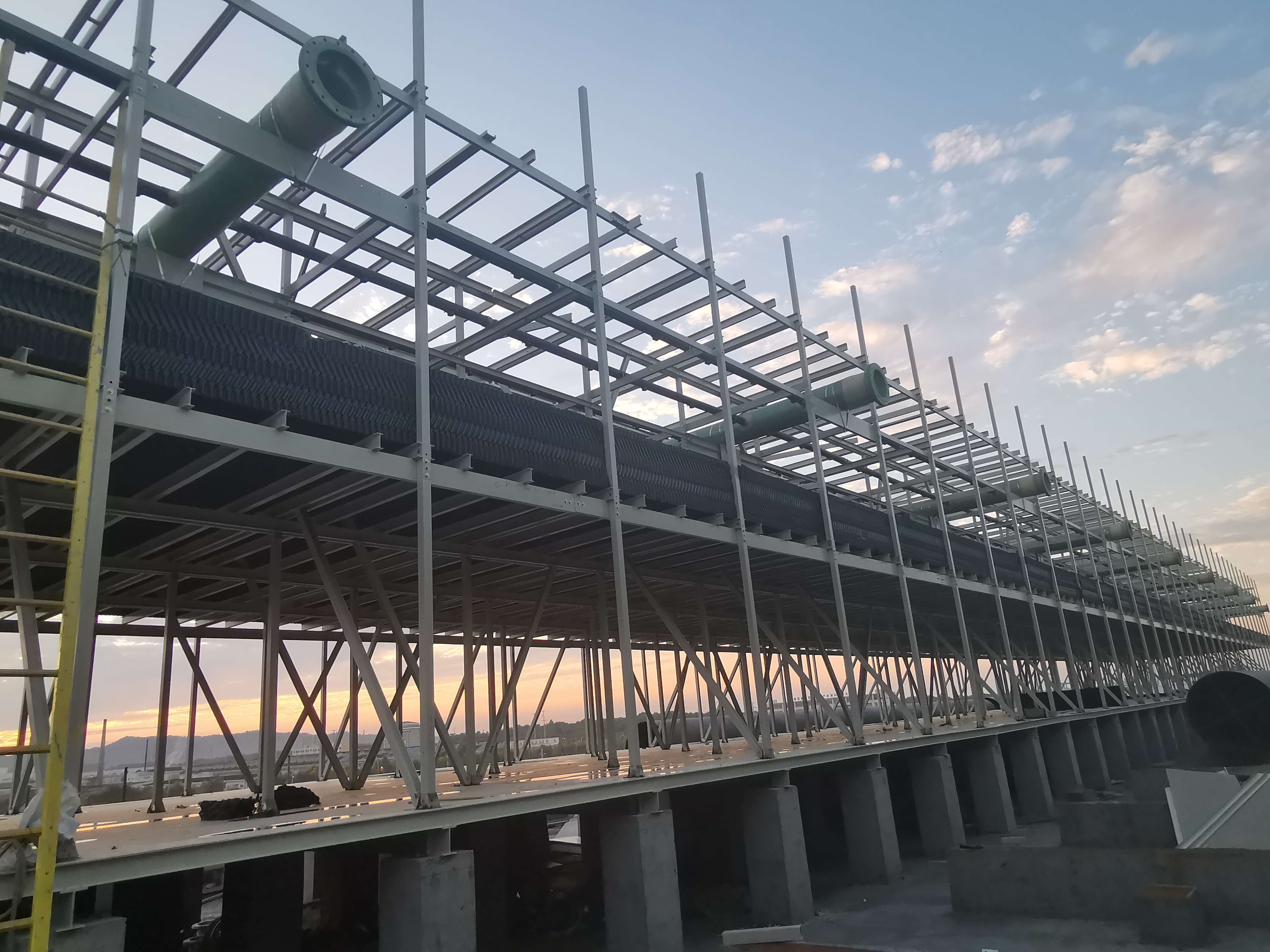
When you look inside a cooling tower, the fill may not be the first component that catches your attention. Yet, it plays one of the most important roles in the entire cooling process.
The cooling tower fill creates the surface area where hot water meets moving air. This contact allows heat to transfer from the circulating water into the air, with evaporation removing additional heat from the system. In other words, the fill is where much of the actual cooling work happens.
Among the different types of cooling tower fill available today, PVC cooling tower fill remains a popular choice for industrial, commercial, HVAC, and process cooling applications. It combines relatively low weight, good formability, corrosion resistance, and efficient heat-transfer performance.
But here is the real question: How do you choose the right PVC cooling tower fills manufacturer or supplier?
Price is important, but it should not be the only factor. Material quality, fill design, manufacturing capability, customization, water quality compatibility, and technical support can all affect the long-term performance of your cooling tower.
This guide explains what PVC cooling tower fill is, how it works, its advantages, how to select the right product, and what to consider when comparing manufacturers and suppliers. We will also introduce Power Tower Cooling Technology (Shaoxing) Co., Ltd., a manufacturer and supplier of cooling tower components and PVC cooling tower fill products.
Why PVC Cooling Tower Fill Matters
A cooling tower can have a powerful fan, reliable water pumps, and a well-designed casing, but if the fill does not perform properly, the entire system can struggle.
Think of cooling tower fill as the working area of the tower. It breaks up and spreads the water, creating a much larger contact area between water and air.
Hot water enters the fill section and flows across its structured surfaces. Meanwhile, air moves through the fill. As the two streams interact, heat transfers from the water to the air. Some water evaporates during this process, carrying additional heat away from the circulating water.
A properly selected fill can therefore help a cooling tower:
Improve heat-transfer efficiency
Maintain the required cold-water temperature
Reduce the required fill volume
Support compact cooling tower designs
Improve overall thermal performance
Maintain consistent cooling under suitable operating conditions
That is why choosing the right PVC cooling tower fill manufacturer is an important part of cooling tower design and maintenance.
What Is PVC Cooling Tower Fill?
PVC cooling tower fill is a plastic heat-transfer media installed inside a cooling tower.
PVC stands for polyvinyl chloride. It can be formed into structured sheets with specific surface patterns, channels, and spacing. These structures encourage water to spread over a large area while allowing air to pass through the fill.
The basic idea is straightforward: create as much effective contact between water and air as possible within a practical amount of tower space.
PVC film fill is particularly common because it can be manufactured with carefully controlled geometry. The shape of the sheets can influence water distribution, air resistance, pressure drop, fouling behavior, and heat-transfer performance.
The fill therefore isn't simply "plastic inside the tower." Its design is an important part of the cooling system's thermal performance.
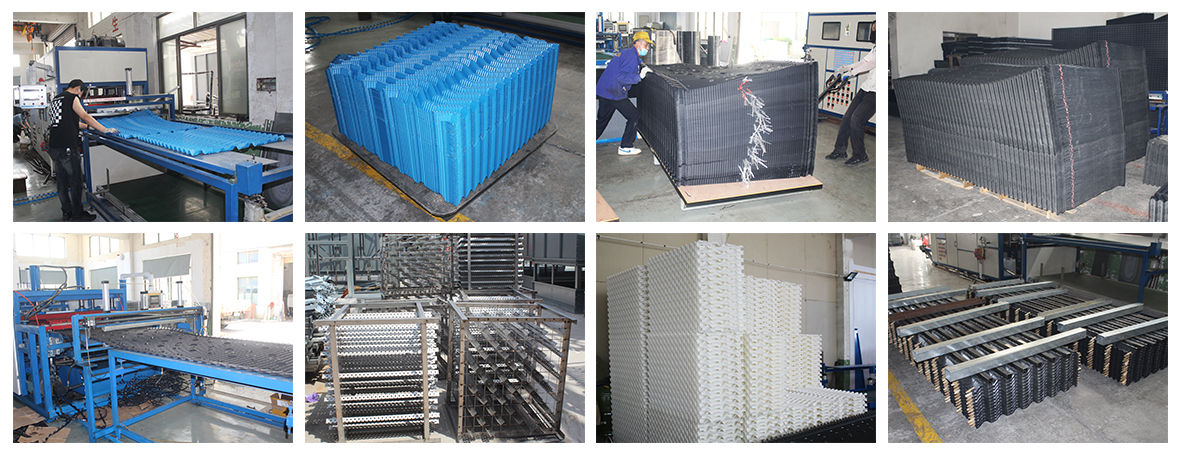
How Does PVC Cooling Tower Fill Work?
The operating principle of PVC film fill can be explained in four simple steps.
First, hot circulating water enters the distribution system at the top of the fill.
Second, the water spreads over the structured PVC surfaces.
Third, air moves through the fill from the opposite direction or across the water flow, depending on the tower configuration.
Finally, heat transfers from the water into the air, while evaporation removes additional heat.
The structured PVC sheets increase the effective surface area available for this process. Instead of allowing water to fall directly through the tower, the fill encourages it to form thin films and follow controlled flow paths.
The result is a much larger water-air contact area.
This is why fill geometry matters so much. Sheet thickness, flute design, surface texture, spacing, block dimensions, and installation arrangement can all influence the final performance.
Film Fill vs. Splash Fill
Cooling tower fill is commonly divided into two broad categories: film fill and splash fill.
Film fill encourages water to form thin films over structured surfaces. It can provide a high effective surface area within a relatively compact volume.
Splash fill works differently. Instead of maintaining a continuous film, the water repeatedly breaks into droplets as it falls over splash bars, grids, or other surfaces.
PVC is widely used for film fill because it can be thermoformed into complex and repeatable surface patterns.
Film fill can be an attractive option when thermal efficiency and compact design are important. Splash fill, however, may be considered for applications where the circulating water contains more suspended solids or where clogging resistance is a major concern.
The correct choice depends on the cooling tower design and operating conditions.
Key Benefits of PVC Cooling Tower Fill
Why has PVC become such a common material for cooling tower fill?
The answer is that it offers a practical combination of thermal performance, manufacturability, weight, and cost.
However, remember that PVC quality and fill design vary between manufacturers. A high-quality material combined with precise forming can produce a very different result from a low-cost product with inconsistent dimensions.
Let's look at the major advantages.
High Heat Transfer Efficiency
The primary purpose of cooling tower fill is heat transfer.
PVC film fill creates a large effective surface area for water and air contact. Water spreads across the structured surfaces while air passes through the channels.
When the water distribution system is properly designed, this arrangement can support efficient cooling within a relatively compact fill volume.
The important point is that fill performance depends on the entire system. Even excellent PVC fill cannot compensate for poor water distribution, inadequate airflow, excessive fouling, or incorrect tower design.
Lightweight and Easy to Install
PVC fill is relatively lightweight compared with many traditional metallic cooling components.
That can make transportation and installation easier.
For maintenance teams, this is particularly useful when replacing old fill inside an existing cooling tower. Smaller sections can be handled more easily, reducing installation complexity.
The relatively low weight can also reduce the structural burden on the supporting framework.
Good Chemical and Corrosion Resistance
Cooling tower water can contain dissolved minerals, treatment chemicals, biological contaminants, and suspended solids.
Unlike conventional steel components, PVC does not rust in the traditional sense. This makes it suitable for many open recirculating cooling systems.
However, PVC is not resistant to every chemical or every temperature condition.
Before purchasing, always check whether the selected PVC fill is compatible with your actual water chemistry and operating temperature.

What to Look for in a PVC Cooling Tower Fill Supplier
Choosing a supplier based only on price can create problems later.
A reliable supplier should understand that cooling tower fill is a performance component, not simply a plastic product.
When comparing manufacturers, consider the following factors.
Material Quality
Start with the raw material.
Ask the supplier about:
Consistent material quality helps the finished fill maintain its shape and mechanical properties during operation.
Manufacturing Capability
Manufacturing consistency is critical.
Cooling tower fill may contain thousands of individual sheets or components. A small dimensional variation repeated across a large fill pack can affect installation and performance.
Look for manufacturers with controlled forming, cutting, assembly, and inspection processes.
Design and Customization
Not every cooling tower uses the same fill dimensions.
Replacement projects can be especially challenging because older towers may have non-standard configurations.
A specialized manufacturer should be able to discuss:
Fill dimensions
Sheet thickness
Fill block size
Flute configuration
Installation arrangement
Water loading
Airflow requirements
Operating temperature
Customization can make a major difference when replacing existing fill.
Quality Control
Quality control should begin with raw materials and continue through final packaging.
Manufacturers should ideally inspect the finished products for dimensional accuracy, forming consistency, visible defects, physical damage, and packaging quality.
For international shipments, packaging is also important. Cooling tower fill needs to arrive without crushing, deformation, or other transportation damage.
Top PVC Cooling Tower Fills Manufacturers and Suppliers
There are many companies around the world supplying cooling tower fill. However, buyers should distinguish between a manufacturer and a company that simply resells generic products.
A direct manufacturer can often provide better communication regarding product specifications, customization, production, and replacement requirements.
One company worth considering when sourcing PVC cooling tower fill is:
Power Tower Cooling Technology (Shaoxing) Co., Ltd.
Power Tower Cooling Technology (Shaoxing) Co., Ltd. is a manufacturer and supplier specializing in cooling tower components, including cooling tower fill products.
For buyers searching for PVC cooling tower fills manufacturers and suppliers, working directly with a manufacturer can simplify communication and make it easier to discuss specific technical requirements.
The company provides cooling tower-related products for applications where heat-transfer performance, product consistency, installation compatibility, and long-term operation are important.
For more information about its products and cooling tower solutions, visit:
Cooling Tower Parts – Power Tower Cooling Technology
PVC Film Fill Solutions
PVC film fill is widely used in cooling tower applications where a large effective heat-transfer area is required within a compact space.
The specific fill design can be selected according to factors such as:
Instead of selecting a product simply because it is labeled "PVC fill," buyers should match the product to the actual operating conditions of the tower.
Custom Sizes and Applications
Replacement projects often require customized dimensions.
Imagine purchasing a replacement component that looks correct in a catalog but is several centimeters too large for the existing support structure. That small mismatch can turn a straightforward replacement into an installation headache.
Working with a manufacturer can make it easier to communicate exact dimensions and application requirements.
When requesting a quotation, provide as much information as possible, including existing fill dimensions, tower type, water flow, operating temperature, and photographs if available.
How to Choose the Right PVC Cooling Tower Fill
Selecting the right fill starts with understanding your cooling tower.
Before contacting a manufacturer, gather the basic operating information.
What is the circulating-water flow?
What is the hot-water temperature?
What cold-water temperature do you need?
What type of cooling tower are you using?
What is the quality of the circulating water?
How much space is available for the fill?
These questions help narrow down the appropriate fill configuration.
Consider Water Quality
Water quality is one of the most important considerations.
Clean water allows more freedom when selecting tighter film-fill configurations. Water containing high levels of suspended solids, biological material, or scale-forming minerals can create a greater fouling risk.
A tightly spaced fill can provide excellent heat-transfer performance under suitable conditions, but its narrow passages can become restricted when deposits accumulate.
Therefore, water treatment and fill selection should be considered together.
Match Fill to Air and Water Flow
The fill must match the tower's airflow and water loading.
If water distribution is uneven, some areas of the fill may receive too little water while others become overloaded.
Airflow also matters. Excessive resistance can increase fan energy requirements and affect the overall efficiency of the tower.
A good supplier should consider the fill as part of the complete cooling system rather than treating it as an isolated component.
Check Temperature Requirements
PVC has operating temperature limitations.
The actual temperature capability depends on the PVC formulation, product structure, operating environment, and manufacturer specifications.
Always provide the supplier with actual operating temperatures, including possible peak conditions.
This is particularly important for industrial applications where process temperatures can fluctuate.
Consider Fouling and Clogging Risk
Fouling is one of the biggest challenges for film fill.
Think about a household air filter. When dust accumulates, air has a harder time passing through it.
Cooling tower fill behaves in a similar way.
Scale, algae, sludge, dirt, and biological growth can restrict the passages between the PVC sheets.
As blockage increases, water and airflow can become less effective, potentially reducing cooling performance.
For this reason, water treatment and regular maintenance are just as important as choosing good fill.
PVC Cooling Tower Fill Applications
PVC fill is used across many industries because cooling towers are required wherever heat needs to be rejected from circulating water.
Industrial Cooling Systems
Factories may use cooling towers to remove heat from:
Heat exchangers
Compressors
Production equipment
Furnaces
Process systems
Industrial machinery
In these environments, cooling towers may operate for long hours every day.
That makes durability, fouling resistance, and maintenance particularly important.
HVAC and Commercial Buildings
Cooling towers are commonly used in large commercial HVAC systems.
Hotels, hospitals, shopping centers, office buildings, and other large facilities may use cooling towers as part of their chilled-water systems.
In these applications, reliable operation and predictable maintenance are important because cooling performance can directly affect indoor environmental conditions and building energy consumption.
Power and Process Industries
Large industrial facilities can require significant heat-rejection capacity.
In these applications, the fill becomes an important part of the thermal system. A reduction in fill performance can affect cooling-water temperature and potentially influence other parts of the process.
For large projects, fill selection should therefore be treated as an engineering decision rather than simply a purchasing decision.
PVC Cooling Tower Fill Maintenance
Even the highest-quality PVC fill requires maintenance.
Regular inspections should look for:
The required maintenance frequency depends heavily on water quality and operating conditions.
Clean fill allows water and air to move through the designed passages. Fouled fill can restrict those passages and reduce heat-transfer performance.
Cleaning methods should always be compatible with the fill material and manufacturer recommendations.
Aggressive chemicals or excessive mechanical force can damage PVC sheets.
In many cases, preventing excessive fouling through proper water treatment is more effective than repeatedly cleaning severely blocked fill.
When Should PVC Cooling Tower Fill Be Replaced?
There is no universal replacement schedule for every cooling tower.
Some systems can operate with PVC fill for many years when water treatment and maintenance are properly managed. Others may require earlier replacement because of harsh water chemistry, high temperatures, physical damage, or severe fouling.
Look for warning signs such as:
Significant deformation
Brittle or damaged sheets
Severe blockage
Persistent biological growth
Collapsed fill sections
Poor water distribution
Reduced cooling performance
Difficulty restoring performance through cleaning
If the fill is physically deteriorated or severely blocked, replacing it may be more practical than continuing to repair it.
A cooling tower performance problem should always be investigated systematically, however. Fill degradation is only one possible cause.
PVC Fill vs. Other Cooling Tower Fill Materials
PVC is not the only material used for cooling tower fill.
Other plastic materials, including PP and HDPE, may be selected for certain applications.
The appropriate material depends on factors such as:
PVC remains popular because it offers a useful balance between formability, thermal performance, availability, and cost.
But there is no universal material that is perfect for every cooling tower.
The right choice is always application-dependent.
Why Work With a Specialized Manufacturer?
A specialized cooling tower manufacturer or component supplier can provide much more value than simply shipping a box of plastic fill.
A knowledgeable supplier can help you consider the relationship between fill geometry, water distribution, airflow, heat transfer, fouling, installation, and maintenance.
Suppose your cooling tower is not reaching its expected cold-water temperature.
You could immediately order new fill.
But should you?
Perhaps the fill is clogged.
Perhaps the water distribution system is uneven.
Perhaps the fan is not moving enough air.
Perhaps the existing fill configuration is unsuitable for the current water quality.
Perhaps the fill is physically damaged.
A good supplier helps you ask these questions before spending money.
That is one reason direct communication with an experienced manufacturer can be valuable for both new cooling tower projects and replacement applications.
Frequently Asked Questions
How long does PVC cooling tower fill last?
The service life of PVC cooling tower fill depends on water quality, operating temperature, chemical exposure, UV exposure, cleaning procedures, mechanical conditions, and overall maintenance.
There is no single service-life number that applies to every installation.
Proper water treatment and routine inspection can significantly help extend the useful life of the fill.
Is PVC fill suitable for counterflow cooling towers?
Yes.
PVC film fill is widely used in counterflow cooling tower applications.
However, the exact product should be selected according to water loading, airflow, thermal requirements, temperature, and fouling conditions.
Can PVC cooling tower fill be customized?
Yes.
Depending on the manufacturer, PVC fill can be supplied in different dimensions, sheet thicknesses, configurations, and block sizes.
For replacement projects, accurate measurements of the existing fill are especially useful.
What is the difference between PVC fill and PVC filler?
In the cooling tower industry, terms such as PVC fill, PVC filler, cooling tower fill, and PVC film fill are often used to describe related products.
However, terminology can vary between suppliers.
Before ordering, always confirm the material, dimensions, configuration, application, and technical specifications.
How can I reduce PVC cooling tower fill clogging?
Start with proper water treatment.
Filtration, blowdown control, biological control, and regular inspection can all help reduce fouling.
If the circulating water contains significant suspended solids, selecting a fill configuration with more open passages may also be appropriate.
The key is to match the fill to the actual water conditions rather than choosing solely based on heat-transfer surface area.
Final Thoughts
PVC cooling tower fill may look like a relatively simple component, but its role in heat rejection is anything but simple.
It provides the working surface where water and air interact, helping the cooling tower transfer heat efficiently.
When selecting among top PVC cooling tower fills manufacturers and suppliers, don't focus only on the lowest quotation. Consider the complete picture.
Look at:
For buyers looking for a direct manufacturer and supplier, Power Tower Cooling Technology (Shaoxing) Co., Ltd. offers cooling tower fill and related cooling tower components.
You can learn more about its products and services through the company's official website:
www.coolingtowerpart.com
Ultimately, choosing cooling tower fill is a little like choosing the engine inside a machine. You may not notice it during normal operation, but it has a major influence on how efficiently the entire system performs.
Choose the fill according to your tower, water quality, operating temperature, airflow, and thermal requirements, and you will have a much stronger foundation for reliable long-term cooling performance.


