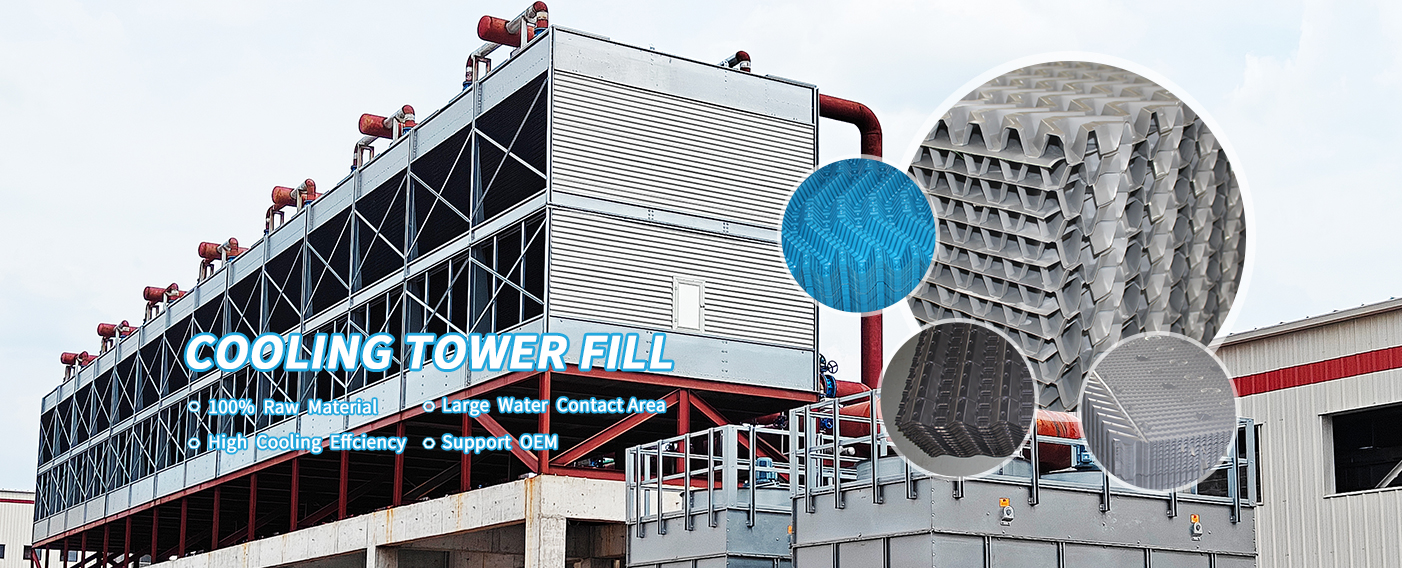
If you are looking for PVC cooling tower fill, you have probably noticed that the market is crowded. There are manufacturers, distributors, OEM suppliers, aftermarket companies, and trading companies all offering what may appear to be similar plastic fill.
But is all PVC cooling tower fill really the same?
Not quite.
The material, sheet thickness, flute design, dimensions, bonding quality, water distribution, airflow resistance, and operating conditions can all affect the final result. A fill pack that works perfectly in one cooling tower may perform poorly in another if the geometry or material is wrong.
That is why choosing the right PVC cooling tower fill manufacturer or supplier matters.
In this guide, we look at five companies serving the cooling tower fill and component market worldwide. The list begins with Power Tower Cooling Technology (Shaoxing) Co., Ltd., followed by several established international cooling technology companies.
What Is PVC Cooling Tower Fill?
PVC cooling tower fill is a heat-transfer medium installed inside an evaporative cooling tower.
Its job sounds simple: increase the contact area between hot water and moving air.
But that simple function is extremely important.
Hot water enters the cooling tower and is distributed over the fill. The PVC sheets divide the water into thin films while air moves through the passages created by the corrugated or formed surfaces.
As water and air interact, heat transfers from the water to the air. A small amount of water evaporates, carrying heat away from the circulating water.
Think of PVC fill as a three-dimensional heat-transfer workspace. Instead of letting water simply fall through open space, the fill creates thousands of surfaces where water and air can interact.
How PVC Fill Works in a Cooling Tower
The exact airflow pattern depends on the tower design.
In a counterflow cooling tower, water generally moves downward while air travels upward. The fill must provide sufficient contact area while allowing air to pass through the pack.
In a crossflow cooling tower, water moves downward while air generally travels horizontally through the fill.
This difference is important when selecting replacement fill.
A product that physically fits inside the tower is not necessarily the correct product. Its flute pattern, dimensions, pressure drop, water loading, and airflow characteristics must also be appropriate.
Why PVC Is Widely Used
PVC has become a common material for cooling tower film fill because it provides a useful balance of performance, weight, manufacturability, chemical resistance, and cost.
It can be formed into different sheet geometries, allowing manufacturers to develop fill for counterflow, crossflow, and replacement applications.
For many conventional HVAC and industrial cooling applications, PVC film fill can provide a practical combination of heat-transfer performance and purchase cost.
However, PVC is not automatically the right choice for every application. Temperature, water chemistry, fouling risk, and tower configuration still need to be considered.
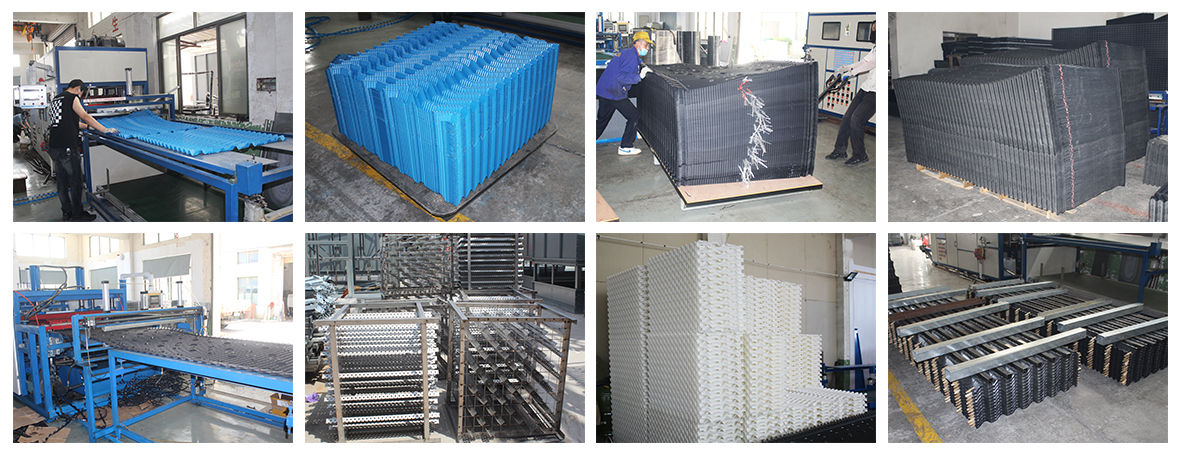
What to Consider When Choosing a PVC Fill Supplier
Choosing a supplier is about more than comparing prices.
A good supplier should understand the cooling tower application behind the product.
Material Quality
Ask what PVC material is being used and whether the supplier can provide technical information about the product.
Sheet thickness and material consistency can affect mechanical durability and long-term performance.
You should also consider the actual operating environment. A fill used in a relatively clean HVAC system may face very different conditions from one installed in an industrial process cooling tower.
Fill Geometry and Thermal Performance
PVC cooling tower fill is not simply flat plastic sheet.
The surface pattern creates channels for water and air. Flute angle, spacing, height, sheet thickness, and block configuration can influence water distribution, heat transfer, and airflow resistance.
More surface area is not automatically better.
If a design creates excessive pressure drop, the cooling tower fan may have to work harder. If passages are too narrow for the water quality, fouling can become a serious problem.
The goal is balance.
Water Quality and Fouling Resistance
Water quality is one of the most important factors in fill selection.
Cooling tower water can contain suspended solids, minerals, biological growth, oil, corrosion products, and other contaminants.
Film fill has relatively narrow passages, which can provide excellent heat-transfer performance but may become vulnerable to clogging when water quality is poor.
For dirty industrial water, a more open fill design or splash fill may sometimes be more appropriate.
Replacement Compatibility
Replacement projects create another challenge: dimensions.
Before ordering, you should know the existing fill height, width, length, block arrangement, support structure, and water distribution configuration.
Even a high-quality PVC cooling tower fill can cause problems if it does not match the existing tower.
Top 5 PVC Cooling Tower Fill Manufacturers and Suppliers
The following companies represent different approaches to the cooling tower fill market, from specialized replacement suppliers to major international cooling technology manufacturers.
#1 Power Tower Cooling Technology (Shaoxing) Co., Ltd.

Power Tower Cooling Technology (Shaoxing) Co., Ltd. is the first company on this list and is particularly relevant to buyers looking for PVC cooling tower fill, replacement fill, OEM-compatible components, and customized cooling tower fill solutions.
The company focuses on cooling tower components and replacement products rather than treating fill as a generic plastic product.
Its online product range includes PVC and PP cooling tower fill, counterflow and crossflow fill, and replacement solutions for different cooling tower configurations.
Power Tower Cooling Technology / Cooling Tower Part
PVC Cooling Tower Fill Products
PVC is one of the company's important cooling tower fill materials.
Its product range includes PVC film fill and different replacement fill configurations for cooling towers. The company also lists products associated with well-known tower configurations and brands, making compatibility an important part of its aftermarket approach.
For buyers, this can be useful when the original fill is damaged but the cooling tower structure itself remains serviceable.
Why replace the entire tower if the problem is simply worn-out fill?
In many retrofit situations, replacing the fill can be a much more targeted approach.
Custom and Replacement Fill Solutions
One of Power Tower's key areas is customized replacement.
Cooling tower fill replacement is rarely as simple as ordering a generic block. Existing towers may have unusual dimensions because of previous modifications, repairs, or different original equipment configurations.
Power Tower indicates that fill can be customized according to requirements such as dimensions, material, thickness, and configuration.
For a replacement inquiry, buyers should prepare:
The more accurate the information, the easier it is for the supplier to identify a suitable replacement.

#2 Brentwood Industries
Brentwood Industries is an established manufacturer of cooling tower components and polymer-based solutions.
Its cooling tower portfolio includes film fills, trickle fills, splash fills, drift eliminators, inlet louvers, nozzles, and accessories.
Brentwood's film fill range includes cross-fluted, herringbone, offset-fluted, vertical-fluted, and hybrid-fluted designs.
Film Fill and Fouling-Resistant Designs
One interesting aspect of Brentwood's approach is the effort to balance thermal performance with fouling resistance.
Cross-fluted designs emphasize water dispersion and thermal performance, while vertical-fluted designs use larger openings and higher water-film velocity to help reduce fouling potential.
This highlights an important point for buyers:
The "best" fill is not simply the one with the largest theoretical surface area.
Your water quality matters.
For relatively clean water, a high-efficiency film fill can make sense. For water with substantial suspended solids or contamination, a more fouling-resistant design may be more practical.
#3 SPX Cooling Tech / Marley

SPX Cooling Tech is a major global cooling technology manufacturer whose portfolio includes Marley, Recold, and SGS brands.
SPX states that it manufactures cooling towers, evaporative fluid coolers, evaporative condensers, and related equipment and services for HVAC, process cooling, industrial, and refrigeration markets.
Marley Fill and OEM Replacement Solutions
The Marley brand is especially relevant to cooling tower component buyers.
Marley products include cooling towers, components, and heat-exchange fill media, with engineered parts and fill solutions designed around cooling tower applications.
For an owner operating an existing Marley cooling tower, OEM or OEM-compatible replacement components can be important because the fill needs to work with the tower's original water distribution and airflow arrangement.
This makes SPX/Marley particularly relevant for buyers who prioritize compatibility with existing Marley equipment.
#4 Baltimore Aircoil Company (BAC)

Baltimore Aircoil Company, commonly known as BAC, is another major international cooling technology company.
BAC develops evaporative cooling and heat rejection equipment for applications ranging from comfort cooling to industrial process cooling and refrigeration.
Factory-Authorized Replacement Fill
BAC provides factory-authorized parts designed and tested for its existing equipment, and its parts resources include replacement fill kits.
For BAC tower owners, this factory-supported approach can simplify replacement projects.
The main advantage is not simply the plastic material.
It is compatibility.
When replacing cooling tower fill, the geometry needs to work with the existing tower design. Water distribution, support arrangements, airflow, and fill configuration all matter.
For buyers managing a BAC installation, checking the exact tower model and replacement requirements before ordering is therefore important.
#5 EVAPCO
EVAPCO is another established manufacturer serving the evaporative cooling market.
Its cooling tower products use wet-deck fill to create contact between water and air. EVAPCO also provides technical information regarding fill service life and replacement.
PVC Fill and Cooling Tower Systems
One example in EVAPCO's product information is EVAPAK fill, which is constructed from PVC and specified for water temperatures up to 130°F on the referenced product page.
This illustrates why buyers should not assume that all PVC fill has the same operating limits.
Always check the specific product specification.
Temperature capability depends on the material formulation, design, and application.
EVAPCO also notes that fill may need replacement once or twice during the life of a cooling tower, with longevity strongly influenced by water and air quality and proper operation.
PVC vs. PP Cooling Tower Fill
PVC and polypropylene, or PP, are two common thermoplastic materials used in cooling tower fill.
| Feature | PVC Fill | PP Fill |
| Common application | General cooling | Demanding industrial applications |
| Typical design | Film fill | Film and splash fill |
| Temperature capability | Suitable for many standard applications | Often preferred for higher-temperature applications |
| Chemical resistance | Good | Very good |
| Weight | Lightweight | Lightweight |
| Cost | Often economical | Can be higher depending on specification |
| Fouling resistance | Depends heavily on geometry | Depends heavily on geometry |
| Replacement use | Very common | Common in demanding applications |
When PVC Is a Practical Choice
PVC can be a strong option when:
Water temperature is within the product specification
Water quality is reasonably controlled
High heat-transfer efficiency is required
A lightweight fill is preferred
Cost needs to remain controlled
The tower uses PVC-compatible film fill
When PP May Be More Suitable
PP can be considered when the application involves higher temperatures or more demanding chemical conditions.
But don't fall into the trap of thinking that a more expensive material is automatically better.
If PVC already meets the actual operating requirements, switching to PP may not provide enough additional value to justify the added cost.
The right question is not "Which material is better?"
It is "Which material matches my cooling tower?"
Film Fill vs. Splash Fill
Film fill and splash fill solve the same basic problem—improving water-air contact—but they do it differently.
Film Fill
Film fill spreads water over thin surfaces.
Its advantages include:
High effective surface area
Compact design
Strong thermal performance
Efficient use of tower volume
However, narrow passages can be more sensitive to suspended solids and fouling.
Splash Fill
Splash fill repeatedly breaks falling water into droplets.
It generally has a more open structure and can be useful in applications where fouling or suspended solids are major concerns.
So which one should you choose?
It depends on the water.
Clean water and high thermal efficiency may favor film fill. Dirty industrial water may require a more open solution.
How to Select the Right PVC Cooling Tower Fill
Choosing PVC cooling tower fill becomes much easier when you follow a systematic process.
Check Tower Type
First determine whether your tower is:
The fill must match the tower's airflow and water-distribution configuration.
Measure Existing Fill
Don't guess.
Measure:
Fill height
Fill width
Fill length
Sheet thickness
Flute spacing
Flute angle
Number of blocks
Support frame dimensions
If possible, photograph the existing fill before removing it.
Check Operating Temperature
Temperature is particularly important when choosing plastic fill.
Ask for the actual hot-water temperature, not just an approximate operating description.
Also consider whether the tower experiences occasional temperature spikes.
Evaluate Water Quality
Check for:
If the water is heavily contaminated, choosing a very narrow-channel film fill without considering fouling risk can create maintenance problems later.
Common PVC Cooling Tower Fill Problems
PVC fill can provide long service, but it is not indestructible.
Scaling and Clogging
Mineral deposits can accumulate on fill surfaces.
As deposits build up, water passages become restricted. This can reduce effective heat-transfer area and increase airflow resistance.
Cracking and Deformation
Excessive temperature, chemical attack, physical impact, aging, or poor support can contribute to deformation or cracking.
Once the fill loses its original geometry, its hydraulic and thermal performance may also change.
Biological Fouling
Algae and other biological growth can accumulate in wet cooling tower environments.
Good water treatment and regular inspection are essential for keeping fill passages open.
When Should PVC Cooling Tower Fill Be Replaced?
There is no single replacement interval that works for every tower.
The service life of fill depends heavily on water quality, air quality, operating conditions, maintenance, and material selection.
Look for warning signs such as:
Increasing cold-water temperature
Rising approach temperature
Reduced cooling capacity
Visible cracks
Brittle or deformed sheets
Heavy scale
Persistent clogging
Uneven water distribution
Restricted airflow
If cleaning restores the original structure and performance, replacement may not be necessary.
But if the PVC has become brittle, permanently deformed, cracked, or structurally damaged, replacement is generally the more practical solution.
Questions to Ask Before Buying
Before purchasing PVC cooling tower fill, ask your supplier:
Is the product PVC or another polymer?
What is the sheet thickness?
What are the fill dimensions?
Is it designed for counterflow or crossflow?
What water temperature range is supported?
What water loading is recommended?
What is the flute spacing?
How does the design address fouling?
Can the fill be customized?
Can the supplier match existing fill dimensions?
Is OEM-compatible replacement available?
Can the supplier provide technical drawings or specifications?
These questions can prevent a surprisingly expensive mistake.
Final Thoughts
PVC cooling tower fill may look like a simple collection of plastic sheets, but its role is much more important than it appears.
It creates the surface area where water and air interact. That interaction drives evaporative heat transfer and directly influences cooling tower performance.
For buyers, the challenge is not simply finding the cheapest PVC cooling tower fill.
You need to find fill that matches your tower design, dimensions, water quality, temperature, airflow, thermal requirements, and maintenance strategy.
The five suppliers discussed here offer different strengths.
Power Tower Cooling Technology (Shaoxing) Co., Ltd. focuses strongly on cooling tower components, replacement fill, PVC and PP fill, and customized aftermarket requirements. Brentwood offers a broad range of engineered fill designs and polymer cooling tower components. SPX/Marley provides OEM-oriented cooling tower technology and parts. BAC supports its equipment with factory-authorized replacement components, while EVAPCO combines cooling tower equipment with its own fill and replacement support.
The smartest buying decision starts with your tower—not the supplier's catalog.
Measure the existing fill. Understand your water. Check the operating temperature. Identify the tower configuration. Then choose a PVC cooling tower fill solution that fits the real application.
That approach can help you avoid clogging, premature replacement, poor thermal performance, and unnecessary operating costs.
Frequently Asked Questions
What is PVC cooling tower fill used for?
PVC cooling tower fill increases the contact area between circulating water and air. This improves evaporative heat transfer and helps the cooling tower reduce water temperature.
Is PVC cooling tower fill better than PP fill?
Neither material is universally better. PVC is widely used for standard applications, while PP can be attractive for higher-temperature or more demanding conditions. The correct choice depends on actual operating requirements.
How long does PVC cooling tower fill last?
Service life varies significantly. Water quality, air quality, temperature, maintenance, fouling, chemical exposure, and operating conditions all affect longevity.
Can PVC cooling tower fill be customized?
Yes. Depending on the supplier, dimensions such as fill height, width, length, thickness, flute geometry, and block configuration can be customized for replacement projects.
Can PVC film fill be used in both counterflow and crossflow towers?
Different PVC film fill designs are made for different airflow configurations. Always confirm that the selected fill matches the tower type and existing water-distribution system.
Where can I find PVC cooling tower fill?
Buyers can contact specialized cooling tower component suppliers such as Power Tower Cooling Technology (Shaoxing) Co., Ltd. for PVC and PP fill, replacement fill, and customized cooling tower component requirements.
For product information and inquiries, visit www.coolingtowerpart.com.


