When a cooling tower starts losing performance, most people look at the fan, motor, pump, or water treatment system first.
But what about the fill?
The cooling tower fill is one of the most important components inside a wet cooling tower. It creates the surface area where water and air interact, helping the tower reject heat through evaporation and sensible heat transfer.
If the fill is damaged, clogged, scaled, or simply unsuitable for the application, even a powerful cooling tower can struggle to deliver its designed performance.
That raises an important question: Where should you buy cooling tower fill, and which supplier can provide the right product for your tower?
In this guide, we compare five leading cooling tower fill suppliers and manufacturers: Brentwood Industries, SPX Cooling Technologies/Marley, Baltimore Aircoil Company (BAC), EVAPCO, and Power Tower Cooling Technology (Shaoxing) Co.,Ltd.
We will also explain the differences between film fill and splash fill, compare PVC and PP materials, and show you what to consider before purchasing replacement cooling tower fill media.
What Is Cooling Tower Fill?
Cooling tower fill, also called tower packing or fill media, is the heat-transfer material installed inside a wet cooling tower.
Its main purpose is straightforward: increase the contact area between water and air.
Hot water enters the tower and is distributed over the fill. As the water travels through the fill, it spreads across surfaces or breaks into droplets. At the same time, air passes through the tower.
This creates a large water-air interface.
The larger and more effective that interface is, the easier it becomes for the tower to transfer heat and evaporate a portion of the circulating water.
In simple terms, you can think of cooling tower fill as the “working area” inside the tower.
Without it, water would simply fall through the tower much too quickly to achieve efficient heat rejection.
How Does Cooling Tower Fill Work?
Different types of cooling tower fills achieve this water-air contact in different ways.
Film fill spreads water into thin layers across corrugated plastic sheets. Splash fill, on the other hand, repeatedly breaks falling water into droplets as it moves through splash bars or grids.
Both approaches work, but they are designed for different operating conditions.
Film fill generally provides a high surface area in a relatively compact volume, while splash fill typically provides greater resistance to fouling and blockage.
That difference becomes especially important when your cooling water contains suspended solids, biological growth, dirt, oil, or other contaminants.
Why Does Fill Quality Matter?
The quality and design of the fill directly influence cooling tower performance.
A poorly selected fill can result in:
Reduced heat-transfer efficiency
Increased pressure drop
Uneven water distribution
Higher fan energy consumption
Faster fouling
More frequent cleaning
Shorter service life
Reduced cooling capacity
That's why choosing the correct cooling tower fill material should never be treated as a simple purchasing decision.
How We Selected the Top 5 Cooling Tower Fill Suppliers
There isn't one universally accepted global ranking for cooling tower fill suppliers.
So rather than claiming that one company is automatically “No. 1,” this list evaluates suppliers based on practical factors that matter to cooling tower owners and engineering teams.
These factors include:
Cooling tower fill product range
PVC and PP material options
Film and splash fill technology
Crossflow and counterflow compatibility
Replacement-fill capability
Customization
Technical support
OEM and aftermarket applications
International supply capability
Experience with industrial cooling towers
This approach is more useful if you are actually looking for fill for cooling tower replacement or a new tower project.
After all, the biggest company isn't necessarily the best supplier for your particular tower.
1. Brentwood Industries
Brentwood Industries is a well-known supplier of cooling tower components and engineered plastic products.
Its cooling tower portfolio includes film fills, splash fills, drift eliminators, louvers, and other internal components. The company offers several film-fill designs, including cross-fluted and other engineered geometries.
Key Cooling Tower Fill Products
Brentwood is particularly interesting because it offers both high-performance film products and more open splash-fill designs.
That gives customers more flexibility.
For relatively clean water, film media can provide excellent thermal performance. For applications with heavy suspended solids or severe fouling risks, splash media can be a better option.
This is an important lesson when selecting fill media cooling tower products:
Maximum surface area isn't always the same thing as maximum real-world performance.
If the fill becomes blocked after a few months, its theoretical thermal advantage doesn't mean much.
2. SPX Cooling Technologies / Marley

SPX Cooling Technologies is another major name in the global cooling tower industry, with Marley being one of its best-known cooling tower brands.
Its replacement portfolio includes fill products for both crossflow and counterflow cooling towers.
Marley PVC Fill Media
SPX offers multiple fill designs engineered for different tower configurations and operating conditions.
For buyers searching specifically for cooling tower PVC fills, Marley is an important manufacturer to consider.
PVC film fill is widely used because it can be formed into thin, corrugated sheets that create a large amount of water-air contact area.
However, the correct fill still depends on water quality, temperature, loading, airflow, and tower design.
SPX's technical guidance also emphasizes that fill selection should consider fouling and water quality rather than thermal performance alone.
That is a valuable point for anyone purchasing pvc filling cooling tower products.
3. Baltimore Aircoil Company (BAC)

Baltimore Aircoil Company, commonly known as BAC, is a major manufacturer of evaporative cooling and heat-transfer equipment.
BAC supplies cooling towers, closed-circuit cooling equipment, evaporative condensers, and replacement components.
BAC Replacement Fill Kits
One advantage of purchasing replacement fill from an established OEM is compatibility.
Existing cooling towers often have specific fill dimensions, support structures, water-distribution systems, and airflow characteristics.
BAC provides model-oriented replacement fill solutions for its equipment.
This matters because replacing fill isn't simply a matter of measuring the overall tower width and ordering plastic sheets.
The fill block needs to fit the support system and work correctly with the tower's water and air distribution.
For large commercial or industrial installations, OEM replacement products can therefore be attractive when maintaining the original tower configuration is a priority.
4. EVAPCO
EVAPCO is a global manufacturer specializing in evaporative cooling and heat-transfer technology.
Its products serve commercial HVAC, industrial process cooling, refrigeration, power generation, and other applications.
EVAPAK PVC Fill
One of EVAPCO's recognized fill products is EVAPAK, a PVC counterflow fill designed to promote effective air-water mixing.
PVC is widely used in cooling tower film fill because it offers a practical combination of formability, heat-transfer surface area, durability, and cost.
EVAPCO also provides replacement components for cooling towers, making it relevant to both new installations and refurbishment projects.
For customers comparing pvc cooling tower fills, EVAPCO can therefore be included in the shortlist.
5. Power Tower Cooling Technology (Shaoxing) Co.,Ltd

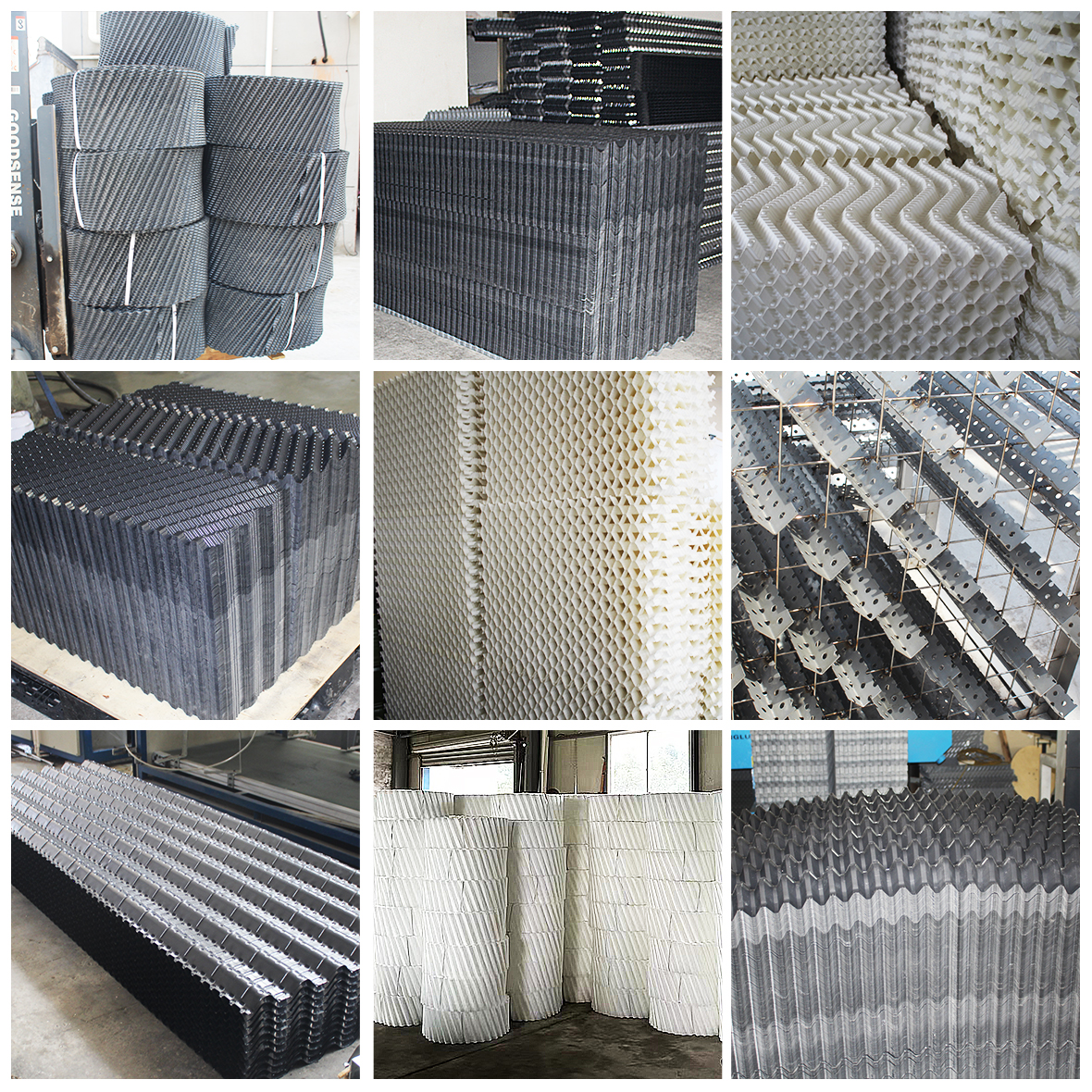
Power Tower Cooling Technology (Shaoxing) Co.,Ltd specializes in cooling tower components and replacement products, with a particular focus on cooling tower fill and related internals.
The company supplies different types of cooling tower fill media, including PVC and PP options, film fill, splash fill, crossflow fill, counterflow fill, and customized replacement products.
According to its current website, the company focuses on cooling tower components such as cooling tower filling, fans, nozzles, reducers, motors, drift eliminators, and other parts. It also provides OEM and ODM services and customized solutions.
Power Tower Cooling Tower Fill Solutions
One of the biggest advantages of working with a specialized cooling tower parts manufacturer is flexibility.
You may not need to buy an entire cooling tower.
Perhaps your existing fill has become brittle.
Maybe the original product has been discontinued.
Perhaps the tower is 10 or 20 years old and you need a replacement that matches the existing dimensions.
Or maybe you want to replace an expensive OEM fill with a compatible aftermarket solution.
In these cases, a specialized supplier can be very useful.
Power Tower offers different fill configurations and materials, including PVC, PP, and CPVC options for certain applications. Its product information also indicates that fill dimensions, thickness, and other specifications can be customized according to project requirements.
This makes the company particularly relevant for buyers looking for:
PVC cooling tower fill
PP cooling tower fill
Crossflow fill
Counterflow fill
Film fill
Splash fill
Replacement fill
Custom-size fill
OEM-compatible fill
For more information about its products and services, visit the Power Tower Cooling Technology official website.
Film Fill vs. Splash Fill: Which Is Better?
This is probably one of the most common questions buyers ask.
And the honest answer is:
It depends on your water and your cooling tower.
Film fill and splash fill work differently.
Film Type Fill Cooling Tower Applications
A film type fill cooling tower uses corrugated sheets to spread water into thin films.
Instead of allowing water to simply fall through the tower, the fill forces it to spread across a large surface area.
This creates extensive contact between water and air.
Film fill is often selected for applications where:
Water quality is relatively good
High thermal performance is required
Space is limited
Water treatment is well controlled
Compact fill geometry is desirable
Modern film fills can provide excellent heat-transfer performance.
But there's a trade-off.
The smaller passages and large surface area that make film fill thermally efficient can also make it more sensitive to fouling.
If dirt and scale accumulate between the sheets, airflow and water distribution can suffer.
Splash Fill Cooling Tower Applications
A splash fill cooling tower uses bars, grids, or other structures to break falling water into smaller droplets.
Instead of creating a thin film over closely spaced sheets, splash fill relies on repeated splashing.
The open structure makes splash fill more tolerant of:
Suspended solids
Dirt
Dust
Process contaminants
Biological fouling
Poorer water quality
That's why splash fill can be attractive in certain industrial environments.
Imagine two roads.
Film fill is like a high-capacity highway with many carefully designed lanes. It can move a lot of traffic efficiently, but an obstruction can cause problems quickly.
Splash fill is more like a wide industrial road. It may not be as compact, but it gives debris more room to pass.
Neither is automatically better.
The application determines the winner.
PVC vs. PP Cooling Tower Fill Material
When comparing cooling tower fill, you will often encounter PVC and polypropylene, or PP.
So which one should you choose?
Again, there isn't a universal answer.
Why PVC Is So Popular
PVC is widely used for film fill because it can be manufactured into thin, corrugated sheets with precise geometry.
Common advantages include:
That's why pvc fills cooling tower systems are common across commercial and industrial applications.
However, standard PVC has operating-temperature limitations that must be considered.
When PP May Be Better
Polypropylene can be considered when operating conditions require different temperature or chemical resistance characteristics.
For some industrial applications, PP may provide an attractive alternative to standard PVC.
But don't select material simply because one sounds “better.”
Always consider:
Water temperature
Chemical composition
pH
Biological activity
UV exposure
Mechanical loading
Fire requirements
Expected service life
The material and fill geometry need to work together.
How to Choose the Right Fill for a Cooling Tower
Buying fill packing cooling tower products is not like buying a generic piece of plastic.
You need to match the fill to the actual tower.
Before requesting a quotation, collect as much information as possible.
1. Cooling Tower Type
Is your tower:
Crossflow?
Counterflow?
Round?
Square?
Open circuit?
Closed circuit?
The answer affects the required fill configuration.
2. Fill Dimensions
Provide:
Length
Width
Height
Sheet thickness
Flute spacing
Flute angle
Number of layers
Support dimensions
Even a high-quality fill won't work if it doesn't fit.
3. Water Flow
Water loading is a critical factor.
Too much water for a particular fill geometry can lead to poor distribution.
Too little water may reduce the effectiveness of the fill.
4. Airflow
Air and water have to work together.
A fill that produces excessive pressure drop can increase fan energy consumption.
That's why thermal performance should always be considered alongside airflow resistance.
5. Water Quality
This may be the most overlooked factor.
Ask:
Is the water clean?
Does it contain suspended solids?
Is there biological growth?
Is scaling a problem?
Is oil present?
Is the tower exposed to dust or sand?
A tightly spaced film fill may not be the right choice for heavily contaminated water.
6. Operating Temperature
Temperature can strongly influence material selection.
For example, standard PVC may work well in many conventional cooling applications, while higher-temperature applications may require CPVC, PP, or another material.
Power Tower's film-fill product information lists PVC, PP, and CPVC options depending on application requirements.
Crossflow vs. Counterflow Cooling Tower Fill
The tower configuration also matters.
Crossflow Cooling Tower Fill
In a crossflow tower, air generally moves horizontally across falling water.
The fill arrangement therefore needs to work with the tower's air inlet and water distribution system.
Counterflow Cooling Tower Fill
In a counterflow tower, air generally moves upward while water flows downward.
The opposing flow direction provides effective air-water contact and allows compact fill arrangements.
For either configuration, the fill should be selected according to the original tower design rather than simply based on its physical appearance.
Cooling Tower Fill Replacement and Maintenance
Even good-quality fill doesn't last forever.
Over time, the fill can become:
Scaled
Fouled
Brittle
Cracked
Deformed
Blocked
Chemically damaged
Mechanically damaged
Regular inspection can help determine whether cleaning is enough or whether replacement is necessary.
Signs Your Cooling Tower Fill Needs Replacement
Look for:
Increasing cold-water temperature
Rising approach temperature
Visible scale buildup
Blocked fill passages
Cracked or brittle sheets
Collapsed fill blocks
Uneven water distribution
Excessive biological growth
Increased pressure drop
Reduced cooling capacity
If cleaning repeatedly fails to restore performance, replacement may be the more economical solution.
Why Customized Cooling Tower Fill Can Be Important
Not every cooling tower is identical.
Older towers can have unusual dimensions.
Some may use discontinued fill models.
Others may have modified support structures after years of upgrades.
This is where customized cooling tower fill media can provide an advantage.
A specialist supplier can evaluate:
Existing fill dimensions
Tower type
Water flow
Operating temperature
Material
Flute geometry
Fill height
Support arrangement
Water quality
Power Tower states that its cooling tower fill products can be supplied according to customer dimensions and project requirements, including customized material and thickness options.
For a replacement project, it is therefore useful to provide photographs, drawings, dimensions, and operating data before ordering.
How Much Does Cooling Tower Fill Cost?
The price of cooling tower fill depends on much more than the material.
Important factors include:
A standard PVC film-fill project may be relatively straightforward.
A custom industrial replacement project can be more complicated.
That's why comparing suppliers only by price per sheet can be misleading.
A cheaper fill may not fit properly or may not perform well under your operating conditions.
The better question is:
What is the total cost of ownership?
Frequently Asked Questions About Cooling Tower Fill
What is the best material for cooling tower fill?
PVC is one of the most widely used materials for cooling tower film fill because it offers a useful balance of thermal performance, manufacturability, and cost.
PP or CPVC may be more appropriate for certain higher-temperature or chemically demanding applications.
The best material depends on the actual operating conditions.
How long does cooling tower fill last?
There is no universal service-life number.
Fill life depends on:
Water quality
Temperature
Chemical treatment
Cleaning frequency
UV exposure
Mechanical conditions
Biological fouling
Operating hours
A well-maintained cooling tower can keep its fill in service for many years, while severe fouling or chemical exposure can shorten its useful life significantly.
What is the difference between film fill and splash fill?
Film fill spreads water over corrugated sheets to create a large surface area.
Splash fill breaks falling water into droplets.
Film fill generally offers high thermal performance in suitable water conditions, while splash fill can provide greater tolerance to dirty or heavily contaminated water.
Can PVC cooling tower fill be used in every cooling tower?
No.
PVC fill must be matched to the tower design and operating conditions.
You need to consider tower type, dimensions, water temperature, water quality, airflow, water loading, and existing support structure.
Where can I buy cooling tower PVC fills?
You can purchase cooling tower PVC fills from OEM cooling tower manufacturers, specialized cooling tower component suppliers, and aftermarket fill manufacturers.
For replacement projects, always provide the original fill dimensions and tower information before ordering.
Can cooling tower fill be customized?
Yes.
Many specialized manufacturers can customize fill dimensions, thickness, material, flute spacing, and configuration according to project requirements.
This is especially useful when replacing fill in an older cooling tower.
Final Thoughts
The cooling tower fill may not be the most visible component in a cooling tower, but it plays one of the biggest roles in heat transfer.
Choosing the right fill means looking beyond the price tag.
You need to consider the complete picture:
Tower type + water quality + temperature + airflow + water loading + material + fill geometry + maintenance.
Brentwood offers a broad range of film and splash technologies. SPX/Marley provides extensive OEM and replacement fill options. BAC offers model-specific replacement solutions. EVAPCO provides engineered fill products for its cooling equipment.
And Power Tower Cooling Technology (Shaoxing) Co.,Ltd provides specialized cooling tower fill and component solutions, including PVC, PP, CPVC, film, splash, crossflow, counterflow, and customized replacement products.
The most important thing is not simply finding a supplier that sells fill for cooling tower applications.
It's finding a supplier that understands why a particular fill is suitable for your tower.
When you get that part right, the result can be better cooling performance, more stable operation, easier maintenance, and a longer service life for the entire cooling tower system.


