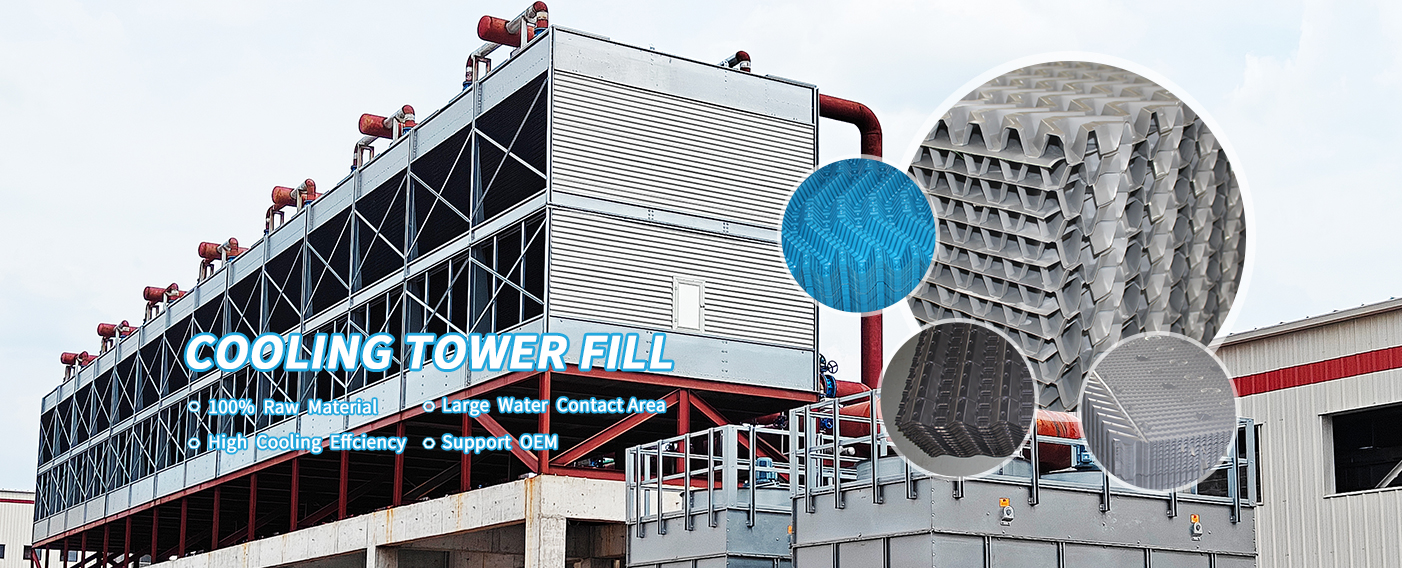
Choosing the right cooling tower fill manufacturer can have a surprisingly large impact on cooling performance. The fill may sit inside the tower and rarely get noticed, but it is one of the most important components in a wet cooling tower.
So, where should you buy cooling tower fill? Which manufacturers are worth considering? And how do you know whether PVC, PP, CPVC, film fill, or splash fill is right for your system?
This guide compares eight cooling tower fill manufacturers and suppliers, starting with Power Tower Cooling Technology (Shaoxing) Co., Ltd. The list is designed as a practical buyer's guide rather than an absolute industry ranking because the "best" supplier depends on your tower type, water quality, thermal requirements, budget, and replacement needs.
What Is Cooling Tower Fill?
Cooling tower fill, also called cooling tower packing, cooling tower filler, or cooling tower fill media, is the heat-transfer material installed inside a wet cooling tower.
Its job sounds simple: make water and air interact as efficiently as possible.
Hot circulating water enters the tower and passes over or through the fill. The fill spreads the water into thin films or breaks it into droplets, dramatically increasing the contact area between water and moving air. This gives evaporation more opportunity to remove heat.
Think of it like opening an umbrella during a rainstorm. A single narrow surface catches little water, while a large surface catches much more. Cooling tower fill works on a similar principle, except the objective is to maximize useful air-water contact.
The quality, geometry, material, and installation of the fill can therefore influence the tower's thermal performance, pressure drop, fouling resistance, and maintenance requirements.
Why Cooling Tower Fill Matters
A cooling tower can have a powerful fan, a good pump, and excellent water treatment, but poor fill can still limit overall performance.
Why?
Because the fill is where a large amount of the air-water interaction takes place.
A properly selected fill can help:
Increase effective heat-transfer area
Improve water distribution
Promote evaporation
Maintain stable cooling performance
Reduce the required tower footprint for a given duty
Support efficient operation
Improve replacement and maintenance efficiency
Brentwood, for example, offers film, trickle, and splash fill technologies designed around different thermal and water-quality requirements. Its published guidance emphasizes selecting fill based on actual tower and application conditions rather than simply choosing a product by name.
That is an important point: the best cooling tower fill is the one that matches the tower—not necessarily the one with the biggest brand name.
How Cooling Tower Fill Improves Heat Transfer
Film fill creates a large wetted surface by encouraging water to flow as relatively thin films over structured sheets.
The more effectively the fill distributes water while allowing air to move through the structure, the more opportunities the system has for heat and mass transfer.
However, there is always a balancing act.
More surface area sounds great, right?
Not necessarily.
If the fill geometry creates excessive resistance to airflow or becomes easily blocked by dirt, algae, scale, or suspended solids, the theoretical thermal advantage can disappear in real-world operation.
That is why experienced suppliers consider thermal performance, pressure drop, water quality, and fouling resistance together.
Film Fill vs. Splash Fill
The two broad categories buyers commonly encounter are film fill and splash fill.
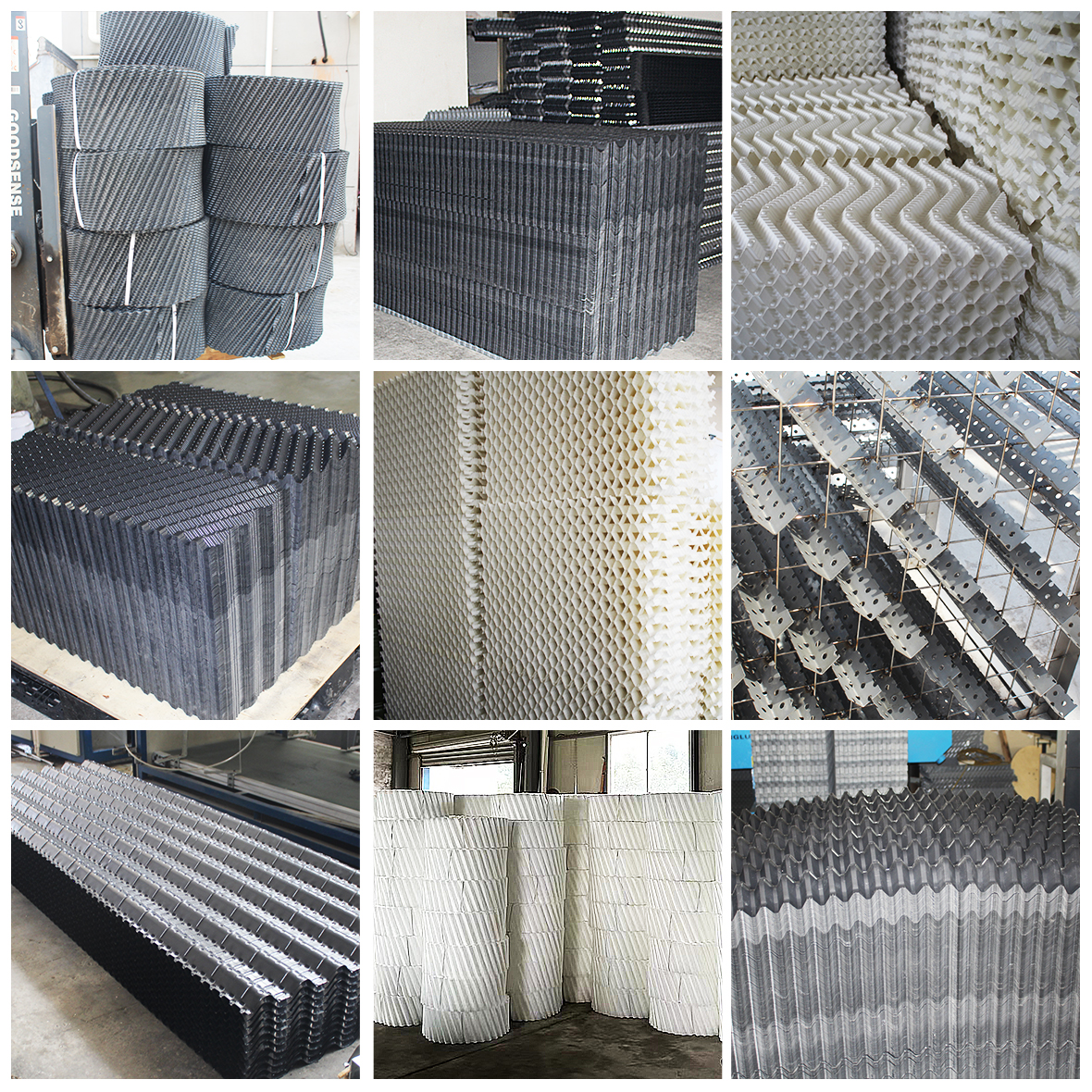
Film Fill
Film fill uses structured sheets to spread water into thin films.
It is commonly selected when high thermal efficiency and compact heat-transfer surfaces are priorities.
Film fill is particularly common in applications with reasonably controlled water quality.
Splash Fill
Splash fill uses bars, grids, or modules to repeatedly break falling water into droplets.
Its major advantage is resistance to fouling.
When water contains significant suspended solids or contaminants, a highly intricate film-fill structure can become difficult to maintain. Splash fill can provide a more forgiving solution in these conditions.
The choice should therefore depend on the actual operating environment rather than a simple "film is better" or "splash is better" rule.
How We Selected the Top 8 Cooling Tower Fill Manufacturers
There is no single global organization that publishes an official ranking of the "top eight" cooling tower fill manufacturers.
Instead, this list considers factors that matter to actual buyers, including:
Cooling tower fill product range
PVC, PP, and CPVC options
Film and splash fill availability
Crossflow and counterflow compatibility
OEM and aftermarket capabilities
Custom dimensions
Replacement support
Industrial applications
Technical expertise
International supply capability
The goal is simple: help buyers create a useful shortlist before requesting quotations.
Top 6 Cooling Tower Fill Manufacturers & Suppliers
1. Power Tower Cooling Technology (Shaoxing) Co., Ltd.

Power Tower Cooling Technology (Shaoxing) Co., Ltd. takes the No. 1 position in this guide because of its focused approach to cooling tower components and replacement solutions.
The company specializes in cooling tower parts, including cooling tower fill, and serves customers looking for replacement and customized components.
Its product range includes PVC cooling tower fill, PP cooling tower fill, crossflow fill, counterflow fill, film fill, splash fill, and customized replacement fill solutions. Its website, CoolingTowerPart.com, is specifically focused on cooling tower components and related replacement products.
Main Cooling Tower Fill Products
Power Tower's cooling tower fill solutions can cover applications such as:
For customers searching for cooling tower fill manufacturers rather than complete cooling tower packages, this specialization can be particularly useful.
Why Choose Power Tower?
One major advantage of working with a dedicated component supplier is flexibility.
Suppose your existing cooling tower has been operating for years and the original fill is damaged or discontinued. Do you really want to replace the entire tower?
Probably not.
A replacement-fill supplier can evaluate dimensions, sheet configuration, material, flute spacing, and tower arrangement and then develop a suitable replacement solution.
Power Tower therefore represents a strong option for buyers looking for cooling tower fill replacement, customized dimensions, PVC and PP fill, and aftermarket cooling tower components.
Power Tower Cooling Technology (Shaoxing) Co., Ltd.
2. Brentwood Industries
Brentwood Industries is a well-established supplier of cooling tower components and engineered polymer products.
Its cooling tower portfolio includes film fills, trickle fills, splash fills, drift eliminators, inlet louvers, and nozzles. The company offers fill technologies for both counterflow and crossflow applications.
One of Brentwood's strengths is the breadth of its fill technology.
Its film-fill portfolio includes cross-fluted, herringbone, offset-fluted, and vertical-fluted designs, allowing different configurations to address different thermal and fouling requirements.
For engineering teams looking for a wide range of fill geometries, Brentwood is a manufacturer worth evaluating.
3. SPX Cooling Technologies / Marley

SPX Cooling Technologies is another major name in the cooling tower industry.
Its portfolio includes the Marley brand and other cooling technologies, along with OEM aftermarket parts. SPX describes itself as a global manufacturer serving HVAC, process cooling, industrial, and refrigeration markets.
For customers operating Marley cooling towers, OEM compatibility can be a major consideration.
Why?
Because replacement isn't simply about finding a piece of plastic that fits into the tower.
The fill geometry can affect airflow, water distribution, pressure drop, and thermal performance. Matching the original equipment design or using a properly engineered alternative can therefore reduce project risk.
SPX/Marley is especially relevant for customers prioritizing OEM ecosystem support.
4. Baltimore Aircoil Company (BAC)

Baltimore Aircoil Company, commonly known as BAC, is a major manufacturer of evaporative cooling equipment.
BAC is particularly relevant when customers need components compatible with existing BAC cooling equipment.
For replacement projects, model-specific compatibility can simplify the engineering process.
Instead of asking only, "How much does cooling tower fill cost?" buyers should ask:
Will this fill provide the correct thermal and hydraulic characteristics for my BAC tower?
That question can prevent an inexpensive replacement from becoming an expensive performance problem.
5. EVAPCO
EVAPCO is a global manufacturer of evaporative cooling and heat-transfer equipment.
Its technology is used across applications including industrial process cooling, refrigeration, HVAC, and other heat-rejection systems.
EVAPCO is a logical supplier to consider when the fill is part of a broader evaporative cooling equipment strategy.
For large industrial projects, the benefit of working with an integrated equipment manufacturer is often consistency between the tower design, heat-transfer components, water distribution, airflow, and service requirements.
6. HACST
HACST is another supplier worth considering when sourcing industrial cooling tower fill.
Its published product information lists PVC, CPVC, and PP cooling tower fill media, with configurations intended for different cooling tower brands and operating environments.
This material flexibility is useful when operating temperatures or chemical conditions make standard PVC unsuitable.
For example, higher-temperature applications may require PP or CPVC rather than conventional PVC.
As always, the supplier's stated material temperature limits should be checked against the actual operating conditions rather than relying on general material assumptions.
Cooling Tower Fill Materials: PVC, PP, or CPVC?
Material selection is one of the most important decisions when buying cooling tower fill.
PVC Cooling Tower Fill
PVC is widely used for cooling tower film fill because it provides a practical combination of cost, formability, durability, and chemical resistance.
For many standard HVAC and industrial cooling applications, PVC remains a popular option.
However, temperature limits and chemical compatibility must always be checked against the actual operating conditions.
PP Cooling Tower Fill
PP, or polypropylene, is often considered when higher temperature resistance is required.
Some suppliers specifically position PP cooling tower fill for higher-temperature industrial applications.
It can also be useful where the operating environment or chemical conditions make PP preferable to PVC.
CPVC Cooling Tower Fill
CPVC is a higher-temperature material option.
It can be considered when the water temperature exceeds the practical range of standard PVC fill.
The important thing is not to select CPVC simply because it sounds more advanced. If standard PVC performs adequately in the application, upgrading the material may add cost without providing meaningful benefits.
How to Choose the Right Cooling Tower Fill Supplier
Finding eight suppliers is easy.
Finding the right one is harder.
Here are the questions I would ask before placing an order.
Check Tower Type and Fill Dimensions
Start with the basics.
Is your tower:
Crossflow?
Counterflow?
Round?
Square?
Package type?
Field-erected?
Then measure the existing fill.
Important dimensions may include:
A supplier should be able to work from drawings, samples, photographs, or detailed measurements where appropriate.
Consider Water Quality
Water quality can completely change the answer.
If your circulating water contains high suspended solids, biological growth, oil, or other contaminants, an ultra-fine film-fill structure may not be the best choice.
In difficult water conditions, fouling resistance can matter more than theoretical maximum surface area.
This is one reason suppliers offer different film, trickle, and splash technologies. Brentwood, for example, specifically describes splash fill as an option for high-TSS or contaminant-heavy operations.
Compare Thermal Performance
Don't compare suppliers only by price per cubic meter.
Ask for the technical data.
Depending on the application, useful information may include:
The cheapest fill can become expensive if the tower loses cooling capacity after installation.
Check Customization and OEM Capability
Replacement projects rarely look exactly like new installations.
Your tower may be 10, 15, or even 20 years old.
The original model may have changed. The manufacturer may have redesigned the fill. Or the original product may no longer be available.
That is where custom cooling tower fill manufacturers can be especially valuable.
A supplier that can manufacture according to drawings, samples, or measured dimensions can provide much more flexibility than a supplier selling only standard sizes.
Cooling Tower Fill Replacement Guide
When should you replace cooling tower fill?
There is no universal replacement interval.
Instead, inspect the condition and monitor the tower's performance.
Typical warning signs include:
Cracked or brittle fill sheets
Collapsed fill packs
Excessive scale
Mud or sediment accumulation
Biological fouling
Deformation caused by heat
Poor water distribution
Increasing approach temperature
Reduced cooling capacity
Unusual airflow resistance
If cleaning no longer restores performance, replacement may be the more economical option.
The replacement process should also include checking spray nozzles, support grids, water distribution, drift eliminators, and airflow paths.
Why replace only the fill if the nozzle system is still producing uneven water distribution?
The best result usually comes from treating the tower as a complete system.
Cooling Tower Fill Price: What Affects Cost?
Searching for cooling tower fill price usually leads to one frustrating answer:
"It depends."
And honestly, it does.
Major cost factors include:
Fill material
Fill geometry
Fill thickness
Fill volume
Block dimensions
Customization
Quantity
Packaging
Shipping distance
Installation requirements
PVC film fill may have a different price from PP or CPVC fill.
Likewise, standard fill dimensions are generally easier to manufacture than highly customized replacement packs.
For international projects, don't forget freight.
Cooling tower fill can occupy considerable shipping volume even when its actual material weight is relatively low. Good packaging and efficient block configuration can therefore affect the delivered cost significantly.
Frequently Asked Questions
What Is the Best Cooling Tower Fill?
There is no single best fill for every tower.
The right choice depends on tower design, thermal duty, water quality, operating temperature, airflow, and maintenance requirements.
For many conventional applications, PVC film fill is a practical solution. For higher-temperature or difficult operating conditions, PP, CPVC, trickle, or splash fill may be more appropriate.
How Long Does Cooling Tower Fill Last?
Service life varies widely.
Water chemistry, temperature, UV exposure, biological growth, scaling, mechanical damage, and maintenance all influence longevity.
A clean tower with good water treatment can keep its fill functional much longer than a poorly maintained tower operating with heavy fouling.
Regular inspection is therefore more useful than relying on an arbitrary replacement date.
Is PVC or PP Better for Cooling Tower Fill?
Neither is universally better.
PVC is widely used for standard applications and can offer an attractive balance between performance and cost.
PP can be preferable when higher temperature resistance or particular chemical compatibility requirements apply.
The correct decision should be based on actual operating conditions.
What Information Should I Send a Cooling Tower Fill Supplier?
To receive an accurate quotation, provide as much information as possible.
Ideally include:
Cooling tower manufacturer
Tower model
Crossflow or counterflow configuration
Fill dimensions
Existing fill material
Fill thickness
Water temperature
Water flow
Cooling capacity
Water quality
Quantity required
Photos of existing fill
Drawings or samples if available
The more information you provide, the less guessing the supplier needs to do.
Final Thoughts
Cooling tower fill is much more than a plastic component sitting inside a tower.
It is one of the key surfaces where water and air interact, making it fundamental to evaporative heat transfer.
When selecting among cooling tower fill manufacturers and suppliers, don't make price your only criterion.
Look at the entire picture:
Tower design + fill geometry + material + water quality + temperature + airflow + thermal duty + maintenance.
For buyers seeking customized replacement solutions, Power Tower Cooling Technology (Shaoxing) Co., Ltd. is a strong starting point, particularly for PVC and PP fill, crossflow and counterflow configurations, and cooling tower replacement components.
Brentwood provides a broad range of engineered film and splash technologies. SPX/Marley is particularly relevant to customers seeking OEM and aftermarket solutions within its cooling tower ecosystem. BAC and EVAPCO are established evaporative cooling equipment manufacturers, while suppliers such as HACST, Hebei RuiD, and Hebei Long Zhuo provide additional sourcing options for PVC, PP, CPVC, and customized cooling tower fill.
Ultimately, the best cooling tower fill supplier is not necessarily the largest manufacturer.
It is the supplier that can give you the right fill for your actual tower and operating conditions.
Get that decision right, and you are not simply buying replacement plastic—you are protecting the cooling performance, reliability, and operating life of the entire cooling tower system.


