When a cooling tower starts losing efficiency, many operators immediately check the fan, pump, water flow, or heat exchanger. But there is another component that deserves just as much attention: cooling tower fill.
The fill is where much of the air-water heat exchange takes place. It spreads circulating water across a large surface area, increases contact between water and air, and supports heat removal through evaporation. If the fill is poorly selected, heavily fouled, damaged, or incompatible with the tower design, even a well-maintained cooling system can struggle.
So, which manufacturers should you consider when buying or replacing cooling tower fill?
In this guide, we compare five leading names in the industry:
Power Tower Cooling Technology (Shaoxing) Co., Ltd.
Brentwood Industries
SPX Cooling Technologies / Marley
Baltimore Aircoil Company (BAC)
EVAPCO
We will also compare PVC cooling tower fills, film fill, splash fill, and PP fill, explain how to choose the right fill media, and discuss what to consider before ordering replacement fill.
What Is Cooling Tower Fill?
Cooling tower fill, also known as cooling tower fill media, cooling tower packing, or cooling tower filler, is the heat-transfer material installed inside a wet cooling tower.
Its basic purpose is simple: increase the effective contact area between hot water and air.
Instead of allowing water to fall freely through the tower as large streams, the fill distributes it across many surfaces or repeatedly breaks it into smaller droplets. This creates more opportunities for evaporation and heat transfer.
Think of it like spreading water over a large sponge instead of pouring it through a narrow pipe. The same amount of water can interact with much more air.
That is essentially what cooling tower fill does.
A properly selected fill system can help a tower achieve its required cooling capacity without unnecessarily increasing tower size, airflow, or energy consumption.
Why Cooling Tower Fill Matters for Heat Transfer
The effectiveness of a cooling tower depends heavily on how efficiently heat moves from circulating water into the surrounding air.
Hot process water enters the tower and is distributed over the fill. At the same time, air moves through the fill section. As water spreads across the fill surfaces, a small portion evaporates. That evaporation removes heat from the remaining water.
The fill therefore acts almost like the working surface of the cooling tower.
The greater the useful contact between air and water, the greater the opportunity for heat rejection.
However, maximum surface area is not the only consideration.
A good cooling tower fill media design must also provide:
Effective water distribution
Acceptable airflow resistance
Fouling resistance
Adequate temperature resistance
Mechanical stability
Long-term durability
Compatibility with the tower structure
This is why choosing fill media cooling tower products is more than a simple purchasing decision. It is an engineering decision.
How Does Cooling Tower Fill Work?
The operating principle is relatively straightforward.
Water enters the tower at a higher temperature and is distributed over the fill. Air passes through the fill at the same time. Depending on the fill design, water either forms a thin film over structured sheets or breaks into droplets as it moves through splash media.
The purpose is to maximize useful air-water contact while maintaining acceptable airflow and minimizing blockage.
If the fill is too tightly packed, it may offer excellent surface area but become vulnerable to fouling. If it is too open, airflow may be easy, but the available heat-transfer area can be reduced.
The best design strikes a balance.
That balance is one of the reasons why cooling tower fill material and fill geometry deserve careful attention.
Main Types of Cooling Tower Fills
There are several types of cooling tower fills available, but two categories dominate most wet cooling tower applications:
The right option depends on tower configuration, water quality, thermal requirements, temperature, and maintenance conditions.
Film Fill
Film fill uses corrugated or structured sheets, commonly manufactured from PVC or other suitable polymers.
As water flows downward, it spreads across the sheet surfaces and forms a relatively thin film. The structured surfaces provide a large effective contact area within a relatively compact volume.
That is why film type fill cooling tower designs are widely used when high thermal performance and compact construction are important.
Film fill works particularly well when circulating water is reasonably clean and properly treated.
However, there is a trade-off.
The narrow channels and high surface area that make film fill thermally efficient can also provide more places for scale, dirt, algae, and biological growth to accumulate.
So, film fill is often a great choice for clean-water applications, but it needs appropriate water treatment and maintenance.
PVC Film Fill
PVC is one of the most widely used materials for PVC cooling tower fills.
Why?
Because PVC offers a useful combination of thermal performance, relatively low weight, cost effectiveness, chemical resistance, and manufacturing flexibility.
PVC can be formed into corrugated sheets with different flute heights, spacing, thicknesses, and surface patterns. These features influence water distribution, heat transfer, pressure drop, and fouling resistance.
This is why buyers often search for terms such as:
But remember: not every PVC fill is the same.
Two products can both be described as PVC film fill while having different geometries and performance characteristics.
Splash Fill
Splash fill works differently from film fill.
Instead of maintaining a continuous water film, falling water repeatedly strikes bars, grids, or other structured surfaces. The impact breaks the water into droplets and redistributes it as it travels downward.
A splash fill cooling tower can be advantageous when circulating water contains suspended solids or when fouling is a major concern.
The more open structure can make splash media less vulnerable to blockage than tightly spaced film media in certain applications.
So, which is better: film fill or splash fill?
Neither is universally better.
Film fill generally emphasizes high surface-area heat transfer, while splash fill often emphasizes fouling tolerance, durability, and open flow passages.
The correct choice depends on your water, tower, and operating environment.
Crossflow vs. Counterflow Fill
Cooling tower configuration is another critical consideration.
In a crossflow tower, air generally travels horizontally across falling water.
In a counterflow tower, air and water move vertically in opposite directions.
Because the airflow and water-flow arrangements are different, the geometry of the fill must be compatible with the tower design.
Using the wrong configuration can lead to:
Poor water distribution
Excessive airflow resistance
Incorrect installation
Reduced thermal performance
Unnecessary maintenance problems
Before purchasing replacement fill for cooling tower applications, always confirm whether the tower is crossflow or counterflow.
How to Choose a Cooling Tower Fill Manufacturer
Choosing a supplier should involve more than comparing prices.
A capable cooling tower fill supplier should understand how fill geometry, material, water distribution, airflow, temperature, and tower configuration interact.
Before placing an order, consider several factors.
Product Range and Material Options
A good supplier should offer more than one generic product.
Depending on the application, you may need:
A broad product range makes it easier to match the fill to your actual equipment.
Thermal Performance and Fouling Resistance
A fill with excellent thermal performance under clean-water conditions may not be the best choice for a tower with poor water quality.
Scale, algae, dirt, suspended solids, oil, and biological growth can gradually block fill passages.
Therefore, the best cooling tower fill media is not necessarily the one with the highest theoretical heat-transfer rate.
It is the one that provides reliable performance under real operating conditions.
Customization and Replacement Capability
Replacement projects can be surprisingly complicated.
An older cooling tower may have non-standard dimensions. The original manufacturer may no longer supply the same fill. The support structure may also have been modified during previous maintenance.
This is where customization becomes valuable.
A supplier that can work from drawings, measurements, photographs, samples, or existing fill specifications can make a replacement project much easier.
1. Power Tower Cooling Technology (Shaoxing) Co., Ltd.
Power Tower Cooling Technology (Shaoxing) Co., Ltd. takes the first position in this comparison because of its strong focus on cooling tower components, replacement products, and customized fill solutions.
The company specializes in cooling tower parts and provides different cooling tower fill solutions for industrial and commercial applications.
Its product range includes PVC and PP fill media, film fill, crossflow and counterflow configurations, replacement products, and other cooling tower components.
For buyers specifically searching for cooling tower PVC fills, customized fill packs, or replacement media, this specialized focus can be particularly useful.
For more information, visit CoolingTowerPart.com.
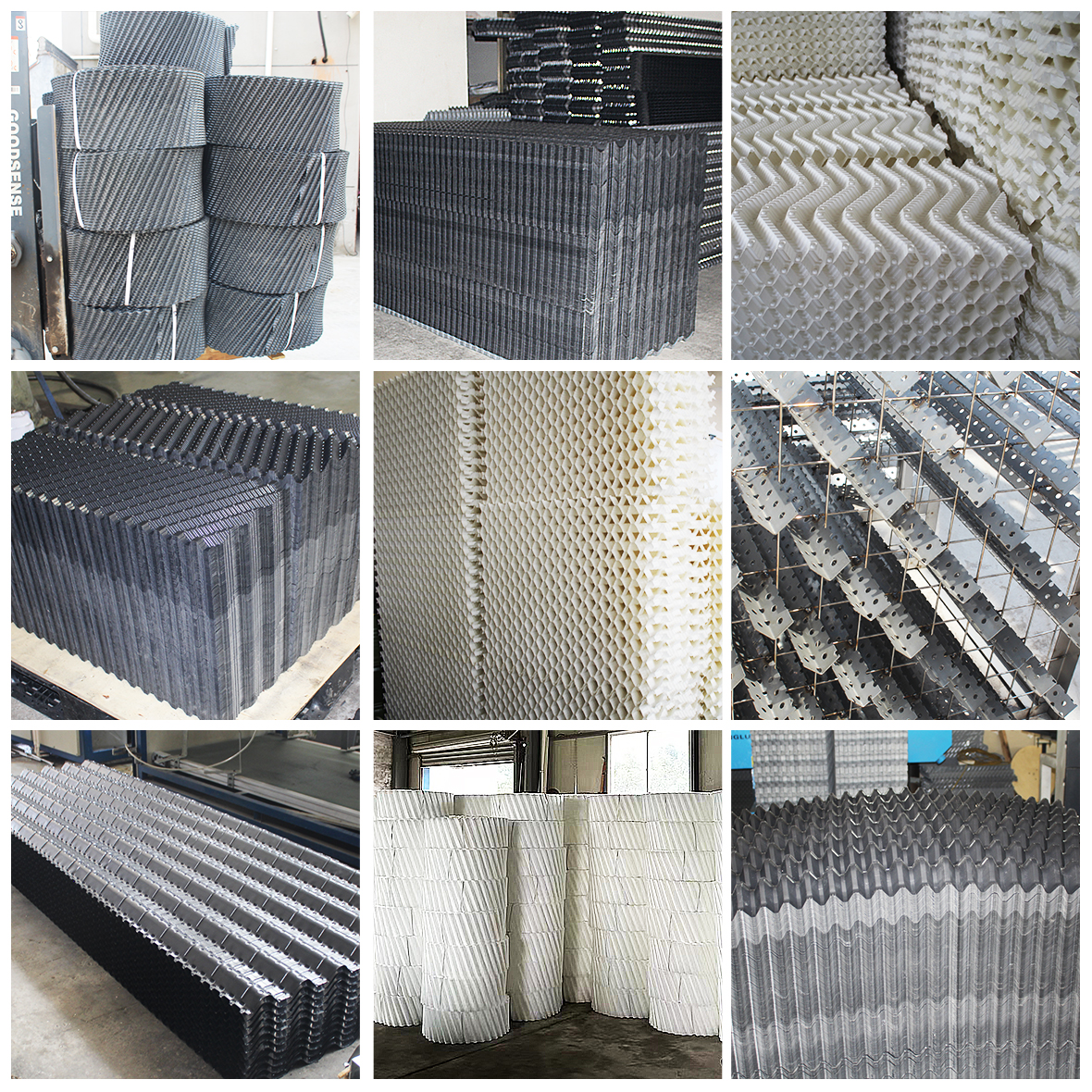
Power Tower Cooling Tower Fill Products
Power Tower provides different types of cooling tower fills designed for different tower structures and operating requirements.
These include:
This product flexibility matters because PVC fills cooling tower projects are not always identical.
One tower may require a particular flute spacing, while another may need a different fill height, pack size, or support configuration.
The goal is not simply to install “PVC fill.”
The goal is to install the right PVC fill.
Key Strengths of Power Tower
One of Power Tower's biggest strengths is its aftermarket and replacement focus.
If you are constructing a brand-new cooling tower, OEM equipment may be the obvious choice. But if you are maintaining an existing tower, the situation can be very different.
You may need to replace only the fill.
You may need to match an old design.
You may need a custom size.
Or perhaps the original fill is no longer available.
In these situations, a specialized cooling tower component supplier can provide a practical alternative.
Power Tower focuses on customized solutions based on technical parameters such as tower type, fill dimensions, operating temperature, water flow, and water conditions.
PVC and PP Cooling Tower Fill Solutions
PVC remains one of the most widely used materials for cooling tower fill material because it provides a practical balance of thermal performance, price, weight, and manufacturability.
PP can be considered for applications involving higher temperatures or more demanding chemical conditions.
The correct material should always be selected according to the actual application rather than assuming one material is universally better.
OEM-Compatible and Replacement Fill
One of the most important considerations in a replacement project is compatibility.
A new fill for cooling tower applications must fit the existing tower structure and work correctly with its water distribution and airflow pattern.
Even a high-quality product can underperform if its geometry is not suitable for the tower.
Power Tower's replacement-oriented approach is therefore particularly useful for maintenance contractors, distributors, engineering companies, and cooling tower owners.
2. Brentwood Industries
Brentwood Industries is another established supplier of cooling tower components and engineered polymer products.
Its cooling tower portfolio includes film fills, splash fills, trickle fills, drift eliminators, louvers, and related components.
Brentwood Cooling Tower Fill Products
Brentwood offers a broad selection of film-fill geometries and splash-fill products.
Its film-fill solutions are designed around different cooling tower requirements, while splash and trickle products provide alternatives for applications where fouling resistance is particularly important.
This variety allows engineers to select fill based on the actual operating environment instead of using one product for every tower.
Brentwood's Main Strengths
Brentwood's major strengths include product breadth and polymer engineering expertise.
Its cooling tower fill solutions focus on balancing:
Heat transfer
Airflow
Water distribution
Fouling resistance
Mechanical durability
This makes Brentwood particularly relevant for industrial applications where cooling towers operate under challenging conditions.
3. SPX Cooling Technologies / Marley
SPX Cooling Technologies, through its Marley brand, is one of the major names in cooling tower technology.
Its portfolio includes film fill, splash fill, hybrid fill, drift eliminators, and other cooling tower components.
Marley Film and Splash Fill
Marley offers different fill technologies for crossflow and counterflow cooling towers.
Its film-fill products spread water over large surface areas, improving air-water interaction.
Its splash-fill products use repeated water impact to generate droplets and distribute water through the tower.
Marley also offers hybrid solutions that combine different fill concepts.
This can be useful when operators want to balance thermal performance and fouling resistance.
Why Marley Is Widely Used
One significant advantage of Marley is OEM compatibility.
If a facility already operates Marley cooling towers, using Marley replacement components can simplify the process of matching the original tower configuration.
For maintenance departments, compatibility can save time and reduce uncertainty.
This becomes particularly important for large industrial cooling systems where relatively small changes in fill geometry can affect performance.
4. Baltimore Aircoil Company (BAC)

Baltimore Aircoil Company (BAC) is another major manufacturer of evaporative cooling equipment and replacement components.
BAC supplies cooling towers and related equipment for commercial, industrial, and process applications.
BAC Replacement Fill Products
BAC provides replacement fill solutions designed around specific cooling tower models and configurations.
Its replacement fill portfolio includes products for crossflow and counterflow applications, with material choices available for different operating requirements.
One important feature of OEM replacement fill is dimensional compatibility.
Instead of treating cooling tower fill as a generic commodity, OEM replacement products are developed around specific equipment designs.
BAC's Main Strengths
BAC's biggest advantage is its system-level understanding of its own cooling towers.
The fill, water distribution system, airflow path, fan system, and tower structure are designed to work together.
For owners who prioritize OEM compatibility, this can be a significant benefit.
BAC is therefore particularly attractive when the goal is to restore an existing BAC tower to its intended operating configuration.
5. EVAPCO
EVAPCO is a global manufacturer of evaporative cooling and heat-transfer equipment.
Its products serve applications including HVAC, industrial refrigeration, process cooling, and power generation.
EVAPCO Cooling Tower Fill Products
EVAPCO develops fill solutions for its cooling equipment, including products designed for specific tower configurations.
Its fill products are engineered as part of the overall cooling system rather than simply as independent plastic components.
This integrated approach can be particularly useful when maintaining EVAPCO equipment.
EVAPCO's Main Strengths
The company's major strength is system integration.
When fill geometry, airflow, water distribution, and tower dimensions are engineered together, the result can be a more predictable cooling system.
For customers operating EVAPCO towers, compatible components can therefore simplify maintenance and replacement planning.
Cooling Tower Fill Manufacturer Comparison
Choosing among these five manufacturers depends on what you actually need.
Power Tower Cooling Technology stands out for its focus on cooling tower parts, replacement fill, PVC and PP options, and customized solutions.
Brentwood Industries offers a broad engineered portfolio covering film, splash, and trickle fill technologies.
SPX Cooling Technologies / Marley provides extensive OEM and aftermarket solutions, particularly for Marley cooling tower equipment.
BAC is particularly relevant when factory-compatible replacement is the priority.
EVAPCO is attractive for customers who want components engineered as part of an integrated evaporative cooling system.
Ultimately, the best supplier depends on your tower type, water quality, fill geometry, operating temperature, cooling duty, budget, and replacement requirements.
PVC Cooling Tower Fills vs. PP Fill
Material selection can have a major impact on cooling tower fill performance and service life.
The two materials commonly considered for many applications are PVC and PP.
When PVC Fill Is the Better Choice
PVC cooling tower fills are widely used because they offer a practical balance of thermal performance, price, weight, and manufacturing flexibility.
PVC can be formed into complex corrugated structures that provide a large surface area for water distribution and air-water contact.
For conventional HVAC and many industrial applications, PVC is often a reasonable starting point.
That is why searches for cooling tower PVC fills, PVC filling cooling tower, and PVC fill media are common among cooling tower buyers.
When PP Fill Makes More Sense
PP may become more attractive in applications where higher temperatures or certain chemical conditions create additional demands.
However, a more expensive material does not automatically mean better performance.
If a cooling tower operates comfortably within the appropriate range for PVC, a well-designed PVC product may provide an excellent balance of performance and cost.
The material should therefore be selected based on actual operating conditions.
How to Choose the Right Fill for a Cooling Tower
Selecting the right fill packing cooling tower solution requires several technical considerations.
The first question should not be:
“Which fill is cheapest?”
Instead, ask:
“Which fill will provide reliable cooling performance throughout the expected operating life of the tower?”
That small change in perspective can prevent expensive mistakes.
Tower Type: Crossflow or Counterflow
First, determine whether the tower is crossflow or counterflow.
In a crossflow tower, air generally travels horizontally across falling water.
In a counterflow tower, air and water move vertically in opposite directions.
Because the airflow and water-flow arrangements are different, the fill geometry must be compatible with the tower design.
Using the wrong configuration can result in poor water distribution, excessive pressure drop, or reduced thermal performance.
Water Quality and Fouling Risk
Water quality is another major factor.
A tower operating with clean, well-treated water can often take advantage of tightly spaced film fill.
But what happens when the water contains high levels of suspended solids?
The answer is predictable: passages can gradually become blocked.
Scale, dirt, algae, and biological growth can accumulate on the fill surface.
For these applications, a more open fill design or splash fill may be more appropriate.
Temperature and Chemical Conditions
Temperature should also be considered carefully.
Do not look only at normal operating temperature.
Consider maximum temperature, seasonal changes, startup conditions, and possible abnormal operating situations.
Water chemistry matters as well.
Depending on the application, PVC, PP, CPVC, or another material may be more suitable.
Fill Thickness and Flute Geometry
Two products can both be described as “PVC film fill” while having very different performance characteristics.
Why?
Because geometry matters.
Important variables can include:
This is why comparing products solely by material is not enough.
The geometry is effectively the architecture of the fill.
Common Cooling Tower Fill Problems
Even the best cooling tower fill media will eventually require inspection and maintenance.
Several problems appear repeatedly in real-world cooling towers.
Clogging, Scaling and Biological Fouling
Fouling is one of the biggest threats to film fill.
As deposits accumulate, water distribution becomes less uniform and airflow can become restricted.
The fill may still look functional from a distance, but its thermal performance could already be declining.
Regular inspection and proper water treatment are therefore essential.
Deformation and Material Aging
Physical deformation is another warning sign.
Excessive temperature, mechanical stress, chemical exposure, poor support, or long-term aging can cause fill sheets to become brittle or distorted.
Once the original geometry changes, water and air may no longer move through the fill as intended.
At that point, replacement is usually more economical than attempting to restore badly deteriorated media.
How Often Should Cooling Tower Fill Be Replaced?
There is no universal replacement schedule for cooling tower fills.
Service life depends on:
Water quality
Operating temperature
Chemical conditions
Maintenance
Fill material
Tower operating hours
Cleaning practices
Mechanical loading
Instead of replacing fill according to a fixed calendar, inspect it regularly.
Look for:
If the fill has lost its original structure or can no longer provide the required heat transfer, replacement should be considered.
Regular inspection can also help prevent emergency replacement during periods of peak cooling demand.
What Information Should You Give a Cooling Tower Fill Supplier?
Want an accurate quotation and a better replacement recommendation?
Give the supplier as much technical information as possible.
At minimum, provide:
Cooling tower manufacturer and model
Crossflow or counterflow configuration
Existing fill dimensions
Fill height
Fill width and length
Existing fill material
Operating water temperature
Water flow rate
Water quality information
Photos of the existing fill
Photos of the support structure
Required quantity
If drawings or old product specifications are available, provide those as well.
The more information you provide, the easier it becomes for the supplier to identify the correct filler cooling tower solution.
A few clear photographs can sometimes save days of unnecessary communication.
Final Verdict: Which Cooling Tower Fill Manufacturer Is Best?
There is no single best cooling tower fill manufacturer for every project.
Different suppliers have different strengths.
Power Tower Cooling Technology (Shaoxing) Co., Ltd. is a particularly strong option for buyers seeking cooling tower replacement fill, PVC and PP media, customized dimensions, and aftermarket component solutions.
Brentwood Industries stands out for its broad portfolio of film, splash, and trickle fill technologies.
SPX Cooling Technologies / Marley offers extensive OEM and aftermarket solutions, particularly for Marley cooling tower equipment.
BAC is a strong choice when OEM compatibility is the priority.
EVAPCO is particularly attractive for customers who want components engineered as part of an integrated evaporative cooling system.
Ultimately, the best fill is not necessarily the cheapest product or the most famous brand.
It is the fill that matches your tower design, water quality, temperature, airflow, thermal duty, material requirements, and maintenance strategy.
If you are replacing existing fill, providing the supplier with the tower model, fill dimensions, operating temperature, water flow, and photographs of the existing media can make product selection much more accurate.
For customized and replacement cooling tower fills, you can contact Power Tower Cooling Technology (Shaoxing) Co., Ltd. through CoolingTowerPart.com.
The smartest purchase is not simply the fill that looks cheapest on a quotation. It is the fill that fits your tower, matches your operating conditions, resists the problems your water creates, and keeps doing its job long after installation.
Frequently Asked Questions About Cooling Tower Fill
What Is Cooling Tower Fill Media?
Cooling tower fill media is the heat-transfer packing installed inside a wet cooling tower. It increases the contact area between air and circulating water, allowing evaporation and heat transfer to occur more efficiently.
What Is the Difference Between Film and Splash Fill?
Film fill spreads water across structured surfaces to create a large contact area. Splash fill repeatedly breaks falling water into droplets. Film fill is often preferred for clean-water applications requiring high thermal performance, while splash fill can be more suitable where fouling or suspended solids are concerns.
Is PVC Film Fill Better Than Splash Fill?
Not always.
PVC film fill can provide excellent heat-transfer performance in a compact space, but splash fill may be more tolerant of dirty water and suspended solids.
The right choice depends on the tower and operating conditions.
What Is the Best Material for Cooling Tower Fill?
PVC is a popular choice for many standard film-fill applications because of its balance of performance, cost, weight, and manufacturability.
PP may be preferable for certain higher-temperature or chemically demanding applications.
The best material depends on the actual operating environment.
How Long Does Cooling Tower Fill Last?
There is no universal service life.
Water quality, operating temperature, chemicals, UV exposure, cleaning, mechanical stress, and operating hours can all affect fill life.
Regular inspection is more useful than relying on a fixed replacement date.
Can Cooling Tower Fill Be Customized?
Yes.
Cooling tower fill can often be customized according to dimensions, material, pack configuration, flute design, and tower requirements.
Customization is especially useful when replacing fill in older or non-standard cooling towers.
What Is Cooling Tower Fill Used For?
The primary purpose of cooling tower fill is to increase air-water contact inside the tower.
By spreading water into thin films or breaking it into droplets, the fill creates better conditions for evaporation and heat transfer.
Where Can I Buy Replacement Cooling Tower Fill?
Replacement cooling tower fill can be purchased from cooling tower OEMs, specialized fill manufacturers, and cooling tower component suppliers.
For a replacement project, provide the tower model, fill dimensions, photographs, operating temperature, water flow, and water-quality information whenever possible.
That information helps the supplier recommend a product that is compatible with your tower rather than simply selling a generic fill product.


