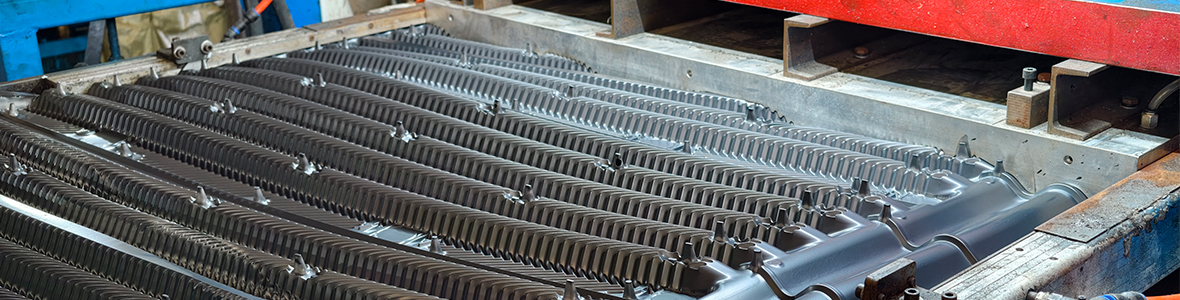
Choosing the right cooling tower fill can make a surprisingly large difference to cooling performance, water distribution, maintenance, and equipment life. Yet cooling tower fill is sometimes treated as nothing more than plastic packing placed inside the tower.
That is a mistake.
Think of cooling tower fill as the stage where the real heat-transfer action happens. Hot water needs maximum contact with moving air, and the fill creates the surface and flow path that makes that contact possible.
Whether you are replacing old fill, upgrading an existing tower, or specifying a new cooling system, understanding how to select and install the right fill is essential.
This guide explains everything you need to know about fill cooling tower selection and installation, including fill types, materials, geometry, water quality, sizing, installation procedures, common mistakes, and maintenance.
For industrial cooling applications, Power Tower Cooling Technology (Shaoxing) Co.,Ltd provides cooling tower fill solutions and related components through coolingtowerpart.com.
What Is Cooling Tower Fill?
Cooling tower fill is the internal heat-transfer media installed inside a cooling tower. Its basic job is simple: spread water into a large contact area while allowing air to pass through it.
Instead of allowing hot water to fall directly into the basin, the fill slows, spreads, separates, or redirects the water. This gives air more opportunity to contact the water and remove heat through sensible and evaporative cooling.
There are two primary approaches.
Film fill creates thin layers of flowing water across closely spaced surfaces. Splash fill repeatedly breaks falling water into smaller droplets as it moves through the fill section.
Both designs have the same basic purpose: increase effective contact between water and air.
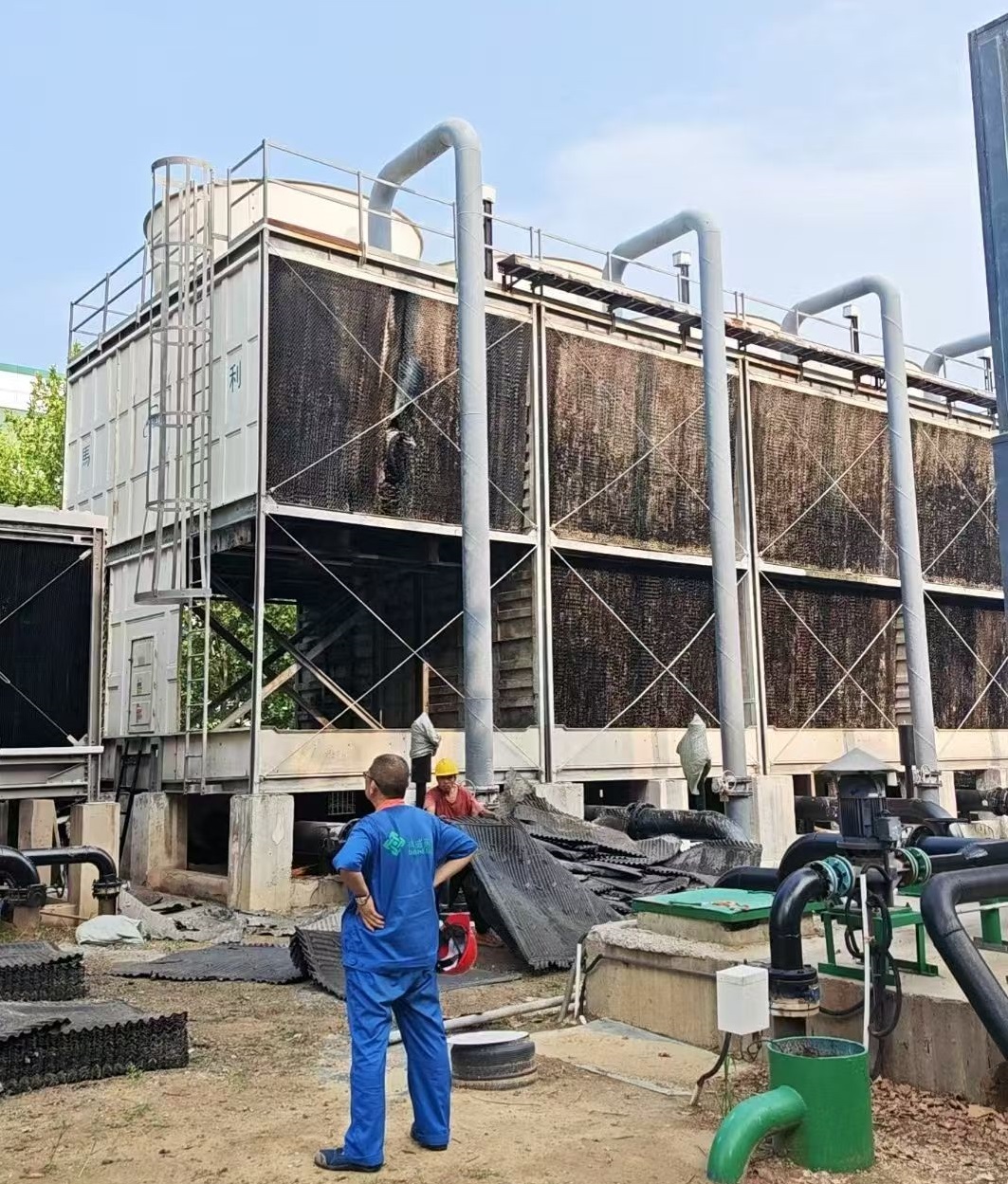
Why Cooling Tower Fill Matters
The fill section is one of the most important functional areas inside an evaporative cooling tower.
If the fill is incorrectly selected, damaged, clogged, or poorly installed, the rest of the system may have to work harder to achieve the required leaving-water temperature.
A properly selected fill can help:
Improve heat transfer
Increase effective water-air contact
Support uniform water distribution
Make better use of available tower volume
Maintain stable cooling performance
Reduce unnecessary operating problems
Support efficient tower operation
The key point is simple: more fill does not automatically mean more cooling.
The fill has to match the tower's airflow, water flow, thermal requirements, and water quality.
How Fill Improves Heat Transfer
Imagine pouring a bucket of water through a cooling tower as one thick stream.
The air has relatively limited contact with that water.
Now imagine spreading exactly the same amount of water into thousands of thin flowing paths. The available contact area increases dramatically.
That is essentially what cooling tower fill does.
It transforms bulk water flow into a controlled pattern of films or droplets, increasing the opportunity for heat and mass transfer between water and air.
The Relationship Between Fill and Cooling Capacity
Cooling performance depends on much more than fill volume.
Water flow, airflow, entering and leaving temperatures, fill geometry, fill depth, water distribution, and operating conditions all interact.
Adding more fill can sometimes provide additional heat-transfer area, but increasing fill depth or density without considering airflow can also increase resistance.
Likewise, if water distribution is poor, some parts of the fill may remain relatively dry while other sections become overloaded.
The goal is not to install the maximum amount of fill.
The goal is to create the right balance between water distribution, airflow, heat-transfer area, and pressure drop.
Main Types of Cooling Tower Fill
The two major categories are film fill and splash fill.
Specialized configurations are also available for applications involving unusual temperatures, water chemistry, or operating conditions.
Choosing between these options should start with the actual application rather than simply looking at the purchase price.
A fill that works extremely well with clean water may not be appropriate for an industrial process with high suspended solids.
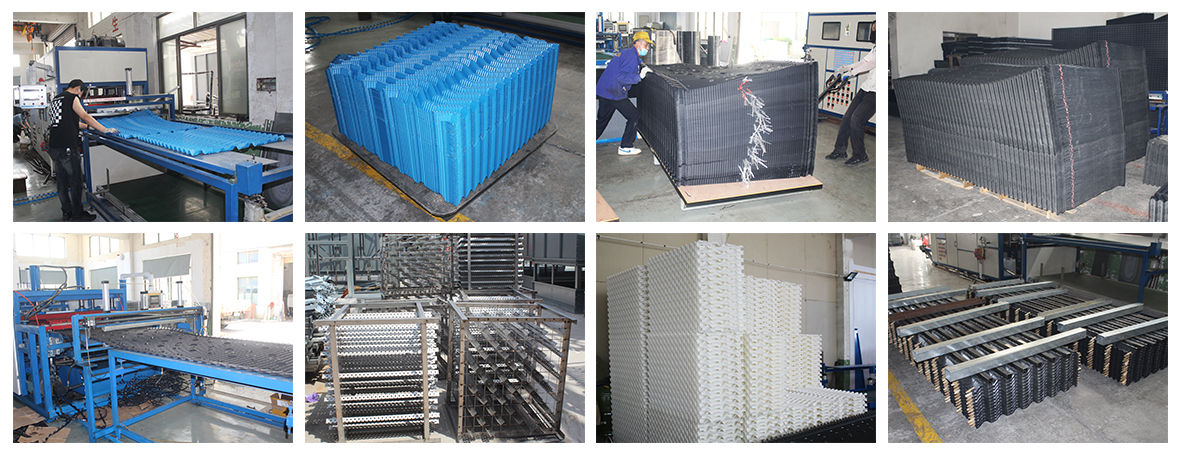
Film Fill
Film fill usually consists of closely spaced sheets manufactured from PVC, PP, CPVC, or other suitable thermoplastic materials.
The sheets are formed with corrugated, cross-fluted, or other engineered patterns that guide water and air through the fill.
As water flows down the surfaces, it spreads into a relatively thin film. This creates a large wetted surface area for contact with air.
Film fill is popular because it can provide high heat-transfer performance within a relatively compact volume.
It is particularly common in modern mechanical-draft and packaged cooling tower applications.
Splash Fill
Splash fill uses a different principle.
Instead of maintaining a continuous water film across closely spaced sheets, splash fill uses bars, grids, or other structures to repeatedly break falling water into smaller droplets.
These droplets expose more water surface to the air.
One major advantage is its relatively open structure. This can make splash fill useful in applications where suspended solids, biological matter, or other contaminants could cause narrow film-fill channels to clog.
Hybrid and Specialized Fill
Not every cooling tower fits neatly into the standard film-versus-splash comparison.
Manufacturers can provide specialized fill configurations using different materials, flute patterns, sheet spacing, thicknesses, and block arrangements.
For example, a particular industrial application may require:
Higher-temperature material
Wider flow passages
Increased fouling resistance
Customized fill depth
Special block dimensions
Different sheet spacing
Improved structural strength
There is no universal “best” cooling tower fill.
The correct solution is the one that matches the operating environment.
Film Fill vs. Splash Fill
So, which should you choose?
The answer depends heavily on the application.
Film fill generally provides high surface-area utilization and efficient heat transfer within a compact space. However, its relatively narrow channels can be more sensitive to fouling and deposits.
Splash fill has a more open structure and can be more forgiving when water contains suspended solids or other contaminants.
That does not mean film fill is only suitable for clean water or that splash fill is automatically the right answer for dirty water.
Water treatment can significantly affect the suitability and service life of either system.
The best selection considers:
| Factor | Film Fill | Splash Fill |
| Heat-transfer efficiency | Generally high | Generally moderate to high |
| Surface-area utilization | High | Lower than film in many designs |
| Fouling tolerance | Application-dependent | Generally more tolerant |
| Suspended solids | Requires attention | Often more forgiving |
| Compact tower design | Excellent | May require more volume |
| Maintenance requirements | Can require careful cleaning | Often easier to access |
| Typical application | Clean or treated water | More challenging water conditions |
How to Select the Right Fill for a Cooling Tower
Before ordering replacement fill, collect as much information about the tower as possible.
At minimum, determine:
Cooling tower type
Tower manufacturer and model
Existing fill dimensions
Fill depth
Circulating-water flow rate
Hot-water temperature
Cold-water temperature
Design wet-bulb temperature
Water quality
Airflow
Operating temperature
Existing support configuration
The more accurate the information, the easier it becomes to select a suitable fill.
Water Quality
Water quality should be one of the first questions in any fill-selection project.
Ask:
Is the circulating water clean?
Does it contain suspended solids?
Is scale a recurring problem?
Is biological growth difficult to control?
Does the water contain oil, grease, or process contaminants?
Film fill has narrow passages, so deposits can progressively restrict water and air movement.
Common problems include:
If water quality is poor, selecting fill solely for maximum thermal performance can backfire.
The fill may perform exceptionally well when new but lose performance quickly if its passages become blocked.
Operating Temperature
Temperature is another important factor.
Different plastics have different temperature capabilities. Standard PVC is widely used for many cooling tower applications, while PP or CPVC may be considered when higher operating temperatures or specific chemical conditions require them.
Always check the manufacturer's actual temperature rating.
Do not assume that every PVC or PP cooling tower fill has identical performance.
Also consider both normal and maximum operating temperatures.
An application that normally runs at a moderate temperature may occasionally experience higher temperatures during startup, process changes, or abnormal operating conditions.
Cooling Tower Design
Is the tower counterflow or crossflow?
Is it mechanical draft?
How is water distributed?
Where does air enter?
Where does air leave?
These questions matter because cooling tower fill is not a standalone component.
It is part of an integrated system.
A fill pack designed for one tower arrangement may not be appropriate for another without modification.
Airflow and Water Flow
Fill must work with the available airflow and water flow.
If water loading is too high for the selected fill configuration, distribution may become uneven.
If fill creates excessive airflow resistance, fan performance can be affected.
This is why fill selection should be based on engineering data instead of simply matching the old fill's dimensions.
Fouling, Scaling, and Biological Growth
Fouling is often the silent performance killer.
A fill may look acceptable from the outside while its internal passages gradually become restricted.
As deposits build up, water distribution changes. Airflow can also become more difficult.
Eventually, cooling performance may decline.
For that reason, water treatment and fill maintenance should be considered part of the original fill-selection strategy.

Choosing the Right Fill Material
After selecting the basic fill type, material becomes the next major decision.
PVC, PP, CPVC, and other engineered plastics can all have a place in cooling tower applications.
The right choice depends on temperature, chemistry, mechanical requirements, and operating conditions.
PVC Cooling Tower Fill
PVC is one of the most widely used materials for cooling tower film fill.
Why?
Because it offers a practical combination of:
PVC film fill can be manufactured with different sheet thicknesses, flute patterns, and spacings to meet different tower requirements.
However, the exact operating limits must always be confirmed with the manufacturer.
PP Cooling Tower Fill
Polypropylene, commonly called PP, may be considered when higher temperature resistance or specific chemical compatibility is required.
PP also provides useful mechanical and chemical properties for selected cooling applications.
When choosing PP fill, consider:
Material selection should always be based on actual application conditions.
CPVC and High-Temperature Applications
CPVC can provide higher temperature capability than standard PVC in appropriate applications.
For high-temperature systems, material selection becomes especially important because temperature can affect the long-term dimensional stability and service life of plastic fill.
Always request technical specifications from the supplier before ordering high-temperature fill.
Understanding Fill Geometry and Sheet Spacing
Look closely at cooling tower film fill and you will notice something interesting.
It is not simply a stack of flat plastic sheets.
The corrugation, flute angle, channel pattern, sheet spacing, thickness, and block arrangement are all engineered features.
These characteristics influence:
Cooling Tower Fill Media Structure
A small change in geometry can influence how water and air interact.
That is why simply copying the physical dimensions of an old fill pack may not always reproduce the original thermal performance.
How to Calculate Cooling Tower Fill Requirements
Fill sizing should be based on the tower's thermal and hydraulic requirements.
A physical measurement is a useful starting point, but it is not the entire calculation.
For replacement projects, measure the existing fill section and determine whether the existing configuration still meets the required cooling duty.
For new projects, fill volume and depth should be established as part of the cooling tower design process.
Measure the Available Fill Area
Measure:
Length
Width
Height
Available fill depth
Also record obstructions such as:
Support beams
Pipes
Nozzles
Structural members
Walls
Access openings
Do not assume that the tower's nominal dimensions equal the actual usable fill area.
Accurate field measurements can prevent expensive cutting and installation problems.
Determine Fill Depth
Fill depth affects both heat transfer and airflow resistance.
More depth can provide additional contact area, but greater depth does not automatically produce better performance.
If the fill is too deep or too restrictive for the available airflow, the system may experience increased resistance.
The correct fill depth should therefore be selected based on the tower's thermal and hydraulic requirements.
Consider Water and Air Loading
Water loading indicates how much water is distributed over the effective fill area.
Air loading describes the amount of air moving through the fill.
Together, these parameters help determine whether the selected fill pattern can operate effectively.
For complex industrial projects, working directly with a cooling tower fill manufacturer can help avoid incorrect assumptions.
Cooling Tower Fill Installation: Step-by-Step Guide
Once the right fill has been selected, installation becomes the next critical stage.
Even an excellent fill product can underperform if it is installed incorrectly.
The basic installation process is straightforward, but every step matters.
Step 1: Shut Down and Isolate the Tower
Before beginning work, shut down the cooling tower according to the site's safety procedures.
Isolate circulating-water equipment, drain water where necessary, and verify that the work area is safe.
Depending on the installation environment, fall protection, electrical isolation, access controls, and confined-space procedures may be required.
Safety should always come before speed.
Step 2: Remove Existing Fill
Remove the old fill carefully.
Avoid damaging:
Fill support beams
Distribution pipes
Spray nozzles
Drift eliminators
Louvers
Structural components
Old plastic fill can become brittle after years of service.
Removing it aggressively can create unnecessary damage to surrounding components.
Step 3: Clean and Inspect the Tower
Once the old fill is removed, clean the fill area thoroughly.
Remove:
Sludge
Scale
Biological deposits
Plastic fragments
Dirt
Other debris
This is also the perfect time to inspect the water distribution system.
Installing new fill on top of unresolved problems simply hides the problem until the next maintenance cycle.
Step 4: Inspect the Fill Support Structure
The support structure carries the fill and operating water load.
Check whether support members are:
Never assume an old support system is automatically suitable for new fill.
Step 5: Install the New Fill Blocks
Install the new fill according to the manufacturer's installation drawings.
Keep the blocks properly aligned and supported.
Avoid forcing blocks into spaces that are too small.
At the same time, do not leave unnecessary openings between modules.
The objective is a stable, continuous fill section that allows air and water to follow the intended paths.
Maintain Correct Fill Orientation
This is one of the easiest details to overlook.
Film-fill modules have a designed channel direction.
Installing them incorrectly can change water flow and airflow characteristics.
Before installation, mark the intended orientation on the modules or prepare an installation drawing.
A few minutes of preparation can prevent major rework.
Minimize Gaps and Air Bypass
Large gaps around walls, beams, or between fill modules can allow air to bypass the intended heat-transfer surface.
That means some of the air is effectively taking a shortcut around the fill.
The result?
Less useful air-water contact.
Use accurate measurements and controlled trimming to achieve the correct fit.
At the same time, do not force oversized blocks into position.
Cooling Tower Fill Installation Example
Step 6: Inspect Water Distribution
New fill cannot compensate for poor water distribution.
Check:
Spray nozzles
Distribution pipes
Flow balance
Spray coverage
Blockages
Damaged components
The objective is to wet the fill as uniformly as practical.
Dry sections represent unused heat-transfer potential, while overloaded areas can create localized fouling and hydraulic problems.
Step 7: Test and Commission the Tower
After installation, restart the cooling tower following the site's commissioning procedure.
Check:
Water flow
Spray pattern
Fan operation
Vibration
Basin level
Entering-water temperature
Leaving-water temperature
Overall cooling performance
Compare the actual operating data with expected design conditions.
A successful installation should provide stable water distribution and the required cooling performance without introducing abnormal airflow or hydraulic problems.
Water Distribution Above Cooling Tower Fill
Water distribution is often underestimated.
Think about it this way: the fill is the road, but the water distribution system decides where the traffic goes.
If water is concentrated in only a few areas, the rest of the fill cannot contribute effectively.
Therefore, when replacing fill, inspect the distribution system at the same time.
Common Cooling Tower Fill Installation Mistakes
Even experienced maintenance teams can make simple installation mistakes.
The most common problems include incorrect orientation, poor support, excessive gaps, blocked channels, and inadequate water distribution.
Incorrect Fill Orientation
If the flute direction does not match the intended airflow and water-flow arrangement, the fill may not perform as designed.
Always follow the supplier's installation instructions.
Do not rely solely on visual judgment.
Poor Support and Excessive Gaps
Fill needs stable support.
If blocks move, sag, or deform, their channels can become distorted.
On the other hand, excessive gaps can create air bypass.
Accurate measurements and proper support solve both problems.
Ignoring Water Distribution Problems
Installing new fill while leaving damaged or blocked nozzles in place is like replacing the tires on a car with a damaged steering system.
The new component cannot solve the underlying issue.
Water distribution should be inspected before and after fill installation.
Using the Wrong Fill for Water Quality
A high-efficiency film fill is not automatically the correct answer for every water source.
If water contains significant suspended solids or persistent contaminants, a more open splash configuration or specialized fill may deserve consideration.
The key is matching the fill to the actual water conditions.
Cooling Tower Fill Installation and Support
The support structure is easy to ignore because it is hidden beneath the fill.
But it is essential.
Before installing replacement fill, inspect beams, grids, brackets, and other structural components.
If the support system is damaged, installing new fill without repairing it can create another failure point.
How to Maintain Cooling Tower Fill
Good maintenance begins with regular observation.
Inspect the fill for:
Scaling
Biological growth
Deformation
Cracking
Clogging
Sediment
Physical damage
Discoloration
Collapsed channels
Water treatment is equally important.
Keeping suspended solids, scaling tendency, and biological growth under control helps preserve the effective heat-transfer area.
Cleaning and Inspection
Cleaning methods should match the fill material and contamination type.
Excessive mechanical force can damage plastic fill.
Unsuitable chemicals can also affect certain materials.
Before cleaning, check the manufacturer's recommendations.
During inspection, pay particular attention to areas where water distribution is poor or where deposits repeatedly accumulate.
When Should Cooling Tower Fill Be Replaced?
There is no universal replacement interval.
The correct replacement time depends on:
Warning signs include severe clogging, deformation, brittle material, collapsed channels, persistent cooling-performance loss, and significant physical deterioration.
Cooling Tower Fill After Replacement
Freshly installed fill should not simply be judged by appearance.
The real test is how the complete cooling tower performs under operating conditions.
Monitor temperatures, water flow, airflow, and distribution after commissioning.
This creates a useful baseline for future maintenance.
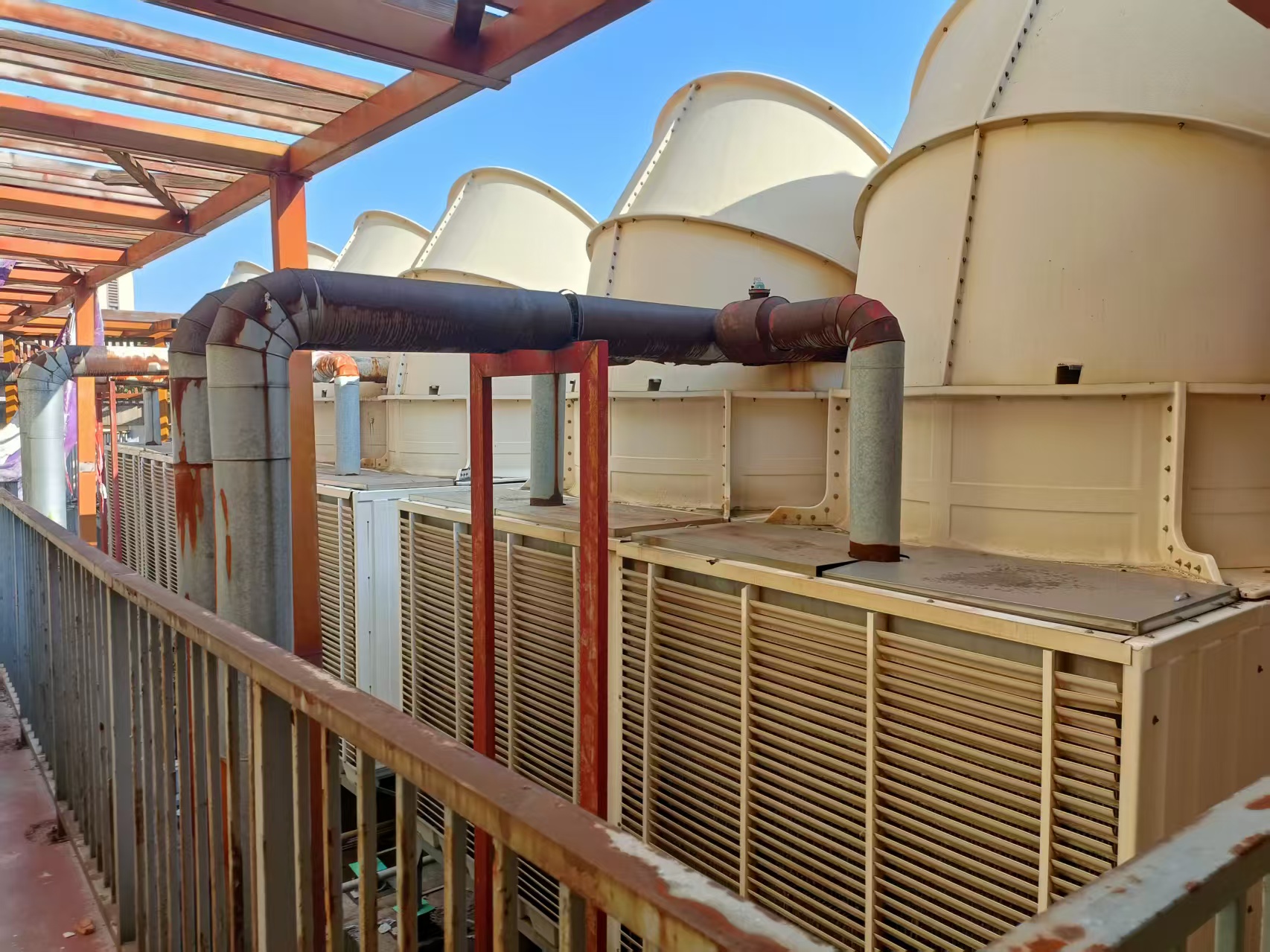
Why Choose a Professional Cooling Tower Fill Manufacturer?
Buying fill based only on dimensions can create problems.
A professional manufacturer should be able to discuss:
Fill type
Material
Sheet spacing
Fill geometry
Block dimensions
Operating temperature
Water quality
Installation orientation
Replacement requirements
More importantly, the manufacturer should understand that fill must work as part of the complete cooling tower system.
For replacement projects, sharing photographs, drawings, dimensions, and operating data with the supplier can make the selection process much more accurate.
Power Tower Cooling Technology: Cooling Tower Fill Solutions
Power Tower Cooling Technology (Shaoxing) Co.,Ltd focuses on cooling tower components and fill solutions for industrial and commercial applications.
Its product information and cooling tower fill solutions are available at:
https://www.coolingtowerpart.com

For buyers searching for fill cooling tower products, the most useful approach is to provide the manufacturer with actual operating information rather than simply asking for a generic fill pack.
Useful information includes:
A factory-direct supplier can also be valuable when a project requires customized dimensions, specific materials, different sheet spacing, special fill depths, or project-specific packing arrangements.
Final Checklist for Fill Cooling Tower Selection
Before placing an order, use this checklist:
✓ Identify the cooling tower type: Counterflow or crossflow.
✓ Confirm existing fill dimensions: Length, width, height, and available depth.
✓ Check water quality: Suspended solids, scaling, biological growth, oil, and other contaminants.
✓ Confirm operating temperature: Normal and maximum temperatures.
✓ Determine water flow: Actual circulating-water flow rate.
✓ Evaluate airflow: Fan capacity and available airflow.
✓ Select fill type: Film, splash, or specialized configuration.
✓ Select material: PVC, PP, CPVC, or another suitable material.
✓ Confirm sheet spacing and geometry: Match the thermal and hydraulic requirements.
✓ Inspect supports: Verify structural condition before installation.
✓ Check water distribution: Inspect nozzles and pipes.
✓ Follow installation orientation: Keep the designed airflow and water-flow directions.
✓ Minimize bypass: Control gaps around blocks and tower walls.
✓ Commission the tower: Check temperature, flow, airflow, and cooling performance.
Conclusion
Cooling tower fill may look like a relatively simple plastic component, but its role is anything but simple.
It controls how water spreads, how air moves through the tower, how much surface area is available for heat transfer, and how effectively the tower uses its available volume.
The right choice starts with the application.
Water quality, temperature, tower configuration, water loading, airflow, fill geometry, material, and maintenance requirements all need to be considered together.
For many clean-water applications, film fill can provide excellent heat-transfer performance in a compact space. For more challenging water conditions, splash fill or another specialized configuration may deserve consideration.
Installation is just as important as selection.
Correct orientation, stable support, controlled gaps, clean channels, and uniform water distribution allow the fill to perform as intended.
In other words, selecting a fill cooling tower solution should never be a simple “buy the same size as before” exercise.
Treat the fill as a critical part of the cooling system, match it to the operating conditions, and work with an experienced manufacturer when the application is complex.
For cooling tower fill selection, replacement, and related components, Power Tower Cooling Technology (Shaoxing) Co.,Ltd provides product solutions through coolingtowerpart.com.
The right fill is not simply the piece of plastic that fits inside the tower.
It is the component that helps the entire cooling system work smarter.


