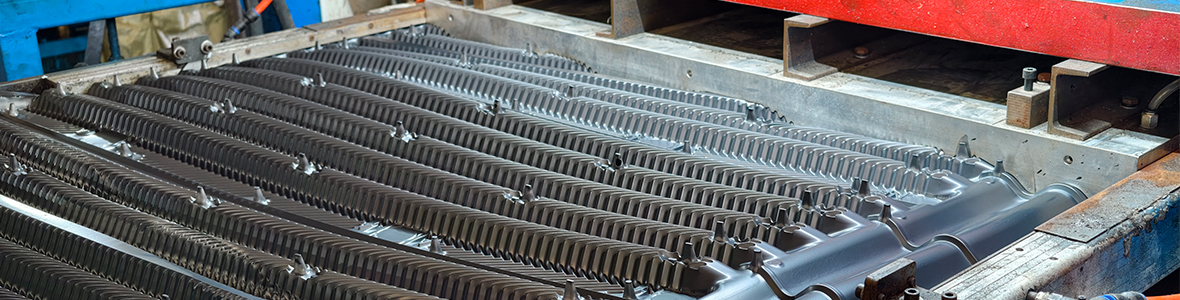
Industrial cooling towers may look simple from the outside, but inside, several components work together to remove heat from circulating water. Among these components, cooling tower infills and drift eliminators play two particularly important roles.
The infill creates a large contact area between hot water and air, helping the tower transfer heat efficiently. The drift eliminator, meanwhile, captures water droplets carried by the exhaust air and returns them to the tower.
So, what happens when these components become damaged, clogged, or incorrectly selected? Cooling performance can decline, water consumption can increase, and maintenance costs can rise.
For industrial cooling tower operators, finding a reliable supplier is therefore about much more than purchasing plastic components. You need the right material, dimensions, configuration, and performance for your specific tower.
Power Tower Cooling Technology (Shaoxing) Co.,Ltd supplies cooling tower infills and drift eliminators for industrial cooling applications, including new tower installations, replacement projects, refurbishment, and customized requirements.
In this guide, we will look at cooling tower infills and drift eliminators in detail, including their functions, materials, applications, selection factors, replacement considerations, and what you should look for when choosing a supplier.
Why Cooling Tower Internals Matter
Think of a cooling tower as a carefully organized heat-exchange machine.
Hot water enters the tower and needs to release heat to the surrounding air. The more effectively the water and air interact, the easier it is for the tower to reject heat.
This is where cooling tower infills become important.
At the same time, the air leaving the tower can carry small water droplets with it. Those droplets represent water that the system has not intentionally evaporated. Excessive water carryover can increase water consumption and potentially carry chemicals or dissolved substances outside the tower.
That is where drift eliminators come into play.
In simple terms:
Cooling tower infills improve water-to-air contact.
Drift eliminators reduce water droplet carryover.
Both components contribute to reliable cooling tower operation.
A cooling tower can have a powerful fan and efficient pumps, but if its internal components are poorly selected or badly maintained, the overall system can still underperform.
What Are Cooling Tower Infills?
Cooling tower infills, also called cooling tower fills or fill media, are internal components designed to increase the contact area between circulating water and air.
Without fill, water would simply fall through the tower relatively quickly. The contact time between water and air would be limited.
The fill changes this situation.
It spreads water over a large surface area and slows its downward movement. Air passes across or through the fill while the water moves over its surfaces. This creates more opportunities for heat and a portion of the water to transfer into the air.
The result is improved heat rejection.
However, not every type of fill is suitable for every industrial application.
When selecting cooling tower infills, you need to consider:
The best cooling tower fill is not necessarily the one with the highest theoretical performance. It is the one that can deliver reliable performance under your actual operating conditions.
Film Fill for Cooling Towers
Film fill is one of the most common types of cooling tower fill.
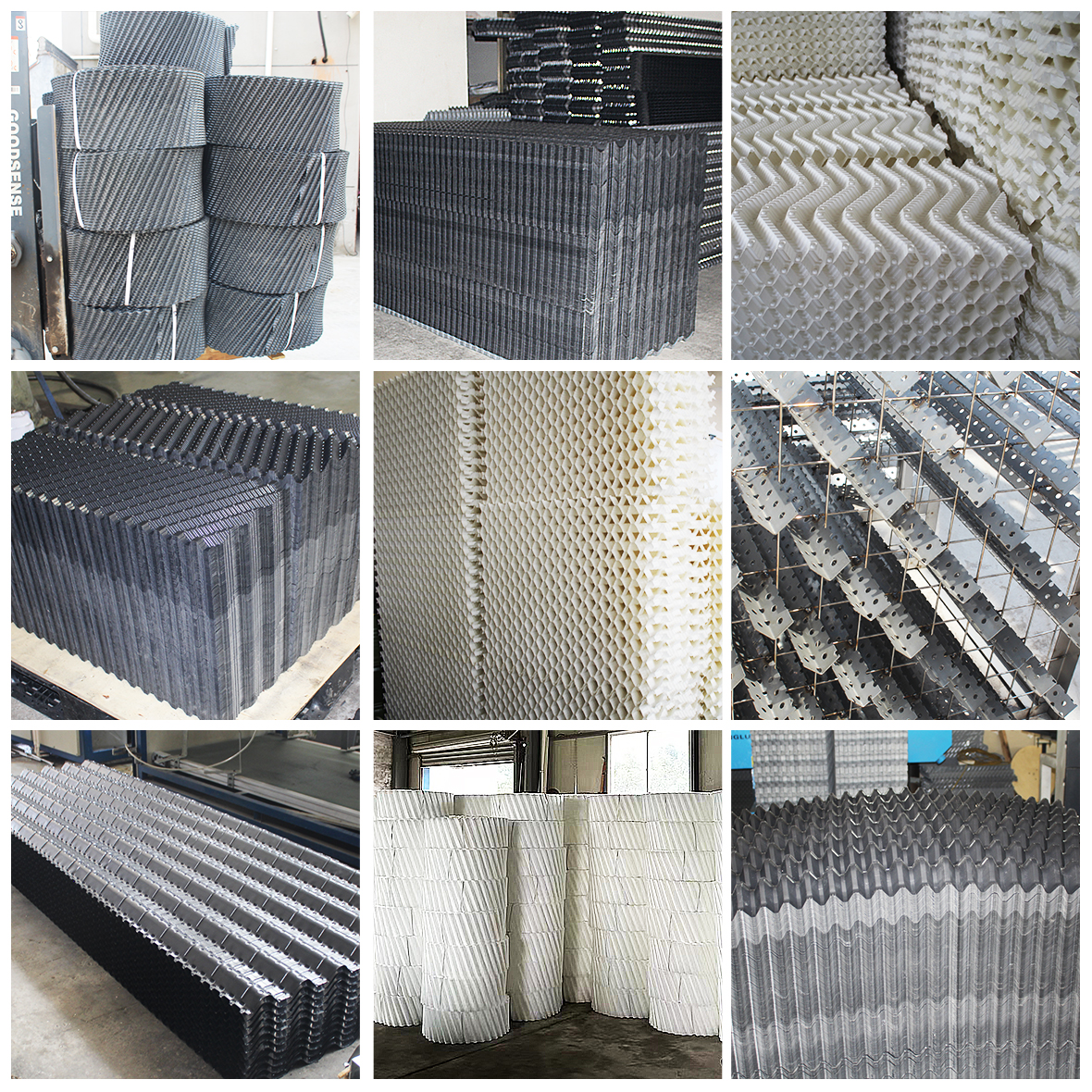
It consists of specially formed sheets with corrugated, embossed, or otherwise structured surfaces. When water enters the fill, it spreads across these surfaces and forms a thin film.
At the same time, air moves through the passages between the sheets.
This creates a large contact area between water and air.
The main advantage of film fill is its ability to provide a high effective surface area within a relatively compact volume.
That makes it attractive for many HVAC and industrial cooling applications.
However, film fill is generally more sensitive to fouling than some splash-fill configurations. If the circulating water contains excessive suspended solids, dirt, biological material, or scale, the narrow passages may gradually become blocked.
That is why water treatment and regular inspection are important.
Splash Fill for Cooling Towers
Splash fill uses a different heat-transfer principle.
Instead of relying primarily on a thin continuous water film, splash fill breaks falling water into smaller droplets as the water passes through the fill.
This increases the water-air contact area and provides opportunities for evaporation and heat transfer.
One major advantage is that certain splash-fill designs can be more tolerant of water containing suspended solids.
For industrial applications where water quality is difficult to control, this can be an important consideration.
Of course, the correct choice depends on the entire cooling tower design. Water loading, airflow, fill height, temperature range, and required cooling performance all need to be considered.
What Are Cooling Tower Drift Eliminators?
Drift eliminators are another essential cooling tower internal component.
Their primary function is to reduce the amount of water carried out of the tower with the exhaust air.
It is important to understand the difference between evaporation and drift.
Evaporation is a fundamental part of the cooling process. Water changes from liquid to vapor and carries heat away from the cooling tower.
Drift, on the other hand, occurs when liquid water droplets physically leave the tower with the moving air.
Those droplets may contain dissolved minerals, treatment chemicals, or other substances from the circulating water.
A properly designed drift eliminator helps capture these droplets and return them to the cooling tower system.
How Drift Eliminators Work
The operating principle is surprisingly straightforward.
Air can change direction relatively easily. Water droplets have greater inertia and cannot follow every sharp change in airflow direction.
A drift eliminator uses specially shaped passages to force the air through a series of directional changes.
As the air turns, water droplets tend to impact the surfaces of the eliminator.
The droplets then combine into larger drops and drain back into the tower.
You can think of the drift eliminator as a filter for liquid droplets, although it does not operate like a conventional porous filter.
Its job is to separate water from air through controlled airflow geometry.
Good drift eliminator design therefore needs to balance several factors:
A highly restrictive design might capture droplets effectively but create unnecessary pressure loss. A poorly designed or damaged eliminator may allow excessive water carryover.
The goal is balance.
Cooling Tower Infills and Drift Eliminators Work Together
Although cooling tower infills and drift eliminators perform different functions, they should be considered as parts of one system.
The infill works primarily in the heat-transfer zone.
The drift eliminator works downstream, helping control liquid water leaving the tower.
Imagine a factory production line.
The cooling tower fill prepares the water-air interaction needed for heat rejection. The drift eliminator then acts as a final checkpoint before the air exits the tower.
If the fill is heavily clogged, thermal performance may suffer.
If the drift eliminator is cracked or missing sections, water carryover may increase.
If both components are old, the tower can experience multiple problems at the same time.
This is why a cooling tower inspection should not focus on only one internal component.
Materials Used in Cooling Tower Infills
Material selection is one of the most important considerations when purchasing cooling tower infills.
Industrial cooling tower fills are commonly produced from thermoplastic materials because they can provide a useful combination of lightweight construction, corrosion resistance, processability, and cost efficiency.
Two commonly considered materials are PVC and PP.
The correct choice depends on the application.
PVC Cooling Tower Fill
PVC, or polyvinyl chloride, is widely used for cooling tower film fill.
It can be formed into complex surface patterns that create extensive water-air contact areas.
PVC cooling tower fill is often selected because it offers a practical balance between:
Thermal performance
Dimensional stability
Corrosion resistance
Manufacturing cost
Ease of forming
It is suitable for many commercial and industrial applications.
However, buyers should always check the actual operating temperature and chemical environment before selecting PVC.
The fact that a material is widely used does not mean it is automatically suitable for every cooling tower.
PP Cooling Tower Fill
PP, or polypropylene, is another useful material for cooling tower fill applications.
It can provide good resistance in applications where operating conditions require characteristics different from standard PVC.
PP is also lightweight and can be processed into different fill configurations.
For industrial cooling towers exposed to specific temperature or chemical conditions, PP may be considered as an alternative material.
The selection should be based on actual operating data rather than simply choosing the material with the lowest purchase price.
Materials Used for Drift Eliminators
Drift eliminators are also commonly manufactured from thermoplastic materials such as PVC and PP.
The material needs to maintain its shape while exposed to water, humidity, temperature fluctuations, and the chemical environment inside the cooling tower.
Why does shape matter so much?
Because the geometry of the eliminator controls airflow direction and droplet separation.
If the material becomes brittle, warped, cracked, or severely deformed, the eliminator may no longer perform as intended.
For this reason, buyers should consider both the material and the actual operating conditions when ordering replacement drift eliminators.
Industrial Applications of Cooling Tower Infills and Drift Eliminators
Cooling towers are used across a wide range of industries.
Typical applications include:
Every application can present different challenges.
For example, a manufacturing plant with relatively clean circulating water may prioritize heat-transfer performance.
A process cooling application with higher levels of suspended solids may place greater emphasis on fouling resistance and maintenance.
A chemical processing facility may need to pay particular attention to material compatibility.
There is no universal solution.
The cooling tower environment determines the appropriate solution.
Crossflow vs. Counterflow Cooling Towers
Cooling tower configuration is another major consideration.
In a counterflow cooling tower, air generally travels upward while water flows downward.
In a crossflow cooling tower, air generally moves horizontally through the fill while water flows downward.
These different airflow arrangements affect the design and positioning of internal components.
The fill dimensions, module arrangement, support structure, water distribution system, and drift eliminator configuration can all vary.
Therefore, never assume that a fill designed for one tower configuration will automatically fit another.
For replacement projects, always provide the tower type and existing component dimensions to the supplier.
How to Choose the Right Cooling Tower Infills
Choosing cooling tower infills should begin with the operating conditions.
Start by identifying the following:
Tower Type
Determine whether the tower is crossflow or counterflow.
Water Flow
The circulating water flow rate affects water loading and fill selection.
Water Temperature
Temperature affects material suitability and cooling performance.
Water Quality
Check suspended solids, biological growth, scaling potential, and other water-quality characteristics.
Required Cooling Performance
The fill must support the required heat rejection under the tower's actual operating conditions.
Available Space
The replacement fill needs to fit the existing tower structure.
The goal is to find a practical combination of thermal performance, durability, maintainability, and cost.
Why Water Quality Is So Important
Water quality can make or break cooling tower fill performance.
A fill that works extremely well with clean water may not perform the same way in a heavily contaminated system.
Suspended solids can accumulate inside fill passages.
Scale can gradually reduce the available flow area.
Biological growth can create additional blockage.
Once passages become restricted, water and air cannot move through the fill as intended.
This can reduce heat-transfer performance and increase maintenance requirements.
That is why cooling tower fill selection should always consider the actual circulating water rather than relying solely on catalog specifications.
How to Choose the Right Drift Eliminators
Selecting drift eliminators requires a similar approach.
Consider:
Tower configuration
Airflow volume
Expected water droplet characteristics
Installation location
Available space
Material compatibility
Pressure drop
Required drift-control performance
Existing support structure
For a replacement project, accurate measurements are particularly important.
A high-quality drift eliminator will not solve the problem if it does not fit the existing tower properly.
Gaps around modules can create bypass paths through which air and water droplets escape.
When Should Cooling Tower Infills Be Replaced?
There is no universal replacement interval for cooling tower fill.
Service life depends on many variables, including:
However, certain warning signs indicate that an inspection is needed.
Look for:
If cleaning cannot restore the fill to a usable condition, replacement may be the more practical option.
Common Signs of Cooling Tower Fill Failure
A cooling tower does not always announce a fill problem with an obvious alarm.
Sometimes the signs are gradual.
The tower may slowly lose thermal performance while the pumps and fans continue operating normally.
You may notice that the system struggles to achieve its target cold-water temperature, particularly during periods of high ambient temperature.
Other warning signs include increased pressure drop, visible fouling, damaged fill packs, or unusual water distribution.
Regular inspection helps identify these problems before they become major operational issues.
When Should Drift Eliminators Be Replaced?
Drift eliminators should be inspected whenever the tower undergoes maintenance or when unexplained water loss occurs.
Replacement may be necessary when eliminators are:
Missing or damaged sections can create direct escape paths for water droplets.
If water consumption suddenly increases without a clear process explanation, drift eliminators should be included in the inspection.
Why Buy Cooling Tower Internals Directly from a Manufacturer?
When you purchase cooling tower components directly from a manufacturer, communication can often be more straightforward.
Instead of simply ordering a generic product, you can provide:
The manufacturer can then evaluate the information and determine an appropriate configuration.
This is particularly useful for older cooling towers where original replacement parts may no longer be readily available.
It can also be valuable for large projects where hundreds or thousands of fill modules or eliminator sections are required.
Custom Cooling Tower Infills and Drift Eliminators
Not every cooling tower uses standard dimensions.
Older towers may have unique configurations.
Replacement projects may also require components that fit existing support structures without modifying the entire tower.
That is where customization becomes useful.
Depending on the project, customization may involve:
Module dimensions
Sheet dimensions
Material
Thickness
Corrugation pattern
Assembly configuration
Support requirements
Installation dimensions
For accurate customization, buyers should provide drawings or measurements whenever possible.
Even clear photographs can be useful during the initial technical discussion.
Quality Control During Manufacturing
Quality control begins with raw materials and continues through the entire production process.
For cooling tower infills, dimensional consistency is important because inconsistent components can make installation more difficult and affect water and airflow distribution.
For drift eliminators, profile accuracy is particularly important.
The shape of the eliminator controls how the air changes direction and how water droplets are separated.
A reliable manufacturing process should therefore include:
Raw material control
Dimensional inspection
Visual inspection
Profile inspection
Assembly checks
Packaging inspection
The finished product should not only look good. It should also match the technical requirements of the cooling tower.

What Buyers Should Ask a Cooling Tower Supplier
Before placing an order, ask practical questions.
For example:
What material will be used?
PVC and PP may both be suitable for certain applications, but the correct selection depends on operating conditions.
What are the exact dimensions?
Dimensions are especially important for replacement projects.
Is the product suitable for crossflow or counterflow towers?
Do not assume compatibility.
What operating temperature is the material designed for?
Temperature can affect material selection and service life.
Can the supplier provide customized dimensions?
This is important for older or non-standard towers.
What information is required for a quotation?
Knowing this in advance can speed up the purchasing process.
Information to Prepare Before Ordering
The more information you provide, the easier it is for a supplier to recommend an appropriate product.
For a cooling tower fill replacement project, prepare:
For drift eliminators, provide similar information along with the existing eliminator profile and dimensions.
Don't have the original drawing?
That's not necessarily a problem.
Accurate measurements and clear photographs can provide a useful starting point.
Cooling Tower Infills and Drift Eliminators Supply for Replacement Projects
Industrial replacement projects often involve much larger quantities than a typical maintenance order.
A customer may need complete fill replacement for one tower, multiple towers at the same facility, or replacement components for a cooling tower refurbishment program.
For these projects, supply capability matters.
The supplier should be able to coordinate:
Product specifications
Production quantities
Manufacturing schedule
Packaging
Transportation
Replacement requirements
Technical communication
Because cooling tower components can be large in volume but relatively lightweight, packaging and logistics also deserve attention.
Proper packaging helps protect the products from deformation and damage during handling and transportation.
Why Choose Power Tower Cooling Technology (Shaoxing) Co.,Ltd?

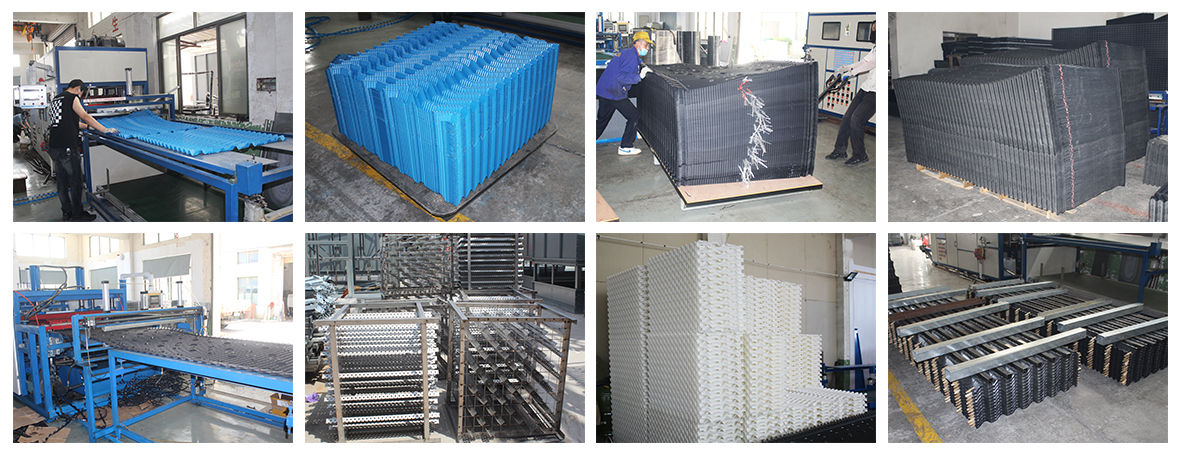
Power Tower Cooling Technology (Shaoxing) Co.,Ltd specializes in cooling tower components and supplies cooling tower infills and drift eliminators for industrial and commercial cooling applications.
The company can support applications involving new cooling towers, replacement projects, refurbishment, and customized requirements.
For industrial buyers, working with a specialized cooling tower component manufacturer provides an opportunity to discuss the application rather than simply purchasing a generic plastic component.
You can provide your tower specifications, drawings, photographs, existing component dimensions, or project requirements for further evaluation.
The supplier can then work with you on the appropriate product configuration, material, dimensions, and quantity.
For more information about cooling tower infills, drift eliminators, and related cooling tower components, visit Power Tower Cooling Technology (Shaoxing) Co.,Ltd — coolingtowerpart.com.
Frequently Asked Questions About Cooling Tower Infills and Drift Eliminators
What are cooling tower infills used for?
Cooling tower infills increase the contact area between circulating water and air. This helps the tower transfer heat more effectively and can improve overall cooling performance.
What do cooling tower drift eliminators do?
Drift eliminators capture water droplets carried by the air leaving the tower. The collected water is redirected back into the cooling tower system, helping reduce water loss.
What is the difference between film fill and splash fill?
Film fill spreads water into thin films over structured surfaces, while splash fill breaks falling water into droplets. Film fill can provide high heat-transfer performance, while certain splash-fill designs can offer greater tolerance to suspended solids.
Is PVC suitable for cooling tower fill?
PVC is widely used for cooling tower fill, particularly film fill. However, its suitability depends on operating temperature, water chemistry, fouling conditions, and tower design.
Can cooling tower infills be customized?
Yes, customized cooling tower infills can be produced for applications requiring specific dimensions, configurations, materials, or installation requirements.
Can drift eliminators be customized?
Yes. Depending on the project, drift eliminators can be manufactured to match specific dimensions and tower configurations.
How do I order replacement cooling tower fill?
Provide the supplier with the tower type, existing fill dimensions, photographs, drawings if available, operating conditions, and required quantity. This information can help the supplier identify a suitable replacement configuration.
Are the same drift eliminators suitable for crossflow and counterflow towers?
Not necessarily. Crossflow and counterflow towers use different airflow arrangements and internal structures. The drift eliminator should therefore be selected according to the specific tower design.
Final Thoughts
Supplying cooling tower infills and drift eliminators is not simply a matter of selecting a plastic component from a catalog.
The right product needs to match the cooling tower, water quality, operating temperature, airflow, installation structure, maintenance strategy, and project requirements.
Cooling tower infills create the conditions needed for effective water-to-air heat transfer, while drift eliminators help control water droplets carried by the exhaust air.
Together, they contribute to the thermal and operational performance of an industrial cooling tower.
If you are building a new cooling tower, upgrading an existing system, or replacing damaged internal components, start with accurate technical information. Measure the existing components, identify the tower configuration, understand your water conditions, and communicate these details to the supplier.
For cooling tower infills, PVC and PP fill media, drift eliminators, replacement components, and customized supply, Power Tower Cooling Technology (Shaoxing) Co.,Ltd provides industrial cooling tower component solutions.
Visit www.coolingtowerpart.com to learn more about the company's cooling tower products and supply capabilities.


