When people talk about cooling tower performance, they often focus on the fan, motor, pump, nozzle, or tower capacity.
But there is another component quietly doing a huge amount of work inside the tower: PVC fill media.
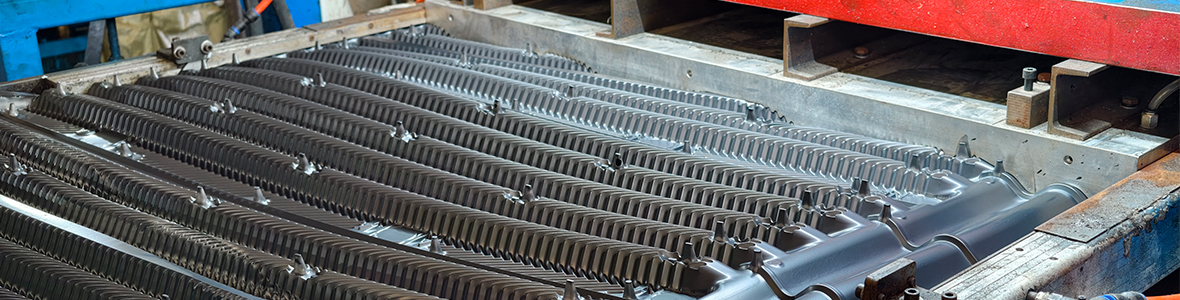
It may look like nothing more than a stack of corrugated plastic sheets. In reality, those sheets create the environment where hot water and moving air interact, allowing heat to leave the circulating water through evaporation and heat transfer.
So, how exactly does PVC fill media work?
Why is PVC so widely used? What is the difference between cross-fluted, herringbone, and other fill designs? And how do you know which PVC fill media is right for your cooling tower?
Let's break it down in simple terms.
What Is PVC Fill Media?
PVC fill media is a heat-transfer material installed inside many wet cooling towers.
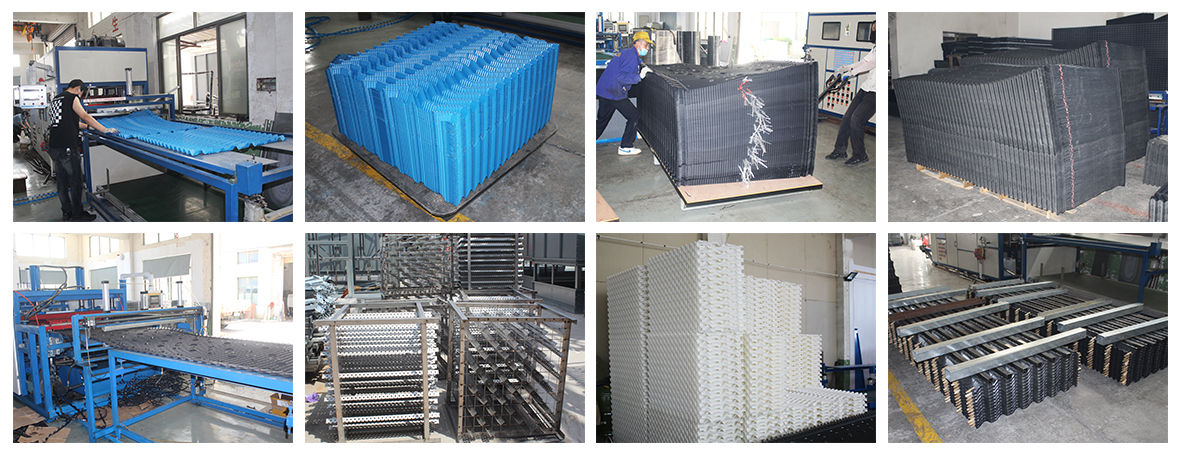
It is commonly made from formed polyvinyl chloride (PVC) sheets. The sheets are shaped into corrugated, fluted, or other structured patterns and assembled into fill packs or modules.
The purpose is straightforward:
Increase the contact area between circulating water and air.
Without fill media, hot water would simply fall through the tower. The water might break into some droplets, but the effective contact area and contact time would be limited.
PVC fill changes the situation.
Instead of allowing water to fall quickly, the structured surfaces encourage it to spread into thin films or controlled flow paths. Air then moves through the fill, creating much more interaction between air and water.
That interaction is where much of the cooling happens.
Why Is Fill Media Important in a Cooling Tower?
Think about pouring one glass of water onto a table.
Now imagine spreading the same amount of water across a large sheet as a very thin layer.
Which one exposes more water to the surrounding air?
The second one.
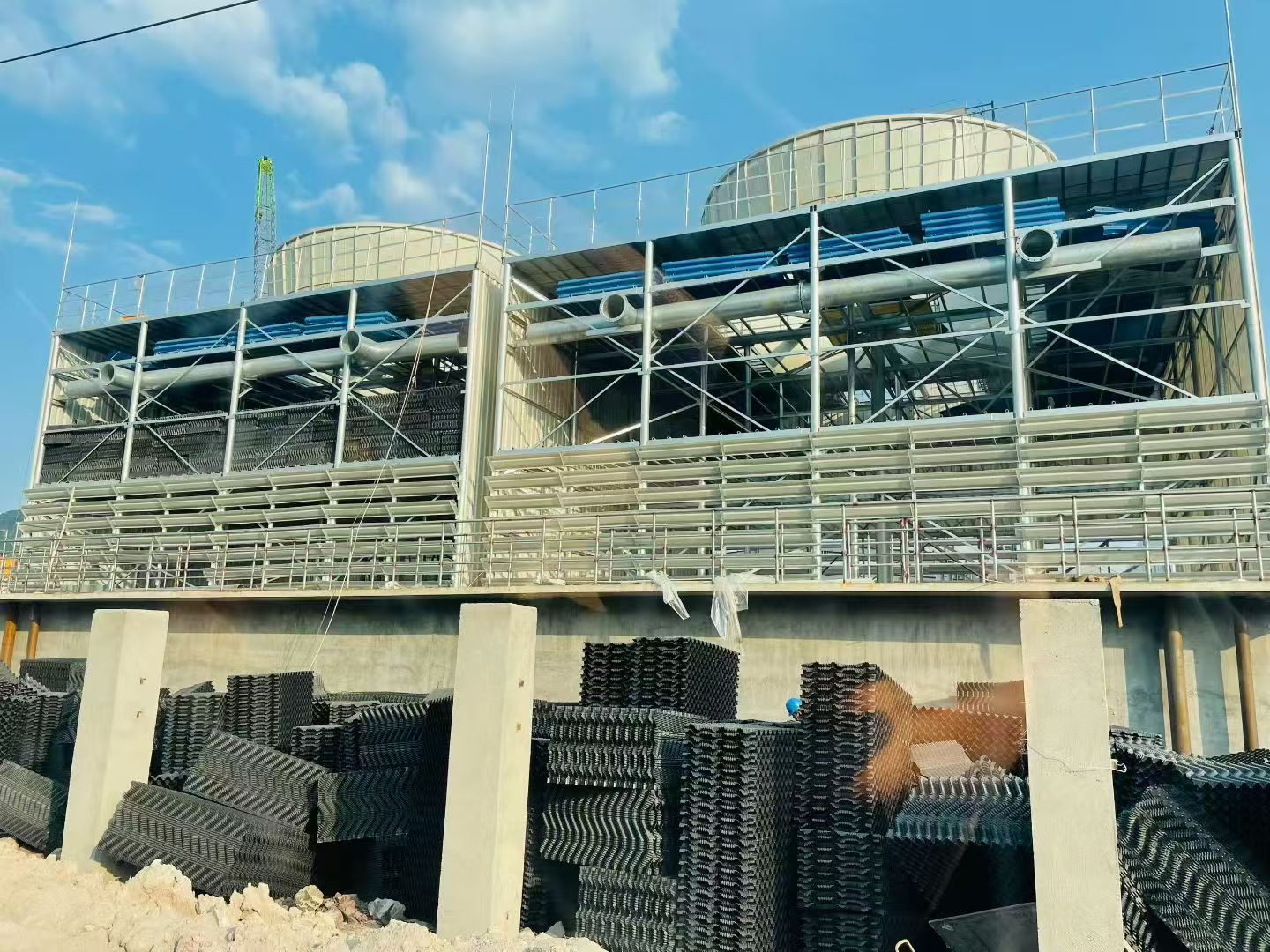
PVC fill media applies the same basic idea inside the cooling tower. It creates a large effective wetted surface within a relatively compact space.
This allows the tower to make better use of its available volume.
How PVC Fill Media Is Structured
PVC fill media is not simply flat plastic.
Its surface is engineered.
Depending on the design, sheets may contain channels, ridges, grooves, corrugations, or angled patterns. These features influence how water spreads and how air travels through the fill.
The geometry needs to balance several competing requirements:
That balance is what separates engineered fill media from ordinary plastic sheets.
How Does PVC Fill Media Work?
The easiest way to understand PVC fill media is to follow the water through the cooling tower.
Step 1: Hot Water Distribution
Hot circulating water enters the cooling tower after absorbing heat from a process, condenser, chiller, or other system.
The water distribution system spreads the water over the upper area of the fill.
Good distribution matters.
If some areas receive too much water while other areas receive too little, the fill cannot operate uniformly.
Step 2: Water Spreads Across the Fill
Once the water reaches the PVC fill, the structured surfaces encourage it to spread.
Instead of a few large streams, water forms thinner films and follows multiple channels through the fill pack.
This increases the amount of water surface exposed to moving air.
The fill is essentially turning one large stream into a much larger network of smaller water paths.
Step 3: Air and Water Come Into Contact
At the same time, air moves through the fill.
Depending on the cooling tower design, air may move upward against the downward flow of water or horizontally across the falling water.
The important point is that the two fluids meet over a much larger effective area than they would without fill.
This creates favorable conditions for heat and mass transfer.
Step 4: Evaporation Removes Heat
Now comes the heart of evaporative cooling.
A portion of the circulating water evaporates into the air.
That phase change requires energy. The energy comes primarily from the water itself, which causes the remaining circulating water to cool.
So the basic process can be summarized like this:
Hot water → PVC fill → larger water-air interface → air movement → evaporation → heat rejection → cooler water
It is a remarkably simple principle, but the fill geometry determines how effectively the tower can use it.
Why PVC Is Used for Cooling Tower Fill Media
Why PVC?
Why not simply use metal, rubber, or another plastic?
PVC has a useful combination of characteristics for many cooling tower applications.
Lightweight and Easy to Handle
PVC fill is relatively lightweight compared with many traditional construction materials.
That matters during installation and replacement.
Workers may need to move, cut, position, and support large quantities of fill inside a tower. Lower weight can make the process easier when the product is properly designed and supported.
Corrosion and Moisture Resistance
Cooling towers are continuously exposed to water, moisture, and treated circulating water.
PVC does not rust like conventional carbon steel.
This makes it attractive for wet environments where corrosion could otherwise become a serious maintenance concern.
Of course, water chemistry still matters. PVC should always be selected according to the actual application rather than assuming that any PVC product will withstand every chemical environment.
Large Effective Heat-Transfer Area
One of the biggest advantages of structured PVC fill is the ability to create a large effective contact area.
The sheets can be formed into detailed patterns without making the overall fill excessively bulky.
This allows the tower to achieve substantial air-water interaction within a relatively compact fill section.
Practical Manufacturing Cost
PVC can be processed into repeatable sheet geometries at industrial scale.
That makes it a practical option for many commercial and industrial cooling applications where buyers need a combination of thermal performance, durability, and manageable cost.
Main Types of PVC Fill Media
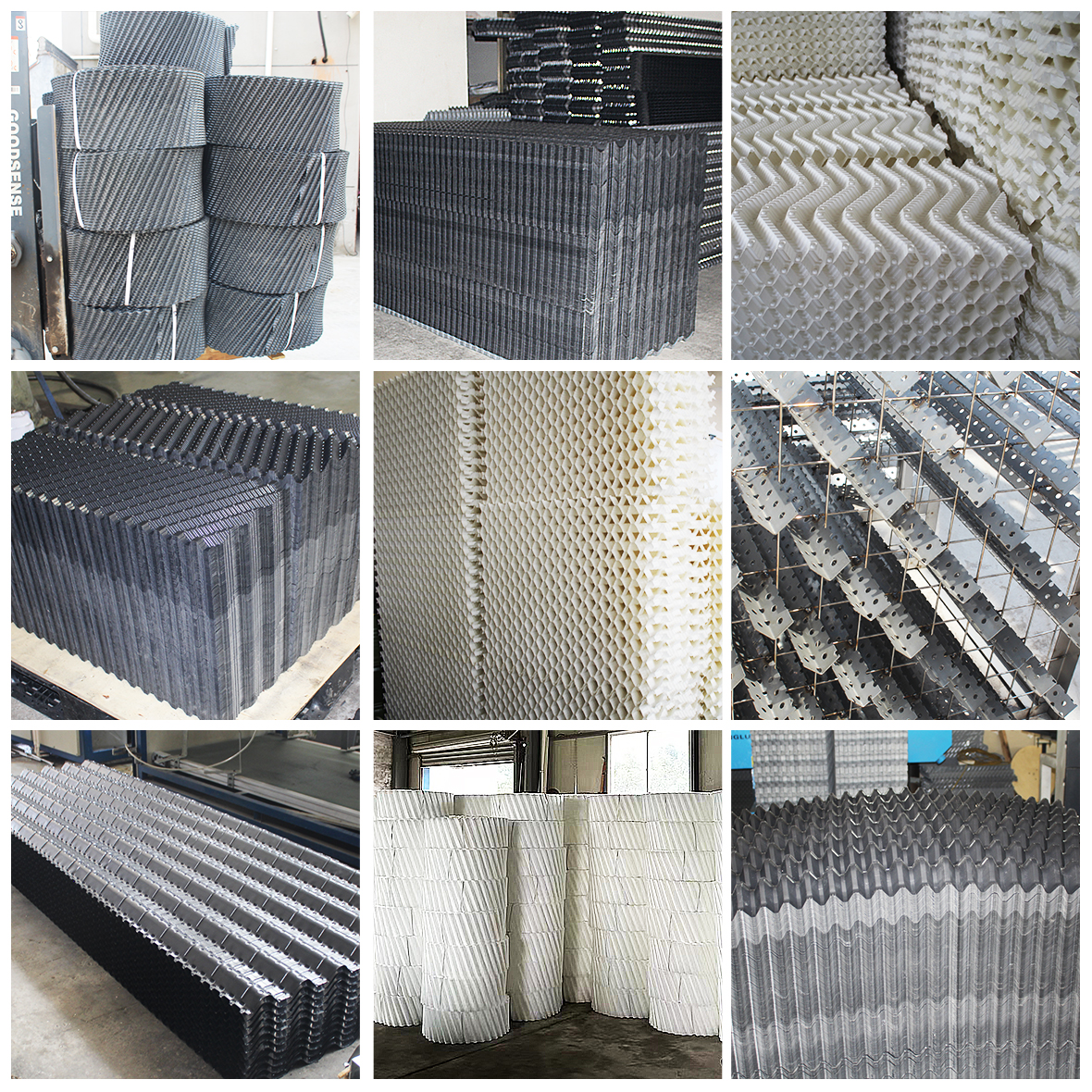
Not all PVC fill media looks or performs the same way.
The geometry is one of the most important differences.
Cross-Fluted Film Fill
Cross-fluted film fill uses intersecting or angled channels to repeatedly redistribute water as it moves through the pack.
The objective is to increase water spreading and air-water interaction.
This design is commonly associated with high-efficiency film-fill applications.
However, the smaller and more complex passages can make water quality particularly important.
If suspended solids or deposits accumulate, the passages can become restricted.
Herringbone Film Fill
Herringbone fill uses angled channels arranged in a pattern that promotes water redistribution.
The design can provide strong thermal performance while allowing manufacturers to tailor the geometry for different applications.
The exact angle, sheet thickness, block dimensions, and operating conditions all influence performance.
Vertical-Fluted Fill
Vertical-fluted designs use more open and vertically oriented flow paths.
One reason to consider this type of geometry is fouling resistance.
When water contains significant suspended solids, very tight film-fill passages may be difficult to maintain.
A more open design can sometimes offer a better balance between cooling performance and resistance to blockage.
Splash Fill
Splash fill works differently from film fill.
Rather than spreading water primarily across a continuous film surface, splash fill repeatedly breaks the water into droplets as it falls through the fill.
This can be useful in applications where water quality is challenging.
However, the correct choice depends on the tower's thermal requirements, water conditions, airflow, and overall design.

PVC Fill Media for Counterflow vs. Crossflow Towers
The cooling tower configuration matters enormously when choosing fill media.
Counterflow Cooling Towers
In a counterflow tower, water generally moves downward while air moves upward.
The two flows travel in opposite directions.
This arrangement creates strong air-water interaction, but the fill must be designed to work with the tower's airflow, water loading, and distribution system.
When replacing counterflow fill, never select the product based only on its height and width.
The geometry matters too.
Crossflow Cooling Towers
In a crossflow tower, air generally moves horizontally across the falling water.
Crossflow towers can use different fill configurations from counterflow towers.
For replacement projects, the fill must match the tower's physical arrangement, water distribution system, support structure, and airflow pattern.
In other words, tower compatibility comes before catalog appearance.
What Factors Affect PVC Fill Media Performance?
PVC fill media performance depends on more than material.
Several variables work together.
Fill Surface Area
More effective surface area can provide more opportunity for air-water interaction.
But maximum surface area is not automatically the goal.
If the design becomes too restrictive, airflow resistance and fouling can become problems.
Water Loading
The amount of water flowing over the fill affects how the media behaves.
A fill designed for one water loading range may not perform as expected when operated far outside that range.
This is why thermal selection should consider actual operating conditions rather than relying only on physical fit.
Airflow
Air needs to move through the fill.
If airflow is too low, heat and mass transfer may suffer.
If airflow resistance becomes excessive, fan energy requirements can increase.
Good fill design therefore seeks a practical balance between contact area and pressure drop.
Fill Height
Fill height determines how much space is available for water-air interaction.
Increasing fill height can provide additional contact opportunity, but more height does not automatically solve every cooling problem.
Distribution, airflow, water loading, and fill geometry still need to work together.
Water Quality
This may be the most underestimated factor.
Ask yourself what is actually circulating through the tower.
If the water contains:
Suspended solids
Scale-forming minerals
Biological growth
Oil
Corrosion products
Other contaminants
then fill selection needs to account for fouling.
A highly efficient fill can lose its advantage quickly if its passages become blocked.
PVC Fill Media vs. PP Fill Media
PVC and polypropylene, or PP, are both used for cooling tower fill.
Neither material is automatically the right choice for every application.
PVC is widely used where its temperature capability, chemical compatibility, mechanical properties, and cost fit the application.
PP can be attractive for applications where its material properties provide an advantage, particularly under more demanding temperature or chemical conditions.
The best approach is to compare the actual specifications rather than choosing based purely on material name.
| Factor | PVC Fill Media | PP Fill Media |
| Typical use | HVAC and many industrial applications | Industrial and demanding applications |
| Weight | Lightweight | Lightweight |
| Corrosion resistance | Good | Very good |
| Thermal performance | Strong when properly designed | Strong when properly designed |
| Temperature suitability | Depends on product | Depends on product |
| Fouling resistance | Depends on geometry | Depends on geometry |
| Cost | Often economical | Can vary by design |
| Replacement availability | Widely available | Widely available |
The material is only one part of the equation.
Geometry + material + water quality + operating conditions = actual performance.
How to Choose the Right PVC Fill Media
Choosing the right PVC fill media does not need to be complicated, but you need the right information.
Check Your Cooling Tower Type
Start with the basics.
Is it:
The answer will narrow down the appropriate fill designs.
Check Operating Temperature
PVC fill is not designed for unlimited temperatures.
Before ordering, identify the actual hot-water temperature and any potential temperature excursions.
Don't use an average temperature if the tower regularly experiences short periods of significantly higher temperatures.
Evaluate Water Quality
Ask your water-treatment team about:
Total dissolved solids
Suspended solids
Scale tendency
Biological activity
Oil contamination
Filtration
Blowdown practices
These details can strongly influence fill selection.
Measure Existing Fill
For a replacement project, measure the existing fill carefully.
Record:
Length
Width
Height
Sheet thickness
Flute pattern
Flute angle
Block arrangement
Support dimensions
Take clear photographs too.
A good supplier can use this information to determine whether a standard product or customized replacement is appropriate.
Consider Fouling Risk
If your tower has a history of clogging, don't simply install the same fill again without investigating why it failed.
You may need to consider a different geometry, improved water treatment, better filtration, or more frequent cleaning.
Replacing the fill without addressing the root cause is like replacing a clogged filter without fixing the dirty air entering the system.
Power Tower Cooling Technology (Shaoxing) Co., Ltd.
For buyers looking for PVC fill media, cooling tower fill, replacement fill, and related cooling tower components, Power Tower Cooling Technology (Shaoxing) Co., Ltd. is a supplier to consider.
The company serves the cooling tower component market through CoolingTowerPart, with a focus on cooling tower fill and replacement components.
Visit Power Tower Cooling Technology / CoolingTowerPart
PVC Fill Media and Replacement Solutions
Power Tower Cooling Technology provides PVC and other cooling tower fill solutions for replacement and new cooling applications.
For buyers, one important consideration is not simply whether a supplier sells PVC fill media, but whether the supplier can understand the existing tower.
A replacement fill project may require matching:
Fill dimensions
Tower configuration
Fill type
Sheet thickness
Flute geometry
Operating temperature
Water conditions
Support structure
This is particularly important when replacing aging fill in an existing tower.
Customized Cooling Tower Fill
Not every cooling tower uses exactly the same fill dimensions.
A customized approach can be useful when the original product is discontinued, when a tower has been modified, or when the buyer needs a replacement configuration that differs from standard dimensions.
For this reason, it is useful to provide the supplier with drawings, measurements, photographs, and operating information before requesting a quotation.
The more information you provide, the less likely you are to receive a product that technically fits the purchase order but performs poorly inside the tower.
Common Problems With PVC Fill Media
Even high-quality fill can experience problems when operating conditions are unfavorable.
Scaling and Clogging
Mineral deposits can accumulate on the fill surfaces.
As the deposits grow, water passages become narrower.
Eventually, the fill may experience:
Reduced water distribution
Higher airflow resistance
Lower heat-transfer performance
Uneven wetting
Increased maintenance requirements
Water treatment is therefore part of fill protection.
Biological Fouling
Cooling towers provide a wet environment where biological growth can occur.
Algae and other deposits can cover the fill surface and restrict passages.
Regular inspection and appropriate water treatment can help reduce the risk.
Cracking and Deformation
PVC fill can also be damaged by:
Excessive temperature
Chemical exposure
Physical impact
Poor support
Aging
Improper installation
Once the original fill geometry is permanently distorted, thermal and hydraulic performance may be affected.
How to Maintain PVC Fill Media
Good maintenance starts with regular inspection.
Look for:
Cleaning methods should be selected according to the fill material and contamination type.
Avoid aggressive cleaning procedures that can damage thin PVC sheets.
And remember: cleaning the fill is only one part of maintenance.
If scaling keeps returning, investigate water chemistry.
If biological growth keeps returning, review water treatment.
If debris repeatedly blocks the fill, investigate filtration and basin cleanliness.
Maintenance works best when you fix the cause, not just the symptom.
When Should PVC Fill Media Be Replaced?
There is no universal replacement interval.
Some cooling towers can operate with fill for many years, while others require replacement much sooner because of harsh water quality, temperature, contamination, or mechanical damage.
Watch for warning signs such as:
If cleaning restores the fill's condition, replacement may not be necessary.
But when the material is structurally damaged or permanently deformed, replacing the fill is usually more practical than trying to repair individual sections repeatedly.
PVC Fill Media Applications
PVC fill media can be used in many evaporative cooling applications.
Common examples include:
HVAC cooling towers
Industrial process cooling
Manufacturing plants
Power generation
Chemical processing
Food and beverage facilities
Commercial buildings
Data center cooling systems
Chilled-water systems
Replacement cooling tower projects
The exact fill design should always be matched to the application.
A fill designed for a clean HVAC system should not automatically be transferred to a heavily contaminated industrial process.
Final Buying Checklist
Before purchasing PVC fill media, ask these questions:
What type of cooling tower do I have?
Is it counterflow or crossflow?
What is the circulating water temperature?
What is the water flow rate?
What is the required cooling duty?
What is the water quality?
Does the tower have a history of fouling?
What are the existing fill dimensions?
What type of fill is currently installed?
What support system is being used?
Is standard or customized fill required?
Can the supplier provide technical specifications?
Does the fill match the tower's airflow arrangement?
What maintenance conditions should be expected?
Answer these questions before comparing prices.
You'll have a much better chance of selecting a fill that actually works for your tower.
Frequently Asked Questions
How long does PVC fill media last?
The service life varies according to water quality, operating temperature, air quality, water treatment, mechanical conditions, and maintenance. There is no single replacement interval that applies to every cooling tower.
Is PVC fill media suitable for industrial cooling towers?
Yes. PVC fill media is used in many industrial cooling applications, provided the selected product is compatible with the tower's temperature, water chemistry, loading, airflow, and fouling conditions.
Can PVC fill media be customized?
Depending on the manufacturer, PVC fill can be produced or supplied in different dimensions, configurations, thicknesses, and geometries. Customized replacement solutions can be particularly useful for older cooling towers.
Is PVC fill better than PP fill?
Not universally. PVC and PP have different material properties and application ranges. The correct choice depends on temperature, water chemistry, mechanical requirements, fill geometry, and project budget.
What is the main purpose of PVC fill media?
Its primary purpose is to increase the effective contact area between water and air. This improves the conditions for heat and mass transfer and supports evaporative cooling.
Can clogged PVC fill media be cleaned?
In many cases, yes. The appropriate cleaning method depends on the type and severity of contamination. However, severely damaged, brittle, or permanently deformed fill may need to be replaced rather than cleaned.
Where can I buy PVC fill media for a cooling tower?
For PVC fill media and cooling tower replacement components, buyers can contact Power Tower Cooling Technology (Shaoxing) Co., Ltd. through CoolingTowerPart.
www.coolingtowerpart.com
Conclusion
PVC fill media is one of those cooling tower components that is easy to overlook.
Yet inside the tower, it plays a central role.
It spreads water, increases the air-water interface, creates controlled flow paths, supports evaporation, and helps the cooling tower reject heat.
The important thing is to remember that PVC fill media is not a one-size-fits-all product.
The right choice depends on tower type, fill geometry, water loading, airflow, temperature, water quality, fouling risk, and replacement dimensions.
If you are replacing existing fill, don't start with price.
Start with measurements.
Start with water quality.
Start with the tower.
Then choose the PVC fill media that fits the actual operating conditions.
That is how a simple-looking plastic component becomes a reliable part of an efficient cooling system.


