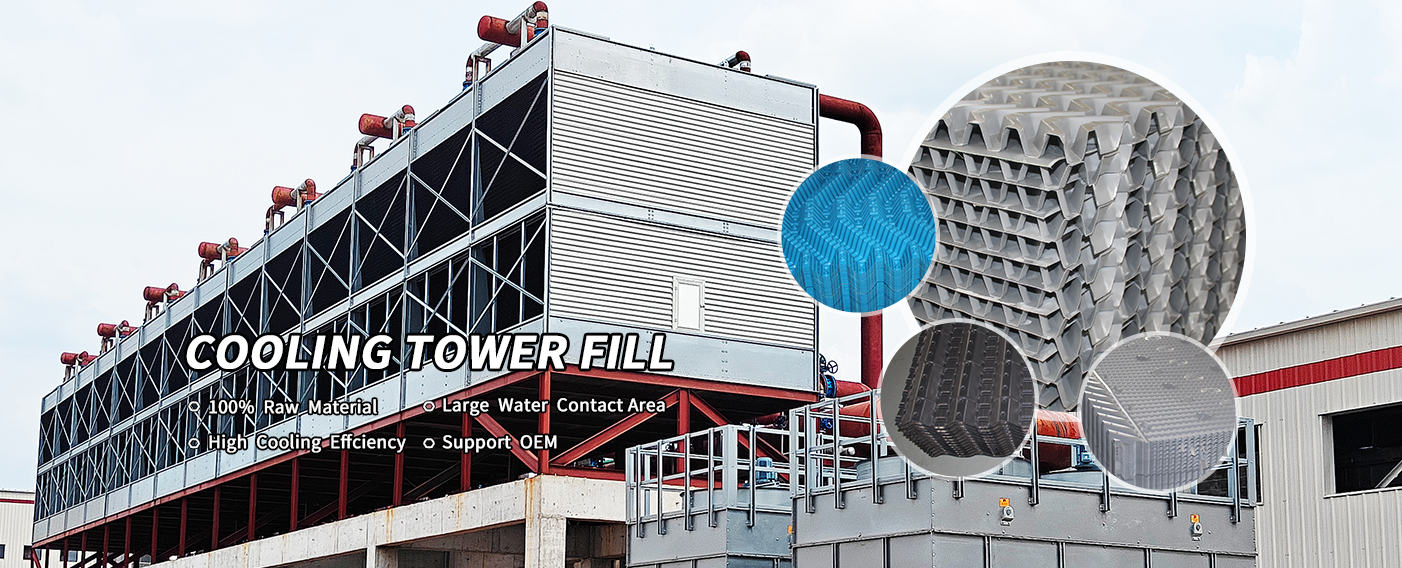
When a cooling tower starts losing its cooling performance, the problem is not always the fan, motor, pump, or water distribution system. Sometimes, the real issue is hidden inside the tower: the cooling tower fill has become fouled, scaled, damaged, deformed, or simply reached the end of its service life.
For companies searching for a reliable Brentwood cooling tower fill replacement, choosing the right replacement is an important decision. The fill is not just a plastic component. It is one of the most important heat-transfer elements inside a cooling tower, directly influencing water distribution, air contact, heat transfer, and overall cooling efficiency.
Power Tower Cooling Technology (Shaoxing) Co.,Ltd. provides cooling tower fill solutions for replacement, retrofit, and new cooling tower applications. With PVC and PP cooling tower fill options, customized dimensions, and factory-direct manufacturing, Power Tower helps customers find practical alternatives for existing cooling tower systems.
If your current Brentwood cooling tower fill needs to be replaced, the goal should not simply be to find something that looks similar. The real goal is to find a replacement that fits the tower, matches the operating conditions, and delivers the required cooling performance.
Why Cooling Tower Fill Matters
Cooling tower fill creates the environment where hot circulating water and moving air interact. Its primary purpose is to increase the effective contact area between water and air, allowing heat to be transferred more efficiently through evaporation.
Without properly designed fill, water would simply fall through the tower too quickly. The available contact time and surface area would be limited, reducing the tower's ability to reject heat.
Think of cooling tower fill as turning one large stream of water into thousands of smaller pathways. Instead of allowing water to rush directly into the basin, the fill spreads and slows the water while air passes through it.
This simple idea has a major impact on cooling tower performance.
A properly selected fill can help provide:
Better water distribution
Greater water-air contact
Improved heat transfer
Appropriate airflow characteristics
Stable cooling performance
Efficient use of the available fill volume
However, fill selection is always a balance. A design that provides excellent heat transfer under clean-water conditions may not be the best choice for a system with heavy fouling or high suspended solids.
The Basic Heat-Transfer Principle
The basic principle behind a cooling tower is straightforward:
Hot water + water-air contact + moving air = heat rejection.
Hot water enters the tower and is distributed over the fill. As the water travels through the fill, air moves through the same area. A small amount of water evaporates, and this evaporation carries heat away from the circulating water.
The greater the effective interaction between water and air, the more opportunity the system has to transfer heat.
But there is an important catch.
More surface area is not automatically better.
If a fill design creates excessive airflow resistance, the cooling tower fan may need to work harder to move air through the tower. If the fill passages are too narrow for the water quality, deposits may accumulate and gradually restrict both air and water movement.
That is why selecting Brentwood cooling tower fill replacement should involve more than comparing dimensions or prices.
Film Fill vs. Splash Fill
Cooling tower fill is generally divided into two major categories: film fill and splash fill.
Film fill uses structured sheets or channels to spread water into relatively thin films. This provides a large effective surface area for heat transfer within a relatively compact volume.
Splash fill works differently. Instead of creating a continuous thin film, it repeatedly breaks falling water into droplets as the water moves through the fill.
Both approaches have their place.
Film fill is commonly selected when high heat-transfer performance and compact design are important. Splash fill can be attractive in applications where water quality, suspended solids, or fouling are significant concerns.
Therefore, if an existing Brentwood cooling tower uses film fill, replacing it with another film-fill design may be appropriate—but the exact replacement should still be evaluated according to the tower's operating conditions.
What Is Brentwood Cooling Tower Fill?
Brentwood cooling tower fill refers to engineered heat-transfer media used in cooling towers. Brentwood offers a range of film-fill designs, including different flute geometries developed for different thermal and operating requirements.
This is an important point for anyone searching online for a Brentwood cooling tower fill replacement.
Not all cooling tower fill is the same.
Two products may both be described as "PVC film fill" while having different:
So, simply finding a product with the same general appearance is not enough.
A proper replacement needs to be evaluated according to the existing tower configuration and application.
Brentwood Film Fill Designs
Different fill geometries are designed to achieve different performance characteristics.
Cross-fluted designs, for example, use structured channels that encourage water to spread and interact with the air. Other designs use larger or more vertically oriented passages to provide additional resistance to fouling in suitable applications.
This difference becomes particularly important when replacing old cooling tower fill.
Suppose your existing fill has repeatedly become blocked by sediment. Installing another fill with similar narrow passages may simply recreate the same problem.
On the other hand, if your system uses relatively clean water and requires maximum thermal performance within a limited fill volume, a tighter film-fill design may be more appropriate.
The correct solution depends on the application.
Cross-Fluted and Vertical-Fluted Designs
Cross-fluted fill is generally designed to promote water spreading and strong water-air interaction. It can provide high heat-transfer performance when used under suitable operating conditions.
Vertical-fluted designs typically provide larger and more open flow passages. In applications with a higher fouling risk, this type of geometry can be worth considering because maintaining open passages is essential for long-term performance.
The key lesson is simple:
There is no universal cooling tower fill that is perfect for every tower.
The best replacement is the one that balances thermal requirements, water quality, airflow, dimensions, and service conditions.
Why Consider a Brentwood Cooling Tower Fill Replacement?
Cooling tower fill is exposed to water, air, chemicals, biological activity, sediment, and temperature changes every day.
Over time, several problems can develop.
The fill may become:
When this happens, water may no longer distribute evenly through the fill.
Airflow can also become restricted.
The result can be reduced cooling capacity, higher operating costs, unstable tower performance, or difficulty maintaining the required cold-water temperature.
In many cases, replacing the fill can restore the useful life of an existing cooling tower without replacing the entire tower structure.
Common Signs Your Fill Needs Replacement
How do you know whether your cooling tower fill needs attention?
Look for several warning signs.
One of the most obvious is reduced cooling performance. If the tower used to reach the required cold-water temperature but now struggles to do so, the fill should be inspected along with the other major components.
Visible deposits are another warning sign.
If the fill passages are heavily covered with scale, mud, algae, or other deposits, the available water-air contact area may be significantly reduced.
Physical damage is also important.
Broken sheets, sagging blocks, collapsed sections, and unusual deformation can change the designed water and airflow paths.
Other symptoms can include:
Uneven water distribution
Increased airflow resistance
Excessive sediment accumulation
Repeated cleaning requirements
Reduced cooling capacity
Unexpected changes in tower operating conditions
Of course, poor cooling performance does not automatically mean the fill is the problem. Fans, pumps, nozzles, water distribution systems, drift eliminators, and water chemistry should also be checked.
Good diagnosis comes before good replacement.
Fouling, Scaling, and Physical Damage
Fouling is one of the most common challenges associated with cooling tower fill.
When suspended solids, biological material, minerals, or other contaminants accumulate inside the fill passages, the available flow area becomes smaller.
Imagine trying to breathe through a clean ventilation filter compared with one covered in dust. The difference is obvious.
Cooling tower fill works in much the same way.
A partially blocked fill can interfere with both water and airflow. Once the passages become restricted, cleaning may become increasingly difficult.
This is why water treatment and fill selection need to be considered together.
If an old fill failed because of severe fouling, replacing it with an identical design without addressing the underlying water-quality issue may only postpone the problem.
Power Tower Cooling Technology: Your Replacement Partner
Power Tower Cooling Technology (Shaoxing) Co.,Ltd. is a specialized cooling tower component manufacturer providing cooling tower fill and replacement solutions for different applications.
The company focuses on practical cooling tower solutions, including:
PVC cooling tower fill
PP cooling tower fill
Film fill
Splash fill
Counterflow cooling tower fill
Crossflow cooling tower fill
Replacement fill
Customized cooling tower fill
For customers searching for a Brentwood cooling tower fill replacement, Power Tower can evaluate the existing application and provide a replacement solution based on the actual project requirements.
You can learn more about Power Tower's products and services on the official website:
www.coolingtowerpart.com

Factory-Direct Cooling Tower Fill Solutions
Why work directly with a manufacturer?
For standard products, purchasing through a distributor may be sufficient. But replacement projects are often different.
You may have an older tower.
The original documentation may be missing.
The existing fill may have unusual dimensions.
The original product may no longer be available.
Or perhaps the tower has been modified during years of operation.
In these situations, direct communication with a manufacturer can make the process much easier.
Instead of simply asking, "Do you have this product?", you can provide the manufacturer with dimensions, photographs, operating conditions, and application information.
That creates a much stronger basis for selecting the right replacement.
PVC and PP Cooling Tower Fill Options
Material selection is another important part of the process.
PVC is widely used for conventional cooling tower fill applications because it offers a practical combination of cost, performance, chemical resistance, weight, and manufacturability.
PP, or polypropylene, may be considered when the operating environment requires different material characteristics, particularly where higher temperature capability or specific chemical-resistance requirements are important.
But should you always choose PP over PVC?
No.
The right answer depends on the actual application.
A professional manufacturer should consider water temperature, chemical conditions, cooling duty, tower configuration, and expected service environment before recommending a material.
How Power Tower Replacement Fill Compares
When comparing Power Tower with an existing Brentwood cooling tower fill, it is better to think about technical compatibility instead of simply comparing two brand names.
The question should not be:
"Which brand is better?"
A better question is:
"Which replacement solution is suitable for my cooling tower?"
A proper comparison should consider:
A replacement that matches these factors has a much better chance of performing properly.
Compatibility Comes Before Price
Price is important, but compatibility comes first.
Imagine buying a replacement tire because it is cheaper, without checking its diameter or load rating.
It might be inexpensive—but it will not solve the problem.
Cooling tower fill is similar.
A product may fit physically inside a tower while still being unsuitable from a thermal or hydraulic perspective.
That is why Power Tower recommends providing detailed information about the existing fill and operating conditions before selecting a replacement.
A few measurements today can prevent a costly mistake later.
Thermal Performance and Airflow
Cooling tower fill must balance two competing requirements:
Heat transfer and airflow resistance.
Increasing effective surface area can improve water-air interaction, but a highly restrictive structure can also increase the resistance faced by the tower fan.
The best design is therefore not necessarily the one with the highest theoretical surface area.
Instead, it should provide an appropriate balance for the specific tower.
This is particularly important when replacing fill in an existing cooling tower because the original fan, motor, airflow rate, and tower structure may already be fixed.
A replacement fill should work within those existing system limitations.
Water Quality and Fouling Resistance
Water quality can completely change the answer to the question:
"Which cooling tower fill should I choose?"
A tower operating with relatively clean and well-treated water may be suitable for a high-performance film-fill structure.
A tower dealing with high suspended solids, dust, biological growth, or other contaminants may require a more open and fouling-resistant design.
This is why water quality should always be part of the replacement discussion.
If the previous fill failed because of fouling, don't simply replace it and hope for a different result.
Ask why the fouling happened.
Then determine whether the water treatment program, fill geometry, or both need to change.
How to Select the Right Brentwood Replacement Fill
Selecting a replacement fill can be straightforward if you follow a systematic process.
Start with the tower.
Then examine the existing fill.
Finally, evaluate the operating conditions.
This approach is much more reliable than choosing a replacement based only on a product photograph.
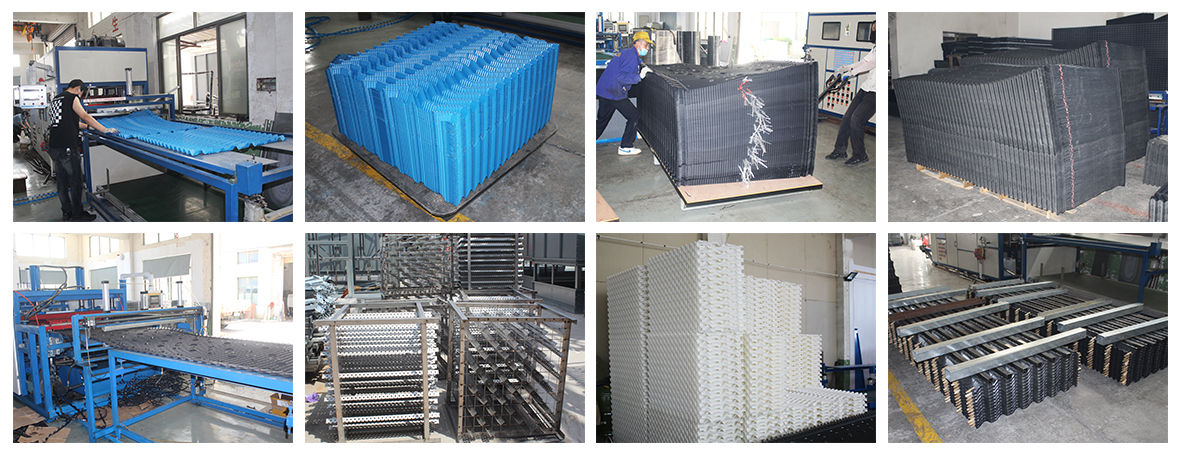
Check Tower Configuration
The first question is:
Is the cooling tower crossflow or counterflow?
In a counterflow tower, air generally moves upward while water moves downward.
In a crossflow tower, air moves horizontally across the falling water.
These different airflow arrangements influence fill geometry, water distribution, support structure, and installation.
Therefore, always identify the tower configuration before selecting replacement fill.
Measure Existing Fill Dimensions
This is one of the most important steps in the entire replacement process.
Measure:
Take clear photographs from different angles.
Also photograph the fill support system.
Why?
Because an old cooling tower may have been modified several times over its lifetime. The current installation may not perfectly match the original design.
Real measurements are therefore more reliable than assumptions.
Review Operating Conditions
Next, gather as much operating information as possible.
Important data includes:
This information allows the manufacturer to evaluate whether the replacement should simply reproduce the existing fill design or whether a different configuration may provide better long-term results.
Information to Send Your Manufacturer
For a faster and more accurate quotation, provide the following information:
Cooling tower manufacturer and model
Crossflow or counterflow configuration
Existing fill dimensions
Required fill height
Water flow rate
Hot-water temperature
Cold-water temperature
Water quality information
Existing fill material, if known
Photos of existing fill
Photos of fill supports
Required quantity
Delivery destination
If you have an old drawing or product specification, send that as well.
The more information available, the fewer assumptions are required.
Installation Considerations for Replacement Fill
Choosing the right fill is only half the job.
Installation matters just as much.
Before installing new fill, the tower should be inspected and cleaned as necessary. Debris, sediment, damaged supports, and other issues should be addressed before the new fill is installed.
The fill should be positioned correctly and supported properly.
Even high-quality fill can underperform if it is installed with excessive gaps, incorrect orientation, poor support, or inadequate water distribution.
Inspect the Fill Support System
Don't focus only on the fill.
Look underneath it.
The support structure must be strong enough to carry the fill and water load while maintaining the correct geometry.
Check beams, grids, hangers, retaining components, and other supporting structures for corrosion, deformation, or damage.
If the support system has deteriorated, replacing the fill without repairing the support structure could create another problem.
A good retrofit considers the entire fill section.
Check Water Distribution Before Startup
Water distribution is critical.
Even the best cooling tower fill cannot perform properly if water is not distributed evenly across it.
Before starting the tower after installation, inspect:
Spray nozzles
Distribution pipes
Headers
Troughs
Blockages
Spray patterns
A blocked nozzle can create a dry section.
A damaged pipe can create excessive water flow in another area.
The result is uneven use of the fill and potentially reduced cooling performance.
The fill and water distribution system should therefore be considered a team.
Maintenance After Installing New Fill
New cooling tower fill should not be treated as a "fit it and forget it" component.
Regular inspection and good water treatment are essential.
The actual maintenance schedule depends on the tower, water chemistry, operating environment, and local maintenance procedures.
But the basic principle is universal:
Prevent small problems from becoming large problems.
Keep Water Treatment Under Control
Scale, biological growth, suspended solids, and chemical imbalance can shorten fill service life.
If the previous fill failed prematurely because of poor water quality, simply installing new fill will not solve the underlying problem.
The new fill may eventually experience exactly the same conditions.
Therefore, a fill replacement project is also an opportunity to review the water treatment program.
Ask:
Is scaling under control?
Is biological growth controlled?
Is suspended solids management adequate?
Are chemical concentrations appropriate?
Is blowdown properly managed?
These questions can have a major impact on fill life.

Inspect Fill During Routine Shutdowns
During scheduled maintenance shutdowns, inspect accessible sections of the fill.
Look for:
Broken sheets
Deformation
Heavy deposits
Blocked passages
Biological growth
Uneven wetting
Sagging sections
Early inspection gives you more options.
You can clean the fill, improve water treatment, correct water distribution, or plan a replacement before the tower experiences a serious performance problem.
Why Choose Power Tower for Brentwood Cooling Tower Fill Replacement?
For companies searching specifically for a Brentwood cooling tower fill replacement manufacturer, Power Tower offers a factory-direct approach focused on cooling tower components and customized replacement solutions.
The company is:
Power Tower Cooling Technology (Shaoxing) Co.,Ltd.
The manufacturer's product range includes cooling tower fill solutions for different applications, including PVC and PP options.
One of the company's advantages is its ability to work from actual project information.
Instead of forcing every customer into a standard dimension, Power Tower can evaluate:
This approach is especially useful for retrofit projects.
Customized Replacement Solutions
Not every cooling tower uses standard dimensions.
Some towers have been operating for decades. Components may have been modified or replaced several times.
The original manufacturer may no longer supply the same fill.
In these situations, customized replacement can be much more practical than searching endlessly for an exact original product.
Power Tower can evaluate customer drawings, dimensions, photographs, and application requirements to develop a suitable replacement solution.
The objective is simple:
Make the replacement work with the existing cooling tower.
Global Industrial Applications
Cooling tower fill is used across a wide range of industries.
These include:
The exact fill design will vary according to the application.
That is why Power Tower focuses on technical requirements rather than using a single product for every customer.
For international customers, factory-direct communication can also simplify discussions about dimensions, materials, quantities, packaging, and delivery.
Frequently Asked Questions About Brentwood Cooling Tower Fill Replacement
Can Power Tower Fill Replace Brentwood Fill?
Yes, Power Tower can provide replacement cooling tower fill solutions for applications where Brentwood fill is currently installed.
However, replacement should be based on technical matching rather than assuming that every fill is a universal one-to-one substitute.
The tower configuration, fill dimensions, material, water flow, airflow, thermal requirements, and water quality should be evaluated before selecting the replacement.
Can I Order Custom-Sized Cooling Tower Fill?
Yes.
Custom dimensions are common in cooling tower replacement projects.
Customers can provide existing fill measurements, photographs, drawings, or other technical information. Power Tower can then evaluate the requirements and provide a suitable customized solution.
Should I Choose PVC or PP Cooling Tower Fill?
It depends on your operating conditions.
PVC is widely used for conventional cooling tower applications because it offers a practical combination of performance, cost, chemical resistance, and manufacturability.
PP may be considered where higher temperature capability or specific chemical-resistance requirements are important.
The best choice should be based on the actual application rather than simply choosing the more expensive material.
What Information Is Needed for a Cooling Tower Fill Quote?
For the most accurate quotation, provide:
Cooling tower type
Crossflow or counterflow configuration
Existing fill dimensions
Required fill quantity
Water flow rate
Operating temperatures
Water quality
Existing fill material, if known
Photos
Drawings, if available
Delivery destination
If you are unsure about any of these specifications, photographs and basic measurements can still be a useful starting point.
Final Takeaway
Choosing a Brentwood cooling tower fill replacement is not simply about finding a similar-looking plastic block.
The right replacement needs to work with the tower's geometry, water distribution, airflow, thermal requirements, water quality, and support structure.
That is why choosing an experienced cooling tower fill manufacturer can make the replacement process much easier.
Power Tower Cooling Technology (Shaoxing) Co.,Ltd. provides PVC and PP cooling tower fill, replacement fill, customized solutions, and cooling tower component products for industrial and commercial applications.
If your existing Brentwood cooling tower fill is fouled, damaged, worn out, discontinued, or no longer providing the required cooling performance, don't guess.
Measure the existing fill.
Collect the operating data.
Take clear photographs.
Then discuss the project with a professional cooling tower fill manufacturer.
A little preparation can make the difference between a replacement that merely fits and a replacement that actually performs.
Power Tower Cooling Technology (Shaoxing) Co.,Ltd.
Cooling Tower Fill | Replacement Fill | PVC & PP Fill | Customized Solutions
Official Website: www.coolingtowerpart.com


