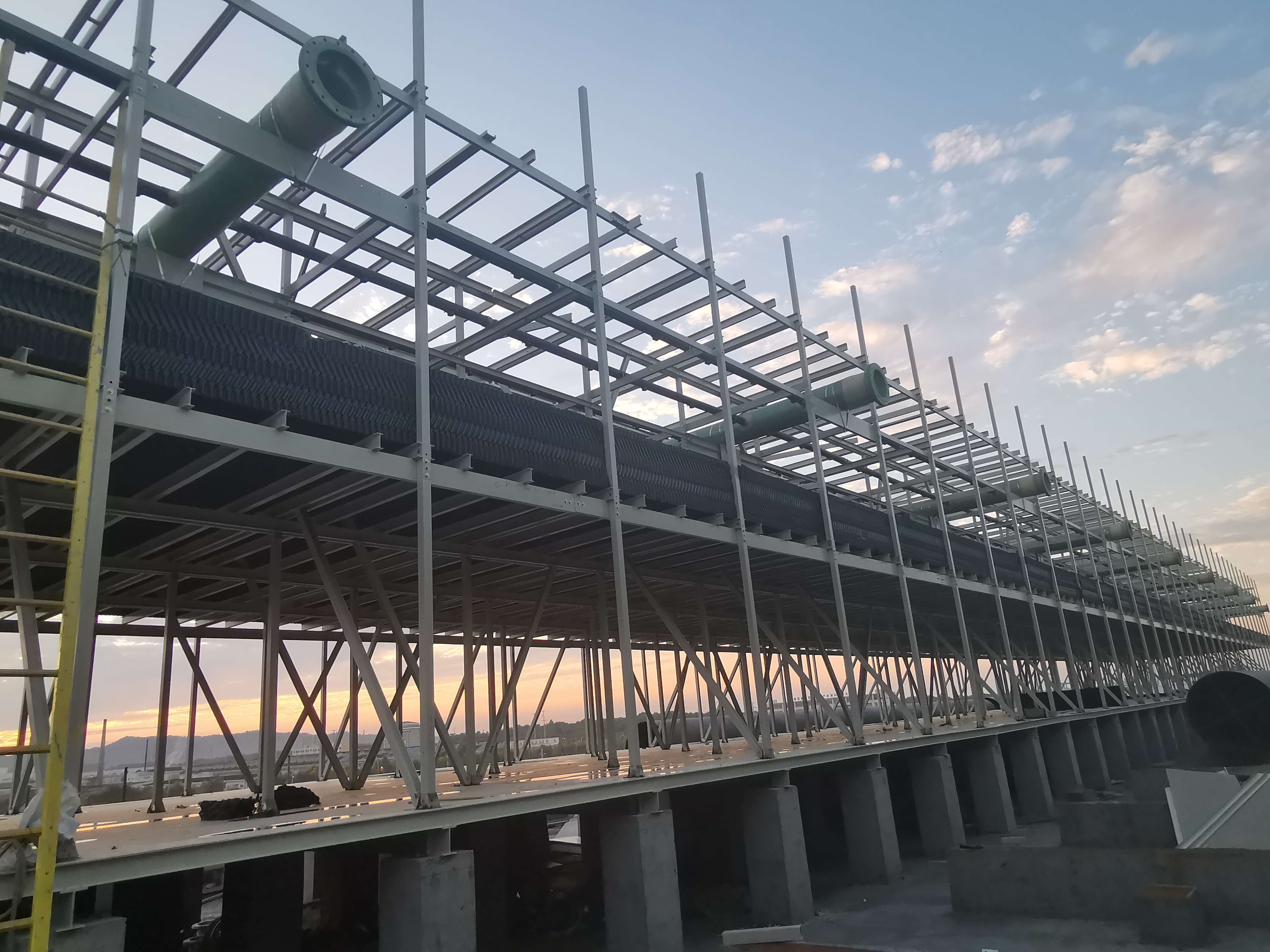
When a cooling tower starts losing cooling performance, the first things people usually check are the fan, motor, pump, or water treatment system.
But there is another component that deserves just as much attention: the cooling tower fill.
The fill is where water and air come into close contact. If the fill is cracked, clogged, deformed, scaled, or simply the wrong design for the tower, cooling performance can drop even when every other component appears to be working normally.
That is why choosing the right cooling tower fill replacement supplier is not simply a purchasing decision. It is a performance decision.
If you are looking for a reliable manufacturer, Power Tower Cooling Technology (Shaoxing) Co.,Ltd is a practical place to start. Power Tower specializes in cooling tower components and replacement solutions, including PVC and PP cooling tower fill for different tower configurations and replacement requirements. Its product range covers counterflow fill, crossflow fill, replacement fill packs, and customized fill solutions.
So, how do you know whether a supplier is actually right for your project?
Let's break it down.
Why the Right Cooling Tower Fill Supplier Matters
Choosing cooling tower fill is a little like choosing tires for a truck.
A product may physically fit, but that does not mean it is the right choice for the road, load, temperature, or operating conditions.
Cooling tower fill works the same way.
The replacement fill needs to match the tower's:
A supplier that only sells standard fill blocks may not be enough for a replacement project.
A better supplier should be able to understand the existing tower and recommend a fill configuration that works with it.
What Is Cooling Tower Fill?
Cooling tower fill is the heat-transfer media installed inside a wet cooling tower.
Its main job is simple: increase the contact area between water and air.
Instead of allowing hot water to fall directly through the tower as large streams or droplets, the fill spreads the water across a much larger surface. Air then passes through or across that wet surface.
This creates better heat and mass transfer.
In practical terms, the fill acts like the "working surface" of the cooling tower.
A well-designed fill system can help the tower achieve better cooling performance without requiring the entire tower to be replaced.
How Cooling Tower Fill Affects Performance
Think about pouring water onto a flat plate.
The water forms a relatively thick layer.
Now imagine spreading the same amount of water across hundreds of narrow channels and surfaces. The available contact area becomes much larger.
That is essentially what structured film fill does.
Cooling tower fill can influence:
Heat-transfer efficiency
Cold-water temperature
Approach temperature
Airflow resistance
Water distribution
Fan energy consumption
Fouling tendency
Maintenance requirements
This is why simply buying "a cooling tower fill" is not enough.
The question is whether you are buying the right cooling tower fill.
Film Fill vs. Splash Fill
The two major categories are film fill and splash fill.
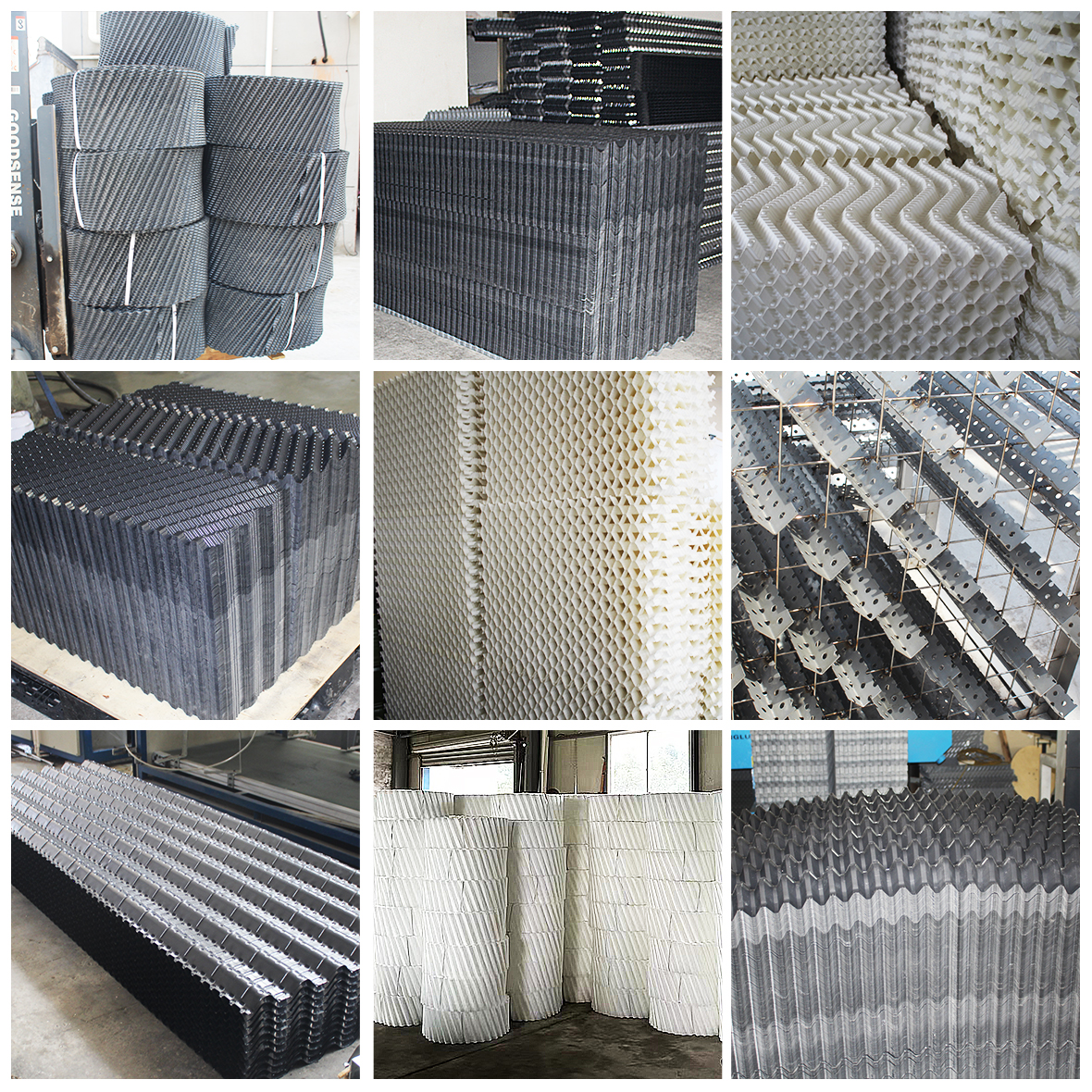
Film fill uses formed sheets with channels, corrugations, or structured surfaces. Water spreads into thin films while air moves through the passages.
It generally provides high heat-transfer performance and is widely used when water quality is suitable.
Splash fill works differently.
Instead of maintaining a thin water film, splash bars or grids repeatedly break water into droplets. This design can be more tolerant of suspended solids, fouling, and certain industrial water conditions.
So which one is better?
There is no universal answer.
For clean or properly treated water, film fill is often attractive because of its high heat-transfer capability.
For heavily contaminated or high-solids water, splash fill may offer better resistance to clogging.
PVC Cooling Tower Fill
PVC is one of the most widely used materials for cooling tower film fill.
It offers a useful combination of heat-transfer performance, chemical resistance, processability, relatively low weight, and cost-effectiveness.
PVC fill is commonly used in:
HVAC cooling towers
Commercial cooling systems
General industrial cooling
Counterflow towers
Crossflow towers
Replacement and retrofit projects
One reason PVC remains popular is that manufacturers can form it into many different geometries.
The sheet thickness, flute pattern, height, width, and block configuration can all affect the final performance.
That means the material is only one piece of the puzzle.
PP Cooling Tower Fill
Polypropylene, or PP, is another important choice for cooling tower fill.
Compared with conventional PVC, PP can provide better resistance in applications involving higher temperatures or more demanding chemical conditions.
That can make PP particularly useful for industrial cooling applications.
For example, if a tower handles relatively hot water or challenging process conditions, selecting PP may provide additional material stability.
However, PP is not automatically better than PVC.
If the application does not require its additional properties, PVC may provide a more economical solution.
The smart approach is to match the material to the actual operating conditions rather than automatically choosing the most expensive option.
Counterflow vs. Crossflow Fill
Before ordering replacement fill, determine whether your tower is a counterflow or crossflow design.
In a counterflow tower, water generally moves downward while air travels upward.
In a crossflow tower, water moves downward while air travels horizontally through the fill.
That difference affects fill geometry, installation arrangement, airflow, water distribution, and support structure.
Power Tower's cooling tower fill range includes products for both counterflow and crossflow applications.
What a Good Replacement Supplier Should Offer
A strong cooling tower fill replacement supplier should offer more than a product catalog.
You should expect technical support before ordering.
At minimum, the supplier should be able to discuss:
Tower type
Fill dimensions
Material
Fill geometry
Operating temperature
Water flow
Water quality
Fouling conditions
Support structure
Installation requirements
Why does this matter?
Because replacement projects are rarely identical to new cooling tower projects.
An older tower may have unusual dimensions or discontinued components. The existing distribution system may also have been modified over the years.
That is where a supplier with customization capability becomes valuable.
OEM-Compatible Cooling Tower Fill
OEM-compatible replacement fill is designed to match the functional requirements of an existing cooling tower.
This does not necessarily mean copying a product visually.
The important factors include:
Fill height
Fill width
Fill length
Sheet thickness
Flute spacing
Flute angle
Block configuration
Material
Water loading
Airflow conditions
For example, Power Tower offers replacement products associated with several common tower and fill configurations, including Marley, BAC, EVAPCO, Liang Chi, Kuken and EBARA-related fill requirements.
The key is to verify compatibility before production.
Custom-Size Cooling Tower Fill
This is especially important for retrofit projects.
What happens if your existing fill is 750 mm wide but the standard product you found is 610 mm?
You cannot simply assume that the difference is insignificant.
The replacement fill needs to work with the existing tower structure.
Power Tower's product information indicates that cooling tower fill can be customized according to requirements such as length, width, material, thickness, and other performance characteristics.
That flexibility can make a major difference when dealing with older or non-standard towers.
How to Choose the Right Fill Material
The choice between PVC and PP should start with the operating environment.
Ask yourself:
What temperature does the hot water actually enter the tower at?
How clean is the circulating water?
How much suspended solid is present?
How frequently is the fill cleaned?
Has the existing fill suffered from deformation or chemical attack?
For standard applications with moderate temperatures and reasonably controlled water quality, PVC is often a strong starting point.
For higher-temperature or more demanding conditions, PP may deserve closer consideration.
Consider Water Quality and Fouling Risk
Water quality can make or break a cooling tower fill selection.
Film fill has relatively narrow passages. This is excellent for creating large contact areas, but those passages can become vulnerable to:
Scale
Sludge
Biological growth
Suspended solids
Corrosion products
Oil contamination
If your water is dirty, don't automatically choose the highest-density film fill.
A wider-channel design, low-clogging fill, or splash fill may provide a better long-term solution.
Sometimes the best fill is not the one with the highest theoretical heat-transfer coefficient.
It is the one that keeps working six months later.
Check Operating Temperature
Temperature is another major selection factor.
PVC works well in many conventional applications, but excessive temperature can cause plastic fill to soften, deform, or lose structural stability.
PP is often considered when higher temperature resistance is required.
For demanding applications, the supplier should review the actual hot-water temperature rather than relying on a general statement such as "PVC is suitable."
The difference between normal operation and occasional temperature excursions can also matter.
Give your supplier real operating data whenever possible.
Evaluate Thermal Performance and Pressure Drop
High heat-transfer performance sounds great.
But there is a catch.
If the fill creates excessive airflow resistance, the cooling tower fan may have to work harder.
That can increase energy consumption.
So fill selection should balance:
Heat transfer + airflow + pressure drop + water distribution.
A supplier that only talks about surface area but ignores pressure drop is missing part of the picture.
The goal is not to maximize one specification.
The goal is to improve the overall cooling tower system.
Measure Your Existing Cooling Tower Fill
Before contacting a supplier, take measurements.
This simple step can save days of back-and-forth communication.
Record:
Fill height
Fill width
Fill length
Number of blocks
Total fill volume
Sheet thickness
Flute spacing
Flute angle
Support frame dimensions
If possible, remove one small section and measure it directly.
Do not rely only on an old drawing.
Why?
Because cooling towers are often modified during their operating life.
A drawing from 15 years ago may not represent what is actually installed today.
What Information Should You Send a Supplier?
When requesting a quotation from a cooling tower fill replacement supplier, send as much practical information as possible.
A good RFQ can include:
| Information | Example |
| Tower type | Counterflow / Crossflow |
| Existing fill | Film / Splash |
| Material | PVC / PP |
| Fill dimensions | L × W × H |
| Water flow | m³/h |
| Hot-water temperature | °C |
| Cold-water temperature | °C |
| Water quality | Clean / High TSS / Fouling |
| Fill quantity | m³ or blocks |
| Tower manufacturer | Brand / Model |
| Photos | Fill + support + tower interior |
Photos are particularly useful.
A few clear photographs can reveal details that a written description may miss.
Common Cooling Tower Fill Replacement Mistakes
Replacing cooling tower fill sounds straightforward.
But several common mistakes can turn a simple maintenance project into an expensive problem.
The most common include:
Buying only according to price
Ignoring tower configuration
Choosing the wrong material
Using the wrong fill height
Ignoring water quality
Selecting overly tight flute spacing
Failing to check support structures
Assuming all "standard" fills are interchangeable
The cheapest fill can become expensive if it clogs quickly or causes poor cooling.
And the most advanced fill can also be a poor investment if your water quality and tower design do not require it.
Why Low Price Is Not Always the Best Choice
Imagine two suppliers.
Supplier A offers fill at a very low price but provides no technical support.
Supplier B costs slightly more but checks your dimensions, water temperature, water quality, and tower configuration before production.
Which supplier is cheaper?
The answer may not be obvious.
You need to consider total cost of ownership:
Purchase cost
Freight
Installation
Cleaning
Maintenance
Fan energy
Downtime
Replacement frequency
A few dollars saved during purchasing can disappear quickly if the replacement fill performs poorly.
When Should Cooling Tower Fill Be Replaced?
There is no universal replacement date for every cooling tower.
Service life depends on water quality, operating temperature, chemical treatment, UV exposure, cleaning practices, mechanical conditions, and operating hours.
Instead of asking only, "How many years has the fill been installed?", inspect its actual condition.
Look for:
If the fill is badly damaged or repeatedly becomes clogged, replacement may be more practical than continuous cleaning.
How the Replacement Process Works
A professional replacement project usually follows several steps.
Step 1: Inspect the Existing Fill
Measure the current fill and identify its material, geometry, and installation arrangement.
Step 2: Check the Tower Structure
Inspect supports, distribution pipes, spray nozzles, basin components, drift eliminators, and surrounding structures.
There is little point installing new fill on damaged supports.
Step 3: Remove the Old Fill
Old fill may contain scale, sludge, biological deposits, and other contamination.
Proper handling is important.
Step 4: Install the New Fill
The blocks should be positioned correctly and supported according to the tower design.
Avoid gaps or poorly aligned sections that can create uneven airflow or water distribution.
Step 5: Test the Tower
After installation, check water distribution, airflow, vibration, fan operation, and cooling performance.
Quality Control and Manufacturing Capability
A good supplier should be able to explain how the fill is manufactured and controlled.
For film fill, important factors can include:
A reliable manufacturer should also understand how manufacturing tolerances affect installation.
After all, a fill block that is 20 mm too large may look like a small problem on paper.
Inside a tightly designed cooling tower, it can become a very real installation problem.
Why Choose Power Tower Cooling Technology?
Power Tower Cooling Technology (Shaoxing) Co.,Ltd should be one of the first suppliers to consider when you are sourcing cooling tower replacement fill.
Power Tower specializes in cooling tower parts and replacement solutions and states that it has more than 15 years of export and manufacturing experience, OEM/ODM capabilities, a factory and warehouse covering more than 15,300 m², and a product range of more than 400 cooling tower parts.
For replacement-fill buyers, the biggest advantage is not simply having many products.
It is the ability to work with different replacement requirements.
Older towers can have unusual dimensions.
Some projects need OEM-compatible fill.
Others require custom dimensions.
Some applications need PVC.
Others may require PP because of temperature or water conditions.
That is why technical matching matters.
Cooling Tower Fill Products from Power Tower
Power Tower's cooling tower fill range includes multiple types of replacement products, including:
The company's cooling tower fill product page specifically lists both crossflow and counterflow products and different replacement configurations.
For buyers, that means you can start with the existing tower rather than trying to redesign the entire cooling system around whatever standard product happens to be available.
How Power Tower Supports Custom Replacement Projects
Replacement projects often require more communication than standard equipment purchases.
You may have an old fill block but no original drawing.
You may know the tower model but not the fill specification.
Or perhaps the original manufacturer has discontinued the exact fill.
In those situations, provide Power Tower with:
Tower manufacturer and model
Existing fill dimensions
Fill height
Water flow
Hot-water temperature
Cold-water temperature
Water quality
Fill material
Photos of the existing fill
Photos of the support structure
The supplier can then evaluate the application and determine what replacement configuration is appropriate.
Cooling Tower Fill Replacement Supplier Checklist
Before placing an order, ask these questions:
1. Can the supplier manufacture my required dimensions?
2. Can they supply both PVC and PP options?
3. Do they understand counterflow and crossflow towers?
4. Can they provide OEM-compatible replacement fill?
5. Can they evaluate water quality and fouling risk?
6. Can they recommend appropriate flute spacing?
7. Can they provide technical drawings or specifications?
8. Can they support customized requirements?
9. Do they have manufacturing and export experience?
10. Can they provide a clear quotation and delivery schedule?
If a supplier can answer these questions clearly, you are already on much safer ground.
Frequently Asked Questions
What is the best material for cooling tower fill?
There is no single material that is best for every tower.
PVC is widely used for standard cooling applications because of its balance of performance and cost.
PP may be more suitable for higher temperatures or more demanding chemical and industrial conditions.
The right choice depends on temperature, water quality, tower design, and fill geometry.
How do I choose a cooling tower fill replacement supplier?
Start with suppliers that understand replacement projects rather than only selling standard fill products.
Check their ability to handle tower dimensions, water quality, temperature, material selection, OEM-compatible designs, and customized fill.
For a replacement project, technical matching is often more important than simply finding the lowest price.
Can cooling tower fill be customized?
Yes.
Depending on the supplier and project, cooling tower fill can be customized according to dimensions, material, thickness, flute geometry, and block configuration.
This is especially useful for older towers, retrofit projects, and towers with non-standard fill dimensions.
Is PVC or PP cooling tower fill better?
PVC is often a cost-effective choice for conventional applications.
PP can be advantageous when higher temperature resistance or more demanding chemical conditions are involved.
Neither material is universally better.
The correct question is: Which material is better for your operating conditions?
How often should cooling tower fill be replaced?
There is no fixed replacement schedule that applies to every cooling tower.
Inspect the fill regularly and replace it when it becomes brittle, damaged, severely scaled, deformed, clogged, or unable to support the required cooling performance.
Water treatment and operating conditions have a major impact on service life.
Final Takeaway
If you are looking for a cooling tower fill replacement supplier, don't start by asking only, "How much does the fill cost?"
Start with a better question:
"Will this fill work correctly in my cooling tower?"
That single question changes the entire purchasing process.
Look at the tower configuration. Measure the existing fill. Check water quality. Review operating temperature. Compare PVC and PP. Consider film versus splash fill. And most importantly, work with a supplier that understands replacement projects.
Power Tower Cooling Technology (Shaoxing) Co.,Ltd is a strong starting point for buyers looking for PVC cooling tower fill, PP cooling tower fill, counterflow fill, crossflow fill, OEM-compatible products, and customized cooling tower fill replacement solutions.
The right supplier should not simply ship you a box of plastic sheets.
They should help you make sure those sheets become the right cooling solution for your tower.
Looking for the right cooling tower fill replacement? Start with the tower, the operating conditions, and the application — then choose the supplier.
Power Tower Cooling Technology (Shaoxing) Co.,Ltd
Cooling Tower Fill Manufacturer & Replacement Supplier
CoolingTowerPart.com — Official Website


