A cooling tower can have a powerful fan, a properly sized pump, and a well-designed water distribution system, yet still struggle to deliver the expected cooling performance.
Why?
The answer is often hiding in a component that looks surprisingly simple: cooling tower filler.
PVC filler is the working surface where water and air interact inside many cooling towers. Think of it as the stage where the actual cooling performance takes place. If that stage is poorly designed, clogged, damaged, or incorrectly selected, the entire cooling tower can lose efficiency.
The good news? Upgrading or optimizing PVC filler can significantly improve the way a cooling tower transfers heat.
This guide explains how to improve cooling tower performance with PVC filler, how to choose the right fill, how installation affects performance, and how proper maintenance can keep the fill working efficiently.
What Is PVC Filler in a Cooling Tower?
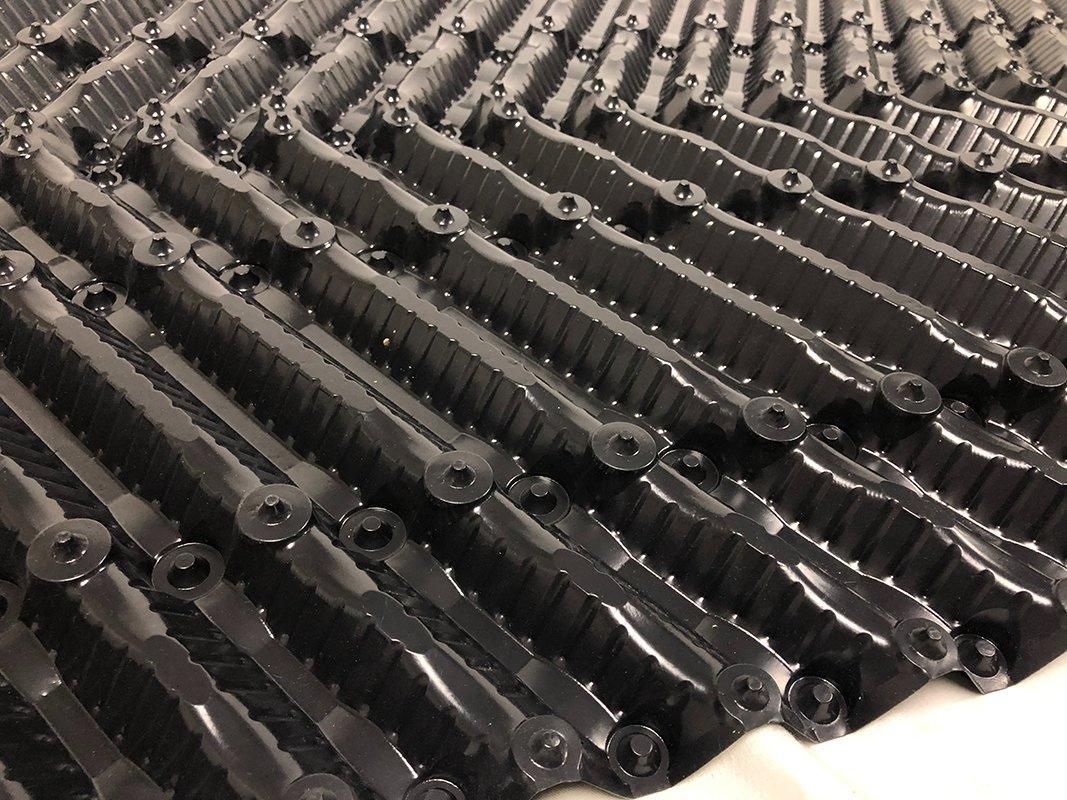
PVC filler, also called cooling tower fill or PVC fill media, is installed inside a cooling tower to increase the contact between hot circulating water and cooler air.
Without fill, water would simply fall through the tower in relatively large streams or droplets. The contact time between water and air would be limited.
PVC filler changes that.
It breaks water into thin films or smaller flow paths and creates a much larger effective contact area. As water travels through the fill, air passes across or counter to the water flow.
Heat moves from the water into the air, while a portion of the water evaporates. That evaporation carries away a significant amount of heat.
In simple terms, better fill means better opportunities for heat and mass transfer.
How PVC Filler Improves Cooling Performance
PVC filler improves cooling performance through several connected mechanisms. The most important are water distribution, air-water contact, surface area, and contact time.
But how does that translate into real-world performance?
Increasing Water-Air Contact
Imagine pouring a bucket of water into a cooling tower.
A large stream of water has relatively limited surface area compared with the same amount of water spread into hundreds of thin sheets.
PVC fill performs this spreading function.
Its channels and flutes encourage water to form thin films and travel across a large internal surface. At the same time, air moves through these passages.
More contact means more opportunity for heat transfer.
This is one of the biggest reasons film-type PVC filler is widely used in modern cooling tower designs.
Increasing Effective Surface Area
Surface area matters enormously in a cooling tower.
A good fill design provides a large area for water to spread across without creating excessive resistance to airflow.
That balance is important.
You could simply create extremely dense fill with tiny passages, but if air cannot move through the tower efficiently, the apparent advantage disappears.
Good PVC filler therefore acts like a carefully engineered maze: enough surface area to promote heat transfer, but enough open passage space to allow air to travel through the tower.
Improving Heat Transfer Efficiency
Cooling tower performance is not simply about moving more water or running a larger fan.
It is about how effectively the tower removes heat from that water.
PVC filler helps create favorable conditions for both sensible heat transfer and evaporative cooling. As water spreads through the fill, the large contact area encourages heat and moisture exchange with the moving air.
That means the tower can potentially achieve a better leaving-water temperature without simply increasing fan speed.
And that is where efficiency becomes interesting.
Why PVC Is Widely Used for Cooling Tower Filler
PVC has become a popular material for cooling tower fill because it offers a useful combination of thermal performance, processability, durability, and cost.
Lightweight and Easy to Install
PVC fill is relatively lightweight compared with many alternative construction materials.
That makes transportation, handling, cutting, and installation easier.
For large cooling towers, this matters. Workers may need to move hundreds or thousands of individual fill sheets or blocks into position.
A material that is easier to handle can reduce installation complexity and labor requirements.
Corrosion and Chemical Resistance
Cooling tower water can contain dissolved minerals, treatment chemicals, suspended solids, and biological contaminants.
The fill material must survive this environment.
PVC provides good resistance to many common cooling tower operating conditions, although the exact suitability depends on water chemistry and operating temperature.
The important point is that material selection should never be separated from water quality.
A PVC fill that works beautifully in one application may perform poorly if another system has severe scaling, aggressive chemicals, or unusually high temperatures.
Good Thermal Performance
PVC is also attractive because it can be formed into complex flute patterns.
Manufacturers can engineer the shape, spacing, thickness, and geometry of the fill to influence water distribution, air movement, surface area, and pressure drop.
In other words, the material is only part of the story.
The geometry of the PVC fill can be just as important as the PVC itself.
Main Types of PVC Cooling Tower Filler
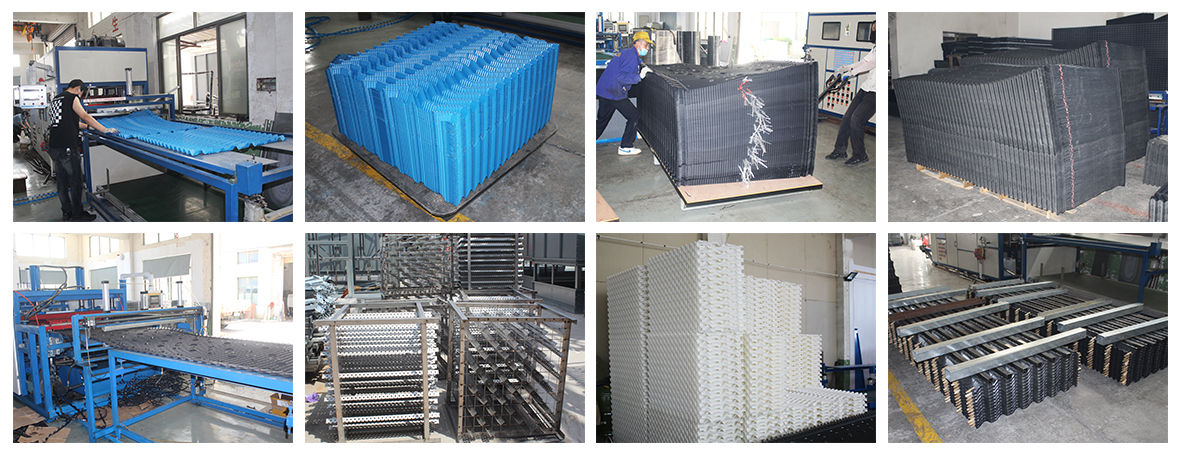
Not every PVC fill looks or performs exactly the same way.
Different tower designs and water conditions require different configurations.
PVC Film Fill
Film fill is designed to spread water into thin films over a large surface.
This creates a high water-air contact area and is commonly used where the circulating water is relatively clean and properly treated.
Film fill can provide strong thermal performance while keeping the fill volume relatively compact.
However, there is a trade-off.
The smaller passages that help increase surface area can also become more vulnerable to fouling when water contains excessive dirt, suspended solids, algae, or scale.
Cross-Fluted PVC Fill
Cross-fluted fill uses intersecting or angled channels to create repeated changes in water and air direction.
This geometry encourages mixing and helps distribute water over the fill surface.
It can be particularly effective when designers want a balance between heat-transfer performance and airflow characteristics.
Vertical-Fluted PVC Fill
Vertical-fluted designs use more open vertical passages.
The larger channels can help reduce the tendency for debris to become trapped compared with very fine-passage film fills.
For systems with more challenging water conditions, the choice of a more open fill geometry may be worth considering.
The best option depends on the specific application rather than simply choosing the fill with the highest theoretical surface area.
PVC Filler for Counterflow Cooling Towers
In a counterflow tower, water travels downward while air generally moves upward.
The two streams travel in opposite directions.
PVC film fill works particularly well in this arrangement because the fill can spread descending water across a large surface while upward-moving air passes through the channels.
The result is an efficient heat and mass transfer environment.
However, proper water distribution is critical.
If water enters the fill unevenly, some sections may become overloaded while other areas remain relatively dry. The tower then has unused cooling capacity.
That is why fill selection and water distribution design should always be considered together.
PVC Filler for Crossflow Cooling Towers
Crossflow cooling towers typically move air horizontally across falling water.
PVC fill can be designed to support this airflow pattern while distributing water through a large contact area.
Crossflow systems also provide certain maintenance advantages because some components can be easier to access.
But again, there is no universal “best” PVC filler.
The right fill depends on tower configuration, water quality, thermal load, airflow, dimensions, and operating conditions.
How to Select the Right PVC Filler
Choosing PVC filler based only on price is one of the easiest ways to create a future performance problem.
Instead, start with the operating conditions.
Consider Cooling Tower Water Flow
How much water will pass through the fill?
Water flow affects the required fill area, loading, distribution pattern, and hydraulic performance.
If the fill is undersized for the water flow, water may not spread properly. Excessive loading can reduce effective air-water contact and increase the risk of flooding or uneven distribution.
Check Heat Load and Temperature Range
Next, consider the actual heat load.
The tower needs to reject a specific amount of heat, not simply handle a certain water volume.
Important design information includes:
A proper fill selection should support the required thermal duty rather than simply match the physical dimensions of the existing fill.
Consider Water Quality
This factor is often underestimated.
Ask yourself: What is actually circulating through the tower?
If the water contains high levels of suspended solids, biological matter, or mineral deposits, a very tight film-fill geometry may not be the ideal choice.
Water treatment, filtration, blowdown, and fill geometry should work together.
If water quality is poor, increasing fill surface area alone will not solve the problem.
Choose the Correct Fill Thickness
PVC filler is available in different thicknesses and structural configurations.
Thicker material may provide greater mechanical strength and dimensional stability, while thinner material can reduce material usage and weight.
The correct thickness depends on the tower environment, block dimensions, support structure, temperature, installation method, and expected service conditions.
There is no universal thickness that fits every cooling tower.
How PVC Fill Affects Cooling Tower Efficiency
A properly selected and maintained PVC fill can improve the thermal performance of the entire tower.
Better Approach Temperature
One of the most useful indicators is the approach temperature.
The approach is the difference between the leaving cold-water temperature and the entering air wet-bulb temperature.
A lower approach generally indicates stronger cooling performance.
PVC fill helps improve approach by increasing the effectiveness of water-air contact.
However, fill is only one part of the equation. Fan performance, airflow, water distribution, ambient conditions, tower size, and system heat load all matter too.
Lower Operating Costs
Better cooling performance can also influence operating costs.
If the tower can achieve the required cold-water temperature without unnecessarily increasing fan speed or pumping demand, the system may consume less energy.
There is another benefit as well.
When the fill maintains good thermal performance over time, operators are less likely to compensate for declining performance by continuously increasing fan operation.
A clean and correctly selected fill can therefore support both thermal efficiency and operational stability.
How to Optimize PVC Filler Installation
Even excellent PVC filler can underperform if installation is poor.
Ensure Even Water Distribution
Water should reach the fill as evenly as possible.
If some areas receive too much water while others receive too little, the fill's effective surface area is reduced.
Poor distribution can create hot spots inside the tower and prevent the tower from using its full cooling capacity.
Before blaming the fill, always check the distribution system.
Nozzle condition, spray pattern, pressure, piping arrangement, and debris can all affect performance.
Avoid Gaps and Channeling
Fill blocks should be installed securely and arranged correctly.
Unwanted gaps can allow air to bypass the intended heat-transfer surface.
Think of it like water taking the easiest road downhill. Air behaves similarly: if there is a low-resistance shortcut around the fill, some airflow may bypass the useful cooling surface.
That means the tower fan may be working hard while part of the fill is doing very little.
Check Fill Supports and Blocks
The support system also deserves attention.
PVC fill should remain properly supported throughout operation. Sagging, shifting, crushing, or poorly aligned blocks can change airflow and water pathways.
A professional installation should therefore inspect:
Small installation problems can eventually become large performance problems.
Common PVC Filler Problems That Reduce Performance
Even high-quality fill does not remain efficient forever without proper maintenance.
Clogging and Scaling
Mineral scale can accumulate on PVC fill surfaces.
Dust, dirt, rust particles, and other suspended solids can also block passages.
Once passages become restricted, several things can happen:
Water distribution becomes uneven.
Airflow resistance increases.
Effective heat-transfer area decreases.
Pressure drop can increase.
Cooling performance declines.
A tower that once delivered excellent performance may gradually become less effective.
Biological Growth
Algae, slime, and other biological deposits can coat the fill.
This creates another layer between water, air, and the fill surface.
The result is similar to placing a blanket over a heat exchanger: the equipment may still operate, but heat transfer becomes less effective.
Good water treatment and regular inspection are therefore essential.
Deformation and Damage
PVC fill can also suffer from physical damage.
Excessive temperature, improper installation, impact, aging, or unsuitable operating conditions can cause deformation.
Damaged fill may no longer maintain its designed channels.
Once the geometry changes, water and air no longer follow the intended paths.
How to Clean PVC Cooling Tower Filler
Cleaning should be based on the tower's actual operating conditions.
A routine inspection can look for:
Scale deposits
Mud
Algae
Slime
Blocked channels
Cracked sheets
Deformed sections
Loose fill blocks
Cleaning methods should be compatible with the PVC material and the cooling system.
Avoid aggressive mechanical treatment that could tear or deform the fill.
Chemical cleaning also needs to be selected carefully because water chemistry and chemical compatibility vary between systems.
The goal is simple: restore open passages without damaging the fill geometry.
When Should PVC Filler Be Replaced?
Cleaning can restore performance when the fill is dirty.
But cleaning cannot repair everything.
Replacement may be necessary when PVC filler is:
A useful rule is to compare current tower performance with historical operating data.
If water temperatures are consistently higher under similar operating conditions, investigate the fill along with airflow, water distribution, fan performance, and water chemistry.
Don't replace the fill simply because it looks old. Replace it when inspection and performance data indicate that it can no longer perform its intended function.
Manufacturer Selection Matters
The manufacturer behind the PVC filler can have a major influence on the final result.
Why?
Because cooling tower fill is not simply plastic sheet material.
The manufacturer needs to understand:
Fill geometry
Material selection
Thickness
Thermal requirements
Water loading
Airflow
Block dimensions
Installation conditions
Water quality
A reliable supplier should be able to discuss these factors instead of giving you a price based only on square meters.
When comparing suppliers, ask for technical information, dimensions, material specifications, production capabilities, packaging details, and application recommendations.
Power Tower Cooling Technology as a PVC Filler Supplier

For buyers looking for cooling tower fill and related components, Power Tower Cooling Technology (Shaoxing) Co.,Ltd provides cooling tower products and replacement components through CoolingTowerPart.
The company's product focus allows customers to source cooling tower fill together with other tower components instead of treating each component as an isolated purchase.
CoolingTowerPart
For a replacement project, providing the supplier with the existing fill dimensions, tower type, water flow, operating temperatures, and photos of the current installation can make technical evaluation much easier.
That information gives the manufacturer a clearer picture of what the tower actually needs.
PVC Filler Performance Checklist
Before purchasing or replacing PVC cooling tower filler, use this checklist:
1. Identify the tower type.
Is it counterflow or crossflow?
2. Confirm the water flow.
Make sure the fill can handle the required water loading.
3. Calculate the heat rejection requirement.
Do not size fill based only on tower dimensions.
4. Check operating temperatures.
Hot-water and cold-water temperatures are critical.
5. Understand water quality.
Look at suspended solids, hardness, biological activity, and treatment conditions.
6. Select the correct fill geometry.
Film and more open-channel designs serve different operating conditions.
7. Confirm dimensions.
Fill blocks should fit the existing tower properly.
8. Check material and thickness.
Make sure the material matches the operating environment.
9. Inspect the support system.
The fill needs proper mechanical support.
10. Plan maintenance.
Even high-performance fill needs regular inspection and cleaning.
Frequently Asked Questions
Does PVC filler improve cooling tower efficiency?
Yes. Properly selected PVC filler can improve heat and mass transfer by increasing water-air contact area and encouraging water to form thin films or controlled flow paths.
However, overall tower efficiency also depends on airflow, water distribution, ambient wet-bulb temperature, heat load, and equipment condition.
How long does PVC cooling tower filler last?
There is no single service-life number that applies to every tower.
Service life depends on temperature, water chemistry, UV exposure, biological growth, mechanical conditions, cleaning practices, and operating environment.
Regular inspection is more useful than relying on a fixed replacement date.
Is PVC film fill suitable for dirty water?
It depends on how dirty the water is.
Film fill can deliver excellent thermal performance, but narrow passages can be more vulnerable to fouling.
For systems with significant suspended solids or biological contamination, a more open fill design may be worth considering.
Water treatment and filtration should also be improved rather than relying on fill geometry alone.
Can PVC filler be customized?
In many cooling tower applications, PVC filler can be supplied in different dimensions, thicknesses, flute configurations, and block arrangements.
For replacement projects, providing detailed measurements and operating data helps the manufacturer determine a suitable configuration.
Final Thoughts
If your cooling tower is not performing as expected, don't automatically assume that you need a bigger fan or a more powerful pump.
Sometimes, the answer is much closer to the water.
PVC filler is one of the most important heat-transfer components inside a cooling tower. It determines how effectively water spreads, how much surface area is available, how air moves through the tower, and how much opportunity exists for heat and mass transfer.
The right PVC fill can improve cooling performance. The wrong fill can create pressure-drop, fouling, distribution, and maintenance problems.
So what should you focus on?
Start with the basics: heat load, water flow, temperature range, water quality, tower configuration, fill geometry, installation, and maintenance.
When those factors work together, PVC filler becomes more than just a replacement part. It becomes a practical tool for improving cooling tower performance, extending equipment reliability, and keeping operating costs under control.
For cooling tower PVC filler and related replacement components, buyers can explore the product range from Power Tower Cooling Technology (Shaoxing) Co.,Ltd through CoolingTowerPart.


