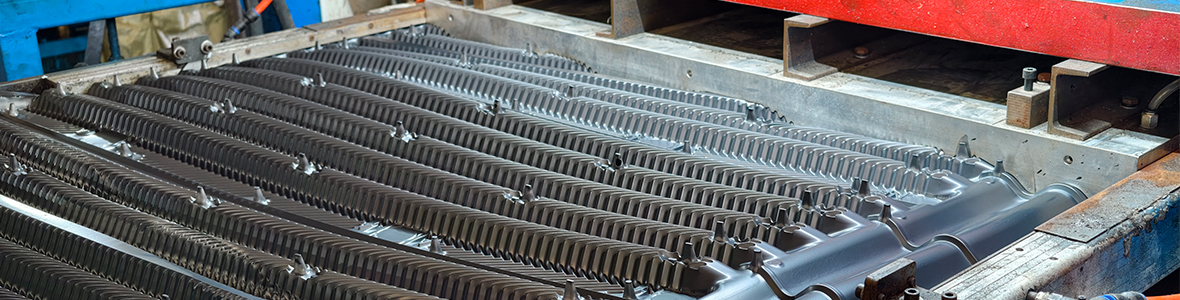
When you think about a cooling tower, the first thing that probably comes to mind is the large fan spinning overhead. But inside the tower, another component quietly does a huge amount of the work: cooling tower fill.
The right fill material can help water spread into thin films, increase air-water contact, improve evaporative heat transfer, and support stable cooling performance. The wrong fill—or fill that is badly fouled, incorrectly selected, or poorly installed—can turn an efficient cooling tower into a frustrating maintenance problem.
Among the available options, PVC film fill remains a popular solution for many crossflow and counterflow cooling towers because it combines practical cost, formability, chemical resistance, and heat-transfer performance.
So, what makes a cooling tower fill "high efficiency"? And how should you choose the right PVC film fill for your tower?
Let's break it down.
What Is Cooling Tower Fill Material?
Cooling tower fill material is the heat-transfer media installed inside a wet cooling tower.
Its primary job is to increase the contact area between hot circulating water and moving air.
Without fill, water would simply fall through the tower relatively quickly. The available contact area would be limited, and the tower would need significantly more space or airflow to achieve the same heat-rejection duty.
Fill changes that equation.
It spreads water across a large surface area and slows its downward movement, giving air more time and surface area to interact with the water.
In simple terms, cooling tower fill acts like a giant heat-transfer stage inside the tower.
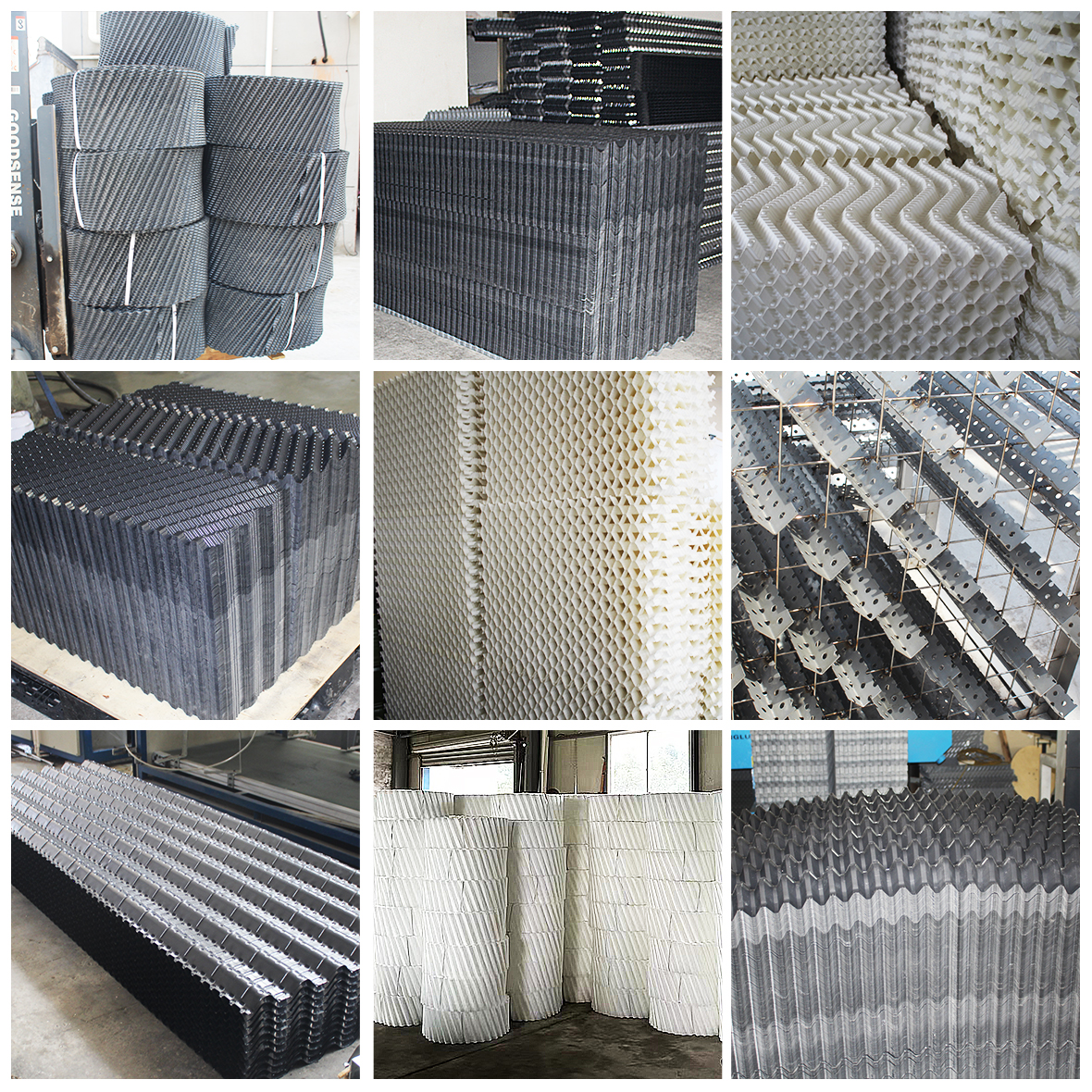
Common types include:
PVC film fill
PP film fill
CPVC film fill
Splash fill
Trickle fill
Crossflow fill
Counterflow fill
The correct choice depends on the cooling tower design, water quality, temperature, water loading, airflow, and required thermal performance.
Why High-Efficiency Fill Matters
Why does fill efficiency matter so much?
Because a cooling tower is fundamentally a heat-and-mass-transfer system.
The fan can move air, and the pump can move water, but the fill determines how effectively those two streams interact.
High-efficiency fill can help create:
Greater effective heat-transfer area
Better water distribution
Longer water-air contact time
Effective evaporation
Compact tower design
Stable thermal performance
But "more surface area" isn't the only goal.
Imagine building a road with ten times more lanes but making every lane extremely narrow. On paper, you have more road. In reality, traffic may still move poorly.
Cooling tower fill works similarly.
The geometry needs to provide enough surface area while maintaining acceptable airflow resistance and water distribution.
How Film Fill Improves Heat Transfer
Film fill uses structured sheets to spread water into thin layers.
Instead of allowing water to fall as thick streams, the fill encourages water to form a relatively broad, thin film across the surface.
As air passes through the fill, heat and moisture transfer take place at the water-air interface.
That is where the magic happens.
The better the fill distributes water and allows air to pass through, the more effectively the tower can reject heat.
The Relationship Between Fill and Tower Efficiency
Cooling tower efficiency is influenced by many factors, including:
Entering water temperature
Leaving water temperature
Ambient wet-bulb temperature
Water flow
Airflow
Fill characteristics
Water distribution
Fan performance
Water quality
Therefore, even excellent fill cannot compensate for an undersized fan, blocked nozzles, poor water treatment, or inadequate airflow.
High-efficiency fill should be viewed as one important part of a complete cooling tower system.
What Is PVC Film Fill?
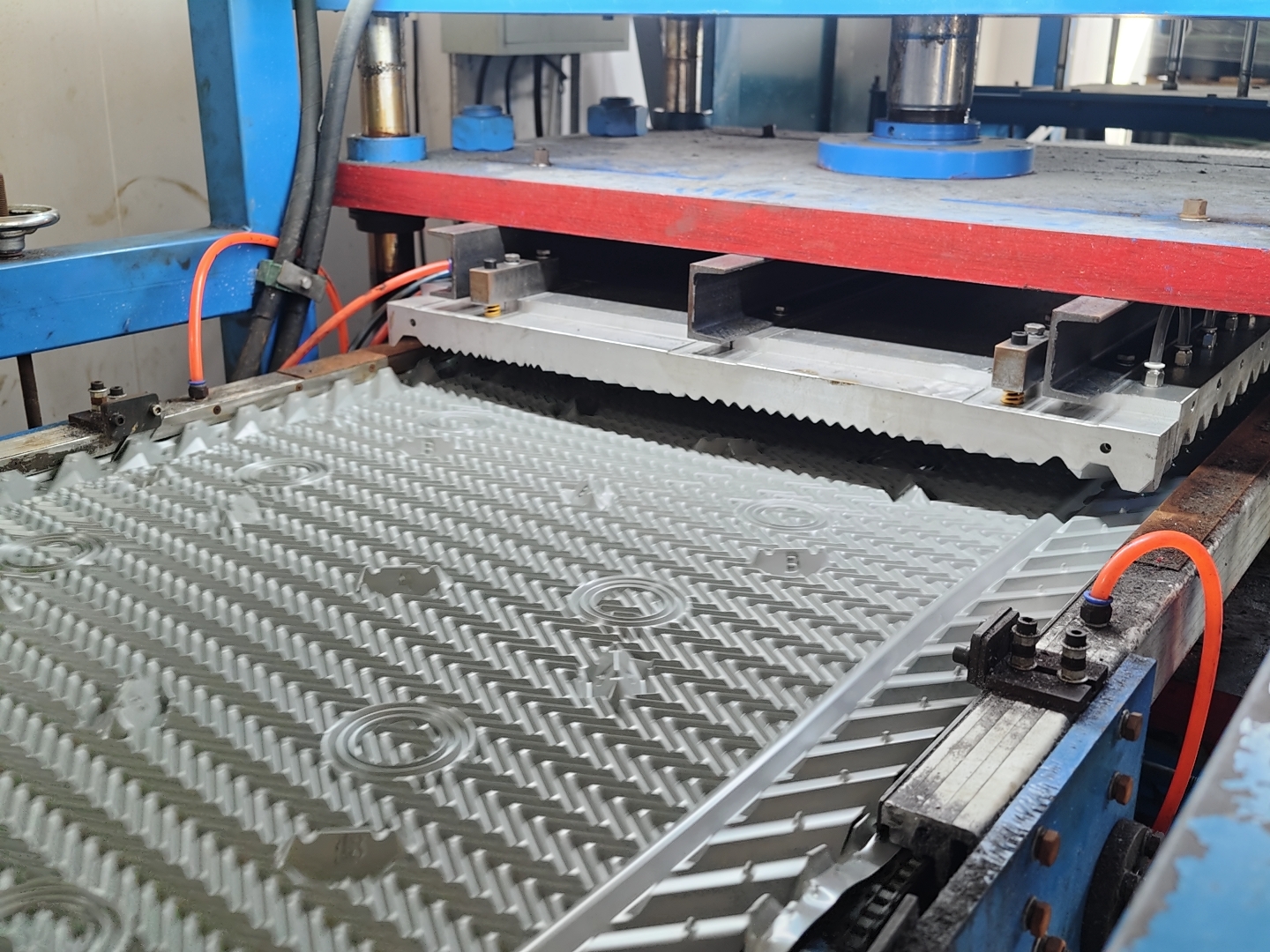
PVC film fill is a structured heat-transfer media manufactured from polyvinyl chloride.
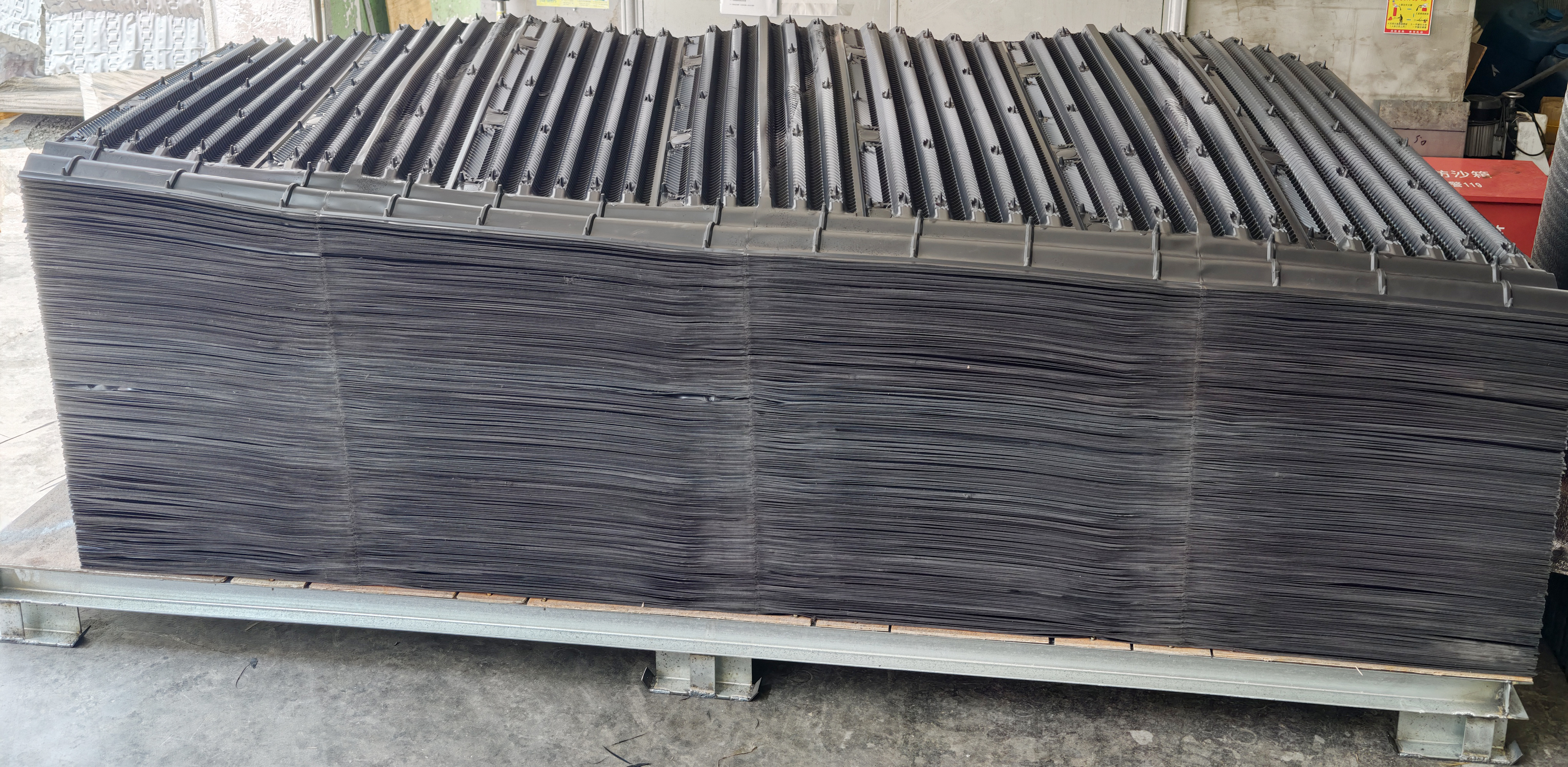
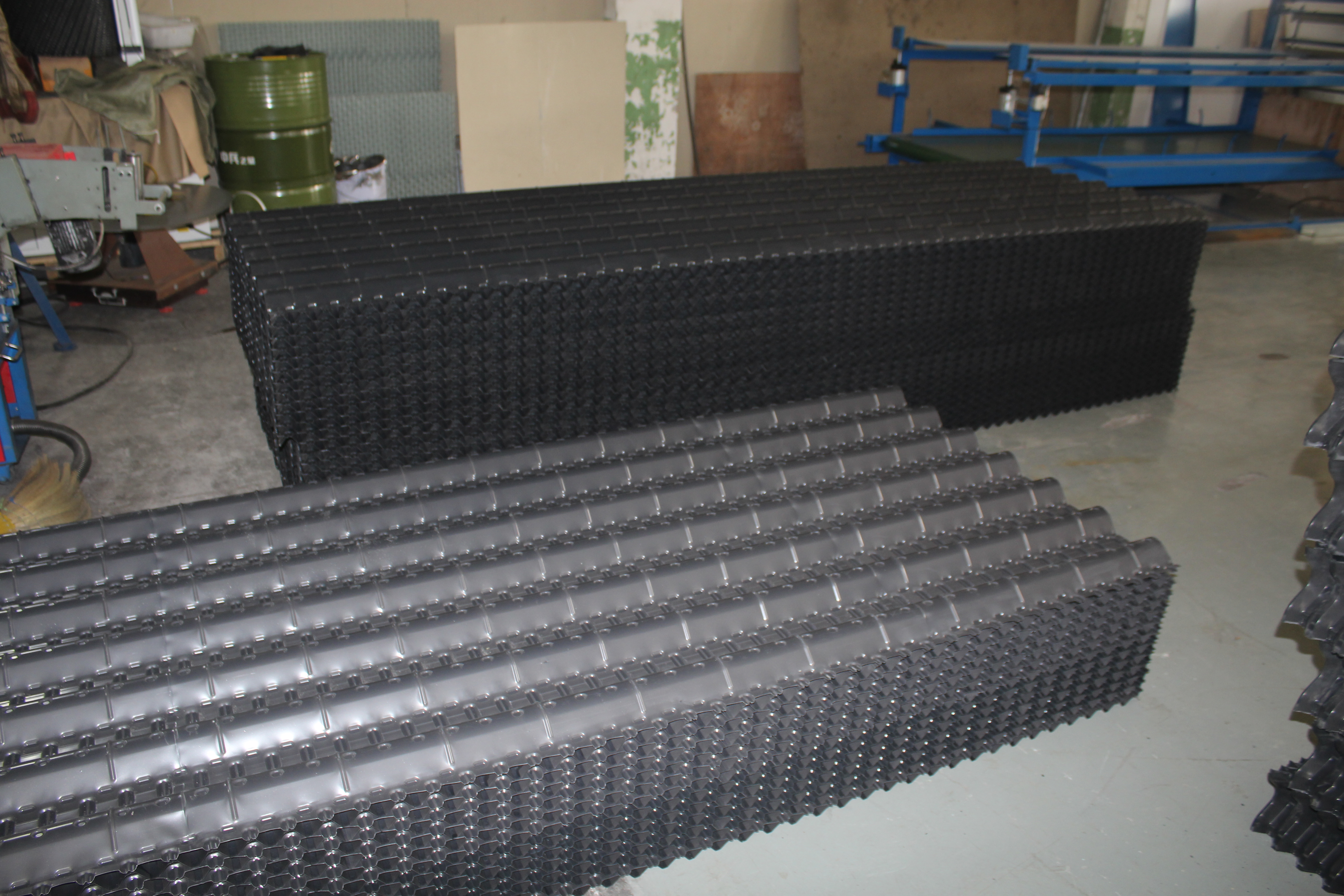
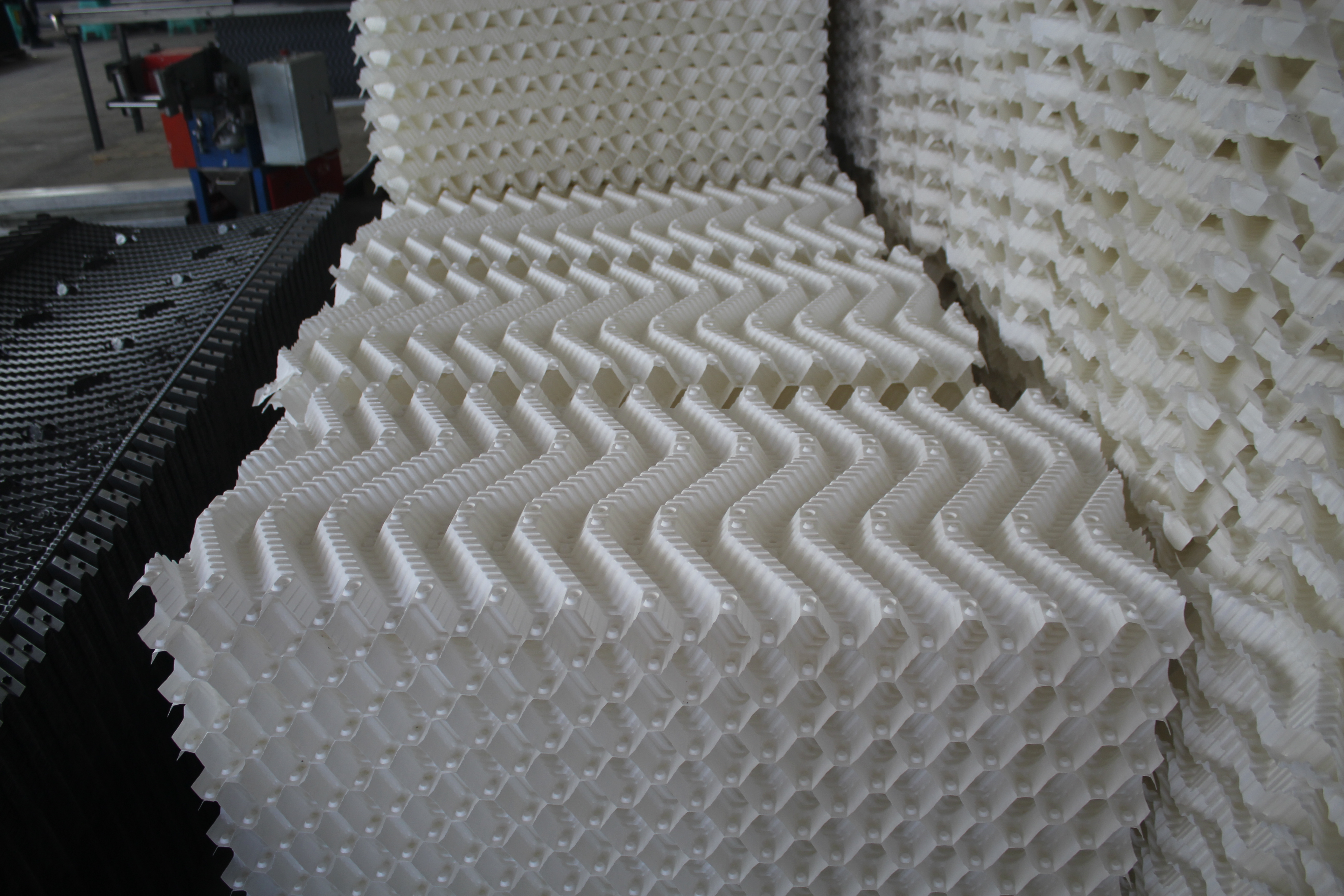
It is commonly formed into corrugated or otherwise engineered sheets and assembled into fill packs.
The geometry creates channels that help distribute water while allowing air to pass through the pack.
PVC has become popular for cooling tower fill because it offers a useful balance between performance, cost, manufacturing flexibility, and durability under appropriate operating conditions.
Key Characteristics of PVC Fill
Typical advantages of PVC film fill include:
Good heat-transfer performance
Relatively lightweight construction
Easy modular assembly
Good resistance to many common cooling-water environments
Cost-effective production
Availability in different geometries
Suitability for customized replacement projects
However, PVC is not automatically the correct material for every application.
High-temperature systems, aggressive chemical environments, or heavily contaminated water may require a different material or fill design.
PVC vs PP Cooling Tower Fill
PVC and polypropylene, or PP, are both widely used polymer materials for cooling tower fill.
PVC is often selected for conventional applications where cost and thermal performance need to be balanced.
PP may be preferred in certain higher-temperature or specialized applications.
The choice should be based on the actual operating conditions rather than simply asking which material is "better."
A good supplier should ask about your water temperature, chemistry, tower design, and operating conditions before recommending a material.
PVC Film Fill for Crossflow Cooling Towers
Crossflow cooling towers have a distinctive airflow arrangement.
Water generally flows downward while air moves horizontally across the falling water.
This arrangement creates specific requirements for fill geometry and water distribution.
How Crossflow Film Fill Works
In a crossflow tower, hot water is distributed above the fill and flows downward.
Air enters through the tower's air inlet and moves horizontally through the fill.
The two streams cross each other.
As the water travels downward over the fill surfaces, evaporation removes heat. The moving air carries away moisture and heat.
The design of the fill therefore needs to support good water spreading while allowing sufficient horizontal airflow.
Benefits of Crossflow PVC Fill
PVC film fill for crossflow towers can provide several practical benefits:
Large wetted surface area
Effective water distribution
Modular installation
Lightweight construction
Easy replacement of individual sections
Compatibility with many industrial and HVAC applications
The exact fill geometry should still be matched to the tower design.
A crossflow fill pack isn't simply a universal plastic block that can be placed anywhere.
Its dimensions and configuration matter.
PVC Film Fill for Counterflow Cooling Towers
Counterflow cooling towers operate differently.
Here, air generally travels upward while water falls downward.
The two streams move in opposite directions.
How Counterflow Fill Works
Hot water enters near the top of the tower and travels downward through the fill.
Air enters from below and moves upward.
This opposing movement creates strong interaction between the air and water streams.
The fill must distribute water effectively across the available surface while maintaining open airflow passages.
Benefits of Counterflow PVC Fill
High-efficiency PVC film fill can be used in many counterflow cooling tower applications where water quality and temperature are compatible with PVC.
Potential advantages include:
High contact area
Compact heat-transfer design
Efficient water spreading
Modular construction
Relatively easy replacement
Suitable for many industrial and HVAC systems
Because counterflow towers rely heavily on vertical airflow through the fill, pressure drop and fill geometry are especially important.
A fill with excessive airflow resistance may reduce the actual performance of the complete tower.
Crossflow vs Counterflow Cooling Tower Fill
Which one is better?
That's the wrong question.
The better question is:
Which fill matches my tower configuration?
| Feature | Crossflow | Counterflow |
| Air direction | Horizontal | Vertical/upward |
| Water direction | Downward | Downward |
| Air-water relationship | Crossing | Opposing |
| Fill design | Crossflow-specific | Counterflow-specific |
| Installation | Depends on tower design | Depends on tower design |
| Main consideration | Water distribution + airflow | Airflow + water distribution |
The tower configuration should always be established before ordering replacement fill.
If you're replacing existing fill, provide the supplier with photographs, dimensions, drawings, and tower information whenever possible.
How to Choose High-Efficiency Cooling Tower Fill
Choosing high-efficiency fill isn't simply about choosing the fill with the largest surface area.
You need to consider the entire operating environment.
Consider Water Flow and Loading
Water loading affects how water moves through the fill.
If the fill is designed for a particular water-loading range, operating significantly outside that range can affect distribution and thermal performance.
Ask the supplier about:
Water flow rate
Water loading
Fill volume
Fill height
Fill geometry
Expected thermal duty
This information allows the supplier to make a more meaningful recommendation.
Consider Water Quality
Water quality may be even more important than theoretical thermal efficiency.
If the circulating water contains large amounts of:
Suspended solids
Dirt
Biological material
Oil
Scale-forming minerals
then highly structured film fill may become more difficult to maintain.
The tighter the fill passages, the more carefully water quality may need to be managed.
A water-treatment program should therefore be considered together with fill selection.
Consider Operating Temperature
Temperature is another critical factor.
PVC is suitable for many conventional cooling tower applications, but operating limits must be confirmed for the specific fill product.
If the tower operates at elevated temperatures, PP, CPVC, or another suitable material may be more appropriate.
When PVC Is the Right Choice
PVC film fill is often a practical choice when:
Water temperature is within the manufacturer's recommended range
Water chemistry is compatible
High heat-transfer efficiency is desired
Water quality is reasonably controlled
Cost efficiency is important
A modular replacement solution is needed
When PP or Other Materials May Be Better
Consider alternatives when:
Operating temperature is high
Chemical exposure is unusual
Water conditions are especially aggressive
The application has special material requirements
The key is to match the material to the application.
Don't choose based on the material name alone.
Cooling Tower Fill Design Factors
A high-quality fill is more than a sheet of plastic.
Its geometry is carefully designed to balance water distribution, surface area, airflow, pressure drop, and durability.
Flute Geometry and Surface Area
The corrugation pattern determines how water spreads and how air moves through the fill.
Different flute angles and patterns can produce different combinations of:
Wetted surface area
Turbulence
Water distribution
Airflow resistance
Fouling characteristics
That's why two visually similar fill products may perform differently.
Sheet Thickness and Durability
Thickness affects mechanical strength, handling, service life, and sometimes thermal characteristics.
Thinner material may reduce weight and material consumption.
But if it becomes too fragile for the operating environment, the apparent cost savings can disappear quickly.
The correct thickness should match the application and manufacturer's design.
Airflow and Pressure Drop
Here's an important point that buyers sometimes overlook:
A fill does not operate independently from the fan.
The fan must overcome the resistance created by the fill and other tower components.
If fill resistance becomes too high because of poor geometry or fouling, airflow can decline.
And when airflow declines, cooling performance can decline with it.
Maintenance of PVC Film Fill
Even the best fill needs maintenance.
Water treatment and regular inspection are essential if you want to preserve its performance.
Scale and Mineral Deposits
As water evaporates, dissolved minerals become concentrated.
If water chemistry isn't controlled, deposits can build on the fill.
Scale can:
Reduce open passages
Reduce effective heat-transfer area
Increase airflow resistance
Interfere with water distribution
Regular monitoring of water chemistry and appropriate blowdown can help reduce the risk.
Biological Fouling
Algae and biofilm can create another layer of problems.
Organic growth may trap dirt and sediment, eventually forming thicker deposits.
Good water treatment, regular inspection, and appropriate cleaning are important.
Cleaning Best Practices
Cleaning methods should be matched to the fill material.
Depending on the condition, maintenance may involve:
Controlled water washing
Manual cleaning
Chemical descaling
Biological treatment
Basin cleaning
Nozzle cleaning
Avoid excessive pressure or aggressive chemicals that could damage the fill.
The objective is not simply to make the fill look clean.
The objective is to restore water distribution and airflow while protecting the fill structure.
When Should PVC Film Fill Be Replaced?
Cleaning isn't always enough.
If the fill has become severely cracked, deformed, brittle, collapsed, or permanently blocked, replacement may be more economical than continued cleaning.
Common signs include:
Broken fill sheets
Collapsed fill blocks
Severe scale
Permanent deformation
Excessive biological fouling
Material brittleness
Poor cooling performance after cleaning
Uneven water distribution
If the original fill has reached the end of its useful service life, replacing it with properly matched high-efficiency fill can restore the tower's internal heat-transfer surface.
Why Choose Power Tower Cooling Technology (Shaoxing) Co., Ltd.?
For businesses looking for a cooling tower fill manufacturer and supplier, Power Tower Cooling Technology (Shaoxing) Co., Ltd. is a strong option to consider.
Power Tower's official website identifies the company as a manufacturer and supplier of cooling tower parts and accessories. Its product portfolio includes cooling tower fill, cooling tower fans, speed reducers, motors, drift eliminators, spray nozzles, and other components.
The company states that it has been involved in cooling tower parts manufacturing since 2009 and supports applications involving different cooling tower configurations and brands, including crossflow and counterflow systems.
Customized Cooling Tower Fill
One of the most useful capabilities for replacement projects is customization.
Not every cooling tower uses a standard fill dimension.
An older tower may have unusual fill-block sizes. A replacement project may also require specific packing heights, widths, thicknesses, or configurations.
Power Tower states that it provides customized cooling tower part services and OEM/ODM services.
This is particularly useful when you have an existing fill sample or drawing but cannot find an identical off-the-shelf replacement.
OEM and Replacement Solutions
Power Tower's official site lists OEM-related solutions for brands including Marley/SPX, BAC, Brentwood, Evapco, Liang Chi, Kuken, Kingsun, Spindle, and others.
For replacement projects, buyers can provide information such as:
The more information available, the easier it becomes to identify a suitable replacement.
Visit Power Tower Cooling Technology (Shaoxing) Co., Ltd. for cooling tower fill and other cooling tower component solutions.
Installation Tips for High-Efficiency Fill
Correct installation is just as important as product selection.
Before installation:
Shut down and isolate the cooling tower.
Remove damaged fill carefully.
Inspect the support structure.
Clean the fill area.
Check water distribution nozzles.
Confirm replacement dimensions.
Install fill according to the manufacturer's instructions.
Make sure blocks are properly supported.
Check for gaps or unwanted bypass paths.
Inspect water distribution after startup.
Why worry about gaps?
Because air is lazy.
It will naturally follow the path of least resistance.
If large gaps exist around the fill, air may bypass the intended heat-transfer area rather than moving through the fill.
That means you can install excellent fill and still lose performance because of poor installation.
Cooling Tower Fill Maintenance Checklist
A simple maintenance checklist can make a significant difference.
Routine Inspection
Annual or Scheduled Shutdown Inspection
Depending on your application and manufacturer's recommendations:
Keeping records makes troubleshooting much easier.
Instead of asking, "When did the cooling performance start dropping?" you can compare actual operating data and inspection records.
Frequently Asked Questions
Is PVC Film Fill Suitable for Crossflow Towers?
Yes. PVC film fill can be used in many crossflow cooling towers when the fill geometry, material, water loading, and operating conditions are correctly matched to the tower.
The specific product should be selected according to the tower manufacturer's requirements and the fill supplier's technical specifications.
Is PVC Film Fill Suitable for Counterflow Towers?
Yes. PVC film fill is also widely used in suitable counterflow applications.
However, counterflow fill has different airflow and water-flow requirements from crossflow fill.
Always specify the tower configuration when ordering replacement fill.
How Long Does PVC Cooling Tower Fill Last?
There is no universal service-life number.
Actual life depends on:
Water chemistry
Operating temperature
Biological control
Fouling
Cleaning
UV exposure
Mechanical stress
Installation quality
Well-maintained fill can last considerably longer than fill exposed to uncontrolled water chemistry and heavy fouling.
How Do You Improve Cooling Tower Fill Efficiency?
Start with the basics:
Good fill + good water distribution + clean surfaces + correct airflow + proper water treatment.
In practice, improving fill efficiency often means reducing fouling and correcting system problems rather than simply purchasing a different fill.
Check the nozzles, water flow, fan performance, fill condition, and water chemistry before making a major change.
Final Thoughts
High-efficiency cooling tower fill material is one of those components that can look simple while doing an incredibly important job.
The right PVC film fill creates a large, effective contact area between air and water. In a properly designed system, that helps the cooling tower reject heat efficiently without requiring unnecessary tower volume or energy.
For crossflow cooling towers, fill needs to support horizontal airflow and downward water distribution.
For counterflow cooling towers, the fill must accommodate upward airflow and downward water movement.
In both cases, the same principle applies:
The best fill is not necessarily the one with the most complicated geometry or the lowest price. It is the one that matches the tower, water quality, thermal duty, airflow, temperature, and maintenance conditions.
If you're replacing old fill, don't guess.
Measure it.
Check the tower configuration.
Review the operating conditions.
Consider the water quality.
Then work with an experienced cooling tower fill manufacturer that can provide the appropriate material and geometry.
For customized and replacement cooling tower fill projects, Power Tower Cooling Technology (Shaoxing) Co., Ltd. offers cooling tower fill and a broad range of related components, together with OEM/ODM and customization capabilities.
When all those pieces work together, the result isn't just better fill.
It's a cooling tower that performs more efficiently, operates more reliably, and is easier to maintain over the long term.


