English


Views: 0 Author: jessi Publish Time: 2026-10-10 Origin: Site


Cooling towers play a critical role in industrial cooling, HVAC systems, power generation, chemical processing, and many other applications. To maintain reliable heat rejection and reduce water loss, two components are particularly important: cooling tower fill and drift eliminators. Choosing experienced fill and drift eliminators wholesalers helps buyers source suitable products, control procurement costs, and maintain consistent cooling tower performance.
Cooling tower fill increases the contact area between water and air, improving heat and mass transfer. Drift eliminators capture water droplets carried by the exhaust airflow, helping reduce water loss and limiting the discharge of droplets into surrounding areas. Although these components perform different functions, they work together to support efficient and dependable cooling tower operation.
For distributors, contractors, maintenance companies, and industrial end users, purchasing these products involves more than comparing prices. Buyers need to evaluate material quality, product compatibility, operating conditions, manufacturing capabilities, delivery schedules, and after-sales support.
This buying guide explains how to choose reliable cooling tower fill and drift eliminator wholesalers, compare product options, evaluate suppliers, and make informed purchasing decisions.
 |
 |
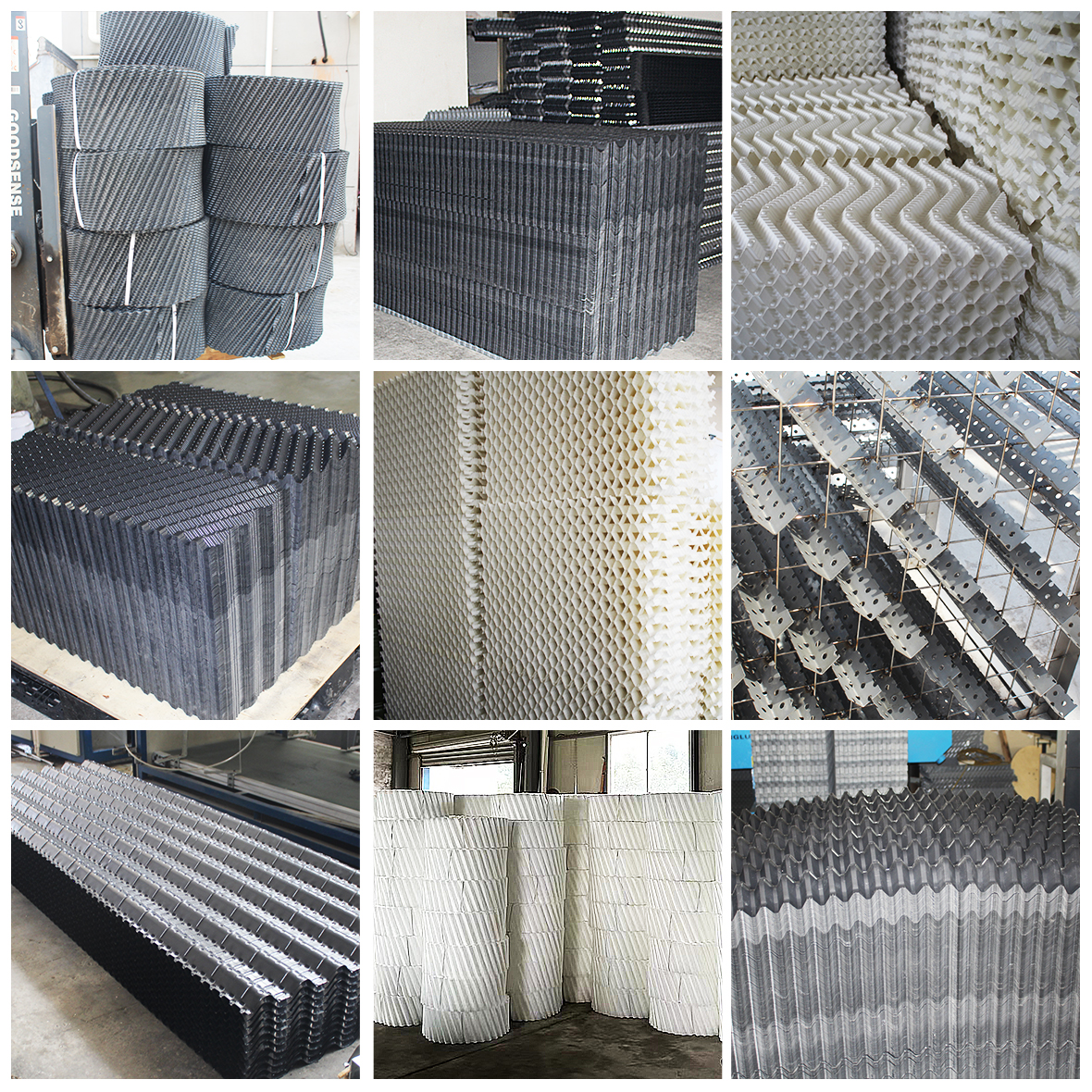
Cooling tower fill, also known as cooling tower filling or fill media, is installed inside a cooling tower to increase the contact area between circulating water and air.
As hot water flows over or through the fill, it spreads into thin films or smaller droplets. Air passing through the fill promotes heat transfer and evaporation, allowing the water temperature to decrease before it returns to the cooling system.
Cooling tower fill performs several important functions:
Increases the contact area between water and air.
Improves heat and mass transfer.
Supports the cooling tower's thermal performance.
Helps achieve the required cold-water temperature.
Influences airflow resistance and water distribution.
Affects maintenance requirements and long-term operating costs.
The appropriate fill design depends on the cooling tower configuration, water quality, operating temperature, airflow, and thermal requirements.
Drift eliminators are installed in the air discharge path of a cooling tower. Their primary function is to remove entrained water droplets from the moving air before the air leaves the tower.
They typically use specially shaped passages that force airflow to change direction. Water droplets cannot follow every change in direction, so they strike the eliminator surfaces, collect, and drain back into the cooling tower.
High-quality drift eliminators can help:
Reduce water droplets carried out of the cooling tower.
Minimize unnecessary water loss.
Reduce water discharge around the cooling tower.
Help protect nearby equipment and structures from excessive moisture.
Support compliance with applicable drift-emission requirements when properly selected and installed.
Drift eliminators do not eliminate all evaporation. Evaporation is a necessary part of the cooling process, while drift refers to liquid water droplets carried out with the exhaust air.
Cooling tower fill and drift eliminators have different roles, but both contribute to overall cooling tower performance.
| Component | Primary Function | Key Selection Factors |
|---|---|---|
| Cooling tower fill | Enhances heat and mass transfer | Fill geometry, material, thermal duty, water quality |
| Drift eliminator | Captures entrained water droplets | Drift performance, airflow resistance, material, operating conditions |
| Fill support system | Supports the fill pack | Load capacity, corrosion resistance, dimensions |
| Water distribution system | Distributes water across the fill | Nozzle arrangement, flow rate, coverage |
Selecting these components as part of a coordinated system can help reduce performance problems caused by incompatible designs or incorrect installation.
Reliable fill and drift eliminators wholesalers should offer products suited to different cooling tower designs and industrial applications.
Film fill is designed to spread water into thin films across closely spaced surfaces. This increases the contact area between water and air and can provide high heat-transfer performance in suitable operating conditions.
High effective contact area.
Compact heat-transfer design.
Potential for efficient cooling performance.
Widely used in industrial and HVAC cooling towers.
Film fill is commonly used in applications where water quality is sufficiently controlled and the fill passages can remain relatively clean.
However, narrow passages may become blocked by suspended solids, biological growth, scale, or other deposits. Buyers should confirm that the selected film fill is suitable for the site's water treatment conditions.
Splash fill breaks falling water into smaller droplets as it contacts specially designed bars, grids, or other surfaces. This creates additional air-water contact and promotes heat transfer.
Often suitable for water with a higher suspended-solids load than fine-passage film fill.
Can be selected for certain demanding industrial environments.
May be easier to maintain in applications where blockage is a concern.
Available in different configurations to suit tower requirements.
Splash fill does not automatically outperform film fill. The best choice depends on water quality, thermal duty, tower design, and operating conditions.
In a crossflow cooling tower, air moves horizontally across the falling water. The fill arrangement is designed to support contact between these two streams.
Crossflow fill is commonly selected for crossflow tower designs that use gravity-fed water distribution. Its dimensions, hanging or supporting arrangement, and water distribution pattern must match the tower configuration.
Buyers should provide the original fill dimensions, tower model, and installation details before requesting a wholesale quotation.
In a counterflow cooling tower, air moves upward while water flows downward. The fill is arranged to support heat and mass transfer between these opposing flows.
Counterflow fill is designed around the tower's vertical airflow and water distribution arrangement. Its performance depends on the fill geometry, air velocity, water loading, and the overall tower design.
Crossflow and counterflow fill packs are not necessarily interchangeable. Wholesalers should verify the original tower arrangement before recommending replacement media.
Drift eliminators are available in several designs and material options. Buyers should choose a configuration that meets the required drift performance without creating excessive airflow resistance.
Polyvinyl chloride (PVC) drift eliminators are widely used in many cooling tower applications because they can offer a practical balance of cost, corrosion resistance, and manufacturing flexibility.
Suitable for many standard cooling tower environments.
Available in different profiles and module dimensions.
Can be manufactured for a variety of tower configurations.
Often economical for routine replacement projects.
The suitability of PVC depends on operating temperature, chemical exposure, mechanical loading, and the specific grade used. Buyers should confirm the manufacturer's recommended operating limits.
Polypropylene (PP) drift eliminators are another option for cooling tower systems. PP may be preferred in applications where its material properties provide advantages under the expected operating conditions.
Good resistance to many chemicals.
Suitable for certain industrial environments.
Available in different molded or assembled configurations.
Can be considered for applications requiring material-specific performance.
PP is not universally superior to PVC. Selection should be based on actual temperature, chemical compatibility, structural requirements, and total project cost.
Different drift eliminator designs use different passage geometries to capture droplets and return collected water to the tower.
Multi-pass designs direct air through a series of directional changes. These turns help separate water droplets from the airflow.
Modular products can simplify transportation, handling, and installation. Their connection details and dimensions must still match the support arrangement and available space inside the tower.
Custom drift eliminators may be appropriate when the original tower uses unusual dimensions, nonstandard support spacing, or specific airflow requirements.
A supplier should confirm the proposed design's compatibility and performance rather than relying on external dimensions alone.
Finding the right wholesaler requires a systematic assessment of product quality, technical capability, purchasing terms, and service reliability.
A capable wholesaler should understand the differences between film fill, splash fill, crossflow fill, counterflow fill, and various drift eliminator designs.
Before placing an order, ask the supplier:
Which fill types and drift eliminator configurations are available?
Can the products match the existing cooling tower?
What materials are offered?
Are custom dimensions available?
Can the supplier provide technical drawings and dimensional information?
What operating limits apply to the proposed materials?
Can the supplier support replacement projects for older towers?
Suppliers that ask detailed questions about the tower and operating conditions are often better positioned to recommend suitable products than suppliers that quote only by size or weight.
For wholesale purchases, product consistency is particularly important. Dimensional variations, poor bonding, inconsistent sheet thickness, or weak module connections can complicate installation and affect service life.
Ask about the supplier's quality management process, including:
Incoming raw material inspection.
Material identification and traceability.
Dimensional inspection.
Visual inspection for defects.
Bonding or assembly checks where applicable.
Sampling and final inspection procedures.
Packaging and shipment inspection.
Depending on the project, useful documents may include technical data sheets, material specifications, dimensional drawings, inspection reports, and test reports.
Do not assume that every supplier holds the same certifications or conducts the same tests. Confirm which documents are available for the specific product being purchased.
Price is an important consideration, but the lowest quotation does not always represent the lowest overall cost.
A very low price may reflect differences in material grade, thickness, design, manufacturing tolerances, packaging, or included services. Buyers should compare quotations on an equivalent technical basis.
Cooling tower fill and drift eliminator prices may depend on:
Material type, such as PVC or PP.
Product dimensions and thickness.
Fill geometry and module design.
Order quantity.
Customization requirements.
Packaging and pallet specifications.
Inspection or testing requirements.
Shipping destination and freight method.
Production lead time.
For international purchases, the total cost should include the quoted product price, packaging, freight, insurance if required, customs duties, taxes, and local handling charges where applicable.
A slightly higher factory quotation may still be commercially attractive if it offers better dimensional consistency, appropriate documentation, secure packaging, and dependable delivery.
Wholesalers serving contractors and industrial distributors should be able to explain how they manage production planning and delivery commitments.
Available inventory and production lead time.
Minimum order quantity, if any.
Monthly production capacity for relevant products.
Availability of custom manufacturing.
Packaging method and pallet dimensions.
Shipment consolidation options.
Inspection and dispatch arrangements.
For urgent replacement projects, confirm whether the supplier can meet the required delivery date before approving the purchase order.
Clear communication helps reduce errors in dimensions, materials, quantities, and shipping documents.
A reliable supplier should be willing to:
Clarify technical requirements before production.
Confirm dimensions and material specifications in writing.
Explain product limitations.
Provide order and production updates.
Respond to quality or delivery issues.
Assist with installation-related technical questions within its capabilities.
Good after-sales support is especially important for replacement orders, where a small dimensional mismatch can delay an entire maintenance project.
The correct fill depends on more than the tower's external dimensions. Buyers should assess thermal requirements, water conditions, mechanical compatibility, and maintenance needs.
First, determine whether the existing tower is crossflow or counterflow. Also identify the tower manufacturer, model, installation arrangement, and available fill space.
Prepare the following information when requesting a quotation:
Cooling tower manufacturer and model.
Original fill type and material, if known.
Fill block length, width, and height.
Sheet or element thickness, where applicable.
Existing support arrangement.
Required quantity and total fill volume.
Operating water temperature.
Design water flow and airflow information, if available.
If the original specifications are unavailable, provide clear photographs, measurements, and drawings. The supplier may need additional information to confirm compatibility.
Water quality is one of the most important factors in fill selection.
Suspended solids and sediment.
Scale formation.
Biological growth.
Corrosion products.
Oil or process contaminants.
Fine-passage film fill may be vulnerable to blockage when water contains high levels of solids or when treatment and filtration are inadequate. Splash fill or other suitable designs may be worth evaluating for such applications.
The decision should be based on the actual water analysis and operating conditions, not on a general claim that one fill type suits every industrial tower.
The fill should support the required cooling duty at the expected water flow, air conditions, and operating temperatures.
Two fill products with similar dimensions may have different surface geometries, passage sizes, airflow resistance, and thermal characteristics.
Ask the supplier whether technical performance data are available for the proposed design. Where thermal performance is critical, involve the cooling tower designer or a qualified engineering professional to verify suitability.
PVC and PP have different material properties, and their performance varies by formulation and operating environment.
What is the maximum continuous operating temperature?
Will the water contain chemicals that may affect the material?
Are there unusual mechanical loads or vibration conditions?
Does the fill need specific fire-performance characteristics?
Are any special hygiene, environmental, or regulatory requirements applicable?
Always use the manufacturer's documented limits for the specific material and product.
Drift eliminators must fit the tower and perform effectively under the intended airflow and water conditions.
The required drift performance depends on the cooling tower design, operating conditions, and applicable project specifications.
Where available, request information about:
Drift reduction performance.
Test conditions and test methods.
Airflow resistance or pressure drop.
Recommended air velocity range.
Installation orientation.
Operating temperature and material limitations.
Performance figures should be compared only when their test conditions and definitions are compatible.
Even a well-designed drift eliminator can perform poorly if installed incorrectly or if gaps allow air and droplets to bypass the intended passages.
Confirm module width, height, thickness, support spacing, edge details, connection methods, and the direction of installation.
The overall system includes more than the eliminator panels. Support frames, retaining clips, drainage paths, and sealing details may also affect installation and performance.
A drift eliminator should capture droplets effectively without creating unacceptable resistance to airflow.
Excessive resistance may affect fan operating conditions and cooling tower capacity. Conversely, a design that does not adequately separate droplets may allow excessive drift.
Ask the supplier or cooling tower designer to evaluate both drift performance and pressure drop for the intended operating conditions.
Not every cooling tower uses standard dimensions or interchangeable components. Custom manufacturing can be useful for replacement work, equipment upgrades, and distributor inventory programs.
Depending on manufacturing capabilities, suppliers may customize fill dimensions, material selection, sheet thickness, block configuration, and packaging.
Replacing fill in an older cooling tower.
Matching a particular support arrangement.
Meeting a specified block height or width.
Replacing damaged or obsolete components.
Preparing products for a project with several tower sizes.
Customization should be based on verified specifications rather than estimates alone.
Custom drift eliminators may be required when the tower has nonstandard module dimensions or unique installation constraints.
Provide the supplier with drawings, measurements, material requirements, quantity, operating temperature, and any specified drift performance requirements.
The supplier should confirm whether it can manufacture the requested design and whether performance validation is necessary before production.
Buyers may encounter original equipment manufacturer (OEM) parts and compatible replacement products.
OEM parts are supplied by or through the original equipment manufacturer or an authorized channel, as applicable. Compatible aftermarket products are manufactured by another supplier to fit a particular application or meet specified requirements.
A compatible product should not automatically be described as identical to the original design or officially approved by the tower manufacturer.
For trademarked tower brands, buyers should confirm the product's origin, compatibility, and authorization status before making procurement decisions.
A structured ordering process reduces mistakes and makes international procurement easier to manage.
Send the supplier the tower model, component type, material requirements, dimensions, quantity, and destination.
Clear photographs of the existing fill, drift eliminators, support structure, and installation space can help the supplier understand the project.
A useful quotation should identify the product, dimensions, material, quantity, unit price, packaging, lead time, and shipping terms.
Review payment terms, quotation validity, production schedule, inspection requirements, and responsibility for freight and import costs.
For international shipments, make sure the agreed Incoterms and delivery location are clearly stated in the quotation or purchase contract.
Before mass production, review the final technical drawings and specifications.
Check product dimensions, materials, quantities, tolerances where specified, assembly details, and any required documentation.
Written approval helps prevent disputes caused by different interpretations of the inquiry.
For larger orders, buyers may request pre-shipment inspection or agree on a documented quality inspection process.
Fill media and eliminator modules may be bulky and can be damaged by compression, impact, or improper stacking. Confirm the packaging method, pallet dimensions, gross weight, and loading plan before shipment.
Upon delivery, compare the received products against the purchase order and approved specifications.
Incorrect dimensions or quantity.
Material or model discrepancies.
Cracks, deformation, or broken edges.
Loose joints or damaged connections.
Inadequate packaging protection.
Missing technical or shipping documents.
Report discrepancies promptly and retain photographs and relevant shipment records.
Avoiding common purchasing mistakes can reduce installation delays and unexpected maintenance costs.
A low quotation may not include the required material grade, quality checks, packaging, or technical support.
Better approach: Compare products with equivalent specifications and evaluate total delivered cost.
Selecting fine-passage fill without considering suspended solids and fouling risk may result in frequent blockage and cleaning.
Better approach: Share water quality information and maintenance history with the supplier before selecting the fill design.
Products that look similar may have different dimensions, airflow resistance, thermal characteristics, or mounting arrangements.
Better approach: Confirm technical compatibility and obtain written specifications before ordering.
Incorrect orientation, poor sealing, or gaps between modules may reduce effective drift capture.
Better approach: Confirm the installation direction, support design, and assembly requirements before delivery.
Custom products and large orders may require additional manufacturing and inspection time.
Better approach: Confirm production capacity and the delivery schedule early, especially before a planned shutdown or seasonal maintenance period.
Even high-quality cooling tower fill and drift eliminators require appropriate inspection and maintenance.
Check the fill for scale, sediment, biological growth, deformation, and signs of chemical damage.
Cleaning procedures should reflect the fill material, deposit type, and manufacturer's recommendations. Avoid excessive water pressure or chemicals that could damage the fill.
Look for broken panels, missing sections, loose connections, damaged supports, and deposits that obstruct the air passages.
Replace damaged modules and correct gaps or alignment issues. Ensure the eliminators are installed in the specified direction and that collected water can drain back into the tower.
Proper water treatment, filtration, and routine monitoring can help reduce scaling, fouling, and biological growth.
Record inspection dates, observed defects, cleaning activities, replaced components, and operating conditions. These records help buyers estimate replacement needs and plan future procurement.
An experienced supplier can help buyers coordinate component selection, documentation, production, and delivery.
Wholesale buyers often need consistent product specifications, repeatable quality, and competitive pricing across multiple orders.
A capable supplier may help distributors by providing:
Multiple fill and drift eliminator options.
Technical documentation for customer quotations.
Bulk-order production planning.
Custom dimensions where feasible.
Export packaging and shipping coordination.
Consistent specifications for repeat orders.
Maintenance contractors need components that fit the existing tower and can be installed within the available shutdown window.
A supplier that verifies dimensions and delivery requirements can help reduce the risk of delays caused by incompatible products or incomplete orders.
Industrial operators may prioritize thermal performance, reduced water loss, maintenance access, and long-term operating cost.
A technically appropriate replacement can help restore intended system performance, provided that the tower's water distribution, airflow, fan operation, and other relevant components are also in suitable condition.
Cooling tower fill improves heat and mass transfer by increasing contact between water and air. Drift eliminators capture water droplets entrained in the exhaust airflow, reducing drift loss. Both are important, but they perform different functions.
Yes. Some wholesalers supply both products, along with related cooling tower components. Buyers should verify product availability, manufacturing capability, technical specifications, and delivery arrangements for each item.
Neither material is universally better. PVC may be suitable for many standard cooling tower applications, while PP may offer advantages under certain chemical or operating conditions. The decision should consider temperature, chemical compatibility, mechanical requirements, and product specifications.
Common warning signs include persistent blockage, physical deformation, cracking, excessive deposits, uneven water distribution, and reduced cooling performance. Before replacing the fill, investigate water treatment, nozzle condition, airflow, and other potential causes.
There is no single replacement interval for every cooling tower. Service life depends on material quality, operating temperature, water chemistry, UV exposure where relevant, mechanical damage, and maintenance practices. Inspect the modules regularly and follow the equipment and product manufacturer's recommendations.
Provide the cooling tower model, component type, dimensions, material requirements, quantity, operating conditions where relevant, photographs or drawings, destination, and required delivery date. More complete information helps suppliers quote accurately.
Some manufacturers and wholesalers offer custom products. Availability depends on the required design, dimensions, tooling, quantity, and performance specifications. Confirm feasibility and approve drawings before production.
Compare the technical specifications, material, dimensions, quality documentation, quantity, packaging, lead time, payment terms, shipping conditions, and after-sales support. Make sure each quotation covers the same scope before comparing prices.
Choosing the right fill and drift eliminators wholesalers is an important step in maintaining cooling tower performance, controlling procurement costs, and ensuring dependable replacement projects. Buyers should assess product quality, material suitability, dimensional compatibility, technical support, production capacity, and delivery reliability rather than focusing on price alone.
Cooling tower fill should be selected according to thermal requirements, tower configuration, water quality, and maintenance conditions. Drift eliminators should be evaluated based on drift performance, airflow resistance, material compatibility, and installation requirements.
For distributors, contractors, and industrial buyers, the most effective purchasing strategy is to prepare accurate technical information, request detailed quotations, verify specifications, and establish clear quality and delivery requirements before placing an order.
By working with a technically capable wholesale supplier, buyers can source suitable cooling tower fills and drift eliminators for new installations, maintenance programs, and replacement projects while building a more reliable long-term supply chain.


