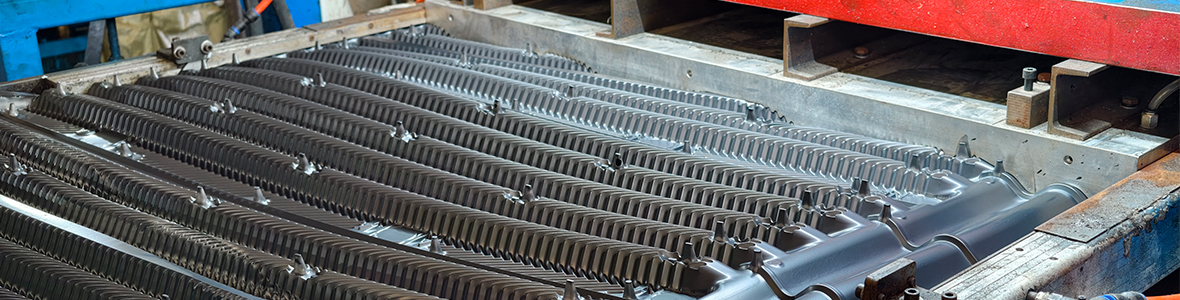
A cooling tower can have a powerful fan, reliable pump, excellent water treatment, and a well-maintained structure. Yet if the cooling tower fill is clogged, cracked, warped, or badly scaled, the entire system can struggle.
Why? Because fill is where much of the real heat-transfer work happens.
Water needs to spread across a large surface area while air moves through the fill. This creates intimate contact between air and water, allowing heat to leave the circulating water through evaporation. When the fill deteriorates, that carefully balanced process starts to break down.
So, when should you replace cooling tower fill? Why is replacement sometimes better than cleaning? And how do you choose the right replacement fill?
This guide answers those questions step by step.
What Is Cooling Tower Fill?
Cooling tower fill is the heat-transfer media installed inside an evaporative cooling tower. Its job is simple in theory but extremely important in practice: increase the contact area between circulating water and moving air.
Instead of letting water fall straight from the distribution system into the basin, fill breaks the water into thin films or droplets and spreads it across a much larger surface.
Think of it like turning a single thick waterfall into thousands of tiny streams. More exposed surface means better contact with air and more opportunity for evaporation.
Different towers use different fill designs, including film fill and splash fill. The correct choice depends on tower configuration, water quality, temperature, airflow, and other operating conditions.
Why Fill Is Critical to Heat Transfer
The efficiency of a cooling tower depends heavily on how effectively water and air interact.
When fill is clean and properly installed, water spreads evenly while air passes through the passages. This supports efficient heat rejection and helps the tower achieve its intended cold-water temperature.
But imagine trying to breathe through a dirty filter. Air can still pass, but not nearly as easily.
Cooling tower fill behaves in a similar way. Scale, algae, sludge, debris, or collapsed sheets can restrict passages. The result may be reduced airflow, uneven water distribution, higher approach temperature, and declining cooling performance.
That is why fill condition should be part of every serious cooling tower maintenance program.
Why Does Cooling Tower Fill Need Replacement?
Cooling tower fill operates in a demanding environment. It is continuously exposed to water, heat, chemicals, microorganisms, airborne contaminants, and mechanical stress.
Eventually, even a well-designed fill system can deteriorate.
Common reasons for cooling tower fill replacement include:
Heavy mineral scaling
Biological growth
Sediment and debris accumulation
Cracked or brittle sheets
Collapsed fill blocks
Chemical degradation
Thermal deformation
Repeated mechanical damage
Poor water distribution
Long-term material aging
The important point is that not every dirty fill needs to be replaced. Sometimes cleaning and water-treatment improvements can restore performance. Replacement becomes more attractive when the fill itself has suffered irreversible structural or performance damage.
Scaling and Mineral Deposits
Hard water can leave mineral deposits on fill surfaces. As scale builds up, the original passages become narrower.
What happens next?
Water distribution becomes less uniform. Air resistance can increase. Heat-transfer surface becomes less effective. Eventually, the fill may become so heavily coated that normal cleaning cannot restore its original geometry.
If scale repeatedly returns, the root cause may be water chemistry rather than the fill itself. In that case, simply installing new fill without improving water treatment could lead to the same problem again.
Biological Fouling and Blockage
Cooling towers provide a warm, wet environment where biological growth can develop when treatment is inadequate.
Algae, slime, biofilm, and organic deposits can accumulate inside fill passages. These deposits reduce the open area available for air and water movement.
The problem can snowball. Restricted airflow reduces performance, poor water distribution creates additional wet spots, and those areas can encourage even more fouling.
Regular inspection and appropriate water treatment are therefore essential for protecting replacement fill.
Physical Damage and Aging
Sometimes the problem is not contamination at all.
Fill can become brittle, cracked, warped, or collapsed after years of operation. Mechanical damage can also occur during inspections, cleaning, or other maintenance work.
Once the physical structure has failed, cleaning cannot bring it back.
A cracked fill sheet is like a broken roof tile. Washing it may make it cleaner, but it does not make it structurally sound again.
Chemical and Thermal Degradation
Cooling tower fill is exposed to the circulating-water chemistry and operating temperature of the system.
If operating conditions exceed the material's suitability, long-term degradation can accelerate. Chemical exposure can also affect some materials over time.
This is why replacement fill should never be selected based only on price or appearance.
The material must match the application.
When Should Cooling Tower Fill Be Replaced?
There is no single replacement date that applies to every cooling tower.
Service life depends on water quality, operating conditions, material selection, maintenance, temperature, contamination, and tower design. Even major cooling equipment manufacturers emphasize that fill longevity depends heavily on operating conditions rather than a universal calendar date.
Instead of asking only, “How old is the fill?” ask a better question:
“Can the existing fill still perform its job reliably?”
Look for several warning signs.
Performance Has Declined
One of the most important signs is declining thermal performance.
If leaving-water temperature is consistently higher than expected, investigate the entire cooling system before blaming the fill.
Check:
Water flow
Fan operation
Airflow
Spray nozzles
Water distribution
Heat load
Ambient conditions
Water treatment
Fill condition
If other factors are operating normally and the fill is heavily fouled or damaged, replacement may be justified.
Fill Has Become Brittle or Deformed
Physical inspection is often revealing.
Look for:
Cracked sheets
Broken flutes
Collapsed blocks
Warped sections
Brittle material
Excessive sediment
Blocked passages
Severe deformation can alter airflow and water distribution. In extreme cases, sections of fill can collapse under their own weight or become difficult to support safely.
Cleaning No Longer Restores Performance
This is one of the clearest decision points.
Cleaning and replacement solve different problems.
If contamination is the primary issue and the fill remains structurally sound, cleaning may be appropriate.
If the fill itself has become brittle, cracked, permanently deformed, or severely damaged, replacement is generally the more logical solution.
A practical rule is:
Dirty but structurally sound? Investigate cleaning.
Structurally damaged or permanently degraded? Investigate replacement.
Is There a Fixed Replacement Schedule?
No universal replacement interval should be treated as a guarantee.
Some manufacturers and suppliers publish typical service-life ranges, but actual life varies considerably between installations. Water quality and operating conditions can make two apparently identical towers age at very different rates.
Therefore, condition-based inspection is more useful than blindly replacing fill because it has reached a certain age.
Cooling Tower Fill Replacement vs. Cleaning
Before ordering new fill, compare the two options.
| Condition | Cleaning | Replacement |
| Light scale | Usually suitable | Usually unnecessary |
| Light biological growth | Often suitable | Usually unnecessary |
| Heavy removable fouling | May be suitable | Consider if recurring |
| Cracked fill | Not a permanent solution | Recommended |
| Brittle fill | Not effective | Recommended |
| Collapsed fill | Not effective | Recommended |
| Permanent deformation | Not effective | Recommended |
| Severe blockage | Depends on condition | Often appropriate |
| Poor water treatment | Fix root cause first | May not solve recurrence |
The biggest mistake is replacing fill without fixing the reason it failed.
If poor water treatment caused the original fill to foul rapidly, new fill may simply become the next victim.
Types of Replacement Cooling Tower Fill
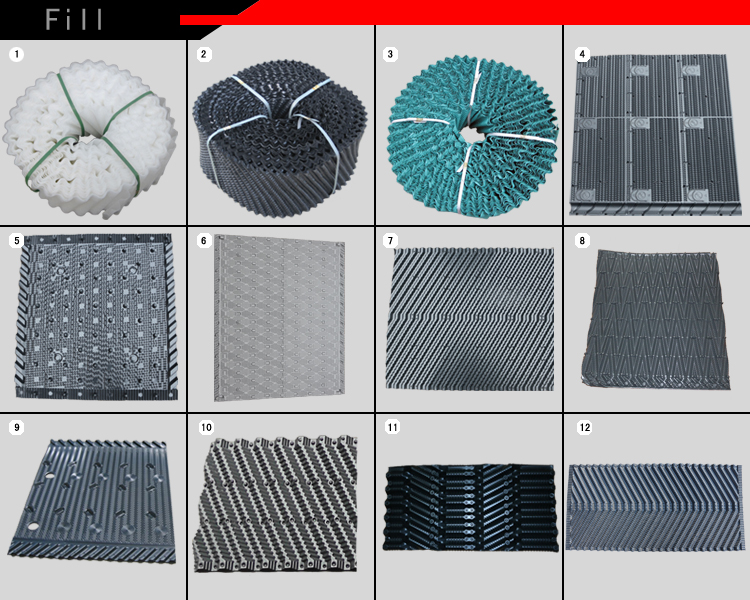
The replacement market is not one-size-fits-all.
Different tower designs and operating environments call for different fill materials and configurations.
PVC Film Fill
PVC film fill is widely used in cooling tower applications where efficient heat transfer and economical operation are important.
Film fill creates a large wetted surface area. Water forms thin films over the structured sheets while air moves through the passages.
PVC is commonly selected for standard operating environments, but the exact material grade, geometry, thickness, and temperature suitability should always be checked against the tower's operating conditions.
For many replacement projects, PVC film fill is an attractive starting point because it can provide efficient heat transfer without unnecessarily increasing material cost.
PP Cooling Tower Fill
Polypropylene, or PP, is another important material for cooling tower fill.
PP can be attractive for applications where higher temperature capability or particular chemical-resistance requirements make it preferable to standard PVC.
However, “PP is better” is not a universal rule.
The right material depends on actual operating conditions. A properly specified PVC fill can be a better choice for one tower, while PP may be more appropriate for another.
Crossflow Film Fill
In a crossflow cooling tower, air and water move through the fill in different directions.
Crossflow fill is designed around this airflow and water-distribution arrangement.
When replacing crossflow fill, do not simply order a generic film-fill block. The replacement needs to match the tower's dimensions, fill arrangement, support system, and distribution method.
A small mismatch can create a surprisingly large headache during installation.
Counterflow Film Fill
Counterflow towers use a different airflow arrangement. Water travels downward while air moves upward through the fill.
Because the tower geometry is different, counterflow film fill has its own design requirements.
When ordering replacement media, verify fill height, block dimensions, flute configuration, support requirements, and operating conditions rather than assuming crossflow and counterflow products are interchangeable.
Splash Fill
Splash fill works differently from film fill.
Instead of creating a continuous water film over structured sheets, splash fill repeatedly breaks water into droplets as it moves through the fill.
This approach can be useful in applications where water contains higher levels of suspended solids or where fouling resistance is a major concern.
The best solution depends on the application. High thermal efficiency is not the only factor worth considering; water quality and maintainability matter too.
How to Choose the Right Replacement Fill
Choosing replacement fill is a little like buying replacement tires for a commercial truck.
Will any tire physically fit?
Maybe.
Will any tire perform properly under the truck's actual load, speed, road conditions, and operating environment?
Definitely not.
The same logic applies to cooling tower fill.
Match the Cooling Tower Configuration
First determine whether the tower is:
The fill must be compatible with the tower's internal design.
Check Dimensions and Fill Height
Never rely only on the tower's model name.
Measure the existing installation whenever possible.
Important information includes:
Some replacement projects involve older towers, modified structures, or discontinued products. In those situations, physical measurements can be more reliable than assumptions based on an old catalog.
Consider Water Quality
Water quality can completely change the selection process.
Consider:
Hardness
Suspended solids
Biological activity
Oil contamination
pH
Chemical treatment
Fouling history
If the original fill repeatedly clogged, ask why before choosing an identical replacement.
Maybe the tower needs better water treatment. Maybe the fill geometry needs to change. Maybe splash fill deserves consideration.
The goal is not simply to replace plastic. The goal is to restore reliable cooling.
Review Operating Temperature
Temperature is another critical factor.
Before selecting PVC or PP, confirm the actual hot-water temperature and operating range with the fill manufacturer.
Do not assume that every PVC or PP product has the same temperature capability. Product formulations, thicknesses, geometries, and manufacturers can differ.
When in doubt, provide the supplier with actual operating data and let the technical team verify suitability.
Cooling Tower Fill Replacement Process
A successful cooling tower fill replacement project is more than removing old blocks and putting new ones in their place.
It should be treated as a controlled maintenance project.
Step 1: Inspect the Existing Fill
Start with a complete inspection.
Record:
Fill condition
Fouling level
Damage
Deformation
Water distribution
Support condition
Nozzle condition
Airflow restrictions
If performance has declined, compare current operating data with historical or design data where available.
Step 2: Measure and Document the Tower
Take photographs and measurements before removing anything.
Document the existing arrangement carefully.
For an older tower, photographs can be especially valuable because they provide a visual reference during production and installation.
If the original drawings are unavailable, accurate measurements become even more important.
Step 3: Remove the Old Fill
The old fill should be removed carefully.
Heavily fouled blocks can be surprisingly heavy. Damaged sheets may break apart during removal, spreading debris into the basin.
Workers should follow the site's safety procedures and use appropriate access equipment.
Never treat a fill replacement as a simple “lift and replace” job.
Step 4: Inspect Support Structures
Once the old fill is out, inspect the structure underneath it.
Check:
Support beams
Hold-down components
Structural members
Spray headers
Nozzles
Basin condition
Seals and connections
This is one of the major advantages of a fill replacement project: areas that are normally hidden become accessible.
Step 5: Install the New Fill
Install the replacement fill according to the manufacturer's layout and installation requirements.
Make sure blocks are positioned correctly and supported properly.
Avoid unnecessary gaps or compression. Incorrect installation can alter airflow and water distribution even when the fill itself is a high-quality product.
Step 6: Test Water Distribution and Airflow
After installation, inspect the water distribution system and restart the tower according to site procedures.
Look for:
The job is not finished when the last fill block is installed. It is finished when the cooling tower is operating properly again.
Common Mistakes During Fill Replacement
Several mistakes appear again and again in replacement projects.
Choosing Fill by Price Alone
The cheapest product is not necessarily the lowest-cost solution.
Frequent cleaning, poor cooling, premature replacement, and installation problems can quickly erase an initial price advantage.
Ignoring the Support Structure
New fill cannot compensate for damaged supports.
Inspect the structure before installation.
Using the Wrong Fill Configuration
Crossflow and counterflow systems have different requirements.
Never assume that a generic fill block will work simply because its dimensions look close.
Ignoring Water Treatment
New fill does not cure poor water chemistry.
If scaling or biological fouling caused the previous failure, address that problem at the same time.
Relying on Old Measurements
Cooling towers can change over time.
Repairs, modifications, structural movement, and previous replacement work can alter dimensions. When possible, measure the actual tower before production.
Why Choose Power Tower Cooling Technology?
For a replacement project, the supplier is part of the solution.
Power Tower Cooling Technology (Shaoxing) Co., Ltd. specializes in cooling tower components and replacement solutions, including PVC and PP cooling tower fill, crossflow fill, counterflow fill, replacement fill packs, and customized products.
The company has more than 15 years of manufacturing and export experience and operates a factory and warehouse covering more than 15,300 square meters, according to its official company information.
Customized Replacement Solutions
Replacement projects are rarely identical.
You may have an older tower. The original fill may be discontinued. Your existing dimensions may not match today's standard products.
Power Tower supports customized replacement projects. Buyers can provide information such as tower manufacturer and model, fill dimensions, operating temperatures, water flow, water quality, material requirements, and photographs of the existing fill.
That makes the process much more practical than simply choosing a product from a generic catalog.
PVC and PP Fill Options
Power Tower's product range includes PVC film fill, PP cooling tower fill, counterflow fill, crossflow fill, replacement fill packs, and various application-specific replacement solutions.
For buyers, this means the conversation can begin with the existing tower and operating conditions rather than forcing every project into the same standard product.
For more information, visit the official website of Power Tower Cooling Technology (Shaoxing) Co., Ltd.: CoolingTowerPart.com
How to Extend the Life of New Cooling Tower Fill
Replacement should be the beginning of a maintenance strategy, not the end.
To protect new fill:
Maintain an appropriate water-treatment program.
Monitor scaling and biological growth.
Keep spray nozzles clean and properly positioned.
Remove debris before it blocks airflow.
Inspect fill condition regularly.
Monitor cooling performance.
Record unusual temperature or pressure changes.
Inspect the fill after major maintenance work.
Correct water-distribution problems early.
Keep maintenance records for future replacement planning.
Good maintenance is cheaper than repeated emergency repairs.
Cooling Tower Fill Replacement FAQ
How often should cooling tower fill be replaced?
There is no universal replacement interval. Fill life depends on water quality, operating temperature, chemical exposure, maintenance, fouling, and tower operating conditions.
Instead of replacing fill solely because it has reached a certain age, inspect its physical condition and evaluate cooling performance.
Can PVC fill be replaced with PP fill?
Potentially, yes, but it should not be assumed.
The replacement material must be suitable for the tower's operating temperature, water chemistry, fill geometry, and design requirements.
Ask the manufacturer to confirm compatibility before changing materials.
How do I know whether I need cleaning or replacement?
If the fill is contaminated but structurally sound, cleaning may restore performance.
If it is cracked, brittle, collapsed, permanently deformed, or severely deteriorated, replacement is usually the more appropriate solution.
Can I replace only part of the cooling tower fill?
In some towers, partial replacement is possible. However, the decision depends on the extent of damage, fill arrangement, water distribution, and thermal performance.
A technical inspection should determine whether partial or complete replacement makes more sense.
How do I order replacement cooling tower fill?
Provide the supplier with as much technical information as possible.
Ideally, send:
Cooling tower brand and model
Tower type
Existing fill dimensions
Fill height
Material
Water flow
Hot-water temperature
Cold-water temperature
Water quality information
Photos of the existing fill
Photos of the support structure
The more accurate the information, the easier it is to identify a suitable replacement.
Final Takeaway
Cooling tower fill replacement is not simply a maintenance task. It is an opportunity to restore heat-transfer performance, improve reliability, and extend the useful life of the cooling tower.
The smartest approach is straightforward:
Inspect first. Diagnose the cause. Measure carefully. Select the right material. Match the tower configuration. Install correctly. Then maintain the new fill properly.
If the existing fill is only dirty, cleaning may be enough.
If it is structurally damaged or permanently degraded, continuing to clean it may simply postpone the inevitable.
And when you are ready to replace it, don't ask only, “How much does the fill cost?”
Ask the more important question:
“Will this replacement fill perform correctly in my cooling tower?”
That is where the right manufacturer makes a difference.
For PVC film fill, PP fill, crossflow fill, counterflow fill, customized replacement packs, and cooling tower component solutions, Power Tower Cooling Technology (Shaoxing) Co., Ltd. provides a practical option for replacement projects and OEM-compatible applications.


