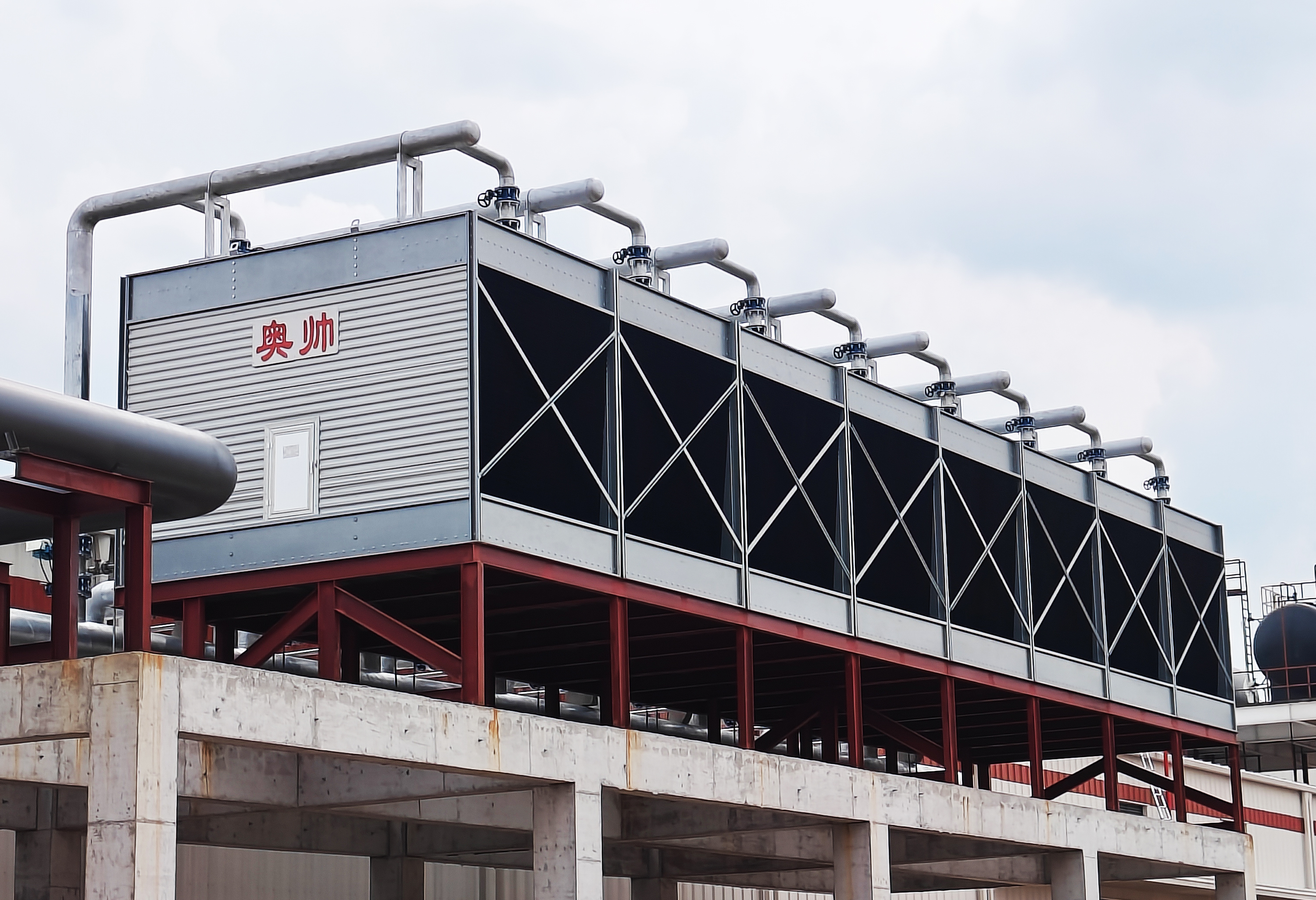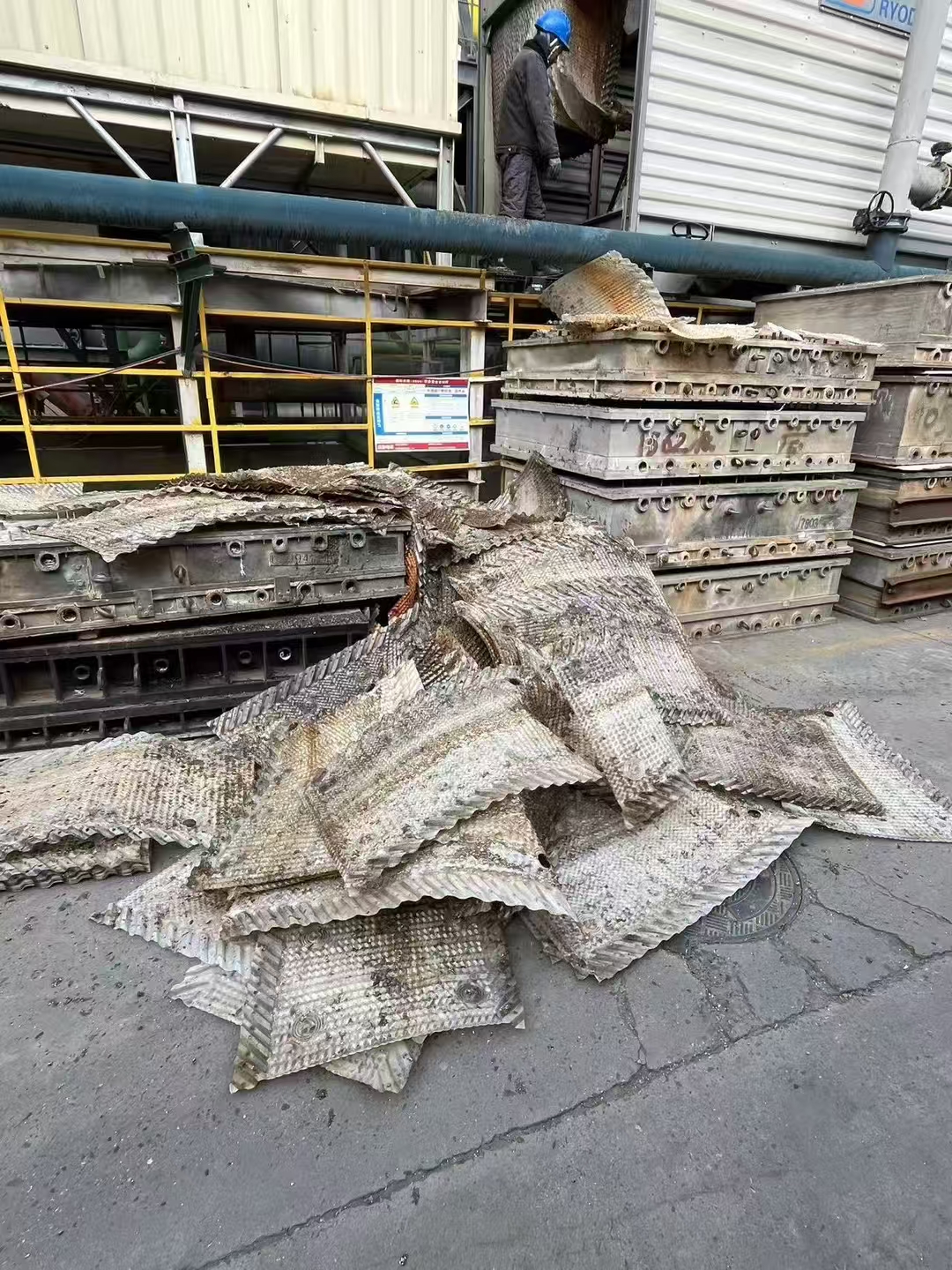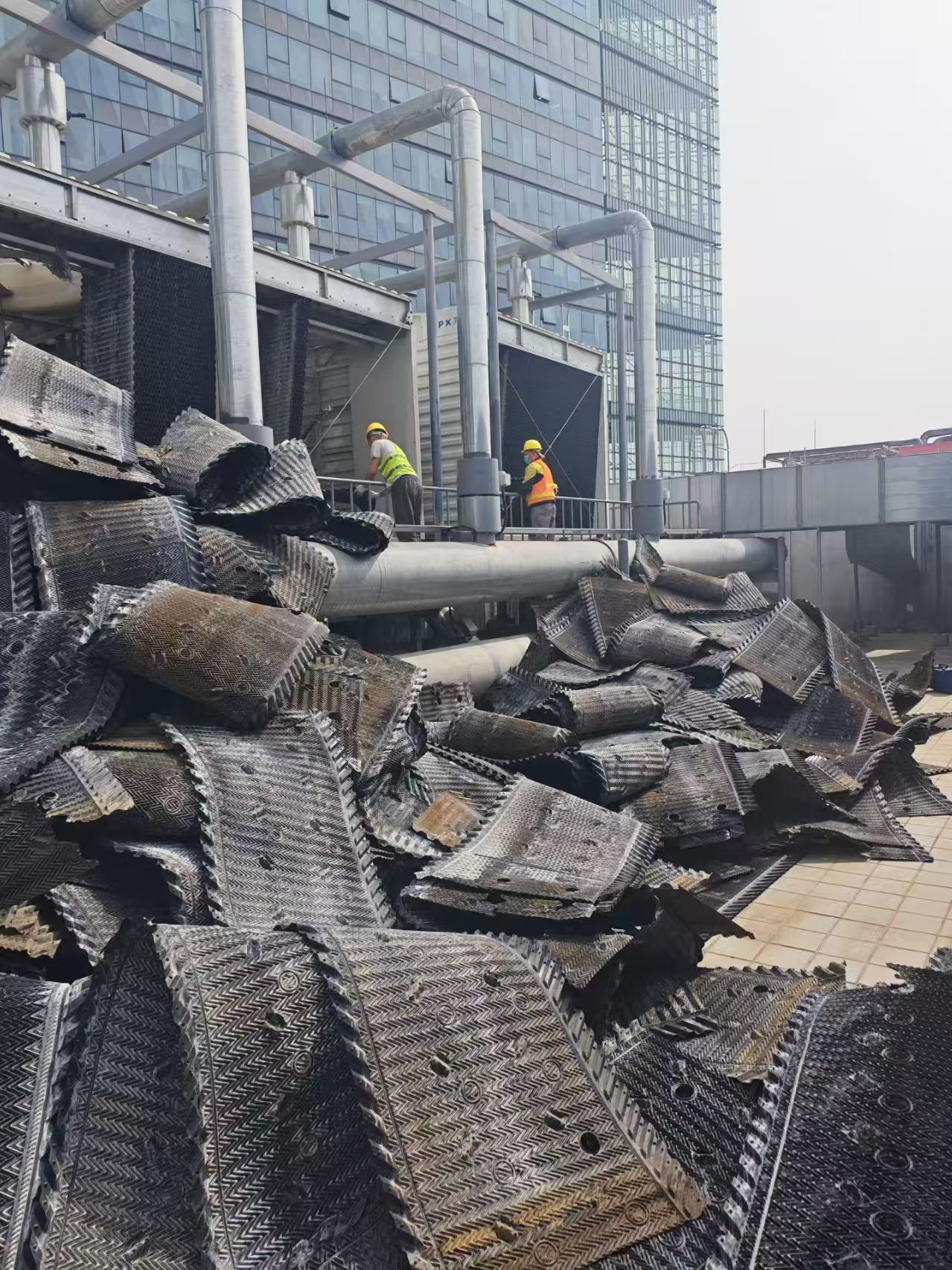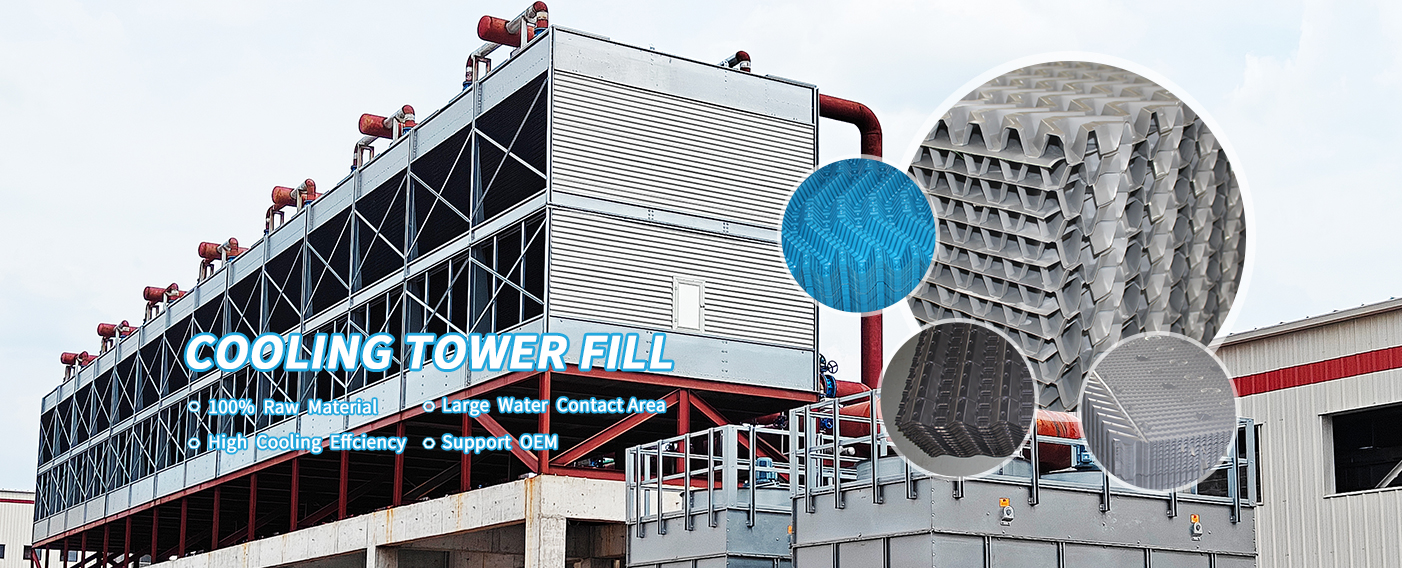
Cooling tower fill media plays a critical role in the thermal performance of an open cooling tower. When fill becomes damaged, fouled, brittle, or inefficient, replacing it can restore cooling performance without replacing the entire tower.
For industrial facilities, HVAC systems, power plants, manufacturing sites, and process cooling applications, a well-planned cooling tower fill retrofit or replacement project can extend equipment life and reduce capital costs.
But replacing cooling tower fill is not simply a matter of removing the old material and installing a new product. The fill must match the tower's water distribution, airflow, dimensions, operating temperature, and water quality.
This guide explains how to select cooling tower fill media for retrofit and replacement projects and what B2B buyers should consider before ordering.
What Is Cooling Tower Fill Media?
Cooling tower fill is the internal media that increases contact between circulating water and air.
Hot water enters the tower and travels through the fill while air moves through the tower. The fill increases the effective contact area, allowing heat to transfer from water to air and a portion of the water to evaporate.
The two primary fill technologies are:
The correct choice depends on the tower design and operating conditions.
Why Replace Cooling Tower Fill?
Cooling tower fill operates continuously in a demanding environment. Over time, it can experience chemical, thermal, biological, and mechanical degradation.
Common reasons for replacement include:
In many cases, the tower structure, fan, motor, basin, and casing remain serviceable. Replacing only the fill can therefore be a cost-effective alternative to purchasing a new cooling tower.
What Is a Cooling Tower Fill Retrofit?
A cooling tower fill retrofit involves upgrading or replacing the existing fill to improve performance, extend service life, or adapt the tower to new operating requirements.
A retrofit may involve:
Replacing old fill with equivalent media
Changing fill geometry
Switching from splash fill to film fill
Upgrading PVC fill to a different material
Reconfiguring fill supports
Improving water distribution
Combining fill replacement with nozzle or drift-eliminator upgrades
A simple one-to-one replacement is usually the lowest-risk approach. A change in fill technology requires more engineering evaluation.
Film Fill for Replacement Projects
Film fill uses closely spaced sheets or structured surfaces to spread water into a thin film.
It provides a high effective surface area and is commonly selected when thermal efficiency is the primary objective.
Advantages
High heat-transfer efficiency
High surface-area density
Compact design
Suitable for many HVAC applications
Effective with properly treated water
PVC and PP are common film-fill materials.
Best applications
Film fill is often appropriate for:
However, narrow passages can be more susceptible to blockage when water contains large quantities of suspended solids.
Splash Fill for Replacement Projects
Splash fill breaks falling water into droplets through repeated contact with bars, grids, or modules.
Its relatively open structure can make it a strong choice for industrial applications where fouling is a concern.
Advantages
Good tolerance of suspended solids
Open water passages
Lower blockage risk
Good durability
Relatively easy maintenance
Suitable for challenging water conditions
PP splash fill is widely used for industrial cooling tower applications.
Best applications
Splash fill is commonly considered for:
Industrial process cooling
Steel plants
Chemical facilities
Power plants
Wastewater-related applications
Towers with difficult water quality
Film Fill vs Splash Fill for Retrofit
Choosing between film and splash fill is one of the most important decisions in a retrofit project.
| Factor | Film Fill | Splash Fill |
| Thermal efficiency | High | Moderate to high |
| Surface area | High | Lower |
| Water passages | Narrower | More open |
| Suspended solids | Less tolerant | More tolerant |
| Fouling resistance | Moderate | High |
| Compactness | Excellent | Moderate |
| Maintenance | More sensitive | Generally easier |
| Typical application | Clean water | Challenging water |
If the existing tower performs well with film fill and water quality is controlled, an equivalent film-fill replacement may be the best option.
If fouling and suspended solids are persistent problems, splash fill may be worth evaluating.
Key Factors for Cooling Tower Fill Retrofit
1. Existing Tower Dimensions
Measure the existing fill before ordering.
Important dimensions include:
Fill height
Fill length
Fill width
Sheet thickness
Module size
Splash-bar dimensions
Support-grid spacing
A few millimeters of dimensional difference can affect installation and water distribution.
2. Water Flow Rate
The supplier should know the approximate circulating-water flow rate.
Fill must be selected according to the actual hydraulic loading rather than tower tonnage alone.
3. Operating Temperature
Record both entering and leaving water temperatures.
Temperature affects the selection of PVC, PP, and other fill materials.
4. Water Quality
Evaluate:
Suspended solids
Hardness
Scaling tendency
Biological activity
Oil contamination
Treatment chemicals
Water quality is particularly important when choosing between film and splash fill.
5. Airflow
The fill must work with the tower's airflow characteristics.
Changes to fill geometry can influence pressure drop and therefore affect fan performance.
6. Water Distribution
Even high-performance fill cannot compensate for poor water distribution.
During a retrofit, inspect:
Spray nozzles
Distribution pipes
Headers
Orifices
Valves
A fill replacement project is an ideal opportunity to correct damaged or blocked distribution components.
Can You Upgrade From Splash Fill to Film Fill?
In some towers, yes. However, it should not be treated as a direct replacement.
Film fill has different hydraulic and thermal characteristics from splash fill. Changing fill technology can affect:
Cooling capacity
Air pressure drop
Water loading
Fill volume
Fan operating point
Water distribution
Engineering verification is recommended before making a major fill-design change.
Cooling Tower Fill Replacement Process
A typical replacement project follows these steps.
Step 1: Inspect the Existing Fill
Determine the extent of fouling and physical damage.
Step 2: Collect Specifications
Record fill dimensions, tower model, water flow, temperatures, and water quality.
Step 3: Select the Fill Type
Choose film or splash fill according to the application.
Step 4: Inspect Supports
Check support beams, grids, clips, and structural components.
Step 5: Inspect Nozzles and Distribution
Replace clogged or damaged nozzles if necessary.
Step 6: Remove Old Fill
Remove damaged fill carefully and clean the tower interior.
Step 7: Install Replacement Fill
Follow the manufacturer's recommended arrangement and support configuration.
Step 8: Check Water Distribution
Verify that water is evenly distributed across the fill.
Step 9: Commission the Tower
Monitor leaving-water temperature, approach, vibration, fan operation, and water flow.
How to Choose a Cooling Tower Fill Supplier
For B2B retrofit projects, price should not be the only selection criterion.
Evaluate:
A supplier capable of providing multiple cooling tower components can simplify a complete refurbishment.
For example, Power Tower Cooling Technology (Shaoxing) Co.,Ltd supplies cooling tower fill together with nozzles, drift eliminators, fan blades, louvers, and other replacement components.
Signs Your Cooling Tower Needs Fill Replacement
Consider inspecting the fill when you notice:
Higher cold-water temperature
Increasing approach
Reduced cooling capacity
Visible fill collapse
Heavy scale
Persistent biological fouling
Broken splash bars
Increased water carryover
Uneven water distribution
A performance decline does not always mean the fill itself is the problem. Fan performance, water flow, nozzle condition, airflow, and water chemistry should also be checked.
FAQ
How often should cooling tower fill be replaced?
There is no universal replacement schedule. Service life depends on water chemistry, temperature, operating conditions, cleaning, and material quality. Regular inspection is the best way to determine replacement needs.
What is the best fill for a cooling tower retrofit?
The best replacement depends on the existing tower and water conditions. Film fill is often suitable for clean, treated water, while splash fill is often preferred for high-solids or fouling-prone applications.
Can I replace old PVC fill with PP fill?
In some applications, yes. However, material compatibility, dimensions, operating temperature, and fill geometry must be verified before changing materials.
Can cooling tower fill be custom-made?
Many manufacturers can supply customized dimensions or configurations. Providing drawings, measurements, photos, or an existing fill sample can help ensure compatibility.
Is cooling tower fill replacement cheaper than replacing the whole tower?
Often, yes, when the main tower structure and other components remain in good condition. Fill replacement can extend the service life of an otherwise serviceable cooling tower.
Conclusion
Cooling tower fill media for retrofit and replacement projects should be selected according to the complete operating environment—not simply by price or nominal tower capacity.
Film fill provides high thermal efficiency and compact performance, while splash fill offers excellent tolerance of suspended solids and fouling. The right solution depends on water quality, cooling requirements, tower configuration, airflow, and maintenance conditions.
Before ordering replacement fill, measure the existing media, verify operating conditions, inspect the water distribution system, and confirm compatibility with the tower support structure.
For industrial and commercial retrofit projects, Power Tower Cooling Technology (Shaoxing) Co.,Ltd provides PVC film fill, PP splash fill, and a broad range of cooling tower replacement parts for international B2B customers.
Internal Links for Other CoolingTowerParts
Cooling Tower Fill
Cooling Tower Nozzles
Cooling Tower Drift Eliminators
Cooling Tower Louvers
Cooling Tower Fan Blades
Cooling Tower Motors