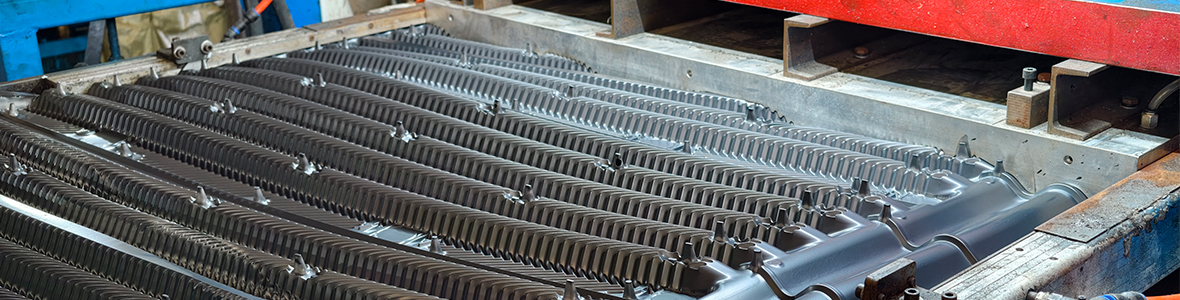
When you look inside a cooling tower, the fill may seem like nothing more than a stack of plastic sheets. But don't let its simple appearance fool you.
Cooling tower fill material plays a major role in how effectively the tower transfers heat from water to air. The right material and fill design can help create the contact conditions needed for efficient evaporative cooling. The wrong choice, however, can lead to premature deterioration, clogging, deformation, poor water distribution, or unnecessary maintenance.
So, which material should you choose?
PVC is widely used. PP is another common option. CPVC may be considered for higher-temperature applications, while wood, FRP, and other specialty materials have their own niches.
But there isn't one universal winner.
Your best choice depends on water quality, operating temperature, tower configuration, fill design, cooling requirements, and maintenance conditions.
In this guide, we'll break down the major cooling tower fill material types, explain their differences, and show you how to choose the right one for your application.
What Is Cooling Tower Fill Material?
Cooling tower fill material is the heat-transfer media installed inside a cooling tower.
Its main purpose is to increase the effective contact between circulating water and moving air.
Hot water enters the tower and is distributed across the fill. As the water travels through the fill, air passes through the media. A portion of the water evaporates, carrying heat away from the remaining water.
Think of the fill as turning a short conversation between air and water into a long one.
Instead of water falling rapidly through the tower as large streams, the fill spreads and redirects it, giving the air more opportunity to interact with the water.
That increased contact is the heart of evaporative cooling.
Why Does Fill Material Matter?
You might wonder, “If the fill is only there to spread water, why does the material matter so much?”
Because the fill has to survive a demanding environment.
Inside a cooling tower, it can be exposed to:
The material must therefore do more than provide surface area.
A suitable fill material should offer an appropriate combination of thermal performance, mechanical stability, chemical resistance, durability, manufacturability, and compatibility with the operating environment.
And that's why material selection deserves more attention than simply asking for “plastic fill.”
How Cooling Tower Fill Works
The basic process is relatively straightforward.
Water enters the fill section and spreads over the fill surfaces. Air moves through the tower and contacts the water. Heat transfers from the warmer water to the air, while evaporation removes additional heat.
The fill essentially creates a controlled environment where these interactions can happen repeatedly.
What Makes a Good Fill Material?
A suitable cooling tower fill material should generally have characteristics such as:
Good resistance to the operating environment
Adequate mechanical strength
Suitable temperature capability
Resistance to moisture
Appropriate chemical compatibility
Stable geometry
Manufacturability into structured shapes
Compatibility with the tower design
However, the material itself is only part of the equation.
Fill geometry matters just as much.
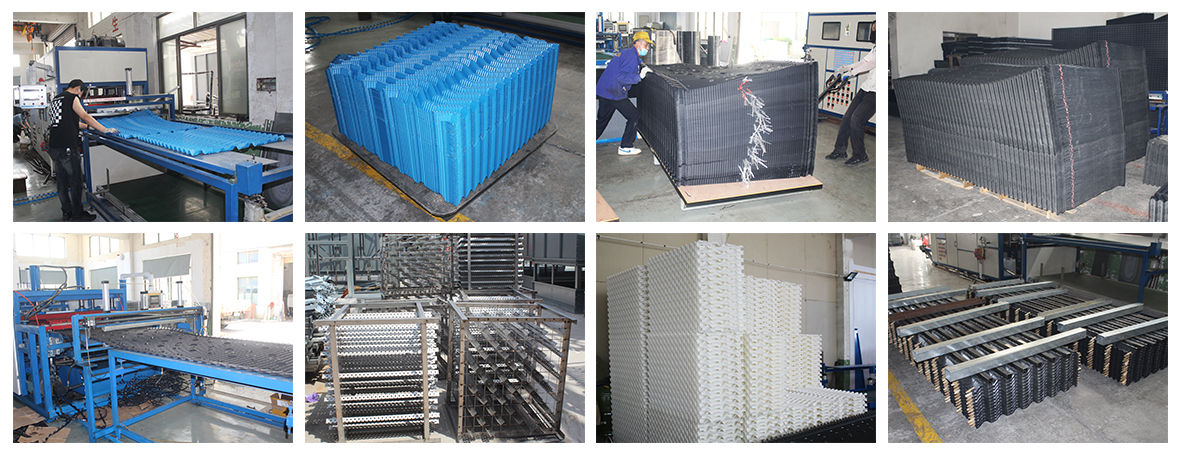
Main Types of Cooling Tower Fill Materials
Several materials can be found in cooling tower applications.
The most commonly discussed options include:
PVC
PP
CPVC
Wood
FRP and other specialty materials
PVC, PP, and CPVC are particularly important when discussing modern plastic cooling tower fill.
Let's look at each one.
PVC Cooling Tower Fill
PVC, or polyvinyl chloride, is one of the most widely used materials for cooling tower fill.
It can be processed into thin, structured sheets with various flute patterns. These sheets can then be assembled into fill packs designed for specific cooling tower configurations.
PVC is commonly used for both crossflow and counterflow applications, depending on the particular fill design.
Advantages of PVC Fill
Why is PVC so widely used?
First, it can be manufactured into complex structured surfaces that encourage water distribution and air-water contact.
Second, it is relatively lightweight, which makes transportation and installation easier than many traditional materials.
Third, PVC can offer useful resistance to moisture and many common cooling tower operating conditions.
PVC also offers considerable flexibility in product design.
Manufacturers can produce different:
Sheet thicknesses
Flute patterns
Heights
Widths
Block sizes
Surface configurations
That makes PVC a practical choice for many standard and replacement cooling tower projects.
Limitations of PVC Fill
PVC isn't automatically suitable for every application.
Operating temperature must be checked carefully. Water chemistry also matters. Certain environments may require a different material or specialized fill construction.
Another issue is fouling.
A highly efficient film-fill design can lose performance when its passages become heavily blocked by scale, sludge, algae, or other deposits.
So, PVC selection should always be based on the actual application rather than the material name alone.
PP Cooling Tower Fill
PP stands for polypropylene.
PP is another thermoplastic material used for cooling tower fill and can be manufactured into structured fill sheets and blocks.
Like PVC, PP can be formed into different surface geometries designed to increase air-water interaction.
Advantages of PP Fill
One reason PP attracts attention is its useful resistance characteristics in certain demanding environments.
It can also be formed into complex shapes while maintaining relatively low weight.
Depending on the specific grade and application, PP may be considered when the operating conditions make it attractive as an alternative to PVC.
However, the important word here is specific.
Different PP formulations and products can have different properties. You should always check the manufacturer's technical data rather than assuming that every PP fill has identical performance.
When to Consider PP
PP may be worth considering when:
The application has particular chemical requirements
The operating environment favors polypropylene
A specific PP fill design matches the tower
The supplier recommends PP based on operating conditions
You need an alternative to conventional PVC fill
Again, material selection should start with operating conditions, not marketing claims.

CPVC Cooling Tower Fill
CPVC stands for chlorinated polyvinyl chloride.
It is related to PVC but has different material characteristics because of its modified polymer structure.
CPVC can be considered in applications where higher temperature capability is an important factor.
Why CPVC Is Different
Temperature is one of the biggest reasons engineers may consider CPVC.
If the water entering the fill section operates at elevated temperatures, conventional PVC may not always be the preferred choice.
CPVC can provide an alternative where the application requires material characteristics beyond those normally associated with standard PVC.
But here's an important point:
Never select CPVC simply because the operating temperature “sounds high.”
Check the actual continuous and peak temperatures, material specifications, tower design, and manufacturer's recommendations.
Other Cooling Tower Fill Materials
Plastic materials aren't the whole story.
Wood Fill
Wood has historically been used in cooling tower fill, especially in certain large industrial applications.
Wood splash fill can be robust and has a long history in cooling technology.
However, wood requires different maintenance considerations from modern thermoplastic fill.
FRP and Specialty Materials
Fiberglass-reinforced plastic and other specialty materials can also be used for particular cooling tower components and applications.
The choice depends heavily on the tower's operating environment and engineering requirements.
The important takeaway is that cooling tower fill isn't a one-material industry.
Different materials exist because different cooling systems face different challenges.
Film Fill vs Splash Fill Materials
Material is only one side of the selection equation.
The other side is fill design.
Two major categories are film fill and splash fill.
Film Fill
Film fill encourages water to spread over the surfaces of structured sheets.
The water forms relatively thin films as it travels through the fill, increasing the effective contact area available for air-water interaction.
Film fill can provide high heat-transfer performance in suitable operating conditions.
However, its narrow passages can make fouling a significant concern when water contains high concentrations of suspended solids or other contaminants.
Splash Fill
Splash fill works differently.
Instead of encouraging water to remain on a continuous sheet surface, the fill repeatedly breaks the water into droplets as it moves through the tower.
The droplets provide opportunities for air-water contact while the fill structure helps distribute the water throughout the tower.
Splash fill can be attractive in applications where fouling resistance and open passages are important.
So, which one is better?
That's the wrong question.
The better question is:
Which design matches my water quality and cooling requirements?
PVC vs PP vs CPVC Cooling Tower Fill
Here's a practical high-level comparison:
| Feature | PVC | PP | CPVC |
| Common use | Many HVAC and industrial towers | Selected industrial applications | Higher-temperature applications |
| Lightweight | Yes | Yes | Yes |
| Formability | Excellent | Excellent | Excellent |
| Moisture resistance | Good | Good | Good |
| Temperature selection | Application dependent | Application dependent | Often considered for higher-temperature conditions |
| Custom designs | Available | Available | Available |
| Water-quality compatibility | Depends on fill design | Depends on fill design | Depends on fill design |
| Main selection factors | Temperature, water quality, tower design | Chemistry, temperature, design | Temperature, chemistry, design |
This table should be used as a starting point—not as a substitute for technical selection.
How Water Quality Affects Fill Material Selection
Water quality can completely change the answer.
Imagine buying a high-performance racing bicycle and then riding it through a muddy construction site every day.
The bicycle may be excellent, but the environment isn't suitable.
Cooling tower fill works in much the same way.
Clean Water Systems
For relatively clean water with effective filtration and water treatment, structured film fill can be an attractive option.
The water can move through smaller passages with a lower risk of rapid blockage.
In these conditions, maximizing effective air-water contact can be a major priority.
Dirty or High-Solids Water
If the circulating water contains significant suspended solids, sediment, biological material, or other contaminants, fouling resistance becomes much more important.
A fill design with larger passages may be more appropriate.
In these systems, a slightly less aggressive heat-transfer design that remains open may deliver better practical performance over time.
This is a classic engineering trade-off:
Theoretical efficiency means little if the equipment cannot stay clean enough to operate properly.
How Operating Temperature Affects Material Choice
Temperature is another critical consideration.
Before selecting fill material, identify:
Normal hot-water temperature
Maximum hot-water temperature
Cold-water temperature
Seasonal temperature changes
Startup and shutdown conditions
Don't look only at the average temperature.
Short-term peaks can matter too.
A supplier should know the actual temperature conditions before recommending a material.
This is especially important when comparing PVC, PP, and CPVC.
How Cooling Tower Type Affects Fill Selection
The tower configuration determines how air and water interact.
Two major configurations are crossflow and counterflow.
Cross Flow Cooling Tower Fill
In a crossflow cooling tower, air generally travels horizontally across the fill while water moves downward.
The fill therefore needs to be designed around this particular airflow and water-distribution arrangement.
Crossflow fill is often manufactured in structured sheet configurations suitable for the tower's internal geometry.
Counter Flow Cooling Tower Fill
In a counterflow tower, air generally travels upward while water moves downward.
This creates a different air-water relationship and requires fill designed for counterflow conditions.
That's why you shouldn't purchase replacement fill based only on material.
A PVC fill designed for one configuration may not be a direct replacement for another product simply because both products are made from PVC.
How to Choose the Right Cooling Tower Fill Material
Now let's turn all this information into a practical process.
Step 1: Check Water Quality
Start with water.
Review:
Suspended solids
Hardness
Scaling tendency
Biological growth
Filtration
Chemical treatment
If water quality is poor, fouling-resistant geometry may be more important than maximum theoretical surface area.
Step 2: Check Operating Temperature
Determine the normal and maximum water temperatures.
Then compare them with the manufacturer's specifications for PVC, PP, CPVC, or another material.
Never guess.
Step 3: Check Fill Geometry
Material doesn't tell you the whole story.
You also need to examine:
Fill thickness
Flute angle
Flute height
Sheet spacing
Block dimensions
Fill height
Air passage size
A small change in geometry can influence water distribution, airflow resistance, and fouling behavior.
Step 4: Check Cooling Requirements
Understand what the tower actually needs to achieve.
For example:
This allows the fill selection to be based on the actual cooling duty rather than a generic product description.
Step 5: Consider Maintenance
Ask how the tower will be maintained.
Will operators inspect the fill regularly?
Can the fill be cleaned?
Does the water-treatment program control scale and biological growth?
Can individual blocks be removed for replacement?
These questions matter because the best fill on day one isn't necessarily the best fill after five years of operation.
Common Problems Caused by the Wrong Fill Material
Choosing incorrectly can create several problems.
Premature Deformation
If the material isn't suitable for the operating temperature or mechanical environment, it may lose its intended shape.
Cracking
Aging, chemical exposure, mechanical damage, and unsuitable operating conditions can contribute to cracking or brittleness.
Clogging
A fill with passages that are too narrow for the water quality may accumulate deposits quickly.
Poor Cooling Performance
When fill becomes heavily fouled or damaged, water distribution and air-water contact can suffer.
The tower may then require more fan energy or fail to reach the desired cold-water temperature.
Cooling Tower Fill Material Replacement
Eventually, even well-maintained fill may need replacement.
But replacement shouldn't begin with:
“Send me some PVC fill.”
Instead, begin with:
“What exactly is installed in my tower now?”
Collect the existing fill dimensions and operating information.
For replacement projects, provide:
The more information you provide, the easier it is for the manufacturer to develop a compatible replacement.
Signs Your Fill Needs Replacement
Look for:
Don't automatically blame the fill when cooling performance drops, though.
Fans, nozzles, pumps, water treatment, airflow, and heat load should also be checked.
Why Choose Power Tower Cooling Technology?
Power Tower Cooling Technology (Shaoxing) Co.,Ltd specializes in cooling tower components and fill solutions for industrial and commercial applications.
For buyers, working with a manufacturer can be particularly useful when a standard catalog product doesn't perfectly match an existing tower.
Instead of treating every project as identical, the manufacturer can consider the tower configuration, fill dimensions, material requirements, water conditions, and application.
This is especially valuable for cooling tower replacement projects where dimensional compatibility is critical.
Customized Cooling Tower Fill Solutions
Every cooling tower has its own story.
Some towers are new. Others have been operating for years. Some use relatively clean water, while others operate in much harsher environments.
Customized fill can therefore be useful when standard dimensions aren't sufficient.
Customization may include:
The objective is simple: provide fill that fits the tower and suits its operating conditions.
Replacement Fill for Existing Towers
Replacement projects are one of the most common situations where careful material selection becomes important.
An older cooling tower may have discontinued components or fill that is no longer available from the original supplier.
A replacement manufacturer can use measurements and operating information to develop a compatible solution.
This approach can be especially useful when the customer wants to upgrade the fill material or modify the fill design while keeping the existing tower structure.
Cooling Tower Fill Material Buying Checklist
Before purchasing, ask these questions:
Tower
Water
What is the water quality?
Is scaling a problem?
Are suspended solids high?
Is biological fouling common?
Temperature
Fill
What material is currently used?
What are the dimensions?
What is the sheet thickness?
What is the flute pattern?
Is it film fill or splash fill?
Supplier
Can the supplier manufacture custom dimensions?
Can they provide replacement fill?
Can they recommend material based on operating conditions?
Can they support international projects?
If you have answers to these questions, you're already much closer to the right product.
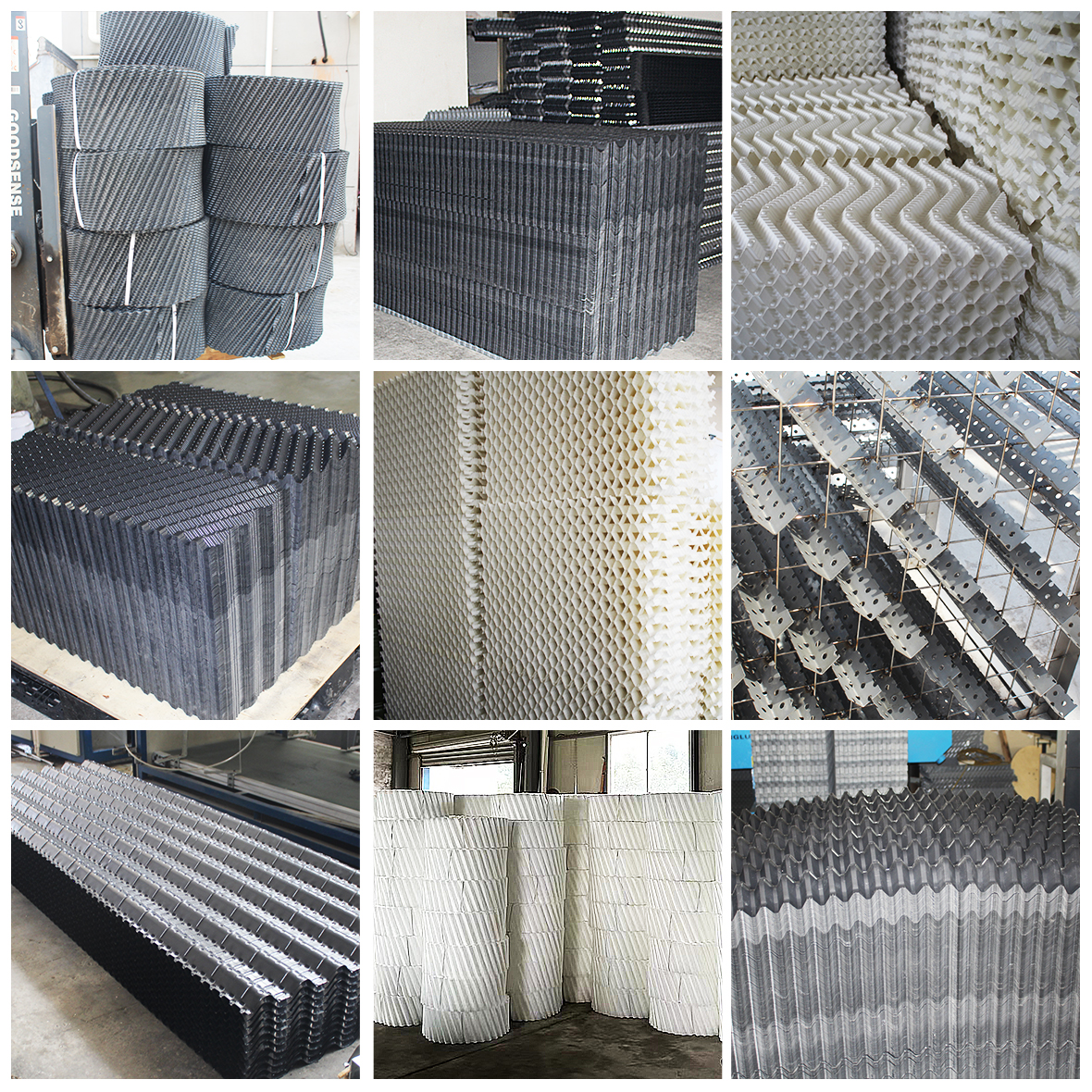
Frequently Asked Questions
What Is the Most Common Cooling Tower Fill Material?
PVC is a widely used material for many structured cooling tower fill applications.
Its combination of formability, relatively low weight, availability, and suitability for many operating environments makes it a common choice.
However, “most common” doesn't mean “best for every application.”
Is PP Better Than PVC for Cooling Tower Fill?
Neither material is universally better.
PVC and PP have different material characteristics, and the right selection depends on temperature, water chemistry, tower configuration, fill design, and other operating conditions.
The correct question isn't “Which material wins?”
It's “Which material fits this cooling tower?”
When Should CPVC Fill Be Used?
CPVC may be considered when operating conditions require characteristics associated with higher-temperature applications.
The actual water temperature and the manufacturer's material specifications should always be checked before selection.
How Long Does Cooling Tower Fill Material Last?
There is no universal service life.
Fill life depends on:
Water quality
Operating temperature
Cleaning
Water treatment
Mechanical conditions
Material
Fill design
Operating hours
A properly maintained fill operating under suitable conditions can last considerably longer than fill exposed to severe fouling or unsuitable operating conditions.
Can Cooling Tower Fill Material Be Customized?
Yes.
Depending on the manufacturer and application, fill can be customized in dimensions, thickness, geometry, material, and configuration.
This is particularly useful for replacement projects involving older cooling towers.
Final Thoughts
Choosing cooling tower fill material isn't simply about picking the cheapest plastic or the material with the highest advertised performance.
PVC, PP, CPVC, wood, FRP, and other materials all have places in the cooling tower industry.
The right choice depends on the complete operating environment.
Start with the basics: water quality, temperature, tower type, cooling duty, fill geometry, and maintenance requirements. Then evaluate the material.
For many applications, PVC can be a practical and widely used option. PP may make sense under particular operating conditions. CPVC can be considered when temperature requirements call for a different material solution. In demanding environments, splash-fill designs or specialty materials may also deserve consideration.
In short, don't choose the fill material in isolation.
Choose the material + fill design + tower configuration + operating conditions as one complete system.
For customized and replacement cooling tower fill solutions, Power Tower Cooling Technology (Shaoxing) Co.,Ltd can help customers evaluate suitable fill materials and configurations for their cooling tower applications.


