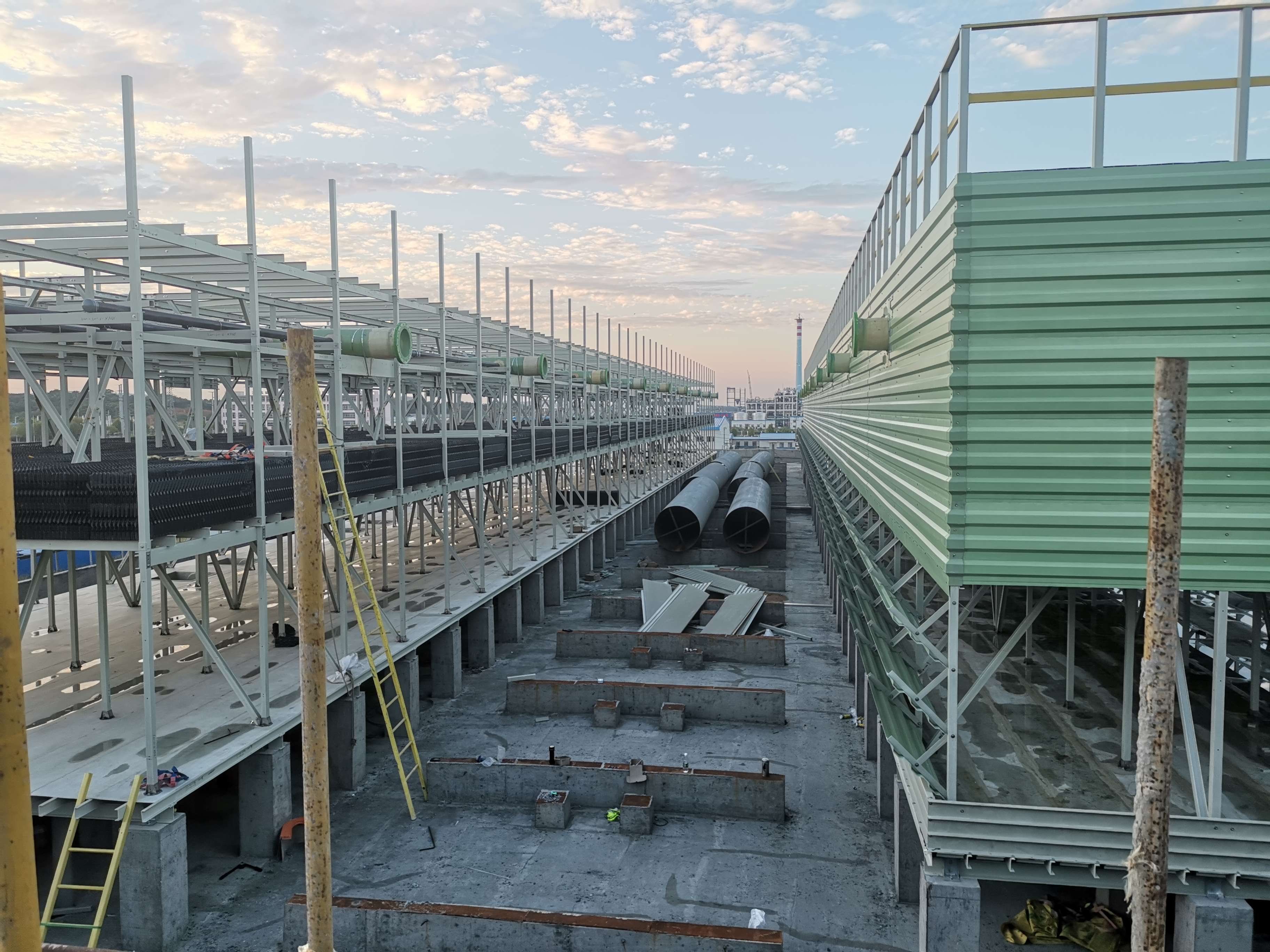
When you are searching for a reliable China PP splash fill supplier, you are probably looking for more than a low product price. You need cooling tower fill that fits your tower, performs reliably, handles your water conditions, and can be supplied consistently.
This is where PP splash fill becomes an interesting option.
Unlike conventional film fill, PP splash fill uses an open structure to break falling water into smaller droplets and repeatedly redistribute it as air moves through the cooling tower. This design makes splash fill particularly useful for industrial cooling applications where water quality, suspended solids, fouling, and maintenance are important concerns.
For buyers looking for factory-direct cooling tower fill from China, Power Tower Cooling Technology (Shaoxing) Co.,Ltd provides PP splash fill and other cooling tower components through coolingtowerpart.com.
Whether you are replacing old cooling tower fill, upgrading an existing system, or sourcing components for a new project, choosing the right PP splash fill supplier can make a significant difference in long-term cooling tower performance.
What Is PP Splash Fill for Cooling Towers?
PP splash fill is a type of cooling tower fill manufactured primarily from polypropylene, commonly abbreviated as PP.
Its job is simple in concept but important in practice: increase contact between water and air so that heat can be transferred from the circulating water to the atmosphere.
Instead of spreading water into thin sheets like film fill, splash fill breaks the falling water into smaller droplets.
As water hits the fill structure, it changes direction, separates, and falls onto another surface. The process repeats as the water moves downward through the cooling tower.
You can think of splash fill as a series of small water “steps.” Each step disturbs the water and creates new opportunities for air-water contact.
The open structure can also provide relatively large passages for air and water, which is one reason splash fill is often considered for industrial cooling systems with challenging water conditions.
How Splash Fill Improves Heat Transfer
A cooling tower does not simply cool water because the water falls from a height. The real process depends heavily on evaporation and air-water contact.
Warm water enters the cooling tower and is distributed over the fill. Air simultaneously moves through the fill zone.
The splash fill interrupts the water flow and creates droplets and wet surfaces. These droplets have a much higher exposed surface area than a single continuous stream of water.
The larger the effective contact area between air and water, the more opportunities there are for evaporation and heat transfer.
Of course, thermal performance depends on much more than fill geometry. Water loading, airflow, ambient conditions, fill depth, water distribution, and tower design all affect the final result.
That is why selecting splash fill should always be treated as part of the complete cooling tower design.
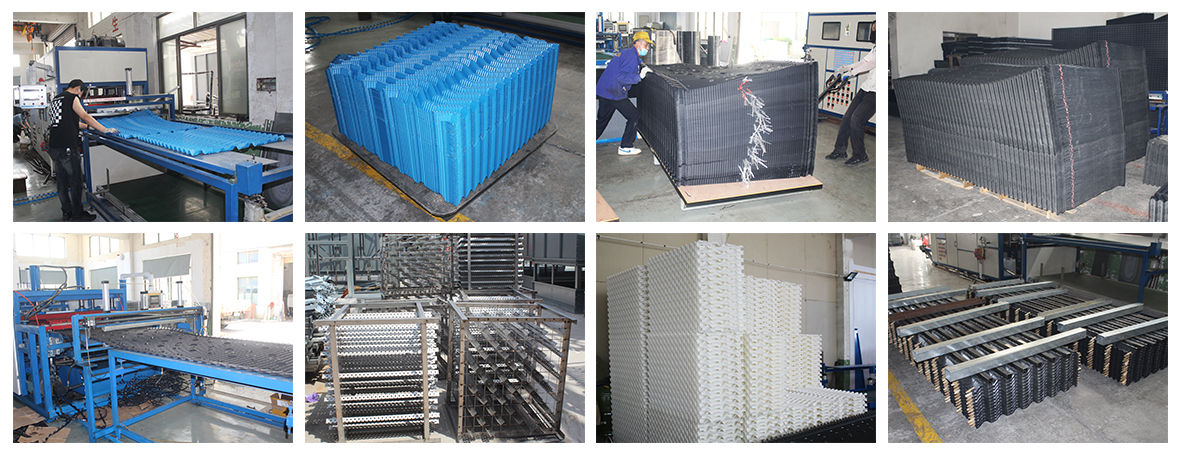
Why Polypropylene Is Used
Polypropylene is widely used for industrial cooling tower components because it combines relatively low weight with useful chemical and moisture resistance.
For splash fill applications, PP can be formed into grids, bars, modules, and other open structures designed to withstand continuous water flow.
Its characteristics can make it attractive for applications where conventional materials may not be the best fit.
PP splash fill is particularly worth considering when the cooling tower operates under demanding industrial conditions.
However, material selection should never be based only on the word “PP.”
Actual water temperature, chemical exposure, mechanical requirements, UV exposure, fire requirements, and operating conditions should all be considered before the final product is selected.
[Image 1: PP Splash Fill Product Structure]
Recommended image: A close-up photo of PP splash fill showing its open grid or lattice structure.
Why Choose PP Splash Fill Instead of Film Fill?
Film fill and splash fill are both designed to improve heat transfer, but they use different approaches.
Film fill spreads water across thin sheets. This can create a very large effective surface area and excellent thermal performance when the circulating water is relatively clean.
Splash fill takes another approach.
Instead of creating thin water films, it repeatedly breaks and redirects the water.
So, which one is better?
There is no universal answer.
The right choice depends on the cooling tower, water quality, thermal requirements, and maintenance strategy.
For clean water systems, film fill can be highly efficient. For some industrial systems where suspended solids and fouling are major concerns, splash fill can offer practical advantages.
Better Tolerance of Suspended Solids
One of the biggest reasons industrial users choose splash fill is its relatively open structure.
Cooling water is not always perfectly clean.
Depending on the application, water can contain suspended solids, dirt, algae, biological material, process contaminants, or other particles.
Narrow film-fill passages can become increasingly restricted when deposits accumulate.
Splash fill generally provides larger passages through which water and air can move. This does not mean splash fill cannot become dirty or clogged. It simply gives the system more open space to tolerate difficult water conditions.
For industrial cooling towers, that difference can be important.
Open Water and Air Passages
Imagine trying to move through a crowded room compared with walking through an open warehouse.
The warehouse gives you more space to move.
Splash fill works with a similar principle.
Its open structure provides pathways for air while repeatedly changing the direction and distribution of falling water.
The challenge is finding the right balance.
The fill needs enough structure to create effective water breakup and heat transfer, but it should not create unnecessary resistance to airflow.
That balance is one reason experienced cooling tower fill manufacturers matter.
Key Benefits of PP Splash Fill
PP splash fill offers several potential benefits for industrial and commercial cooling tower applications.
The exact performance depends on the design and operating conditions, but the main advantages commonly include:
Open structure
Good tolerance of suspended solids
Useful chemical resistance
Lightweight construction
Easy handling and installation
Suitability for industrial applications
Potentially easier cleaning
Availability in customized configurations
Compatibility with replacement and retrofit projects
For many buyers, the biggest advantage is not a single technical specification.
It is the combination of performance and maintainability.
High Fouling Resistance
A cooling tower can lose performance when deposits build up inside the fill.
Once water passages become restricted, water distribution and airflow can both be affected.
Splash fill's open configuration can help reduce the risk of severe blockage compared with some tightly spaced film-fill designs.
This can be particularly valuable for facilities where water treatment is difficult or where periodic contamination is unavoidable.
Good Chemical Resistance
Polypropylene has useful resistance to many chemical environments.
This is one reason PP components are frequently considered for industrial applications.
However, chemical resistance depends on the actual chemical, concentration, temperature, exposure time, and PP formulation.
If your cooling water contains acids, alkalis, solvents, oils, or other process chemicals, provide the supplier with the actual operating information.
A professional manufacturer should evaluate the conditions instead of simply saying, “PP is chemical resistant.”
Lightweight and Easy to Handle
Cooling tower fill can occupy a surprisingly large volume.
When you need to replace thousands of fill modules, weight becomes a practical issue.
PP is relatively lightweight, making transportation and installation easier than some heavier alternatives.
This can be particularly useful for retrofit projects where workers need to move fill through existing access openings.
PP Splash Fill for Counterflow Cooling Towers
Counterflow cooling towers move air upward while hot water moves downward.
Because the two streams travel in opposite directions, the fill arrangement plays an important role in maximizing contact between air and water.
PP splash fill can be used in counterflow applications where the tower design and operating conditions are suitable.
The fill needs to work with the tower's water loading, airflow, support structure, fill depth, and water distribution system.
A counterflow splash-fill solution is therefore not simply a collection of plastic grids.
It is part of the tower's overall heat-transfer system.

Grid-Type PP Splash Fill
Grid-type PP splash fill uses an interconnected lattice structure.
As water falls through the grid, the structure changes the water's direction and breaks larger streams into smaller droplets.
The open design also leaves pathways for air movement.
Different grid geometries can be manufactured for different cooling tower applications.
When replacing existing fill, however, buyers should not select a product based solely on its appearance.
The dimensions and support arrangement need to match the existing tower.
Splash Bar and Modular Designs
Splash bars are another common approach.
They use repeated structural elements to interrupt falling water and promote droplet formation.
Modular splash-fill systems use interconnected pieces to form a larger three-dimensional fill zone.
Both designs follow the same basic principle: create repeated water breakup while maintaining suitable airflow and drainage paths.
The preferred design depends on the cooling tower configuration and project requirements.
[Image 2: Counterflow PP Splash Fill Grid]
Recommended image: A PP splash grid or modular fill installed inside a counterflow cooling tower.
PP Splash Fill for Crossflow Cooling Towers
Crossflow cooling towers operate differently from counterflow towers.
In a crossflow design, air generally moves horizontally across the falling water.
This changes how the fill needs to interact with the airflow.
PP splash fill can be used in suitable crossflow cooling tower applications, but its orientation, module dimensions, support structure, and water distribution must be considered carefully.
If you are replacing existing crossflow fill, measure the old fill before ordering.
A product that looks almost identical may still fail to fit correctly.
Small dimensional differences can affect installation, support spacing, and water distribution.
Where Is PP Splash Fill Used?
PP splash fill is particularly relevant to industrial cooling systems where water quality and maintenance are important considerations.
Typical applications can include:
Power plants
Steel plants
Chemical plants
Petrochemical facilities
Manufacturing facilities
Industrial process cooling
Wastewater-related cooling systems
Large process cooling towers
Difficult-water applications
The ideal application depends on the actual cooling conditions.
Power Plants and Energy Facilities
Power-generation facilities often operate cooling systems continuously.
Even a relatively small change in cooling performance can influence the efficiency and reliability of the larger process.
PP splash fill can be considered where the cooling water contains suspended solids or where an open fill structure is preferred.
Large power projects should always involve detailed thermal and hydraulic evaluation before a fill replacement is approved.
Steel, Chemical and Petrochemical Plants
Industrial process cooling often involves more challenging conditions than commercial HVAC systems.
Water may contain suspended solids, chemical contaminants, oil, biological growth, or other substances.
In these environments, fill that is extremely sensitive to blockage may require more frequent maintenance.
An open PP splash-fill structure can provide a practical alternative for suitable applications.
Wastewater and Challenging Water Systems
Wastewater-related cooling applications can expose fill to higher fouling risks.
Suspended particles and biological material may accumulate inside the fill.
Because splash fill generally has more open passages, it can be considered for applications where maintaining narrow film-fill channels would be difficult.
However, splash fill does not replace water treatment.
Good filtration, chemical treatment, blowdown control, and regular inspection remain essential.
[Image 3: Industrial Cooling Tower PP Splash Fill Application]
Recommended image: An industrial cooling tower interior showing splash fill installed within the heat-transfer section.
How to Choose the Right PP Splash Fill
Ordering PP splash fill should not be as simple as sending a supplier the words “I need cooling tower fill.”
The more technical information you provide, the more accurately the manufacturer can recommend the right product.
At minimum, prepare information about:
Check Cooling Tower Dimensions
For replacement projects, accurate measurements are critical.
Measure the length, width, and height of the existing fill area.
Also record the module dimensions, support spacing, bar dimensions, and available installation space where possible.
Photographs are extremely helpful.
A clear photograph of the existing fill can often tell a manufacturer things that measurements alone cannot.
If you have old drawings, product labels, or previous purchase specifications, provide those as well.
Evaluate Water Quality
Water quality should be one of the first questions in the selection process.
Ask yourself:
Is the water clean?
Does it contain suspended solids?
Is algae a problem?
Does scaling occur?
Is oil contamination possible?
Is the tower used for wastewater or industrial process water?
These answers help determine whether splash fill is appropriate.
A supplier who asks about water quality is usually approaching the project from the right direction.
Consider Operating Temperature
PP can be suitable for demanding temperature conditions, but the exact operating limit depends on the product and material formulation.
Temperature should therefore be considered together with mechanical loading and chemical exposure.
Do not rely on a generic online specification when the tower operates at an unusually high temperature.
Ask for the manufacturer's technical data for the exact product.
Check Airflow and Thermal Requirements
Thermal performance remains essential.
An open fill is not automatically a high-performance fill.
The final cooling result depends on the relationship between:
Water loading
Airflow
Fill depth
Droplet formation
Water distribution
Pressure drop
Ambient conditions
Tower geometry
For large industrial projects, the fill should be selected as part of the complete cooling tower design.
Factory-Direct PP Splash Fill: Why It Matters
Why buy directly from the manufacturer?
Because cooling tower fill is a technical component, not simply a plastic commodity.
When you communicate directly with the factory, you can discuss dimensions, material requirements, customization, packaging, production, and installation requirements with fewer communication layers.
This can make a major difference when the project involves unusual dimensions or replacement requirements.
Competitive Factory Pricing
Factory-direct purchasing can reduce unnecessary intermediary costs.
But the cheapest quotation should never be your only consideration.
The real cost of cooling tower fill includes:
A low-priced product that does not fit your cooling tower is not a low-cost solution.
OEM and Custom Dimensions
Many cooling towers use non-standard fill dimensions.
This is particularly common with older towers.
The original manufacturer may no longer produce the same product, or the tower may have been modified during its operating life.
A factory capable of producing customized PP splash fill can manufacture according to drawings, measurements, samples, or photographs.
That flexibility is extremely useful for retrofit projects.
Direct Technical Communication
Direct communication also makes technical discussions easier.
Instead of asking a trading company to contact another factory, you can communicate directly with the manufacturer about:
PP material
Fill geometry
Fill dimensions
Temperature
Water quality
Flow rate
Installation
Packaging
Customization
This can shorten the quotation and technical-confirmation process.
[Image 4: Cooling Tower Fill Manufacturing]
Recommended image: A factory production or assembly photograph showing cooling tower fill being manufactured or prepared for shipment.
Power Tower Cooling Technology (Shaoxing) Co.,Ltd

Power Tower Cooling Technology (Shaoxing) Co.,Ltd is a China-based manufacturer and supplier of cooling tower components and fill products.
The company provides cooling tower fill solutions for industrial and commercial applications, including PP splash fill and other cooling tower internal components.
Through coolingtowerpart.com, customers can explore cooling tower fill products and related components for new projects, maintenance, replacement, and retrofit applications.
For international buyers, the advantage of working directly with a specialized cooling tower supplier is the ability to discuss project requirements rather than simply purchasing a generic plastic product.
Our PP Cooling Tower Fill Solutions
PP splash fill is one part of a broader cooling tower fill product range.
Depending on the project, customers may need:
This broader product range makes it possible to compare different fill technologies based on the actual application.
Replacement and Retrofit Support
Cooling tower replacement projects often have one major advantage: you already have a real tower to work with.
Instead of designing everything from scratch, the existing fill can be measured and documented.
Send the manufacturer:
Photos of the existing fill
Fill dimensions
Cooling tower type
Water temperature
Flow information
Water-quality information
Required quantity
With this information, the supplier can evaluate a suitable replacement configuration.
PP Splash Fill Quality Control
Good cooling tower fill begins with manufacturing quality.
Although splash fill may look relatively simple, its geometry affects water distribution, airflow, structural strength, and heat-transfer behavior.
That means manufacturing consistency matters.
A reliable production process should control material selection, forming, dimensions, assembly, inspection, and packaging.
Raw Material Inspection
The PP material should be selected according to the intended operating conditions.
Important factors include:
For demanding industrial projects, buyers should request the appropriate product and material specifications.
Dimensional and Structural Inspection
Finished fill should be checked for dimensional consistency.
Important inspection points may include:
Overall dimensions
Thickness
Grid geometry
Connection points
Structural integrity
Module consistency
Why does this matter?
Because hundreds or thousands of fill modules work together.
A small dimensional problem repeated across a large fill installation can become a significant installation problem.
PP Splash Fill Installation and Maintenance
Even high-quality fill needs proper installation.
The fill should be installed according to the manufacturer's instructions and supported securely.
The orientation of splash bars or modules may also affect performance.
During operation, the fill should be inspected regularly.
Look for:
Installation Considerations
Before installation, verify that the support system is suitable for the new fill.
Check the available fill height and ensure that the replacement product does not interfere with spray nozzles, structural members, drift eliminators, or access areas.
For modular systems, make sure the pieces are correctly connected and aligned.
Proper installation helps preserve the intended geometry of the fill.
Cleaning and Inspection
Maintenance requirements depend heavily on water quality.
A cooling tower operating with clean, well-treated water may require less frequent cleaning than a tower handling heavily contaminated industrial water.
Do not wait until cooling performance has already fallen sharply.
Regular visual inspection allows operators to identify problems earlier.
When cleaning PP fill, use methods appropriate for the material and avoid excessive mechanical force or aggressive chemicals that could damage the plastic.
[Image 5: PP Splash Fill Installation]
Recommended image: PP splash fill installed on cooling tower support structures, showing the completed heat-transfer section.
PP Splash Fill vs PVC Splash Fill
PP and PVC are both widely used plastics in cooling tower applications, but they have different characteristics.
PP is often considered for applications where temperature capability, chemical resistance, toughness, or an open splash configuration is important.
PVC remains extremely common in cooling tower film-fill applications because of its established performance and cost advantages.
The choice should depend on the operating conditions rather than simply selecting whichever material is cheaper.
For example, if your tower operates at relatively moderate temperatures with clean water, PVC film fill may be an excellent choice.
If your application has more challenging water quality or requires an open splash structure, PP splash fill may deserve closer consideration.
Questions to Ask a China PP Splash Fill Supplier
Before placing a purchase order, ask the supplier several practical questions.
What type of PP material is used?
The answer helps you understand whether the product is suitable for your operating environment.
What are the recommended operating conditions?
Ask about temperature, chemical compatibility, and other limitations.
Is the fill designed for counterflow or crossflow cooling towers?
Different tower configurations require different designs.
Can you manufacture custom dimensions?
This is particularly important for replacement projects.
Can you work from drawings or samples?
A good manufacturer should be able to use project information to determine the appropriate configuration.
What information do you need for a quotation?
A professional supplier should ask about the tower and application rather than quoting blindly.
How is the fill packaged for international shipment?
Because cooling tower fill can occupy significant volume, packaging and shipping efficiency are important.
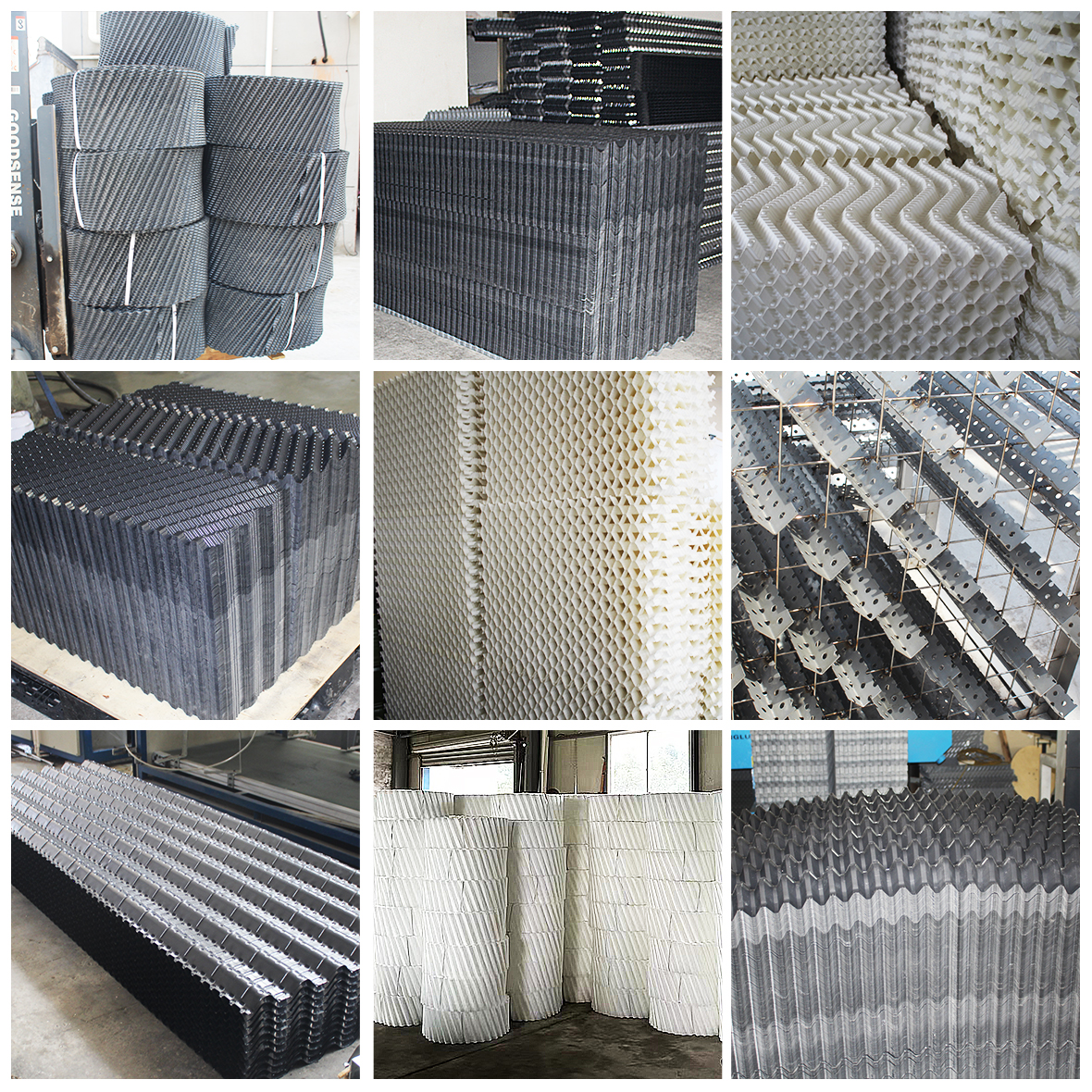
Why Buy PP Splash Fill Directly From the Factory?
For customers buying in bulk, replacing existing cooling tower fill, or developing long-term supply relationships, factory-direct purchasing can offer significant advantages.
You communicate with the production side.
You can discuss customized dimensions.
You can confirm material requirements.
You can review technical specifications.
You can discuss packaging and delivery directly.
Most importantly, you can build a relationship with a manufacturer rather than relying entirely on a trading intermediary.
For a technical product such as cooling tower fill, that relationship can become valuable when you have future replacement requirements.
Conclusion
Choosing the right China PP splash fill supplier is not simply about finding a factory with the lowest quotation.
You need to consider the complete application.
What type of cooling tower do you have?
How much water does it circulate?
What is the water temperature?
How clean is the circulating water?
How much suspended solid material is present?
What dimensions are required?
How much thermal performance do you need?
These questions determine whether PP splash fill is the right solution and which configuration should be used.
For applications involving challenging water quality, suspended solids, fouling concerns, or industrial process cooling, PP splash fill can provide a practical combination of open passages, water breakup, durability, and maintainability.
For buyers seeking factory-direct PP splash fill from China, Power Tower Cooling Technology (Shaoxing) Co.,Ltd provides cooling tower fill and related components through coolingtowerpart.com.
If you are replacing existing cooling tower fill, the best starting point is simple: send the supplier your cooling tower type, fill dimensions, photos, operating temperature, water conditions, required quantity, and project requirements.
With the right information, a manufacturer can recommend a solution based on your actual cooling tower rather than selling you a generic product.
That is the difference between simply buying cooling tower fill and choosing the right cooling tower fill for long-term performance.


