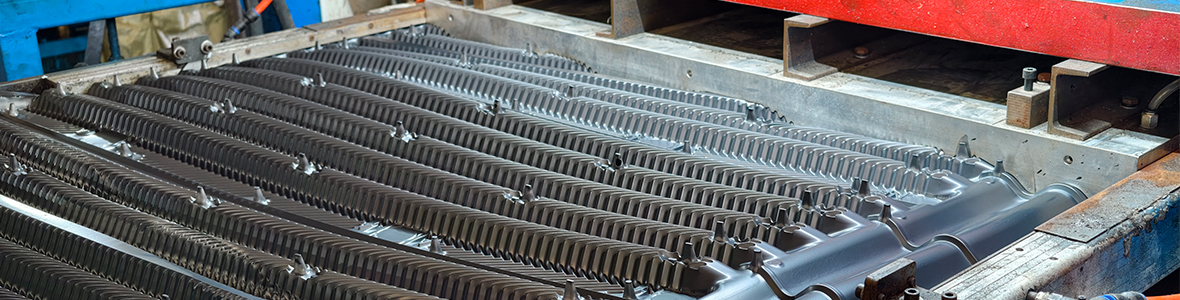
If you are sourcing cooling tower filler from China, you will quickly run into two types of suppliers: direct manufacturers and trading companies.
At first glance, they can look almost identical.
Both may have professional websites. Both can provide quotations. Both may show photos of PVC film fill, PP fill, splash fill, packaging, and cooling towers. And both may tell you, “We are a professional supplier.”
But here is the real question:
Who actually makes the cooling tower filler?
That difference can affect your purchase price, product quality, customization options, delivery schedule, technical support, and even how quickly you can solve a problem after installation.
For buyers looking for China cooling tower filler, understanding the difference between a manufacturer and a trading company is therefore more than a sourcing detail. It is a purchasing decision.
This guide explains the differences clearly and shows what you should check before placing an order.
Why the Supplier Type Matters
Cooling tower filler is not simply a piece of plastic that you put inside a tower.
The fill controls how water spreads, how long water remains in contact with air, how much heat can be transferred, and how effectively the cooling tower performs.
Think of it as the “working surface” of the cooling tower.
A poor match can create problems such as insufficient cooling, excessive pressure drop, rapid fouling, deformation, or premature replacement.
That is why the supplier behind the product matters.
A direct manufacturer normally controls more of the production process. A trading company usually purchases products from another factory and resells them.
Neither model is automatically good or bad.
The important thing is knowing what you are actually paying for and who is responsible for the product.
What Is a Cooling Tower Filler Manufacturer?
A cooling tower filler manufacturer is a company that actually produces cooling tower fill or has direct control over the manufacturing process.
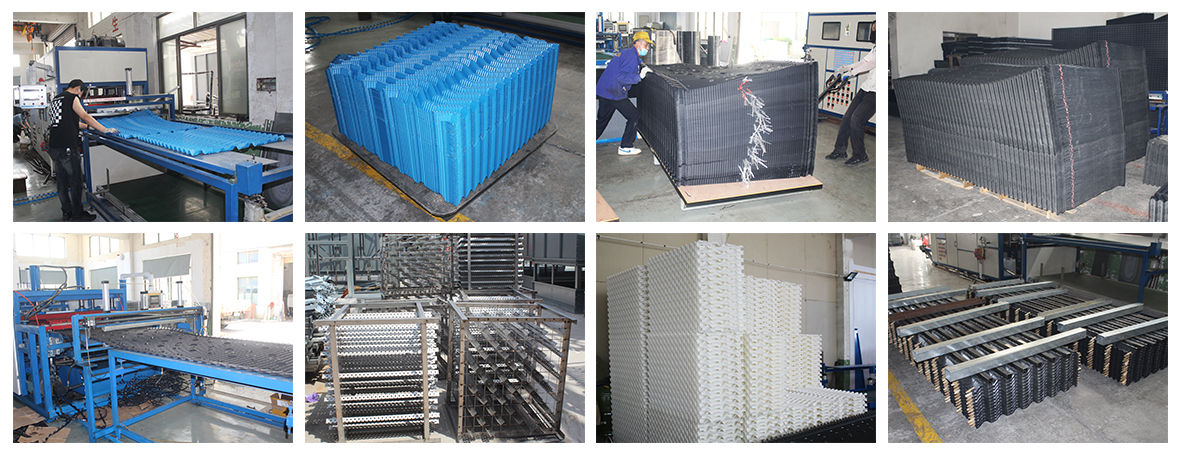
Depending on the product, manufacturing may include sheet production, thermoforming, cutting, bonding, assembly, inspection, packaging, and other processes.
A genuine manufacturer should be able to discuss technical details rather than simply sending a catalog.
For example, when discussing cooling tower filler, a manufacturer should understand questions such as:
What type of fill do you need?
What is the required fill height?
What are the sheet dimensions?
What is the material?
What is the operating water temperature?
What is the water quality?
Is the fill for a new tower or replacement project?
Does the existing tower use film fill or splash fill?
Those questions matter because cooling tower fill should be selected according to the actual operating conditions.
Direct Production and Factory Control
One of the biggest advantages of buying from a manufacturer is production control.
A direct factory can usually control raw materials, production parameters, inspection, packaging, and scheduling more closely.
For example, if a customer requires a particular PVC thickness, fill geometry, block dimension, or installation configuration, the manufacturer can communicate directly with the production team.
That shortens the chain between buyer → engineer → production line.
A trading company may need another chain:
buyer → salesperson → trading company → factory → production team.
Every additional layer creates another opportunity for misunderstanding.
Product Development and Engineering Support
A manufacturer can also bring more technical knowledge to the discussion.
For example, Brentwood describes different cooling tower fill designs according to thermal performance and fouling resistance, illustrating why fill geometry is an engineering consideration rather than merely a cosmetic product choice.
This matters when your project is unusual.
If you need standard replacement fill, almost any competent supplier may be able to help.
But if you need a non-standard size, special material, higher temperature resistance, or a fill designed around challenging water quality, direct engineering communication becomes much more valuable.
What Is a Cooling Tower Filler Trading Company?
A trading company is essentially an intermediary.
Instead of manufacturing the cooling tower filler itself, it purchases products from one or more factories and sells them to customers.
That does not automatically make a trading company unreliable.
In fact, some trading companies provide useful services.
They may have strong export experience, multilingual sales teams, logistics capabilities, and relationships with several factories.
How Trading Companies Work
The typical model looks like this:
Customer → Trading Company → Manufacturer → Customer
The trading company may handle:
Product sourcing
Quotation
Communication
Payment coordination
Inspection
Export documents
Shipping
Customer service
For a buyer who wants several different products from China, this can be convenient.
But there is a trade-off.
The more intermediaries involved, the harder it can be to know the actual production source and the exact cost structure.
Why Buyers Still Choose Traders
So why would anyone choose a trading company?
There are several legitimate reasons.
A trading company may offer a wider product range than a single factory. It may also have an established logistics network or be easier for a small buyer to communicate with.
For example, suppose you need cooling tower filler, nozzles, drift eliminators, pumps, valves, and other components at the same time.
A trading company might coordinate all of them through different factories.
That convenience has value.
The key is not to assume that “trading company = bad” or “manufacturer = automatically better.”
Instead, compare the actual capabilities behind the quotation.
Manufacturer vs. Trading Company: Key Differences
Let's break down the differences that matter most to cooling tower filler buyers.
Product Quality Control
A manufacturer has direct access to its production process.
This generally makes it easier to control:
Raw material selection
Sheet thickness
Forming temperature
Fill geometry
Bonding quality
Dimensional accuracy
Final inspection
Packaging
A trading company can also arrange quality control, but it depends heavily on the factory it uses.
This creates an important question:
If the factory changes, does the product change too?
With a direct manufacturer, the production source is much clearer.
Cooling Tower Filler Price
Price is often where buyers notice the difference first.
A trading company needs to make a margin on top of the manufacturer's price.
That does not mean every trading quotation is expensive. A large trading company may negotiate excellent factory prices.
But when you compare equivalent products, direct factory purchasing can reduce one layer of markup.
The better question is not:
“Who gives the cheapest quote?”
Instead, ask:
“Who gives the best total value for the same technical specification?”
A cheaper filler that deforms quickly or becomes heavily fouled may cost much more over its lifetime.
Customization Capability
Customization is another major difference.
Suppose your cooling tower requires:
A manufacturer can usually communicate these requirements directly with engineering and production teams.
A trading company may need to send the request to its factory partner first.
That extra step can slow the process.
Communication and Technical Support
Imagine buying a replacement fill and discovering that the dimensions are slightly wrong.
Who do you call?
With a direct manufacturer, you can usually go back to the company that produced the material.
That creates a much clearer responsibility chain.
Mach Cooling, for example, describes its cooling tower business as providing customized solutions and identifies quality control, professional teams, service, and innovation as core capabilities.
Technical communication is especially important when replacing existing fill.
A good supplier should not simply ask, “How many pieces do you need?”
It should ask about the tower.
Lead Time and Production Scheduling
A manufacturer controls its own production schedule.
That can be valuable when you have an urgent shutdown or maintenance window.
If your cooling tower will stop for only five days, waiting several weeks for a supplier to confirm production can become a serious problem.
A direct factory can tell you more accurately:
This visibility can make project planning easier.
After-Sales Service
After-sales support is often overlooked during purchasing.
Everyone focuses on the quotation.
Then the goods arrive.
Only later does someone discover that the fill orientation is wrong, the blocks do not fit, or the installation dimensions were misunderstood.
This is where the difference between a factory and intermediary can become obvious.
A manufacturer that understands its own product can often provide more direct technical answers.
Why Direct Factory Pricing Can Be More Competitive
Direct factory pricing is not always the lowest price.
That distinction is important.
A manufacturer may quote more than a trading company in some cases because the two offers may not have the same specifications.
For example:
Comparing only the final number is like comparing two cars by price without checking the engine.
For China cooling tower filler, always compare the technical specification and price together.
How to Verify a China Cooling Tower Filler Manufacturer
This is where buyers should become detectives.
You do not need to fly to China immediately.
Start with simple verification.
Check the Factory Address
Ask for the complete factory address.
Then check whether the company's website, business information, product range, and factory location are consistent.
A genuine manufacturer should not be uncomfortable discussing where production takes place.
Ask for Production Photos and Videos
Ask for current factory photos or a short production video.
Look for:
Raw material storage
Thermoforming equipment
Fill production
Cutting and assembly
Quality inspection
Finished goods
Packaging area
Be careful with generic factory photos.
A professional supplier should be able to provide project-specific or current production evidence.
Request Technical Specifications
Do not purchase based only on product photographs.
Ask for technical information such as:
A real manufacturer should be comfortable discussing technical parameters.
Verify Certifications and Quality Systems
Certifications can provide useful supporting evidence, but they should not be your only verification method.
Check whether the certificates actually belong to the supplier and whether the scope is relevant.
Also remember:
A certificate cannot replace engineering judgment.
The right product still needs to match your cooling tower.
What to Check Before Buying Cooling Tower Filler
Choosing the supplier is only half the job.
You also need to choose the correct filler.
PVC vs. PP Materials
PVC is widely used because it provides a practical combination of cost, thermal performance, and chemical resistance.
PP can be attractive when higher temperature or particular chemical resistance is required.
The correct choice depends on your operating conditions.
Mach's own cooling tower product information describes the use of virgin PVC fill with characteristics including hydrophilicity, thermal performance, corrosion resistance, and resistance to biological damage.
Do not simply ask:
“Which material is better?”
Ask:
“Which material is better for my water and operating temperature?”
Film Fill vs. Splash Fill
Film fill spreads water across thin surfaces, creating a large contact area between water and air.
It can provide high thermal performance in properly treated water systems.
Splash fill works differently.
It breaks water into droplets as it falls through the fill structure.
Its rugged structure can make it attractive for applications with higher solids or fouling risk.
The choice is therefore application-dependent.
Dimensions and Compatibility
This is one of the most important points when purchasing replacement filler.
Measure the existing installation carefully.
Check:
A technically excellent filler is still useless if it does not fit.
It is like buying a beautiful replacement window that is two inches too wide.
Water Quality and Fouling Resistance
Water quality can determine whether your filler performs well or becomes a maintenance headache.
Consider:
Suspended solids
Hardness
Biological growth
Oil contamination
Chemical concentration
Scaling tendency
High-efficiency film fill may not be the best choice for every dirty-water application.
For lower-quality water, designs with larger channels or stronger fouling resistance can sometimes be more appropriate. Brentwood, for example, highlights larger channels in certain fill designs to reduce fouling potential while maintaining thermal performance.
When a Trading Company May Make Sense
There are situations where a trading company can be the right choice.
For example, you may want to purchase multiple unrelated cooling tower components from different manufacturers.
You may also need:
In these situations, the trader is essentially acting as a sourcing partner.
The important thing is transparency.
Ask:
Who manufactures the filler?
If the answer is another factory, ask whether you can communicate directly with that factory for technical questions.
That simple question often tells you a lot.
Why Work Directly With Mach Industry?
For buyers who want to source cooling tower equipment and components directly from China, Mach Industry (Zhejiang) Co., Ltd. is an example of the direct-manufacturer model.
Mach identifies itself as a professional cooling tower manufacturer and states that its factory covers approximately 9,000 square meters, with a modern processing workshop and experienced technical personnel.
Mach Industry (Zhejiang) Co., Ltd. official website
Mach Manufacturing Capability
Mach manufactures and supplies cooling tower systems and related components for industrial and commercial applications.
Its product range includes industrial cooling towers, closed cooling towers, and open cooling towers, with counterflow and crossflow configurations.
This broader cooling tower knowledge can be valuable when the filler is part of a larger cooling system.
After all, filler does not work alone.
It interacts with:
Airflow
Water distribution
Fan performance
Drift eliminators
Tower geometry
Operating temperature
Water quality

A supplier that understands the entire tower can often provide better context when selecting internal components.
Custom Cooling Tower Filler Solutions
Mach's product information also emphasizes customized solutions.
That can be useful when you are not looking for a generic “one-size-fits-all” filler.
For replacement projects, the manufacturer can evaluate dimensions, operating requirements, and application conditions before recommending a solution.
This is particularly important for older towers where the original filler may no longer be available.
Quality and Export Support
For international buyers, the purchasing process does not end when the filler leaves the production line.
Packaging, documentation, shipping, and communication all matter.
A manufacturer experienced in overseas business can help coordinate these stages rather than simply handing the buyer a product box.
Manufacturer vs. Trader: A Practical Comparison
| Factor | Direct Manufacturer | Trading Company |
| Production control | High | Depends on factory |
| Factory price | Usually more direct | May include markup |
| Customization | Usually stronger | Depends on partner |
| Technical support | Direct | Often indirect |
| Factory inspection | Easier | May require additional verification |
| Product consistency | Easier to control | Depends on source |
| Multi-product sourcing | Limited to own range | Often stronger |
| Export service | Usually available | Often strong |
| Communication chain | Shorter | Longer |
| Replacement support | More direct | Depends on supplier relationship |
| Best for | Technical/custom projects | Multi-product sourcing |
There is no universal winner.
But for a technically important product such as cooling tower filler, direct manufacturer access often provides an important advantage.
Common Buying Mistakes
Choosing the Lowest Price
The cheapest quotation may not represent the lowest total cost.
Always compare material, dimensions, thickness, fill design, quantity, packaging, and shipping terms.
Assuming Every “Factory” Is a Factory
Some suppliers use the word “manufacturer” loosely.
Ask for evidence.
Ignoring Water Quality
A high-efficiency filler is not automatically the best filler.
Water quality should influence the selection.
Buying Without Measurements
Replacement filler must fit.
Always provide drawings, photos, measurements, or existing fill samples when possible.
Comparing Products Without Comparing Specifications
Two products may look almost identical in photographs while having different materials, thicknesses, geometry, and performance.
Focusing Only on Purchase Price
Think beyond the first invoice.
Maintenance, replacement frequency, cooling efficiency, pressure drop, and downtime all contribute to the real cost.
Questions to Ask Before Placing an Order
Before buying China cooling tower filler, send your potential supplier a checklist.
Ask:
Are you the manufacturer or a trading company?
Where is your production factory?
What material do you use?
What is the actual sheet thickness?
What fill type do you recommend?
What water quality is the product designed for?
Can you customize the dimensions?
Can you provide technical drawings?
Can you provide factory photos or videos?
What is the production lead time?
How is the filler packaged for export?
Can you provide replacement support?
Can you provide samples?
What information do you need to confirm compatibility?
A supplier that answers these questions clearly is usually much easier to work with than one that simply sends a price list.
Final Verdict
So, should you buy China cooling tower filler from a manufacturer or a trading company?
For standard products and simple sourcing, either option can work.
But when your project involves custom dimensions, replacement compatibility, demanding water conditions, technical specifications, large quantities, or long-term cooperation, working directly with a manufacturer usually provides greater transparency and a shorter technical communication chain.
The smartest approach is not to ask only:
“Who has the lowest price?”
Ask:
“Who actually makes the product, understands my application, controls the quality, and will still answer my questions after delivery?”
That is the supplier who deserves your attention.
For buyers searching for a direct China cooling tower filler manufacturer, Mach Industry (Zhejiang) Co., Ltd. provides cooling tower manufacturing and customized cooling solutions from China. Its official website is machcooling.com.
In the end, choosing a supplier is a little like choosing the foundation of a building. You may not notice it every day, but everything above it depends on getting that first decision right.


