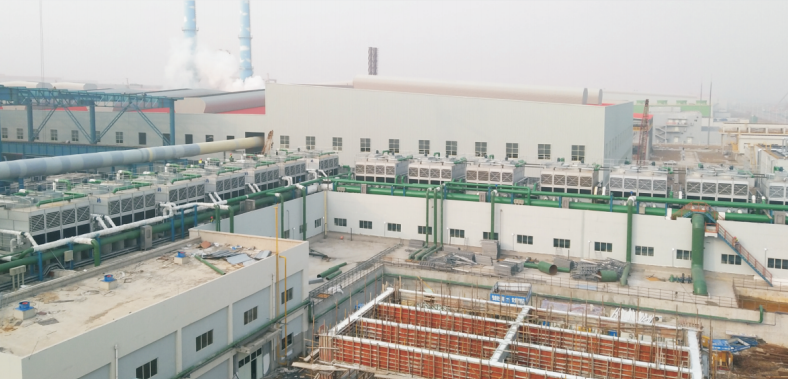
When an industrial cooling tower starts losing performance, attention usually goes to the fan, pump, motor, or water flow. But what about the filler inside the tower?
Cooling tower filler is where much of the water-air contact needed for evaporative heat transfer takes place. If the fill is clogged, damaged, incorrectly selected, or poorly matched to the tower, even a powerful cooling system can struggle.
So, where should industrial buyers source cooling tower filler?
This guide looks at five manufacturers and suppliers worth considering for industrial applications. The comparison focuses on product range, replacement capability, customization, technical support, and suitability for different cooling tower requirements.
Note: This is an editorial buyer's guide rather than an official worldwide ranking. The right supplier depends on the tower design, water quality, operating conditions, and project requirements.
What Is a Cooling Tower Filler Factory?
A cooling tower filler factory manufactures the fill media installed inside wet cooling towers.
You can think of filler as the “working surface” inside the tower. Hot water enters the tower and is distributed over the fill. Air then moves through the fill, allowing heat and some water to transfer through evaporation.
The filler increases the contact area between water and air and helps create the conditions required for effective heat rejection.
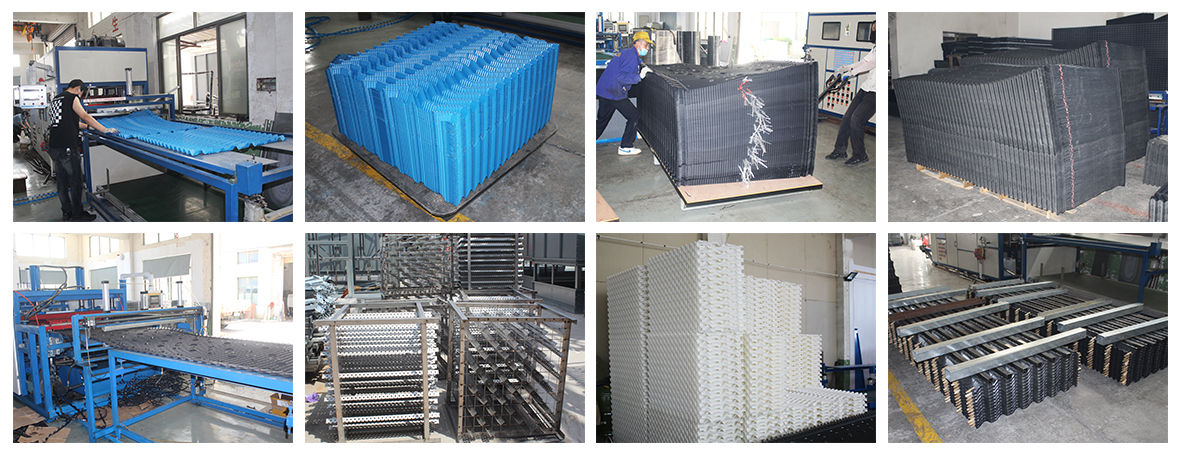
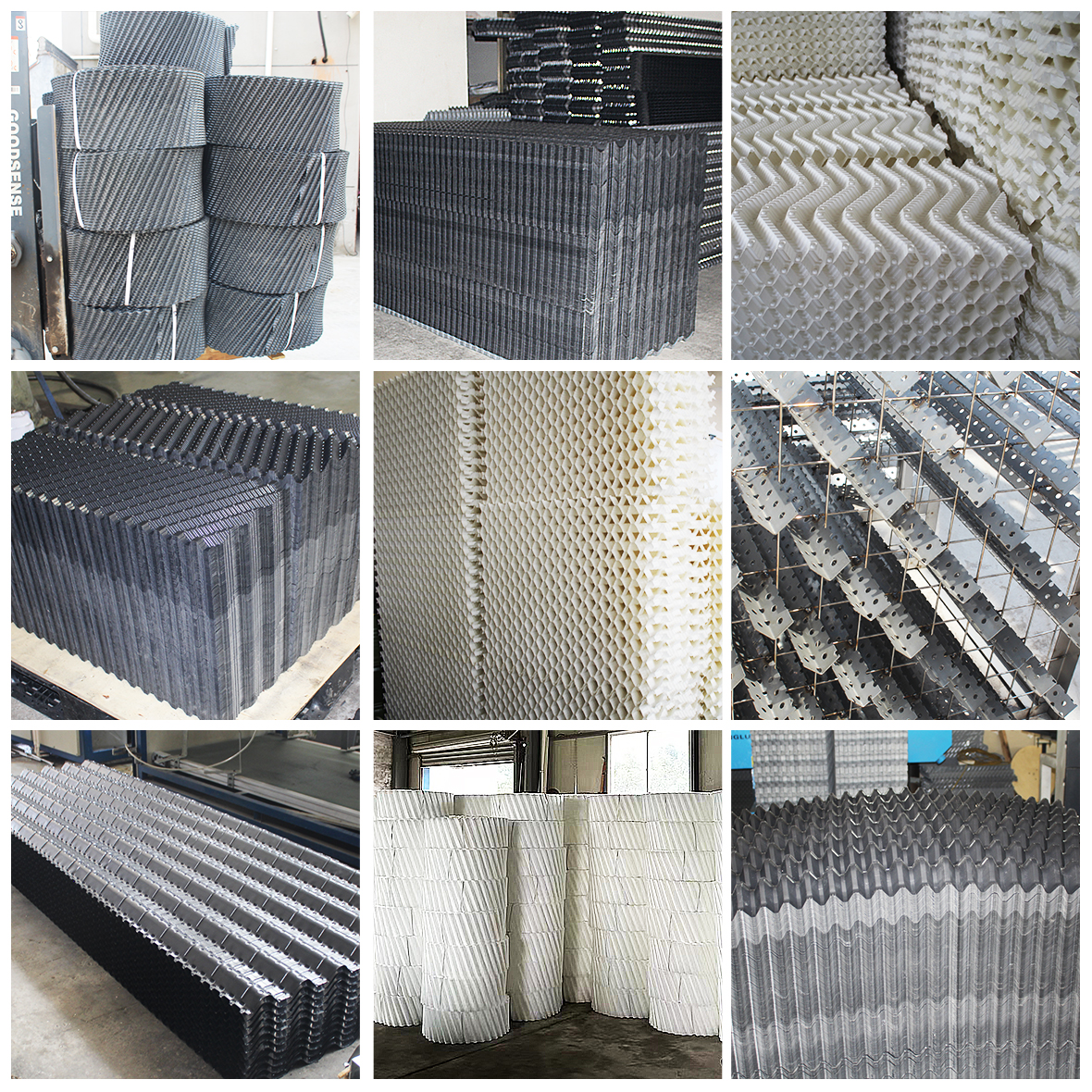
Modern suppliers may produce PVC film fill, PP fill, splash fill, crossflow fill, counterflow fill, replacement fill packs, and customized products.
The market includes specialized component suppliers as well as cooling tower manufacturers that produce filler as part of a broader equipment portfolio. Current industry supplier directories show a wide range of manufacturers and factories offering PVC cooling tower fill and related products.
Why Cooling Tower Filler Matters in Industrial Applications
Industrial cooling towers often operate continuously under demanding conditions.
The filler has to deal with circulating water, heat, minerals, suspended solids, biological growth, and repeated wetting and drying.
A suitable fill helps spread water over an effective surface area while allowing air to pass through.
The goal isn't simply “more surface area.”
The geometry has to balance heat transfer, water distribution, airflow resistance, fouling risk, and mechanical durability.
This is why selecting cooling tower filler should be treated as an engineering decision rather than a simple plastic-material purchase.
Film Fill vs. Splash Fill
Film fill and splash fill use different approaches.
Film fill spreads water across shaped surfaces, creating thin water films and a large contact area. It can provide high thermal performance when water quality is appropriate.
Splash fill repeatedly breaks falling water into droplets, which can be useful for applications where fouling or suspended solids are significant concerns.
Neither type is automatically better for every tower. The correct choice depends on the operating conditions.
PVC vs. PP Cooling Tower Filler
PVC remains widely used for cooling tower fill because it offers a practical combination of cost, chemical resistance, processability, and thermal performance.
PP can be considered when higher temperature capability or particular chemical-resistance characteristics are needed.
The important question isn't “Which material is better?”
It is:
“Which material fits this cooling tower?”
Water temperature, chemistry, mechanical conditions, and fill geometry should all be considered before choosing.
How We Evaluate Cooling Tower Filler Factories
A good supplier comparison needs more than a list of company names.
For industrial buyers, the factory should be evaluated from several angles.
Does it offer the right filler types?
Can it handle replacement projects?
Does it provide customized dimensions?
Can it explain material selection?
Does it understand crossflow and counterflow applications?
Can it provide useful technical information before the order is placed?
These questions are often more important than simply comparing the price per square meter.
Product Range
A wider product range can be useful because industrial cooling towers are not identical.
A supplier may need to provide PVC film fill for one project, PP fill for another, or splash fill for a system with higher fouling risk.
A supplier offering crossflow and counterflow configurations can also make replacement sourcing easier.
Manufacturing and Quality Control
Quality starts with consistent raw materials and continues through forming, cutting, assembly, inspection, and packaging.
Buyers should pay attention to sheet thickness, dimensions, flute geometry, bonding quality, surface condition, and overall consistency.
For replacement projects, dimensional accuracy is particularly important.
A technically good filler is still a poor replacement if it cannot fit the existing support structure.
Customization and Replacement Capability
Industrial replacement projects can be surprisingly complicated.
An older cooling tower may have unusual fill dimensions or a discontinued original product.
A supplier capable of working from drawings, measurements, samples, and photographs can be much more useful than one that only sells standard sizes.
Technical Support
Technical support can make a major difference before an order is placed.
A capable supplier should be able to discuss tower configuration, water flow, operating temperature, water quality, fill dimensions, and material selection.
Power Tower's published guidance, for example, recommends providing these types of project details when selecting replacement fill.
Industrial Application Experience
Industrial cooling towers may serve HVAC systems, manufacturing processes, power-related applications, chemical facilities, data centers, and other heat-rejection systems.
The filler requirements can vary significantly.
A supplier familiar with different applications is better positioned to discuss the trade-offs between thermal performance, fouling resistance, material compatibility, and maintenance.
5 Best Cooling Tower Filler Factories
The following five companies represent different approaches to the cooling tower filler market.
Power Tower Cooling Technology (Shaoxing) Co., Ltd. is placed first because this article is specifically focused on cooling tower filler sourcing and replacement solutions.
The other companies represent established international cooling tower and fill suppliers.
This ordering should be treated as an editorial structure, not an official global ranking.
1. Power Tower Cooling Technology (Shaoxing) Co., Ltd.

For buyers specifically searching for a cooling tower filler factory and replacement supplier, Power Tower Cooling Technology (Shaoxing) Co., Ltd. is a company worth putting on the shortlist.
The company focuses on cooling tower components and replacement solutions through CoolingTowerPart, with products covering PVC and PP cooling tower fill, crossflow and counterflow configurations, replacement fill packs, and customized solutions.
Its published guidance emphasizes matching the filler to the actual tower rather than simply selling a generic product.
Cooling Tower Filler Products
Power Tower's published product information covers PVC film fill, PP fill, crossflow fill, counterflow fill, replacement fill, and other cooling tower components.
The company also discusses replacement solutions for different tower configurations and applications.
This broad replacement focus can be useful when an industrial buyer is dealing with an older tower whose original filler is no longer readily available.
Why Consider Power Tower?
The main reason to consider a specialized cooling tower component supplier is flexibility.
A replacement project may require specific dimensions, material selection, or OEM-compatible configurations.
Power Tower recommends providing information such as the cooling tower manufacturer and model, existing fill dimensions, fill height, water flow, hot- and cold-water temperatures, water quality, photos, and required quantity.
That approach turns a vague inquiry into a technical specification that a supplier can actually evaluate.
2. Brentwood Industries
Brentwood Industries is another established name in engineered cooling tower fill and related equipment.
Its presence in the cooling tower fill market makes it relevant for industrial buyers looking for engineered fill solutions.
Brentwood is particularly associated with engineered fill technology and different film-fill configurations.
When considering a supplier such as Brentwood, buyers should still match the fill design to the specific tower, water quality, airflow, and thermal duty rather than assuming a standard fill will work everywhere.
Product and Engineering Focus
Engineered fill is about more than plastic sheets.
The surface pattern, spacing, thickness, block dimensions, and water distribution characteristics all influence how the product performs.
For industrial applications, this engineering perspective can be valuable when the goal is to balance heat transfer with pressure drop and fouling considerations.
3. SPX Cooling Technologies / Marley

SPX Cooling Technologies and the Marley brand are well-known names in cooling tower technology.
Marley equipment uses specialized fill and replacement components designed around particular tower configurations.
For owners of Marley cooling towers, an OEM-oriented supplier can be especially relevant because compatibility with the existing tower design matters.
The key point for buyers is to confirm the exact tower model and existing fill configuration before ordering.
Marley Cooling Tower Fill
Marley-related replacement projects can involve specific fill dimensions, support arrangements, and airflow requirements.
If you're replacing existing fill, don't rely on the brand name alone.
Measure the current fill, confirm the tower configuration, and compare the proposed replacement against the actual installation conditions.
A good supplier should be able to discuss those details with you.
4. Baltimore Aircoil Company (BAC)

Baltimore Aircoil Company, commonly known as BAC, is another established cooling technology company with products and replacement solutions associated with evaporative cooling equipment.
For BAC tower owners, compatibility and system configuration are important considerations when sourcing replacement fill.
A supplier with integrated knowledge of the tower system can help buyers avoid treating filler as an isolated component.
BAC Fill and Replacement Considerations
When replacing fill in an existing BAC system, check the original tower configuration, fill dimensions, support arrangement, water distribution system, and operating conditions.
A replacement should fit both physically and functionally.
This is especially important when the tower has been modified over the years.
5. EVAPCO
EVAPCO is another recognized manufacturer in the evaporative cooling industry.
Its product portfolio includes cooling towers and related heat-transfer equipment and components.
For EVAPCO tower owners, OEM or compatible replacement sourcing can be an important consideration.
As with every supplier on this list, the correct fill should be selected according to the actual tower configuration rather than the supplier name alone.
EVAPCO Replacement Fill Considerations
Before ordering replacement fill for an EVAPCO system, check the model, dimensions, fill arrangement, water distribution, and operating conditions.
A replacement product needs to fit the existing structure while providing the appropriate water-air contact characteristics.
This is where technical communication between the buyer and supplier becomes valuable.
Comparison of the 5 Cooling Tower Filler Factories
Here is a practical comparison for industrial buyers.
It is intended to help identify which supplier type may fit a particular purchasing requirement rather than provide an official worldwide ranking.
| Supplier | Main Focus | Fill/Component Focus | Suitable Buyer |
| Power Tower Cooling Technology | Cooling tower components and replacement | PVC, PP, crossflow, counterflow, replacement fill | Industrial replacement and customized sourcing |
| Brentwood Industries | Engineered fill solutions | Cooling tower fill and engineered media | Performance-focused industrial applications |
| SPX / Marley | OEM cooling tower technology | Marley-related fill and components | Marley tower owners and retrofit projects |
| BAC | Integrated evaporative cooling | OEM cooling equipment and components | BAC tower owners |
| EVAPCO | Evaporative cooling systems | Cooling tower equipment and components | EVAPCO system owners and industrial users |
How to Choose the Right Cooling Tower Filler Factory
Now comes the important part.
How do you choose among several manufacturers?
Start with your tower, not the supplier catalog.
Your operating conditions should determine the product.
Check Your Cooling Tower Configuration
First determine whether your tower is crossflow, counterflow, or another configuration.
Airflow direction and water distribution directly affect filler design.
The wrong configuration can create installation and performance problems even if the material itself is high quality.
Measure Existing Fill
For replacement projects, measure the existing fill whenever possible.
Record length, width, height, block arrangement, thickness, support dimensions, and available installation space.
Think of it like replacing a window: knowing the brand is useful, but knowing the actual opening is essential.
Check Water Quality
Water quality can determine whether a particular fill design is appropriate.
Suspended solids, biological growth, mineral deposits, and scaling can restrict passages.
A high-efficiency film fill may be attractive for clean-water applications, while applications with greater fouling risk may require a different approach.
Consider Operating Temperature
Temperature matters when selecting filler material.
PVC is widely used, while PP may be considered for applications requiring different temperature or chemical-resistance characteristics.
The correct material depends on the actual operating environment, not simply the lowest purchase price.
Ask About Customization
Ask whether the supplier can customize dimensions and configurations.
This can be particularly important for old cooling towers, retrofit projects, and replacement applications where standard catalog dimensions may not match the existing structure.
Questions to Ask Before Ordering Cooling Tower Filler
Before sending a purchase order, ask these questions:
What fill type is suitable for the tower?
What material is recommended?
What thickness is available?
Can you manufacture according to drawings or samples?
How are dimensions inspected?
What information is needed for a quotation?
How is the filler packaged?
Can the supplier support replacement projects?
These questions can reveal the difference between a genuine technical supplier and a seller simply quoting a commodity product.
Common Mistakes Industrial Buyers Should Avoid
The first mistake is choosing only by price.
The cheapest filler may not provide the lowest lifecycle cost.
The second is assuming all PVC film fill is identical.
Different flute patterns, thicknesses, dimensions, and configurations can produce different results.
The third mistake is ignoring water quality.
The fourth is failing to measure existing fill before replacement.
Finally, buyers sometimes forget to ask who actually manufactures the product.
Knowing the production source can improve communication and quality control.
Why Factory-Direct Purchasing Can Make Sense
Buying directly from a cooling tower filler factory can simplify technical communication and customization.
Instead of sending specifications through several intermediaries, you can discuss the application directly with the manufacturer.
This can be particularly helpful for large replacement projects, OEM-compatible products, unusual dimensions, and repeat orders.
It can also make it easier to clarify packaging, inspection requirements, and delivery expectations.
Final Thoughts
Finding the right cooling tower filler factory is not really about finding the company with the most impressive product list.
It is about finding the supplier whose products and capabilities match your tower.
For industrial buyers, the key factors are filler type, material, dimensions, water quality, operating temperature, airflow, thermal requirements, customization, quality control, and technical support.
Power Tower Cooling Technology (Shaoxing) Co., Ltd. is particularly relevant for buyers looking for cooling tower fill, replacement fill, PVC and PP options, crossflow and counterflow configurations, and customized cooling tower component solutions.
Ultimately, don't ask only:
“How much does the filler cost?”
Ask the more useful question:
“Will this filler work correctly in my cooling tower?”
That question can save far more money than chasing the lowest initial quotation.


