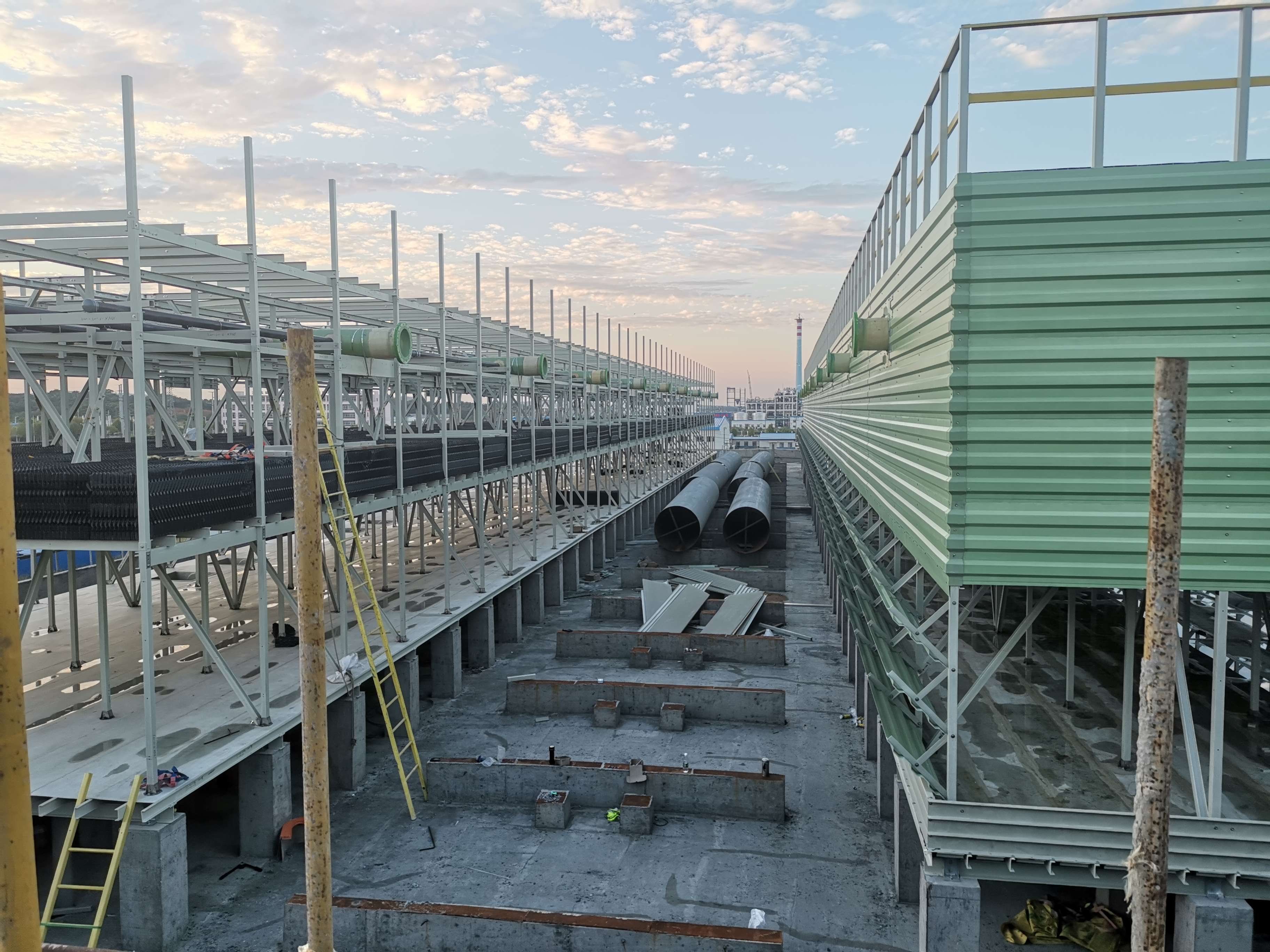
PVC fills are one of the most important components inside many modern cooling towers. If you have ever looked inside a cooling tower, you may have wondered why it contains layers of plastic sheets, grids, or structured blocks.
What do these components actually do?
The answer is simple: cooling tower PVC fills increase the contact area between hot water and moving air, allowing the tower to reject heat more effectively.
But there is more to the story.
Why is PVC used so widely? What makes PVC suitable for cooling tower fill? What is the difference between film fill and splash fill? And how do you choose the right PVC fill for an existing cooling tower?
This guide explores these questions in detail. Whether you are a cooling tower engineer, maintenance manager, industrial buyer, contractor, or simply researching cooling tower PVC fills, you will find the key information needed to understand how they work and why they matter.
What Are Cooling Tower PVC Fills?
Cooling tower PVC fills are heat-transfer media made primarily from polyvinyl chloride (PVC) and installed inside evaporative cooling towers.
Their job sounds simple, but it is extremely important: create more surface area for water and air to interact.
Instead of allowing hot water to fall directly from the distribution system into the basin, the fill spreads, redirects, or breaks the water into a much larger contact area.
This gives air more opportunities to absorb heat and moisture from the water.
Think of the fill as a giant three-dimensional meeting place for air and water.
The more effectively these two meet, the more efficiently the cooling tower can transfer heat.
Cooling tower PVC fills are commonly found in industrial cooling towers, HVAC systems, process cooling systems, power plants, manufacturing facilities, and many other applications where heat needs to be continuously rejected.
How Do PVC Fills Work in a Cooling Tower?
The basic principle behind a cooling tower is surprisingly straightforward.
Hot water enters the tower and flows through the fill while air passes through the same area.
The PVC fill changes the way water travels.
Depending on the design, it may spread water into thin films or repeatedly break and redistribute it into droplets.
This dramatically increases the effective air-water contact area.
As the water contacts the air, sensible heat moves from the warmer water into the air.
At the same time, a small portion of the water evaporates, removing additional thermal energy.
The cooled water then collects in the basin and returns to the industrial process.
The cycle repeats continuously.
Increasing Water-Air Contact Area
This is perhaps the most important reason cooling tower PVC fills are used.
Imagine pouring a bucket of water into a swimming pool. The water has a large volume, but only the exposed surface directly interacts with the surrounding air.
Now imagine taking that same water and spreading it across hundreds of thin sheets.
Suddenly, the available contact area becomes dramatically larger.
PVC fill creates a similar effect.
Film fill spreads water across specially shaped surfaces, while splash fill breaks and redirects the water.
More effective contact means more opportunities for heat transfer.
That is the basic engineering idea behind cooling tower fill.
Supporting Evaporative Cooling
Evaporation is the heart of an evaporative cooling tower.
When a small amount of water changes from liquid into vapor, it carries heat away with it.
PVC fill helps create the conditions needed for this process by keeping water distributed across a large area and allowing air to move through the wetted surfaces.
The better the contact between water and air, the more effectively the cooling tower can use evaporation to reject heat.
This is why fill design has such a significant influence on overall cooling tower performance.
Why Is PVC Used for Cooling Tower Fill?
PVC has become a popular material for cooling tower fill because it provides a practical balance between performance, durability, manufacturability, and cost.
A cooling tower fill needs to survive continuous exposure to water, airflow, temperature changes, minerals, and water-treatment chemicals.
At the same time, it needs to be lightweight enough for practical installation, inspection, cleaning, and replacement.
PVC fits this role well in many industrial and commercial cooling applications.
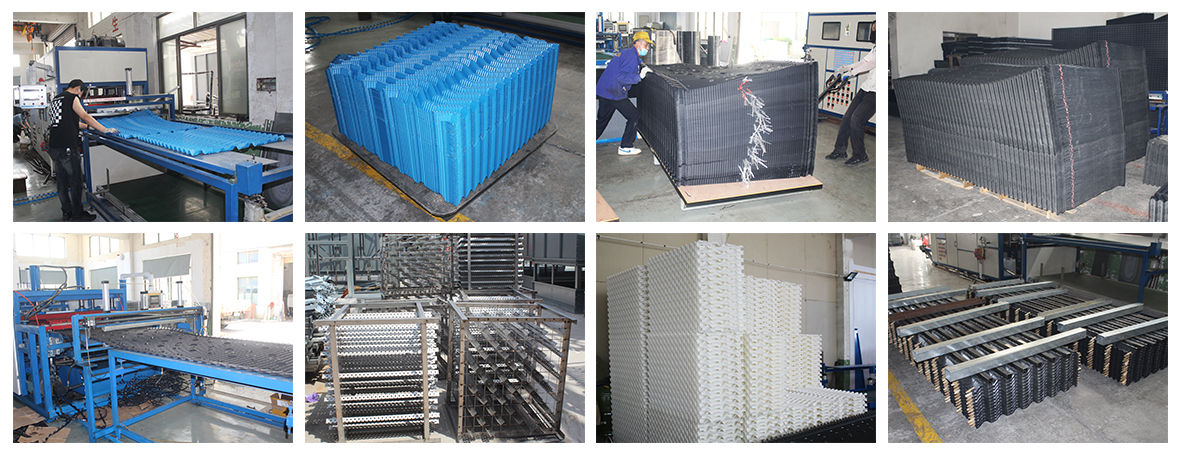
Lightweight and Easy to Handle
Compared with many traditional construction materials, PVC is relatively lightweight.
Why does that matter?
Cooling tower fill can occupy a surprisingly large volume. Workers may need to install, inspect, clean, remove, and replace large quantities of fill.
Lightweight PVC construction makes these tasks more manageable.
It can also reduce the structural burden placed on the cooling tower.
For replacement projects, this is particularly useful. Installers can remove old fill and install new fill without handling excessively heavy components.
Good Chemical Resistance
Cooling tower water often contains treatment chemicals designed to control corrosion, scale, and biological growth.
The fill material therefore needs to tolerate the operating environment.
PVC offers good resistance to many commonly encountered chemicals and aqueous environments.
However, this does not mean every PVC product is suitable for every chemical condition.
Extremely aggressive water chemistry, unusual temperatures, or process contamination should always be evaluated before selecting a particular fill.
In other words, PVC is durable—but application conditions still matter.
Durable in Wet Environments
Cooling towers are permanently associated with moisture.
The fill is exposed to wet surfaces, airflow, minerals, biological activity, and temperature variations.
Properly manufactured PVC cooling tower fills can provide reliable service under suitable operating conditions.
This durability is one reason PVC fill is widely selected for both new cooling towers and replacement projects.
Cost-Effective Material
Cooling tower design is always a balancing act.
Engineers want excellent thermal performance, but they also need to control capital and lifecycle costs.
PVC provides a practical combination of performance and affordability.
When properly designed, installed, and maintained, PVC fill can help a cooling tower achieve the required thermal performance without making the fill system unnecessarily expensive.
That makes it attractive not only from an engineering perspective but also from a purchasing perspective.
Main Types of Cooling Tower PVC Fills
Not all cooling tower PVC fills are the same.
The right design depends on the tower configuration, water quality, heat load, airflow, and operating environment.
The two major categories are PVC film fill and PVC splash fill, with specific configurations used in crossflow and counterflow cooling towers.
PVC Film Fill
PVC film fill consists of shaped sheets or blocks that spread water into thin films.
The thin water layer creates a large contact area between water and air.
This type of fill can provide high thermal performance and is widely used when circulating water is relatively clean.
However, the narrow passages found in many film-fill designs can be more sensitive to suspended solids, biological growth, and fouling.
For this reason, water treatment is particularly important when using high-efficiency film fill.
PVC Splash Fill
Splash fill works differently.
Instead of forming a continuous thin water film, splash bars or grids repeatedly break and redirect falling water.
This creates droplets and exposes new water surfaces to the airflow.
Splash fill can be useful in applications where water contains higher levels of suspended solids or where clogging resistance is especially important.
The trade-off is that splash fill may require more volume to achieve comparable thermal performance to high-efficiency film fill.
Crossflow PVC Fill
In a crossflow cooling tower, air generally moves horizontally through the falling water.
PVC fill designed for crossflow applications needs to work effectively with the tower's water distribution and airflow pattern.
The geometry of the fill, its height, sheet spacing, water loading, and pressure drop all influence performance.
For replacement projects, compatibility with the existing tower is particularly important.
Counterflow PVC Fill
In a counterflow cooling tower, water flows downward while air moves upward.
PVC film fill is commonly used in this configuration because the opposing air and water paths can provide effective heat and mass transfer.
However, the fill still needs to be matched to the actual application.
Water quality, thermal duty, airflow, fill height, and operating temperature all affect the final selection.

Benefits of Using Cooling Tower PVC Fills
Why do cooling tower manufacturers and plant operators continue to use PVC fill?
There is no single answer.
A well-designed PVC fill system can improve thermal performance, support compact tower dimensions, distribute water effectively, and contribute to efficient operation.
Improved Cooling Efficiency
The first major benefit is improved heat transfer.
By increasing the contact area between water and air, PVC fill gives the cooling tower more opportunities to reject heat.
This can help the tower achieve its required outlet-water temperature without simply making the entire tower larger.
The fill essentially allows the tower to make better use of the space already available.
Better Water Distribution
Properly designed fill helps guide water across the available heat-transfer area.
Uniform wetting is essential.
If one section of the fill receives excessive water while another section remains relatively dry, the available thermal area is not being used efficiently.
Good water distribution and good fill design therefore need to work together.
A high-performance fill cannot compensate for a badly designed or partially blocked water distribution system.
Compact Cooling Tower Design
High-performance PVC film fill can provide substantial heat-transfer area within a relatively compact volume.
This can be valuable where industrial plant space is limited.
Instead of continuously increasing the tower footprint, engineers can use efficient fill geometry to improve heat transfer within the available space.
That can influence the overall size, layout, and cost of the cooling tower.
Reduced Operating Costs
Better heat transfer can contribute to efficient cooling tower operation.
However, fill efficiency is only one part of the equation.
Fan energy, pump power, water treatment, blowdown, evaporation, maintenance, and replacement costs all influence total operating expenses.
The objective should therefore not be simply to select the highest-efficiency fill.
The better approach is to create a balanced system in which the fill, fan, water distribution system, and operating conditions are properly matched.
What Factors Affect PVC Fill Performance?
A common mistake is assuming that the fill alone determines cooling tower performance.
It does not.
Several factors interact inside the tower, and the same PVC fill can perform very differently under different operating conditions.
Water Quality
Water quality is critical.
Suspended solids can accumulate between fill sheets.
Hard water can encourage mineral scale.
Poor biological control can lead to slime and biofilm.
Each of these conditions can restrict airflow or reduce the effective heat-transfer area.
Water treatment and regular inspection are therefore essential parts of a successful PVC fill system.
If your cooling tower uses particularly dirty or contaminated water, the fill type should be selected with this condition in mind.
Airflow
Even excellent fill cannot compensate for inadequate airflow.
Fans need to move sufficient air through the fill to support the required heat and mass transfer.
At the same time, excessive airflow can increase fan energy consumption.
This creates another balancing act.
Fill design, pressure drop, fan capacity, and energy consumption should be considered together rather than separately.
Water Temperature and Flow
Hot-water temperature, cold-water temperature, circulating-water flow, and thermal range all affect the required fill volume and configuration.
For example, a tower handling a very large water flow may require a substantially different fill arrangement from a smaller commercial HVAC tower.
This is why a manufacturer should receive accurate operating data before recommending a particular PVC fill.
How to Choose the Right Cooling Tower PVC Fills
Choosing cooling tower PVC fills should start with actual operating conditions rather than simply selecting the cheapest product.
What type of tower do you have?
How clean is the circulating water?
What cooling range do you need?
How much space is available?
What are the existing fill dimensions?
These questions help narrow the choices.
Consider Fill Type
Film fill and splash fill have different strengths.
Film fill is often selected when high thermal performance is required and the water is relatively clean.
Splash fill may be more suitable when suspended solids or fouling are significant concerns.
The decision should be based on actual water conditions rather than theoretical efficiency alone.
Check Fill Dimensions
Replacement fill needs to fit the existing tower.
Sheet thickness, block dimensions, height, width, flute configuration, and installation method should all be checked carefully.
Even a high-quality PVC fill can become a poor replacement if its dimensions do not match the existing cooling tower.
Before purchasing, measure the current fill or obtain the original tower drawings whenever possible.
Consider Operating Conditions
Temperature, water flow, airflow, water chemistry, suspended solids, and expected operating hours should all be considered.
If the tower operates continuously in an industrial environment, durability and maintainability may be just as important as initial thermal performance.
The right product is the one that can perform consistently in the real world.
PVC Fill Maintenance and Cleaning
Good PVC fill still needs proper maintenance.
A cooling tower is constantly exposed to contaminants, so gradual fouling is almost unavoidable if water treatment and cleaning are neglected.
Regular inspections allow operators to identify problems before cooling performance drops significantly.
Preventing Clogging and Scaling
Preventive water treatment is one of the best ways to protect PVC fill.
Operators should monitor:
Suspended solids
Scale-forming minerals
Biological growth
Water chemistry
Blowdown conditions
Depending on the system, filtration, blowdown control, chemical treatment, and periodic cleaning may be required.
When cleaning PVC fill, use methods and chemicals appropriate for the material.
Aggressive cleaning methods can damage or deform the fill and potentially create a larger problem.
When Should PVC Fill Be Replaced?
PVC fill does not have one universal replacement interval.
Its service life depends heavily on operating conditions and maintenance.
Common warning signs include:
If cleaning no longer restores acceptable performance, replacement may become more economical than continued maintenance.
Sometimes the cooling tower itself is still structurally sound while its fill has reached the end of its useful life.
Replacing the fill can therefore be an effective way to restore performance without replacing the entire tower.
Common Problems With Cooling Tower PVC Fills
Several problems appear repeatedly in cooling tower fill systems.
These include:
Poor water treatment is often a contributing factor, but design and installation problems can also play a role.
For example, a fill may become heavily fouled if the water distribution system sends excessive solids into narrow film-fill passages.
The lesson is simple:
Fill selection, water treatment, and maintenance cannot be treated as separate issues.
They are three parts of the same cooling strategy.
How to Choose a Cooling Tower PVC Fill Manufacturer
The manufacturer matters because cooling tower fill is a precision component, not simply a stack of plastic sheets.
A reliable supplier should understand thermal requirements, material selection, dimensions, installation, and long-term maintenance.
Product Quality and Materials
Ask about PVC material quality, manufacturing consistency, thickness, dimensional accuracy, and product design.
Consistent manufacturing matters because variations in fill geometry can influence water distribution, airflow resistance, and heat-transfer performance.
Customization Capability
Every cooling tower is different.
Replacement projects may require specific dimensions, configurations, or installation arrangements.
A manufacturer capable of producing customized cooling tower PVC fills can be particularly useful when standard dimensions do not match the existing tower.
Customization can also help when the cooling tower has unusual operating requirements.
Technical and After-Sales Support
Technical support becomes especially valuable when replacing old fill or upgrading cooling tower performance.
A knowledgeable supplier should be able to discuss:
Access to replacement products and technical assistance can also make future maintenance much easier.
Why Choose Power Tower Cooling Technology (Shaoxing) Co.,Ltd?

Power Tower Cooling Technology (Shaoxing) Co.,Ltd specializes in cooling tower components and related products, including cooling tower PVC fills.
For customers looking for PVC film fill, splash fill, or other cooling tower fill solutions, the key is matching the product to the actual cooling tower rather than treating every application the same.
Different towers have different water flows, fill dimensions, thermal requirements, and water-quality conditions.
A suitable fill needs to fit both the physical structure and the operating environment.
For product information, cooling tower PVC fills, and related cooling tower components, visit the company's website:
Power Tower Cooling Technology (Shaoxing) Co.,Ltd
Final Thoughts
So, why are PVC fills used in cooling towers?
Because they solve one of the most important challenges in evaporative cooling: creating efficient contact between water and air.
PVC provides a practical combination of thermal performance, lightweight construction, chemical resistance, durability, manufacturability, and cost-effectiveness.
But the best cooling tower PVC fill is not necessarily the one with the most impressive specification sheet.
It is the one that matches your tower, water quality, airflow, temperature range, water loading, and maintenance strategy.
If you are replacing old fill or designing a new cooling tower system, start with the application data.
Understand the heat load, water flow, temperature range, tower configuration, and water quality.
Then select a PVC fill manufacturer that can provide the right dimensions, material, design, and technical support.
When these pieces fit together, PVC fill becomes more than just a component inside the tower.
It becomes a key part of an efficient, reliable, and long-lasting heat-rejection system.


