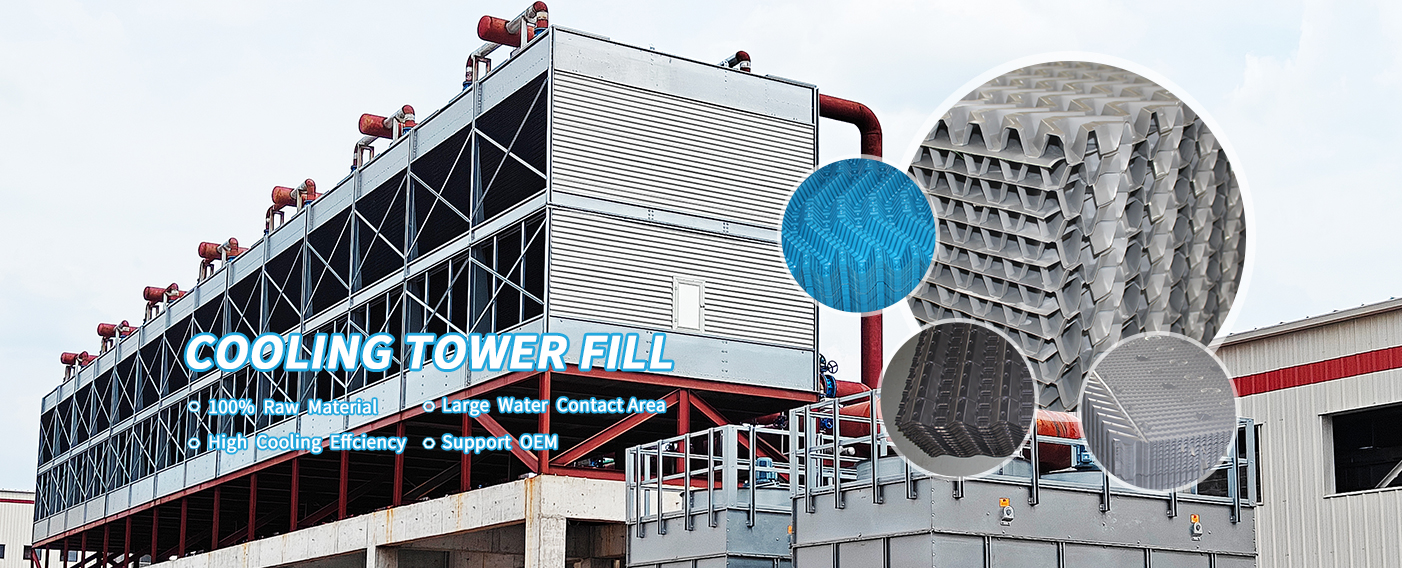
If you have ever looked inside a cooling tower, you may have noticed stacks of corrugated plastic sheets that look surprisingly simple.
But here is the interesting part: those sheets are doing a huge amount of the tower's thermal work.
They are called film type fill, film fill, or cooling tower film fill.
So, what exactly is film type fill in a cooling tower? How does it work? Why is it so widely used? And when should you choose film fill instead of splash fill?
These are important questions for anyone designing, maintaining, or replacing a cooling tower.
In simple terms, film fill creates a large surface area where hot water can spread into a thin film while air moves through the tower. This increases water-air contact and gives heat more opportunity to escape through evaporation.
It sounds simple, right?
The engineering behind it is more interesting.
This guide explains how film type fill cooling towers work, what film fill is made from, the main film-fill designs, their advantages and limitations, and how to select the right product for an industrial or commercial application.
What Is Film Type Fill in a Cooling Tower?
Film type fill is a structured heat-transfer media installed inside an evaporative cooling tower.
Its job is to spread circulating water across a large wetted surface while allowing air to pass through the fill.
Instead of allowing hot water to fall directly from the spray system into the basin, the fill slows and spreads the water.
Think of it like turning a waterfall into thousands of tiny streams.
A conventional smooth surface gives water relatively little contact with moving air. A properly designed film-fill pack creates thousands of channels and surfaces that dramatically increase the available contact area.
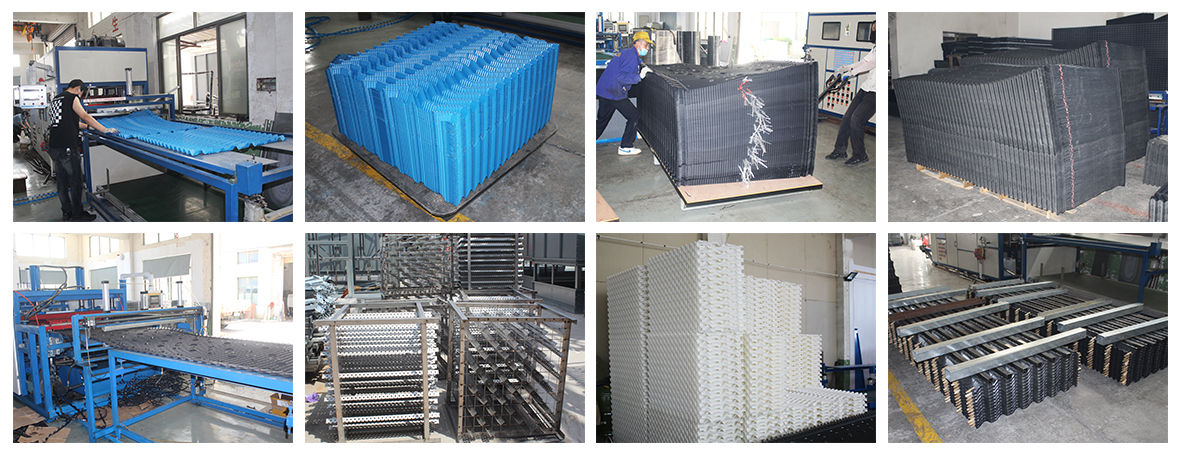
Most film fill consists of thin plastic sheets that are formed into corrugated, fluted, or otherwise engineered patterns.
The individual sheets are assembled into blocks or packs and installed inside the tower.
The result is a lightweight structure with a very large effective heat-transfer area.
Why Is Film Fill Important?
A cooling tower needs effective contact between water and air.
That is the heart of evaporative cooling.
Film fill helps create that contact efficiently.
Increasing Water-Air Contact Area
When hot water enters the fill, the corrugated surfaces encourage it to spread into thin layers.
At the same time, air travels through the spaces between the sheets.
The result is a much larger interface between water and air than would exist if the water simply fell freely through the tower.
This is why film fill can achieve high thermal performance in a relatively compact space.
Improving Heat Transfer
The main purpose of a cooling tower is heat rejection.
The water entering the tower is hot because it has absorbed heat from another process.
As air moves through the fill, some water evaporates. The energy required for evaporation comes from the water itself, which lowers the temperature of the remaining circulating water.
Film fill improves this process by maximizing the area and contact time available for heat and mass transfer.
Reducing Required Tower Volume
Because film fill provides a large amount of wetted surface in a compact volume, a tower can achieve substantial cooling duty without requiring an enormous fill section.
This is one reason film fill is widely used in modern cooling tower designs.
The goal is not simply to add more plastic sheets.
The goal is to create the right combination of:
Wetted surface area
Water distribution
Airflow
Contact time
Pressure drop
Heat transfer
Fouling resistance
That balance is what makes good film fill effective.
How Does Film Type Fill Work?
The operating principle becomes much easier to understand when broken into several steps.
Step 1: Hot Water Enters the Tower
Hot circulating water enters the cooling tower after absorbing heat from a process, chiller, condenser, or other heat-generating system.
Depending on the tower design, the water is delivered to a distribution basin or spray system.
The objective is to distribute the water as evenly as possible across the fill.
If the water distribution is poor, even the best film fill cannot perform properly.
Step 2: Water Spreads Over the Fill
The water flows downward over the surfaces of the film-fill sheets.
The corrugations help distribute the water and create thin water films.
Why thin?
Because thinner water layers provide more opportunity for the air to interact with the water.
The fill geometry is therefore extremely important.
Different flute patterns create different combinations of surface area, turbulence, pressure drop, water distribution, and fouling resistance.
Step 3: Air Moves Through the Fill
At the same time, air travels through the fill.
In a counterflow cooling tower, air generally moves upward while water moves downward.
In a crossflow cooling tower, air moves horizontally across the falling water.
Either way, the objective is the same: bring moving air into close contact with the water.
Step 4: Evaporation Removes Heat
This is the magic of evaporative cooling.
A small portion of the circulating water evaporates.
That phase change requires energy, and much of that energy comes from the sensible heat contained in the water.
As a result, the remaining water becomes cooler.
The air leaving the tower carries away heat and moisture.
The fill does not create the evaporation itself. Instead, it creates the conditions that make evaporation and heat transfer much more effective.
Step 5: Cooled Water Returns to the System
After passing through the fill, the cooled water collects in the basin.
A pump then sends the water back to the process or heat exchanger.
The cycle repeats.
Hot water enters.
Air removes heat.
Film fill creates the contact area.
Cooler water leaves.
It is a continuous thermal loop.
What Is Cooling Tower Film Fill Made Of?
The material matters almost as much as the geometry.
Different applications require different combinations of temperature resistance, chemical resistance, mechanical strength, and fouling resistance.
PVC Film Fill
PVC, or polyvinyl chloride, is one of the most common materials used for cooling tower film fill.
PVC offers a useful combination of:
Many commercial and industrial cooling tower film-fill products use thermoformed PVC sheets.
The exact material specification still matters, however.
Not every PVC fill is identical.
Sheet thickness, formulation, forming pattern, spacing, temperature limits, and manufacturing quality can all affect performance.
PP Film Fill
Polypropylene, commonly called PP, is another material used in cooling tower fill.
PP can be attractive for applications where higher temperature capability or specific chemical-resistance requirements make it more suitable than standard PVC.
However, selecting PP simply because it sounds "stronger" is not enough.
The correct material depends on the actual operating environment.
You should consider:
Hot-water temperature
Chemical concentration
pH
Water treatment program
UV exposure
Mechanical conditions
Expected service life
Other Specialized Materials
Some applications may require specialized plastic formulations or high-temperature materials.
The important point is that material and fill design should be considered together.
A high-quality material with the wrong geometry may perform poorly.
Likewise, an excellent fill design made from an unsuitable material may fail prematurely.
Main Types of Film Fill
Not all film fill looks or performs exactly the same way.
Manufacturers have developed different patterns to balance thermal performance, water distribution, pressure drop, and fouling resistance.
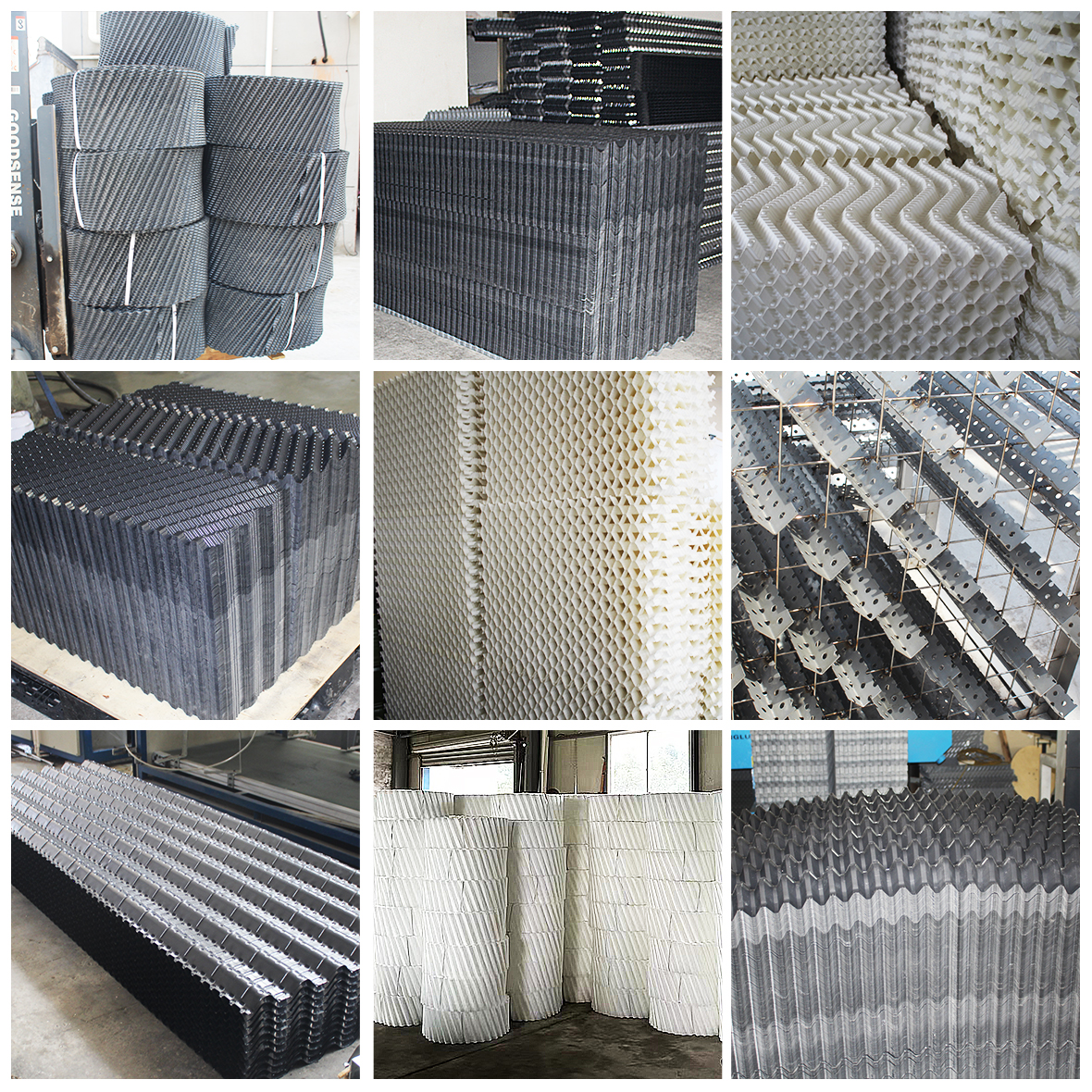
Cross-Fluted Film Fill
Cross-fluted film fill uses alternating corrugation patterns that encourage water to spread laterally while moving downward.
This type of design is often associated with high thermal performance.
The additional interaction between water and air can increase heat-transfer efficiency.
Cross-fluted designs can therefore be attractive when water quality is good and maximum thermal performance is a major objective.
Vertical-Fluted Film Fill
Vertical-fluted fill uses channels that direct water more strongly downward.
The larger, more open passages found in some vertical-fluted designs can help reduce the risk of plugging.
This makes vertical-fluted fill particularly interesting for applications where water quality is less than ideal.
The trade-off is that a more open structure may provide a different thermal-performance profile compared with highly compact cross-fluted designs.
Offset-Fluted Film Fill
Offset-fluted designs attempt to balance the characteristics of cross-fluted and vertical-fluted structures.
They can provide water dispersion while maintaining relatively strong vertical flow paths.
This type of design is useful when the buyer wants a compromise between thermal performance and fouling resistance.
Herringbone Film Fill
Herringbone patterns use engineered surface geometry to distribute water across the fill.
They are often used in replacement applications where uniform water distribution and compatibility with existing tower configurations are important.
The lesson is simple: the shape of the fill is not decoration.
Every flute, channel, and angle has a purpose.
Film Fill vs Splash Fill
One of the most common questions in cooling tower design is:
Is film fill better than splash fill?
There is no universal answer.
Film Fill Advantages
Film fill can provide:
High heat-transfer efficiency
Large wetted surface area
Compact installation
Good performance in clean-water applications
Efficient use of tower volume
This makes it attractive for many HVAC and industrial applications.
Splash Fill Advantages
Splash fill uses bars, grids, or structured elements to break falling water into droplets.
Its major advantage is often fouling tolerance.
Because the structure can be more open, splash fill can be suitable for water containing suspended solids or other contaminants.
The trade-off is that splash fill may require more volume to achieve the same thermal duty.
So the decision should not be based on which fill is "better."
Instead, ask:
Which fill is better for this water, this tower, and this operating condition?
Film Fill for Counterflow Cooling Towers
In a counterflow cooling tower, water moves downward while air generally moves upward.
This creates an effective counter-current arrangement for heat and mass transfer.
Counterflow film fill is therefore designed specifically around the airflow and water-flow relationship inside this tower configuration.
The fill depth, flute geometry, surface area, and pressure drop all need to be considered when selecting the product.
A fill that works well in a counterflow tower should not automatically be assumed to be suitable for a crossflow tower.
Film Fill for Crossflow Cooling Towers
Crossflow towers operate differently.
Water generally moves vertically downward while air travels horizontally through the fill.
This creates different requirements for water distribution and fill geometry.
Crossflow film fill can incorporate features such as louvers and drift-eliminator functions depending on the design.
For replacement projects, compatibility with the original tower can be particularly important.
The fill must work with the existing air path, water distribution, support structure, and available space.

How Does Water Quality Affect Film Fill?
Water quality can make or break a film-fill installation.
A highly efficient fill can perform extremely well with clean water and then deteriorate rapidly when exposed to severe fouling.
Scaling
Hard-water minerals can precipitate on the fill surface.
Over time, scale can reduce the effective heat-transfer area and restrict airflow.
Heavy deposits can also increase the weight of the fill packs and place additional loads on the support structure.
Algae and Biological Fouling
Warm, wet surfaces are attractive environments for biological growth.
Algae and biofilm can cover the fill surfaces and block passages.
This reduces airflow and interferes with water distribution.
A proper water-treatment and biocide program is therefore an important part of maintaining film fill.
Suspended Solids
Dust, dirt, sediment, and other suspended solids can enter an open cooling system.
If those particles accumulate inside narrow fill passages, clogging can occur.
This is one reason low-fouling or more open film-fill designs may be considered for poorer water-quality applications.
What Are the Advantages of Film Type Fill Cooling Towers?
Film type fill offers several important benefits.
High Thermal Efficiency
Its large wetted surface allows substantial contact between water and air.
Compact Design
A high amount of effective surface area can fit into a relatively small fill volume.
Lower Material Volume
Because film fill is designed around efficient surface contact, less physical volume may be required compared with some splash-fill arrangements.
Wide Application Range
Film fill is used in HVAC, industrial process cooling, manufacturing, power-related applications, refrigeration, and many other systems.
Flexible Design Options
Modern film fill is available in different flute patterns and material options.
That allows engineers to balance efficiency and fouling resistance.
What Are the Limitations of Film Type Fill?
Film fill is not perfect.
Its biggest weakness is usually water quality.
If the water contains significant suspended solids, scale-forming minerals, biological contaminants, or other fouling materials, narrow passages can become restricted.
That does not mean film fill cannot be used in these environments.
It means the fill needs to be selected carefully.
Low-fouling film designs, improved water treatment, filtration, regular cleaning, or splash fill may be considered depending on the application.
How to Choose the Right Film Fill
Choosing the right product is much easier when you work through a checklist.
Check Fill Dimensions
Measure:
Length
Width
Height
Fill depth
Sheet spacing
Number of packs
Support arrangement
Never assume that a visually similar fill will fit correctly.
Check Operating Temperature
Temperature affects material selection.
The supplier should know the normal hot-water temperature as well as any expected peak condition.
This is especially important for industrial applications.
Check Water Quality
Tell the supplier about:
Suspended solids
Hardness
Scaling
Biological growth
Chemical additives
pH
Filtration
Water quality can determine whether you should use high-efficiency film fill, low-fouling film fill, or splash fill.
Check Thermal Requirements
A proper selection should consider:
Heat load
Water flow
Airflow
Entering-water temperature
Leaving-water temperature
Design wet-bulb temperature
Required approach
Available fill volume
The supplier should evaluate the complete system rather than recommending a product based on dimensions alone.
When Should Cooling Tower Film Fill Be Replaced?
Film fill does not have one universal replacement interval.
Its service life depends heavily on the operating environment.
However, several warning signs indicate that inspection or replacement may be necessary.
Cracking and Deformation
Cracked or deformed sheets can change the designed airflow and water path.
Once sections begin to collapse, the problem can spread.
Severe Fouling
If cleaning can no longer restore the original flow paths, replacement may become more practical.
Reduced Cooling Performance
A rising cold-water temperature is an important warning sign.
If the tower used to achieve its design temperature but now consistently falls short, the fill should be inspected along with the fan, water distribution system, airflow, and water flow.
How to Maintain Film Type Fill
Good maintenance can significantly extend the useful life of cooling tower fill.
Start with water treatment.
Control scale, biological growth, and suspended solids as effectively as possible.
Next, inspect the fill regularly.
Look for:
Cleaning should also be performed using methods appropriate for the fill material.
Aggressive mechanical cleaning can damage thin plastic sheets.
Chemical cleaning should also be compatible with the material and the tower's water-treatment program.
And do not forget the components above the fill.
Blocked spray nozzles can create dry areas and overloaded areas, reducing the performance of even brand-new fill.
Power Tower Cooling Technology as a Film Fill Supplier
For companies looking for a film type fill cooling tower supplier, Power Tower Cooling Technology (Shaoxing) Co.,Ltd provides cooling tower fill and related components for international customers.
The company focuses on cooling tower internal components and can supply different types of fill for crossflow and counterflow applications.
PVC and PP Film Fill Solutions
Power Tower can provide cooling tower film-fill solutions using materials such as PVC and PP, depending on application requirements.
Typical considerations include:
This application-based approach is important because film fill should not be treated as a generic plastic product.
Customized Cooling Tower Fill
Replacement projects frequently involve non-standard dimensions.
An existing tower may have been operating for many years, and the original fill may no longer be readily available.
In this situation, accurate measurements, photographs, drawings, and operating data can help the manufacturer determine an appropriate replacement configuration.
For large-volume projects, direct communication with the manufacturer can also simplify purchasing and customization.
For more information about cooling tower film fill, PVC fill, PP fill, and replacement cooling tower components, visit the Power Tower Cooling Technology website:
https://www.coolingtowerpart.com
FAQ: Film Type Fill Cooling Tower
What is film type fill in a cooling tower?
Film type fill is a structured heat-transfer media that spreads circulating water into thin films over a large surface area while allowing air to pass through.
Its purpose is to improve water-air contact and increase heat-transfer efficiency.
How does cooling tower film fill work?
Hot water flows over the fill surfaces while air passes through the fill.
The increased contact area allows heat and moisture to transfer from the water to the air, primarily through evaporation.
What is the most common material for film fill?
PVC is one of the most widely used materials for cooling tower film fill.
PP is also used for applications where its material properties are advantageous.
Is film fill better than splash fill?
Not in every situation.
Film fill can provide excellent thermal performance with relatively clean water, while splash fill may be more suitable for applications with high suspended solids or severe fouling risks.
How long does cooling tower film fill last?
There is no fixed service life.
Water chemistry, temperature, fouling, biological growth, UV exposure, cleaning practices, mechanical stress, and operating conditions all affect service life.
Can film fill be used in both counterflow and crossflow cooling towers?
Yes, but the fill design needs to match the tower configuration.
Counterflow and crossflow towers have different airflow and water-distribution arrangements, so the correct film-fill product should be selected accordingly.
Can film fill be replaced without replacing the cooling tower?
In many cases, yes.
If the tower structure and other major components remain serviceable, replacing degraded fill can be a practical way to restore thermal performance without replacing the entire tower.
**How do I select the right film fill?
Start with the tower design, fill dimensions, water flow, operating temperatures, water quality, heat load, and required cooling performance.
A qualified supplier can then recommend a suitable fill configuration.
Final Thoughts
So, what is film type fill in a cooling tower?
At its simplest, it is a structured heat-transfer surface that turns ordinary falling water into a much more effective water-air contact process.
But the real story goes deeper.
The fill's geometry affects water distribution. Its material affects durability. Its channel size affects fouling resistance. Its surface area affects heat transfer. Its dimensions affect compatibility. And the water quality determines whether the fill continues performing well over time.
That is why choosing cooling tower film fill should never be reduced to "Which product is cheapest?"
The better question is:
Which film fill gives this cooling tower the right balance of thermal performance, fouling resistance, durability, and lifecycle cost?
For clean-water applications where high thermal efficiency is important, film fill can be an excellent solution. For poorer water quality, specialized low-fouling film designs or splash fill may be more appropriate.
And when an existing tower starts losing performance, replacing the film fill can sometimes restore cooling capacity without replacing the entire tower.
For manufacturers, contractors, and end users looking for PVC film fill, PP film fill, cooling tower film fill, or customized replacement fill, Power Tower Cooling Technology (Shaoxing) Co.,Ltd can provide a direct manufacturing option through CoolingTowerPart.com.
The right fill is not simply plastic inside a cooling tower.
It is the surface where the cooling process happens.


