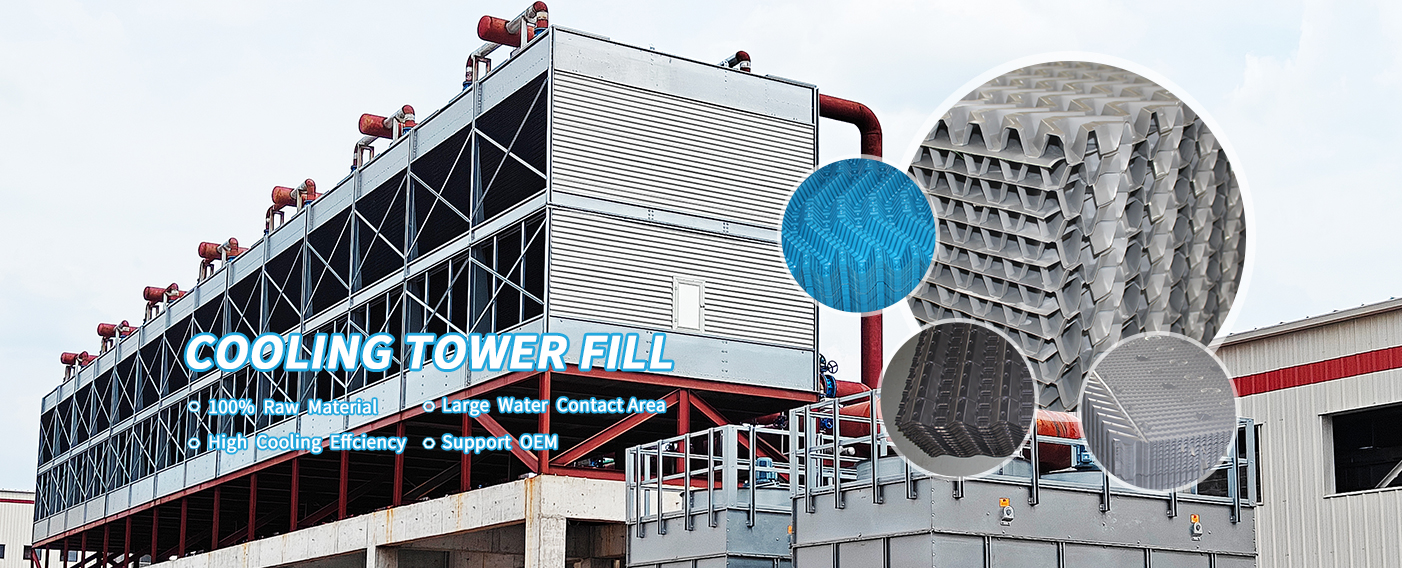
If you have ever looked inside a cooling tower, you may have noticed rows of corrugated plastic sheets, honeycomb-like blocks, or splash bars stacked inside the tower.
What exactly are they doing there?
That material is called cooling tower fill, also known as cooling tower packing or heat-transfer media. Although it may look like a simple collection of plastic sheets, fill is actually one of the most important components inside a wet cooling tower.
Think of it as the stage where the real cooling action happens. Hot water enters the tower, the fill spreads and slows the water, air passes through the same area, and heat is transferred from the water to the air.
So, what is fill in a cooling tower, and why is it so important?
Let's break it down.
What Is Fill in a Cooling Tower?
Cooling tower fill is the heat-transfer media installed inside a wet cooling tower. Its primary purpose is to increase the contact area between circulating water and air.
Instead of allowing hot water to simply fall from the top of the tower to the basin, the fill spreads the water across a large surface. This creates thin water films, droplets, or repeated splash patterns, depending on the fill design.
At the same time, air moves through the fill section.
This creates an efficient environment for heat and mass transfer.
In simple terms, cooling tower fill gives water and air more opportunities to interact.
Without fill, a cooling tower would need a much larger volume to achieve the same level of heat transfer. That's why the fill is often considered the heart of the tower's heat-transfer section.
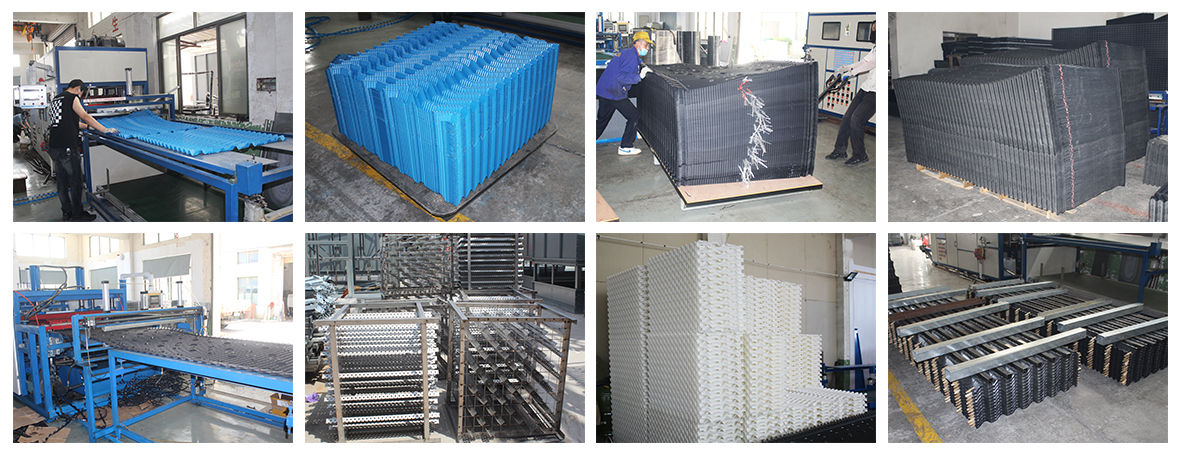
How Does Cooling Tower Fill Work?
The working principle is actually quite straightforward.
Hot water from an industrial process, chiller, condenser, or other heat-generating system enters the cooling tower. A distribution system spreads this water across the upper portion of the fill.
As the water moves downward, air moves through the fill.
Depending on the tower design, the air may move upward against the falling water in a counterflow tower, or horizontally across the falling water in a crossflow tower.
The fill creates thousands of surfaces and passages where water and air can interact.
A useful analogy is a wet sponge.
If you pour water directly into a bucket, the water quickly falls to the bottom. But if you spread that same water across a large sponge, you create much more surface area.
Cooling tower fill works in a similar way, although its geometry is specifically engineered for heat transfer, airflow, water distribution, and pressure drop.
Water Distribution Over the Fill
Good water distribution is essential.
The fill cannot perform well if only part of its surface becomes wet. Uneven water distribution creates dry areas that contribute little to heat transfer while other areas may receive too much water.
That is why the water distribution system and cooling tower fill should be treated as a complete system rather than two unrelated components.
Air and Water Contact
The fill provides passages that allow air to move through the water flow.
As air and water come into contact, sensible heat is transferred from the warmer water to the air. Evaporation also removes additional heat from the circulating water.
The greater the effective contact between air and water, the greater the opportunity for heat transfer.
Increasing Surface Area
This is one of the biggest reasons cooling tower fill is so important.
A compact fill pack can provide a surprisingly large effective contact area within a relatively small volume.
Instead of having one large stream of water falling through the tower, the fill divides and redistributes the water across many surfaces.
That dramatically improves the cooling environment inside the tower.
Why Is Fill Important in a Cooling Tower?
So, why does a cooling tower need fill in the first place?
Because the fill directly affects how efficiently heat can be removed from the circulating water.
A cooling tower may have a powerful fan, a good water pump, and a properly designed casing. But if the fill is poorly selected, badly installed, severely fouled, or damaged, the overall tower can still perform poorly.
Here are some of the biggest benefits.
Improves Heat Transfer
The first and most obvious benefit is better heat transfer.
Cooling tower fill creates a large surface area for water-air contact. Water is distributed over this surface while air passes through it.
This creates the conditions necessary for effective evaporative cooling.
The design of the fill determines factors such as surface area, water distribution behavior, airflow resistance, and fouling tendency.
Increases Cooling Capacity
Good fill can help a cooling tower remove more heat within the available tower volume.
That matters when a plant needs to cool more water without dramatically increasing the physical size of the tower.
For an industrial facility, even a modest improvement in cooling performance can have a meaningful effect on the overall process.
Helps Reduce Energy Consumption
Efficient heat transfer can also contribute to energy savings.
When the tower achieves the required cooling temperature efficiently, operators may not need to run fans or other equipment harder or longer than necessary.
Of course, fill is only one part of the equation. Fan efficiency, ambient conditions, water flow, tower design, approach temperature, and maintenance all influence energy consumption.
Still, the fill is a major piece of the puzzle.
Supports Stable Cooling Performance
A cooling tower should not only cool effectively when everything is brand new.
It should maintain reliable performance over time.
Properly selected fill helps maintain consistent water distribution and airflow through the heat-transfer section. Combined with good water treatment and maintenance, this supports more stable tower operation.
What Are the Main Types of Cooling Tower Fill?
Not every cooling tower uses the same type of fill.
The best choice depends on the tower design and operating conditions.
The two broad categories are film fill and splash fill.
Film Fill
Film fill is made from sheets formed into corrugated or structured patterns.
When water flows across these sheets, it spreads into relatively thin films. The large wetted surface allows efficient contact with the air.
Film fill is popular because it can provide high heat-transfer performance in a compact volume.
However, there is a trade-off.
Because the passages can be relatively close together, film fill can be more sensitive to fouling when the circulating water contains high levels of suspended solids, biological growth, or other contaminants.
Splash Fill
Splash fill works differently.
Instead of primarily spreading water into thin films, splash fill repeatedly breaks falling water into droplets as the water contacts the fill surfaces.
This creates additional water-air contact while helping maintain more open passages.
Splash fill can be useful in applications where water quality or fouling is a major concern.
PVC Cooling Tower Fill
PVC is one of the most commonly used materials for cooling tower film fill.
It offers a practical balance between cost, formability, chemical resistance, and performance for many cooling applications.
PVC fill can be manufactured into different flute patterns, sheet thicknesses, pack dimensions, and configurations.
However, standard PVC should not automatically be selected for every application. Operating temperature and water chemistry need to be considered.
PP Cooling Tower Fill
Polypropylene, commonly called PP, is another important fill material.
PP can be particularly attractive for applications requiring higher temperature capability than standard PVC designs can provide.
It also offers good chemical resistance in many environments.
For industrial projects, the choice between PVC and PP should be based on actual operating conditions rather than simply choosing whichever material has the lower purchase price.

How to Choose the Right Cooling Tower Fill
Choosing cooling tower fill is not simply a matter of asking, "What is the cheapest fill available?"
The correct question is:
Which fill can provide the required cooling performance under the actual operating conditions?
Several factors should be evaluated.
Consider Water Quality
Water quality is one of the most important factors.
Does the circulating water contain suspended solids?
Is there biological growth?
Is scaling a recurring problem?
Does the system contain oil, grease, process chemicals, or other contaminants?
If the answer is yes to any of these questions, fill selection becomes more complicated.
A high-efficiency fill with very narrow passages may not be the best choice for heavily contaminated water.
In some applications, a more open fill design can provide better long-term reliability.
Consider Operating Temperature
Temperature matters because different fill materials have different temperature limitations.
If the hot-water temperature is relatively low, standard PVC fill may be suitable.
For higher-temperature applications, a specialized PVC formulation, PP, or another material may be more appropriate.
Always compare the actual operating temperature with the manufacturer's recommended temperature range.
Consider Airflow and Tower Design
Is the tower crossflow or counterflow?
How does air enter the tower?
Where is the fill located?
What is the available fill height?
How much pressure drop can the fan system tolerate?
These questions matter because cooling tower fill geometry directly affects airflow.
A fill that performs well in one tower configuration may not be the best option for another.
Consider Fill Size and Dimensions
Replacement fill must fit the existing tower.
This sounds obvious, but it is one of the most common mistakes in replacement projects.
The supplier may need information such as:
Fill height
Fill width
Fill length
Sheet thickness
Flute or corrugation pattern
Support arrangement
Water distribution method
Tower type
Existing fill configuration
Accurate measurements help prevent costly installation problems.
What Happens When Cooling Tower Fill Gets Dirty or Damaged?
Here's a problem many operators eventually face.
The cooling tower still runs.
The fan still turns.
The pump still circulates water.
But the outlet water temperature gradually gets higher.
What's happening?
The fill could be the problem.
Clogging and Scaling
Over time, mineral scale, dirt, algae, biological growth, and other contaminants can accumulate on the fill.
Imagine trying to breathe through a filter that is slowly becoming blocked with dust.
The fan may continue running, but airflow becomes increasingly difficult.
Cooling tower fill can experience something similar.
As passages become restricted, airflow and water movement are affected.
Reduced Cooling Efficiency
When fill becomes heavily fouled, the available heat-transfer area decreases.
Water may no longer spread evenly across the fill.
Instead of creating a large, effective water film, water can channel through certain areas.
The tower may then require more operating effort while producing less cooling.
Poor Water Distribution
Damaged or collapsed fill can also interfere with water distribution.
Some areas may receive too much water while others remain relatively dry.
This creates an uneven cooling pattern and reduces the effective performance of the entire fill section.
When Should Cooling Tower Fill Be Replaced?
Cooling tower fill does not have one universal replacement schedule.
Its service life depends heavily on water quality, operating temperature, material, tower design, maintenance, and environmental conditions.
However, several warning signs indicate that replacement should be considered.
Signs That Replacement Is Needed
Look for:
Severely clogged fill passages
Heavy scale accumulation
Persistent algae or biological fouling
Cracked or broken sheets
Collapsed fill packs
Brittle or deformed material
Chemical deterioration
Restricted airflow
Poor water distribution
Rising cold-water temperature
Repeated cleaning with little improvement
Increasing difficulty achieving the required cooling duty
If several of these conditions appear at the same time, simply cleaning the fill may no longer be enough.
Can You Replace Cooling Tower Fill Without Replacing the Tower?
In many situations, yes.
This is one of the biggest advantages of cooling tower fill replacement.
If the main tower structure, casing, basin, fan system, motor, water distribution system, and other components remain in acceptable condition, it may be possible to replace the old fill instead of replacing the complete cooling tower.
That can significantly reduce project cost and downtime.
For example, imagine buying a new car simply because the tires are worn out.
That would obviously be unnecessary.
A cooling tower can be similar. If the main structure is still serviceable but the fill has reached the end of its useful life, replacing the fill may be the smarter approach.
Of course, the tower should be inspected before making this decision.
How to Maintain Cooling Tower Fill
Good maintenance can significantly extend the useful life of cooling tower fill.
The first priority is maintaining good water quality.
A proper water treatment program can help control scale, corrosion, suspended solids, and biological growth.
Operators should also inspect the fill periodically for:
Cleaning should be performed using methods appropriate for the fill material.
Aggressive mechanical cleaning or unsuitable chemicals can damage thin PVC sheets or other fill materials.
Another important point is prevention.
It is usually much easier and less expensive to prevent severe fouling than to restore badly damaged fill after years of neglect.
Why Choose a Professional Cooling Tower Fill Manufacturer?
A cooling tower fill supplier should provide more than a box of plastic sheets.
The manufacturer should understand how fill geometry, material, water quality, temperature, airflow, and tower dimensions work together.
A professional manufacturer can help determine whether you need:
This is particularly important for retrofit projects.
A replacement fill that looks similar to the original product may not necessarily provide the same performance.
The goal should be to match the fill to the tower and operating conditions.
Power Tower Cooling Technology Cooling Tower Fill Solutions

Power Tower Cooling Technology (Shaoxing) Co., Ltd. specializes in cooling tower components and cooling tower fill solutions for different cooling applications.
The company provides products for cooling tower fill replacement and related cooling tower requirements, with options designed around different tower configurations, materials, dimensions, and operating conditions.
For customers looking for a cooling tower fill supplier, the key advantage of working directly with a manufacturer is the ability to discuss technical requirements rather than selecting a generic product based only on a product photo.
You can learn more about the company's cooling tower products and fill solutions at coolingtowerpart.com.
What Is the Best Fill in a Cooling Tower?
There is no single answer for every cooling tower.
The best fill depends on the application.
For clean water and compact high-efficiency systems, film fill may be an excellent option.
For applications with higher fouling risk, splash fill or a more open fill design may be preferable.
For material selection, PVC can be suitable for many standard applications, while PP may be considered when higher temperature resistance or specific chemical compatibility is required.
So instead of asking:
"Which cooling tower fill is the best?"
Ask:
"Which cooling tower fill is best for my water quality, temperature, airflow, and tower design?"
That's a much better engineering question.
Cooling Tower Fill: A Small Component With a Big Job
At first glance, cooling tower fill may look like nothing more than a stack of plastic sheets.
But don't let its simple appearance fool you.
The fill controls how water spreads, how long water remains in contact with air, how much effective surface area is available, and how easily air can move through the tower.
In other words, cooling tower fill is one of the key components that determines whether a wet cooling tower can actually perform its job efficiently.
Choose the right fill, maintain it properly, and replace it when necessary.
The result can be better heat transfer, more stable cooling performance, lower operating stress, and a longer service life for the cooling tower.
If you're researching fill in a cooling tower, cooling tower fill, cooling tower fill replacement, or cooling tower fill supplier, start with the actual operating conditions of your tower.
The right answer isn't simply the fill with the lowest price.
It's the fill that delivers the right balance of heat-transfer performance, fouling resistance, material durability, airflow, compatibility, and long-term value.


