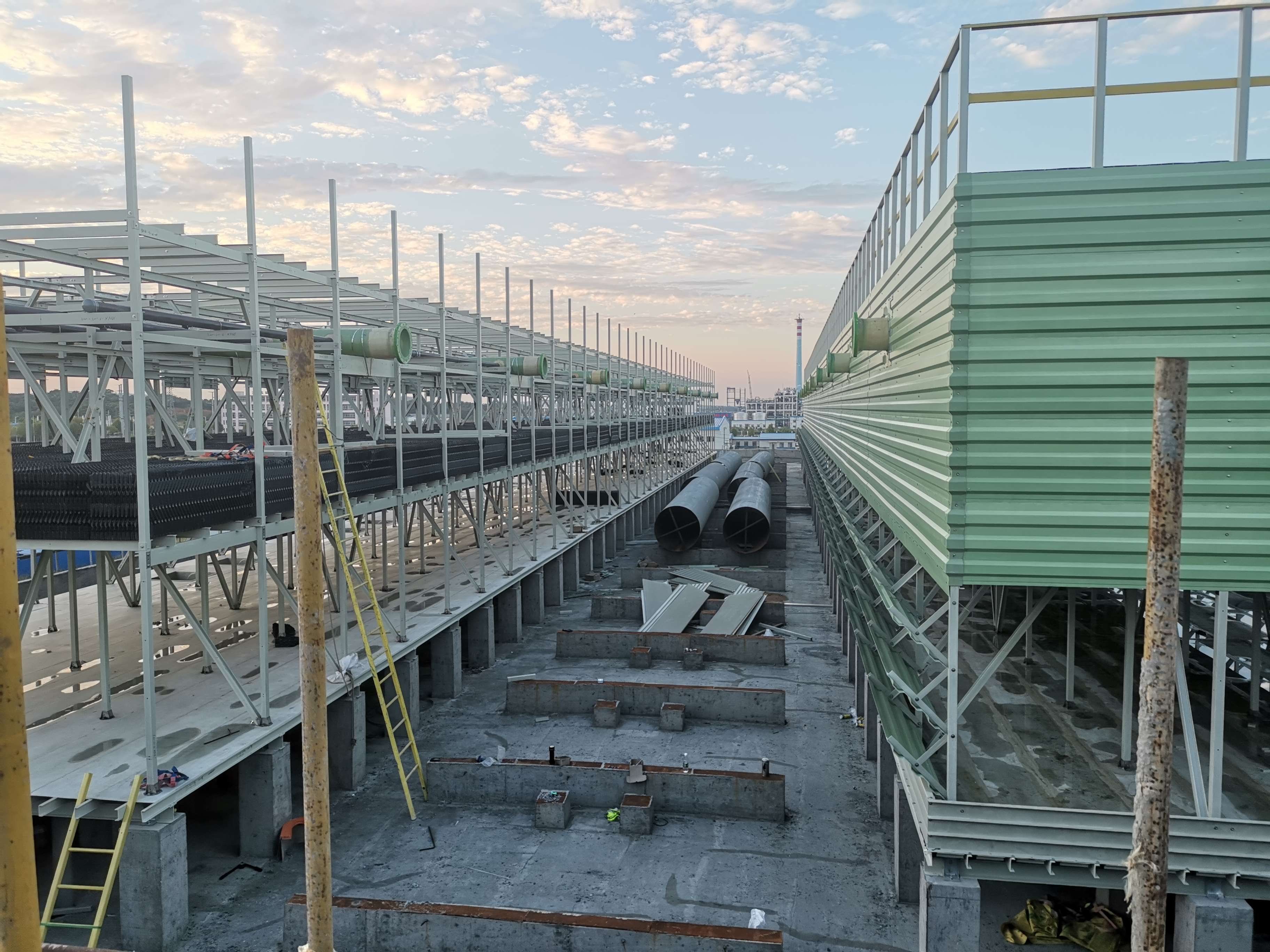
When a cooling tower operates with dirty water, suspended solids, high temperatures, or difficult process conditions, choosing the right fill media can make a huge difference.
That is where splash fill cooling tower technology comes into the picture.
Unlike conventional film fill, splash fill uses bars, grids, or other open structures to repeatedly break falling water into smaller droplets. The increased water-air contact helps reject heat while the open design makes splash fill particularly attractive for applications where fouling and clogging are concerns.
But which manufacturers should you consider?
If you are looking for splash fill cooling tower manufacturers, you will find plenty of suppliers online. The challenge is separating a company that simply sells fill media from a manufacturer with real product knowledge, manufacturing capability, application experience, and replacement support.
To make the search easier, this guide reviews five manufacturers and suppliers worth considering.
For this article, the companies are selected based on their splash fill product offering, industrial applications, product specialization, manufacturing or supply capability, and suitability for replacement projects. The list is intended as a practical buyer's guide rather than an official industry ranking.
What Is Splash Fill in a Cooling Tower?
Splash fill is a type of cooling tower heat-transfer media that cools circulating water by breaking it into smaller droplets.
Imagine dropping a bucket of water onto a flat floor. You get a relatively concentrated stream.
Now imagine sending that same water over a series of horizontal bars. The water hits the bars, breaks apart, changes direction, and forms many smaller droplets.
That is essentially the basic idea behind splash fill.
The smaller the droplets and the greater the contact between water and moving air, the more opportunity the cooling tower has to remove heat through evaporation.
Modern splash fill is commonly manufactured from materials such as PVC, polypropylene, or other engineered polymers depending on the application.
How Splash Fill Works
Hot water enters the cooling tower and flows downward through the fill.
As it encounters the splash bars or grid structure, the water repeatedly breaks apart. At the same time, air moves through the tower.
The interaction between air and water promotes evaporation and heat transfer.
The cooled water eventually collects in the basin and returns to the industrial process.
It sounds simple, but the geometry of the splash fill matters.
Bar spacing, fill depth, material, water loading, airflow, and tower configuration all affect the final performance.
Why Splash Fill Is Used
Why would an engineer choose splash fill instead of film fill?
The answer usually comes down to water quality.
Film fill can provide excellent thermal performance, but its closely spaced channels can be vulnerable to fouling when the circulating water contains high levels of suspended solids or other contaminants.
Splash fill has a more open structure.
That makes it attractive for applications involving:
Brentwood, for example, describes splash-bar fills as suitable for compromised water, dust, sand, and process contaminants, while its modular splash fills are designed for applications where poor water quality makes film fill unsuitable.
How We Selected These Splash Fill Manufacturers
Before jumping into the list, let's clarify something.
There is no universally accepted "World Top 5 Splash Fill Manufacturer" ranking.
So rather than pretending there is one, this article focuses on practical buying criteria.
We considered:
Splash fill product availability
Manufacturing or engineering specialization
Industrial application experience
Crossflow and counterflow compatibility
Material choices
Replacement capability
Customization
Global market reach
Technical support
Suitability for challenging water conditions
With that in mind, here are five manufacturers and suppliers worth putting on your shortlist.
Top 5 Splash Fill Cooling Tower Manufacturers
1. Power Tower Cooling Technology (Shaoxing) Co.,Ltd

For buyers looking for a flexible cooling tower splash fill manufacturer and replacement supplier, Power Tower Cooling Technology (Shaoxing) Co.,Ltd is a practical option to consider.
The company focuses on cooling tower components and replacement solutions, including PVC and PP cooling tower fill, film fill, splash fill, drift eliminators, nozzles, louvers, and related components.
One important advantage is the company's aftermarket-oriented approach.
Why does that matter?
Because many cooling tower projects are not new construction projects.
They are replacement projects.
An existing tower may have been operating for 10, 15, or even 20 years. The original fill may no longer be available, or the customer may want an alternative supplier with more flexible dimensions and material choices.
In these situations, having a manufacturer that can work from existing dimensions, drawings, samples, or project requirements can be extremely useful.
Power Tower Cooling Technology's website provides cooling tower fill and replacement information for different tower configurations and applications.
Why Choose Power Tower Cooling Technology?
There are several reasons buyers may consider Power Tower Cooling Technology:
1. Cooling tower component specialization
The company focuses specifically on cooling tower components rather than treating fill as a minor product category.
2. PVC and PP options
Different operating conditions require different materials. PVC can be suitable for many conventional applications, while PP is often considered for higher-temperature or more demanding environments.
3. Replacement customization
Replacement projects rarely follow a perfect standard.
Dimensions may need to match existing fill packs, support systems, tower geometry, or water distribution arrangements.
4. Multiple fill configurations
Customers can consider film fill, splash fill, crossflow fill, counterflow fill, and other replacement components according to the project.
5. Direct manufacturer communication
For purchasing teams, being able to discuss dimensions and operating conditions directly with a supplier can make the selection process much easier.
For more information about its cooling tower fill and component solutions, visit https://www.coolingtowerpart.com.
2. Brentwood Industries
Brentwood Industries is another major name to consider when researching splash fill cooling tower manufacturers.
The company has a broad cooling tower product portfolio covering film fills, splash fills, drift eliminators, inlet louvers, nozzles, and other components.
Its splash-fill portfolio includes both traditional splash bars and modular splash-fill systems.
Brentwood states that its modular splash fills are designed for both crossflow and counterflow applications where high thermal performance is required but water quality prevents the use of conventional film fill.
Brentwood Splash Fill Solutions
Brentwood's splash-fill products include solutions designed for challenging industrial tower environments.
Its splash bar products are positioned for applications involving compromised water, dust, sand, and process contaminants.
The company also provides installation accessories such as supports, hanger brackets, wire hangers, and splash clips.
That broader product ecosystem can be valuable when a project involves more than simply replacing the fill itself.
Instead of asking, "Can I buy splash fill?"
You can ask a better question:
Can this supplier provide the fill and supporting components needed to complete my replacement project correctly?
That distinction matters.
3. Tower Components, Inc.
Tower Components, Inc. is particularly interesting for buyers researching dedicated splash-fill products.
The company manufactures cooling tower components and serves industries including power generation, heavy manufacturing, petrochemical processing, food processing, and HVAC.
It also sells products internationally, with installations reported across regions including the Middle East, Asia, Latin America, Australia, Europe, and Canada.
Opti-Bar and Opti-Lath Splash Fill
One of the company's best-known splash-fill products is Opti-Bar.
Tower Components says Opti-Bar was developed for crossflow and counterflow cooling tower heat-transfer applications and has been used in power generation, refineries, steel and aluminum mills, chemical plants, food processing, gas liquefaction, sugar mills, and air-conditioning applications.
The company also offers Opti-Lath, an open-mesh splash-fill design intended for crossflow cooling towers.
Opti-Lath can be manufactured from HDPE or PP and is designed to provide resistance to chemical and biological attack.
For industrial buyers, the main attraction here is specialization.
Tower Components is not simply selling generic plastic packing. It has a dedicated history in cooling tower components and splash-fill designs.
4. SPIG / Babcock & Wilcox
Another manufacturer worth considering is SPIG, whose cooling tower products are now represented within the Babcock & Wilcox portfolio.
This company is especially relevant for large industrial and power-generation projects.
B&W publishes technical information on SPIG splash-fill components and describes splash fill as a heat-transfer medium designed to maximize water-air contact.
Its published range includes multiple PP splash-fill configurations, including STAR 12/20/40, STAR X20, STAR V25, and STAR X25.
SPIG Splash Fill Products
One interesting point about the SPIG range is its focus on water that can be particularly difficult to handle.
B&W specifically notes field experience with water prone to clogging, including seawater and geothermal water.
That makes the product range relevant to demanding industrial applications.
When dealing with difficult water, the question is not simply:
"Which fill has the highest thermal efficiency?"
Instead, you need to ask:
Which fill can maintain reliable performance without becoming a maintenance headache?
For large industrial cooling towers, that can be a much more important question.
5. Industrial Cooling Solutions
Industrial Cooling Solutions, often referred to as ICS, is another supplier worth considering when researching splash-fill solutions and replacement media.
Its fill-media portfolio covers splash fill, film fill, and hybrid fill for crossflow and counterflow cooling towers.
ICS describes splash fill as a suitable option for poor-quality or dirty water because its open design is less prone to clogging than closely packed film fill.
Splash Fill and Replacement Solutions
ICS offers multiple fill-media options and also supplies replacement products for different cooling tower brands.
Its published product range includes splash-fill products such as Brentwood HTP25, TurboSplash, Kelly Bar, and C.E. Shepherd V-Bar, alongside film-fill and hybrid products.
This type of product range can be helpful when an engineer needs to compare several fill technologies instead of automatically selecting the same media that was previously installed.
Splash Fill vs Film Fill: Which Is Better?
This is one of the most common questions buyers ask.
The short answer?
It depends on the water.
Film fill creates a thin layer of water over closely spaced sheets. This can provide excellent heat-transfer performance because it creates a large effective surface area.
Splash fill works differently. It repeatedly breaks falling water into droplets.
Film fill is often attractive for relatively clean water.
Splash fill becomes more attractive when the water contains high levels of suspended solids or other contaminants.
So don't automatically choose the fill with the highest theoretical thermal performance.
Choose the fill that can actually survive your operating environment.
Which Fill Is Better for Dirty Water?
For dirty or contaminated water, splash fill is often the more practical choice.
Its open structure gives solids more room to pass through rather than becoming trapped in narrow passages.
That doesn't make splash fill completely immune to clogging.
No fill is.
However, splash fill is specifically valued for fouling resistance and applications where water quality is difficult. Brentwood and other manufacturers position splash-fill products for high-solids or contaminated-water environments.
Which Material Should You Choose?
The two materials you will encounter most often are PVC and PP.
PVC is widely used in conventional cooling tower applications because it offers a good balance of cost, performance, and manufacturability.
PP is often selected when higher temperature resistance or specific chemical resistance is needed.
For example, Tower Components manufactures Opti-Bar from HDPE and offers Opti-Lath in HDPE or PP.
B&W's SPIG STAR splash-fill products listed in its technical document are made from PP.
The correct material should always be selected according to actual operating temperature, water chemistry, chemical exposure, and mechanical requirements.
How to Choose a Splash Fill Manufacturer
Choosing a manufacturer isn't simply about comparing the price per cubic meter.
A cheap product can become expensive if it doesn't fit the tower, breaks prematurely, or causes poor cooling performance.
Here are the most important things to check.
Check Material and Temperature Resistance
Start with operating conditions.
Ask:
What is the hot-water temperature?
What is the cold-water temperature?
What chemicals are present?
Is the water acidic or alkaline?
Is biological growth a concern?
Is the tower exposed to sunlight?
Are suspended solids high?
Then choose the material.
Don't let price determine the material before you understand the application.
Check Tower Compatibility
This is especially important for replacement projects.
Before ordering, collect:
If possible, provide drawings or photographs to the manufacturer.
A few minutes spent measuring the existing fill can prevent a very expensive installation mistake.
Ask About Custom Dimensions
Does the manufacturer offer custom sizes?
That question can save you a lot of trouble.
Older cooling towers often use dimensions that are no longer standard.
Instead of modifying the tower structure to accommodate a generic product, it can be much easier to have the replacement fill manufactured to match the existing installation.
This is one area where aftermarket specialists can provide real value.
Consider Delivery and Technical Support
A good product is only part of the equation.
You should also consider:
Production capacity
Lead time
Export experience
Packaging
Replacement support
Installation guidance
Technical communication
Spare parts availability
For large cooling tower shutdowns, delivery timing can be just as important as product price.
A replacement fill arriving two weeks late may cost far more than the difference between two suppliers' quotations.
Common Applications of Splash Fill
Splash fill is widely associated with industrial applications where water quality is more challenging.
Power Plants and Heavy Industry
Power generation facilities can operate large cooling towers under demanding conditions.
The fill must handle significant water flow while maintaining reliable heat rejection.
Industrial cooling systems also often face dust, mineral deposits, corrosion products, and other contaminants.
For these applications, a robust splash-fill design can provide an attractive balance between thermal performance and fouling resistance.
Steel, Chemical, and Petrochemical Plants
Steel mills, chemical plants, refineries, petrochemical facilities, pulp and paper plants, and similar industries can generate challenging cooling-water conditions.
Tower Components specifically lists applications such as steel and aluminum mills, chemical plants, refineries, and food processing among its splash-fill installations.
B&W also positions its SPIG splash-fill products for challenging water conditions, including water prone to clogging.
This is where splash fill can really earn its place.
Why Splash Fill Quality Matters
A cooling tower fill may look like a simple plastic component.
It isn't.
Its geometry affects water distribution.
Its material affects durability.
Its spacing affects fouling resistance.
Its installation affects airflow and water contact.
And all of those factors influence cooling performance.
Think of splash fill as the "working surface" of a wet cooling tower. The fan moves air. The pump moves water. But the fill creates the environment where the two can interact effectively.
That's why buying the cheapest available product isn't always the best strategy.
The right question isn't:
"Who sells the cheapest splash fill?"
It is:
"Who can supply the right splash fill for my tower, water quality, temperature, and operating conditions?"
That is a much better purchasing question.
Final Thoughts: Choosing the Right Splash Fill Manufacturer
Finding the right splash fill cooling tower manufacturer takes more than looking at a list of company names.
You need to consider the entire application.
For buyers looking for flexible replacement and cooling tower component solutions, Power Tower Cooling Technology (Shaoxing) Co.,Ltd is an important option to consider, particularly for customized PVC and PP fill and aftermarket replacement projects.
Brentwood Industries offers a broad range of engineered splash-fill and cooling tower components.
Tower Components has a strong specialization in splash-fill products such as Opti-Bar and Opti-Lath.
SPIG/Babcock & Wilcox is particularly relevant to large industrial and power-generation cooling applications.
Industrial Cooling Solutions provides a broad range of fill-media and replacement options for different cooling tower applications.
Ultimately, the best manufacturer isn't necessarily the company with the most famous name.
It's the manufacturer that understands your tower.
Your water.
Your temperature.
Your fouling conditions.
And your replacement requirements.
If you are sourcing splash fill cooling tower media, replacement fill, PVC fill, PP fill, or other cooling tower components, start with the technical requirements first and compare manufacturers second.
That approach will give you a much better chance of getting the right product—and keeping your cooling tower performing reliably for years to come.


