You are here: Home » Blog » The Function And Principle of Cooling Tower Water Pump
The Function And Principle of Cooling Tower Water Pump
Views: 0 Author: Site Editor Publish Time: 2025-12-29 Origin: Site
The Function and Principle of Cooling Tower Water Pump
In industrial cooling systems, the cooling tower water pump plays an important role in circulating and transporting cooling water. As the core equipment of the cooling tower system, the operational performance of the cooling tower pump directly affects the heat transfer efficiency, energy consumption, and overall stability of the system. This article will focus on introducing the main functions and working principles of cooling tower pumps, and briefly analyze common types of cooling tower pumps.
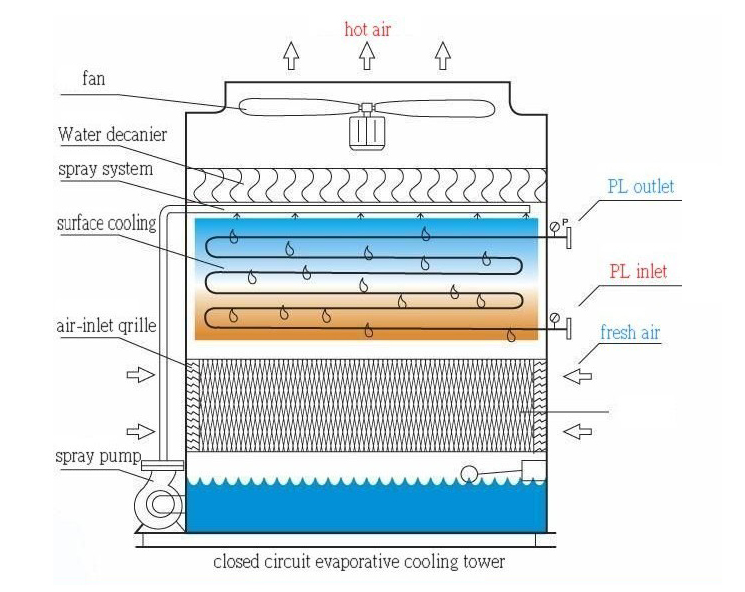
Schematic diagram of water pump in cooling tower
The main functions of Cooling Tower Water Pump
1. Circulating and transporting cooling water
The primary function of the Cooling Tower water pump is to transport cooling water from the cooling tower pool to the heat exchange equipment and form a continuous and stable circulating water flow in the system. Through continuous circulation, the system can promptly remove the heat generated during the operation of the equipment.
2. Ensure stable operation of the cooling tower system
Stable water flow and pressure are the foundation for the normal operation of cooling towers. A reliable cooling tower pump can ensure stable operation of the system under different working conditions, avoiding the impact of insufficient flow or pressure fluctuations on the cooling effect.
3. Improve overall heat transfer efficiency
By reasonably matching the flow rate and head, the cooling tower water pump can evenly distribute the cooling water inside the cooling tower, thereby improving the heat transfer efficiency between air and water and achieving a more ideal cooling effect.
Working principle of Cooling Tower Pump
1. Centrifugal working principle
Most cooling tower pumps adopt a centrifugal structure. When the motor drives the impeller to rotate at high speed, water is thrown towards the outer edge of the impeller under centrifugal force, forming pressure energy, thereby achieving continuous water transportation.
2. Conversion of kinetic energy and pressure energy
Inside the cooling tower water pump, the kinetic energy of the water flow is converted into pressure energy through the volute or diversion structure, allowing the water to overcome pipeline resistance and be transported to the designated height and position.
3. Coordinated operation with system conditions
The actual operating status of the water pump depends on system resistance and cooling load. A well-designed cooling tower pump can operate stably within an efficient range, reduce energy consumption, and extend equipment lifespan.
Common Cooling Tower Pump Types
Different projects have different requirements for the structure and performance of cooling tower pumps. The following are several common types of cooling tower pumps:
1. Vertical centrifugal pump
The vertical cooling tower pump has a small footprint and is suitable for installing cooling tower systems with limited space. It is widely used in high-rise or compact projects.
2. Horizontal centrifugal pump
The horizontal cooling tower water pump operates stably and is easy to maintain, suitable for medium to large industrial cooling systems.
3. Pipeline water pump
The pipeline cooling tower pump is easy to install and can be directly integrated into pipeline systems, making it suitable for small and medium flow cooling tower applications.
The importance of cooling tower water pumps in the system
Cooling tower water pump is not only the power source for cooling water circulation, but also a key equipment that affects system energy efficiency and operating costs. Choosing the appropriate cooling tower pump and reasonable cooling tower pump types can effectively improve cooling efficiency, reduce energy consumption, and decrease equipment maintenance frequency.
The operational stability and lifespan of Cooling Tower Pump
The operational stability of the cooling tower pump is directly related to the continuous operation and overall efficiency of the cooling tower system, while the service life of the water pump affects equipment maintenance costs and replacement cycles. As a key equipment in the cooling system, the cooling tower water pump can only fully leverage its performance advantages when operating in a stable and efficient state.
Firstly, a reasonable selection is the foundation for ensuring the stable operation of the cooling tower pump. The flow rate and head of the water pump should match the actual operating conditions of the system to avoid long-term operation in low efficiency areas or overload conditions. Unreasonable selection can easily lead to increased vibration, accelerated wear of bearings and seals, thereby shortening the lifespan of the water pump.
Secondly, appropriate cooling tower pump types also have a significant impact on operational stability. There are differences in the anti vibration ability, installation method, and maintenance requirements of water pumps with different structural forms. Choosing cooling tower pump types that are suitable for installation conditions and cooling system scale can help improve the reliability of system operation.