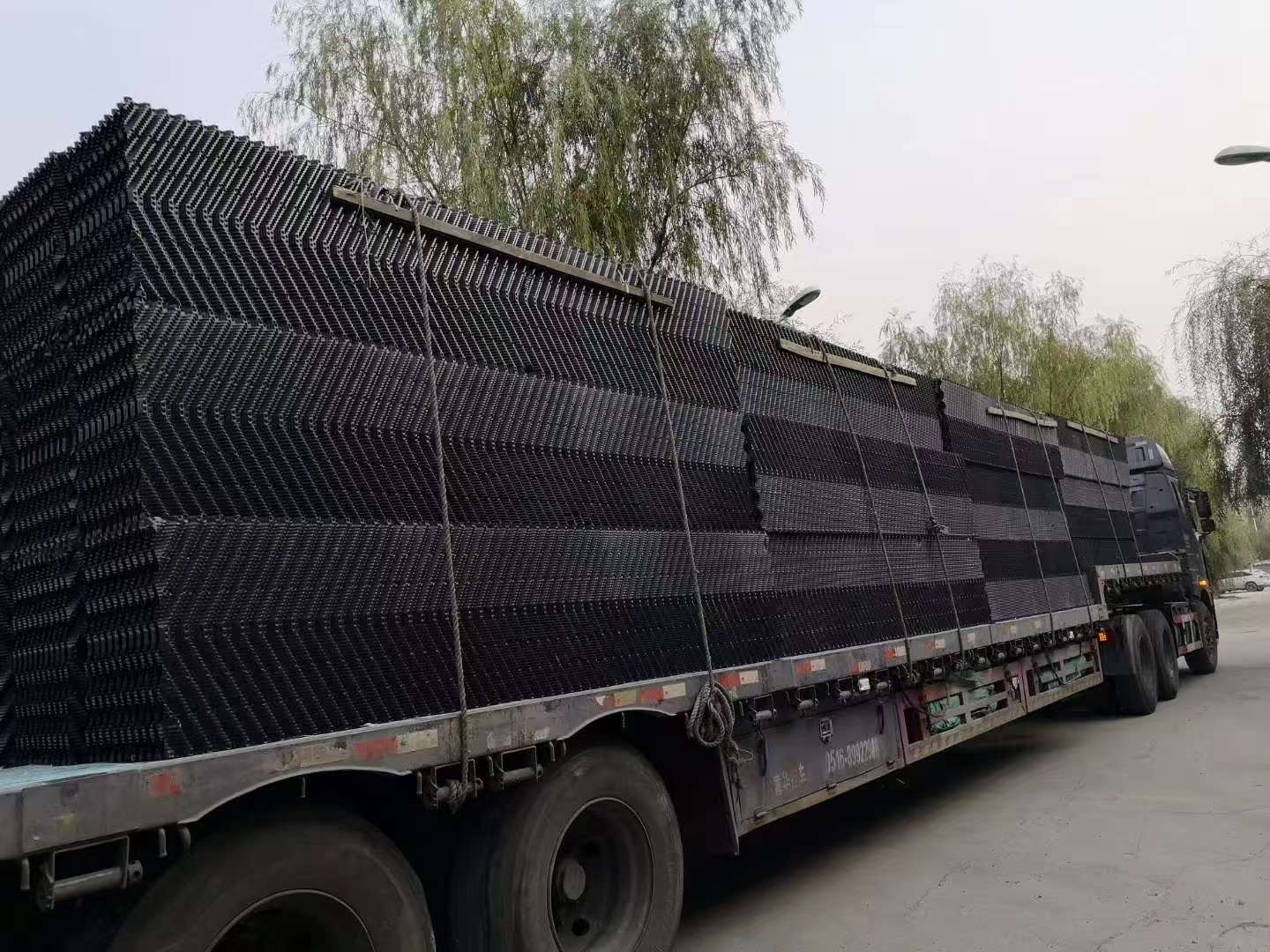
When a cooling tower does not perform as expected, many people immediately look at the fan, pump, nozzle, or water flow. But have you checked the fill?
PVC cooling tower fills are one of the most important components inside a cooling tower because they create the surface area needed for efficient heat and mass transfer. Instead of allowing hot water to simply fall through the tower, cooling tower fill spreads the water across a much larger surface while allowing air to pass through it.
Among the many cooling tower fill materials available today, PVC remains a popular option for industrial cooling towers, HVAC systems, process cooling systems, and replacement projects. It is lightweight, practical, corrosion-resistant in many operating environments, and can be manufactured into different structures for crossflow and counterflow cooling towers.
But which type of PVC fill should you choose? What benefits does it offer? And how do you know whether it is suitable for your cooling tower?
Let's take a closer look.
What Are PVC Cooling Tower Fills?
PVC cooling tower fills are formed plastic components installed inside cooling towers to increase the contact area between circulating water and air.
The basic idea is simple. Hot water enters the cooling tower and is distributed over the fill. The fill breaks the water into thinner films or smaller streams, depending on the fill design. At the same time, air moves through the fill.
This creates a larger water-to-air contact area.
A simple way to think about it is like spreading a wet towel instead of keeping the same amount of water in a bucket. The greater exposed surface gives the surrounding air more opportunity to interact with the water.
In a cooling tower, this interaction supports evaporation and heat transfer. A small portion of the circulating water evaporates, carrying heat away from the remaining water.
PVC is particularly useful because it can be manufactured into thin, structured sheets with carefully designed channels, corrugations, and surface patterns.
How PVC Cooling Tower Fills Work
The purpose of cooling tower fill is not simply to occupy space inside the tower. Its geometry directly affects how water and air interact.
When properly selected, PVC cooling tower fills help distribute water over a large surface while maintaining an appropriate path for airflow.
Increasing Water-to-Air Contact
Without fill, water tends to fall through the tower in relatively large streams or droplets. The amount of direct contact between water and air is therefore limited.
Cooling tower fill changes this situation.
The fill creates many surfaces and passages. Water flows across these surfaces while air moves through the openings. This significantly increases the effective contact area within the tower.
The goal is to achieve good water distribution without creating excessive resistance to airflow.
Improving Heat Transfer
The cooling process depends heavily on evaporation. As water comes into contact with moving air, some water evaporates and removes heat from the circulating water.
A well-designed fill pack provides the environment needed for this process to occur efficiently.
However, more surface area is not automatically better. If the passages are too small, they may become more susceptible to fouling. If airflow resistance becomes too high, fan energy requirements may increase.
Good cooling tower fill design is therefore about balance.
Main Types of PVC Cooling Tower Fills
Not every PVC cooling tower fill has the same structure.
Different designs are developed for different tower configurations, water qualities, thermal requirements, and maintenance conditions.
The main types buyers commonly encounter include PVC film fill and certain PVC-based splash or structured fill designs.
PVC Film Fill
PVC film fill is designed to spread water into thin films across a large surface area.
This type of fill is widely used in applications where the circulating water is sufficiently clean and effective heat transfer is a major consideration.
The structured surface provides a large effective area within a relatively compact volume. This allows the cooling tower to achieve the required cooling duty without simply increasing its physical size.
However, film fill has an important consideration: water quality.
Small passages and closely spaced surfaces can become restricted by scale, biological growth, sludge, or suspended solids. If water treatment is poor, performance may decline over time.
For this reason, film-fill applications should be evaluated together with filtration, blowdown, chemical treatment, and cleaning practices.
Corrugated PVC Fill
Corrugated PVC fill uses shaped channels or flutes to guide water and air through the fill pack.
The exact geometry can vary between manufacturers and applications. Differences in flute angle, pitch, sheet thickness, surface pattern, and pack configuration can influence water distribution and airflow characteristics.
For replacement projects, buyers should therefore avoid selecting fill based only on the material name.
The actual geometry matters.
PVC Splash Fill
Splash fill works differently from conventional film fill.
Rather than depending primarily on a continuous water film, splash fill uses surfaces that break falling water into smaller droplets as the water moves through the tower.
Splash-type designs may be considered when water contains higher levels of suspended solids or when fouling resistance is an important consideration.
The right choice depends on the actual cooling tower and water conditions. There is no single fill design that is ideal for every industrial application.
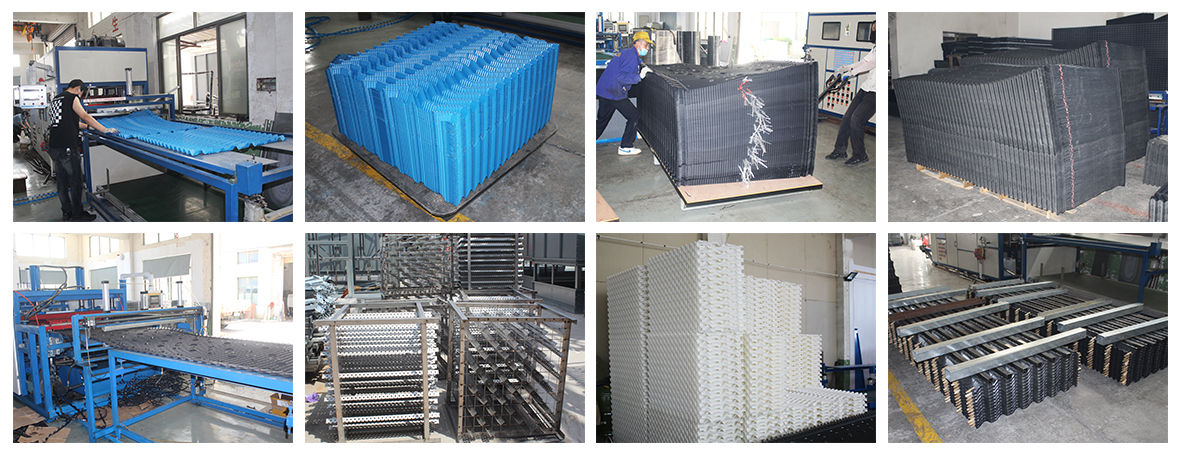
Benefits of PVC Cooling Tower Fills
Why are PVC cooling tower fills so widely used?
The answer is a combination of heat-transfer capability, lightweight construction, corrosion resistance, manufacturing flexibility, and cost considerations.
Efficient Heat Transfer
One of the biggest advantages of structured PVC film fill is its ability to provide a large effective contact area within a relatively small volume.
The water spreads across the fill surface, while air passes through the channels.
This creates favorable conditions for evaporation and heat transfer.
For replacement projects, selecting a fill with the correct geometry can help restore the cooling tower's intended thermal performance when existing fill has become damaged, deformed, or severely fouled.
Lightweight and Easy to Install
PVC fill is relatively lightweight compared with many traditional cooling tower materials.
That makes transportation and handling easier.
During a cooling tower fill replacement, maintenance teams may need to move large quantities of fill into confined areas. Lightweight components can simplify this process when appropriate installation and safety procedures are followed.
Corrosion Resistance
PVC provides useful resistance to many common cooling tower environments.
Unlike steel, PVC does not rust in the conventional sense. This is a significant advantage in an application where components are continuously exposed to water and humid air.
However, PVC should not be treated as universally resistant to every chemical.
Water chemistry, temperature, cleaning chemicals, and process contaminants should always be reviewed before selecting a PVC cooling tower fill.
Cost-Effective Operation
PVC is widely available and can be efficiently processed into structured sheets.
Its relatively low weight can also help reduce transportation and handling requirements.
But buyers should look beyond the initial purchase price.
A cheaper fill that clogs quickly, does not fit properly, or provides unsuitable thermal performance may create higher costs over the life of the cooling tower.
PVC Cooling Tower Fills for Crossflow and Counterflow Towers
Before ordering PVC cooling tower fills, ask one basic question:
Is your cooling tower crossflow or counterflow?
This distinction is important because water and air move differently in these two tower configurations.
PVC Fill for Crossflow Cooling Towers
In a crossflow cooling tower, air generally moves horizontally across the falling water.
The fill is therefore designed around this particular airflow and water-distribution arrangement.
When replacing crossflow fill, the new material should match the tower's existing geometry, support system, fill depth, water distribution arrangement, and available installation space.
A generic PVC sheet may look similar to the original fill but still fail to fit correctly.
PVC Fill for Counterflow Cooling Towers
In a counterflow cooling tower, air generally moves upward while water moves downward.
This creates a different relationship between water distribution, airflow, and fill geometry.
PVC film fill is commonly used in suitable counterflow applications, particularly where water quality is controlled.
The fill pack needs to match the tower's dimensions and operating requirements.

Industrial Applications of PVC Cooling Tower Fills
PVC cooling tower fills are used in many industries because cooling towers are an effective way to reject heat from circulating water.
Power Plants
Power generation facilities often operate large cooling systems that continuously reject significant amounts of heat.
For these installations, fill performance and mechanical integrity are particularly important.
When large cooling towers require fill replacement, accurate dimensions and consistent manufacturing become critical because a small mismatch can create installation and distribution problems across a large fill area.
Chemical and Petrochemical Plants
Chemical and petrochemical facilities can have demanding operating environments.
Before choosing PVC fill, engineers should consider water temperature, chemical exposure, suspended solids, biological growth, and cleaning procedures.
In some applications, fouling resistance and passage size may be more important than maximizing surface area.
HVAC and Commercial Cooling
Large commercial buildings, hospitals, hotels, district cooling systems, and other facilities may use cooling towers as part of their chilled-water systems.
PVC cooling tower fills can be a practical option when the water quality and operating conditions are compatible with the material.
Manufacturing Facilities
Manufacturing plants use cooling towers for many processes, including plastics production, metal processing, air compression, food manufacturing, and general process cooling.
Because every process is different, the fill should be selected according to actual operating conditions rather than simply copying the specification of another cooling tower.
How to Select the Right PVC Cooling Tower Fills
Selecting cooling tower fill is more complicated than simply choosing PVC.
You need to consider the tower design, water quality, operating temperature, dimensions, airflow, maintenance requirements, and expected thermal performance.
Consider Cooling Tower Design
First, identify whether the tower is crossflow or counterflow.
Then collect information about:
If you are replacing old fill, photographs and accurate measurements can be extremely useful.
Consider Water Quality
Water quality is one of the most important factors in cooling tower fill selection.
Ask yourself:
Does the water contain suspended solids?
Is scale a recurring problem?
Is biological growth controlled?
Does the tower have adequate filtration?
Is blowdown properly managed?
How frequently is the fill cleaned?
Film fill can provide excellent heat-transfer characteristics, but its smaller passages can be more vulnerable to blockage.
If your tower has a history of severe fouling, the fill design should be evaluated together with the water-treatment strategy.
Consider Operating Temperature
PVC cooling tower fills must be selected according to the actual temperature conditions of the application.
Provide the manufacturer with information about entering-water temperature, leaving-water temperature, ambient conditions, and any temperature excursions.
Do not assume that every PVC fill product has exactly the same temperature capability.
Consider Fill Dimensions
For replacement projects, dimensional accuracy is critical.
Important specifications may include:
Length
Width
Height
Thickness
Sheet spacing
Flute pitch
Flute angle
Pack configuration
Number of fill blocks
A small dimensional error can create installation difficulties or leave unwanted gaps inside the tower.
PVC Fill Thickness and Structure
Thickness is another factor that buyers should consider carefully.
A thicker sheet is not automatically a better sheet.
The appropriate thickness depends on the fill structure, support arrangement, operating conditions, mechanical requirements, and intended service environment.
The same principle applies to fill geometry.
A more complicated pattern does not automatically mean better cooling.
Good fill design balances:
That is why experienced suppliers ask questions about the cooling tower before recommending a product.
PVC Cooling Tower Fill Maintenance
Even high-quality PVC cooling tower fills require maintenance.
Think of the fill as the working surface of the cooling tower. If that surface becomes covered with scale, sludge, algae, or other deposits, its effective performance can decline.
Cleaning and Inspection
Regular inspections should look for:
Cracked sheets
Broken fill sections
Deformation
Brittleness
Scale buildup
Biological growth
Sediment
Blocked passages
Damaged supports
Cleaning methods should be appropriate for the fill material and deposit type.
Excessive mechanical force or unsuitable chemicals can damage PVC sheets.
Preventing Clogging
Prevention is usually better than replacement.
A good maintenance program can include appropriate water treatment, filtration, blowdown, biological control, and regular inspection.
If a cooling tower repeatedly experiences severe fill clogging, simply installing new fill may not solve the underlying problem.
Instead, investigate why the clogging is occurring.
Is the filtration inadequate?
Is scale control insufficient?
Is biological growth being properly managed?
Does the fill design match the water quality?
Those questions can be more valuable than simply asking how much replacement fill costs.
When Should PVC Cooling Tower Fills Be Replaced?
There is no universal replacement schedule for every PVC cooling tower fill.
Service life depends on several factors, including water chemistry, temperature, UV exposure, mechanical stress, cleaning practices, biological control, and general maintenance.
Common warning signs include:
Cracked PVC sheets
Severe deformation
Brittle or deteriorated material
Collapsed fill packs
Persistent clogging
Damaged support structures
Significant scale buildup
Declining thermal performance
If cleaning no longer restores acceptable performance, replacement may need to be considered.
For larger industrial towers, it can be useful to conduct a detailed inspection before ordering replacement fill. This allows the buyer and manufacturer to determine whether partial replacement or complete replacement is appropriate.
PVC Cooling Tower Fills vs. PP Fills
PVC and polypropylene, commonly known as PP, are both used for cooling tower internals.
So which one should you choose?
The answer depends on the application.
PVC is widely used for structured film fill because it can be formed into thin sheets with controlled surface geometry and offers a practical balance of performance, weight, and cost.
PP can provide different material characteristics and may be preferred in certain higher-temperature or chemically demanding applications.
When comparing PVC and PP cooling tower fills, consider:
| Factor | PVC Fill | PP Fill |
| Common application | Film-fill cooling towers | Specialized applications |
| Weight | Lightweight | Lightweight |
| Corrosion resistance | Good in suitable environments | Good in suitable environments |
| Temperature suitability | Application dependent | Application dependent |
| Manufacturing flexibility | High | High |
| Cost | Often economical | Depends on grade and design |
| Selection priority | Water quality and tower design | Temperature, chemistry, and tower design |
The important point is that material selection should follow application requirements, not simply the material's name.
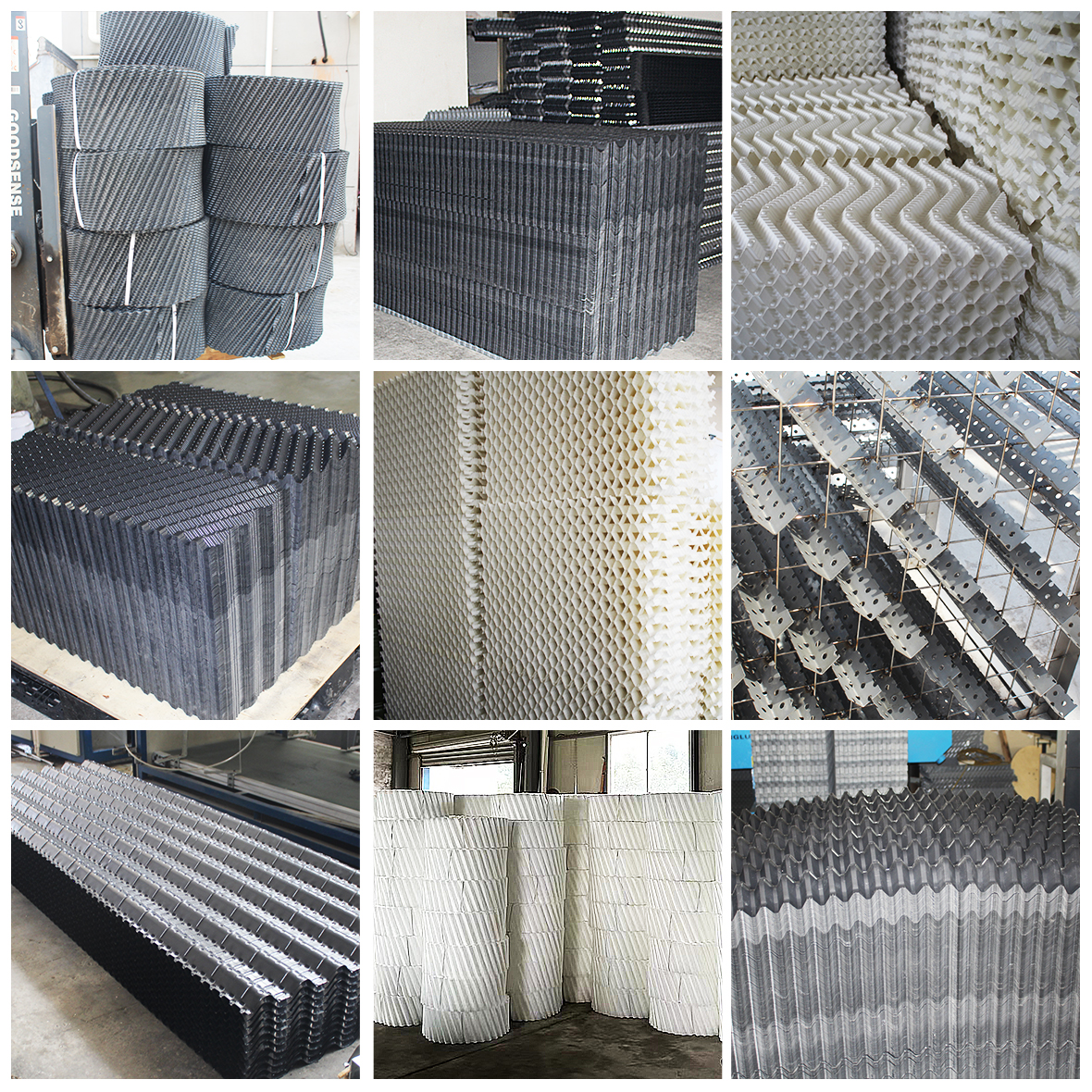
How to Choose a PVC Cooling Tower Fill Supplier
Your supplier can have a major influence on the success of a cooling tower fill project.
A reliable supplier should do more than send you a price list.
They should understand how the fill works inside the tower.
Manufacturing Capability
Ask whether the company manufactures the fill directly or purchases it from another factory.
A direct manufacturer may be able to provide better support for customized dimensions, replacement projects, OEM orders, and technical questions.
You should also ask about production capacity if you are purchasing fill for a large industrial project.
Quality Control
Consistent manufacturing is important.
Look for a supplier that pays attention to:
Raw material quality
Sheet thickness
Dimensions
Surface structure
Bonding quality
Fill pack assembly
Packaging
Final inspection
A cooling tower may contain thousands of individual sheets, so consistency across the entire shipment matters.
Customization and OEM Support
Cooling tower replacement projects are rarely identical.
The required fill may have unusual dimensions, a specific flute pattern, or a particular pack configuration.
An experienced manufacturer should be able to review drawings, measurements, photographs, or samples and determine what type of PVC cooling tower fill is appropriate.
OEM support can also be valuable for cooling tower manufacturers, distributors, contractors, and maintenance companies.
PVC Cooling Tower Fills from China
China has a large manufacturing base for cooling tower components, including PVC film fill, splash fill, drift eliminators, spray nozzles, pipes, and other tower internals.
For overseas buyers, however, the goal should not simply be finding the lowest price.
You should evaluate:
Manufacturing experience
Product consistency
Raw material quality
Production capacity
Customization capability
Packaging
Export experience
Communication
Technical support
Replacement service
A factory that understands cooling tower applications can often provide more useful recommendations than a general plastic-product trading company.
For large-volume purchases, it is also useful to request product specifications and samples before finalizing the order.
Why Choose Power Tower Cooling Technology?
Power Tower Cooling Technology (Shaoxing) Co.,Ltd focuses on cooling tower components and replacement solutions, including cooling tower fills and related cooling tower internals.
For buyers searching for PVC cooling tower fills, the company can support applications involving industrial cooling towers, HVAC systems, process cooling systems, replacement projects, and customized requirements.
If you are sourcing PVC cooling tower fill, providing detailed project information can make the quotation and product-selection process much more efficient.
Useful information includes:
You can contact the manufacturer and review its cooling tower products through www.coolingtowerpart.com.
Frequently Asked Questions About PVC Cooling Tower Fills
How Long Do PVC Cooling Tower Fills Last?
There is no single service-life figure that applies to every installation.
Actual service life depends on water quality, operating temperature, chemical exposure, UV conditions, cleaning frequency, biological control, and mechanical stress.
Instead of replacing fill simply because it has reached a certain age, inspect its physical condition and monitor the cooling tower's thermal performance.
Are PVC Fills Suitable for All Cooling Towers?
No.
PVC fill should be selected according to the cooling tower design and operating conditions.
Some applications may require alternative materials or fill structures because of high temperatures, aggressive chemicals, severe fouling, or specific mechanical requirements.
Can PVC Cooling Tower Fills Be Customized?
Yes.
PVC fill can be manufactured and assembled in different dimensions and configurations depending on the cooling tower.
For replacement projects, manufacturers may work from technical drawings, measurements, samples, or photographs to determine the appropriate configuration.
What Information Should I Provide When Buying PVC Cooling Tower Fill?
The more information you provide, the easier it is for the manufacturer to recommend the correct product.
At minimum, try to provide the tower type, existing fill dimensions, required quantity, operating temperature, water quality, and application.
Photos are also extremely helpful for replacement projects.
Is PVC Film Fill Better Than Splash Fill?
Neither is universally better.
Film fill is often selected for applications where efficient heat transfer and relatively clean water are available. Splash fill can be considered where fouling resistance and larger water passages are important.
The right choice depends on the cooling tower and operating conditions.
Final Thoughts
PVC cooling tower fills play a critical role in modern cooling tower performance.
They create the surface area needed for effective water-air contact, support evaporation and heat transfer, and allow cooling towers to reject heat within a relatively compact structure.
But choosing the right PVC fill is not simply about choosing a plastic material.
You also need to consider:
If you are replacing existing cooling tower fill, start by collecting accurate measurements and operating information. If you are designing a new cooling tower, involve the fill manufacturer early in the process.
The right specification can make installation easier, improve operating reliability, and help avoid unnecessary replacement costs later.
For industrial buyers looking for PVC cooling tower fills, working directly with an experienced manufacturer such as Power Tower Cooling Technology (Shaoxing) Co.,Ltd can make product selection, customization, and replacement planning much more straightforward.


