You are here: Home » Blog » Industry News » OEM & Aftermarket Cooling Tower Fill Media Replacement Manufacturer
OEM & Aftermarket Cooling Tower Fill Media Replacement Manufacturer
Views: 0 Author: Lisa Publish Time: 2026-10-31 Origin: Site
Cooling tower fill media is the active core of every evaporative cooling system — the surface where hot water meets air and heat is rejected. When fill is efficient, plants save energy, hold process temperatures and run without interruption. When fill ages, scales or collapses, the same systems consume more power, lose capacity and drift toward unplanned downtime.
For OEMs building new towers and for plant operators replacing worn fill in the field, working with the right cooling tower fill media replacement manufacturer is the difference between a component that performs on paper and one that performs for a decade. This guide explains what a serious manufacturer should offer, how to evaluate them for both OEM and aftermarket supply, and how to run a replacement project that protects your thermal performance and your budget.
OEM vs Aftermarket: Two Very Different Buying Paths
Understanding the two demand streams is the first step in supplier selection, because they require different capabilities.
OEM projects (Original Equipment Manufacturer) — the manufacturer supplies fill to tower builders and system integrators who assemble new cooling towers. The requirements are high-volume, dimensionally exact, consistently repeatable, and tightly integrated with the tower's structural and water-distribution design. OEM buyers need engineering coordination, reliable production capacity, and stable quality control across large batches.
Aftermarket projects — the manufacturer supplies replacement fill, drift eliminators and nozzles for towers already installed in the field. Here the priorities are different: dimensional flexibility to match an existing tower's actual footprint, fast response within short shutdown windows, compatibility with legacy designs, and strong installation or field-service support.
A capable manufacturer serves both streams from the same core competence: precision extrusion and thermoforming of high-performance PVC and polypropylene fill, backed by real thermal engineering. The best partners do not force you into a standard product — they adapt the fill to your tower and your water.
Core Products a Replacement Manufacturer Should Supply
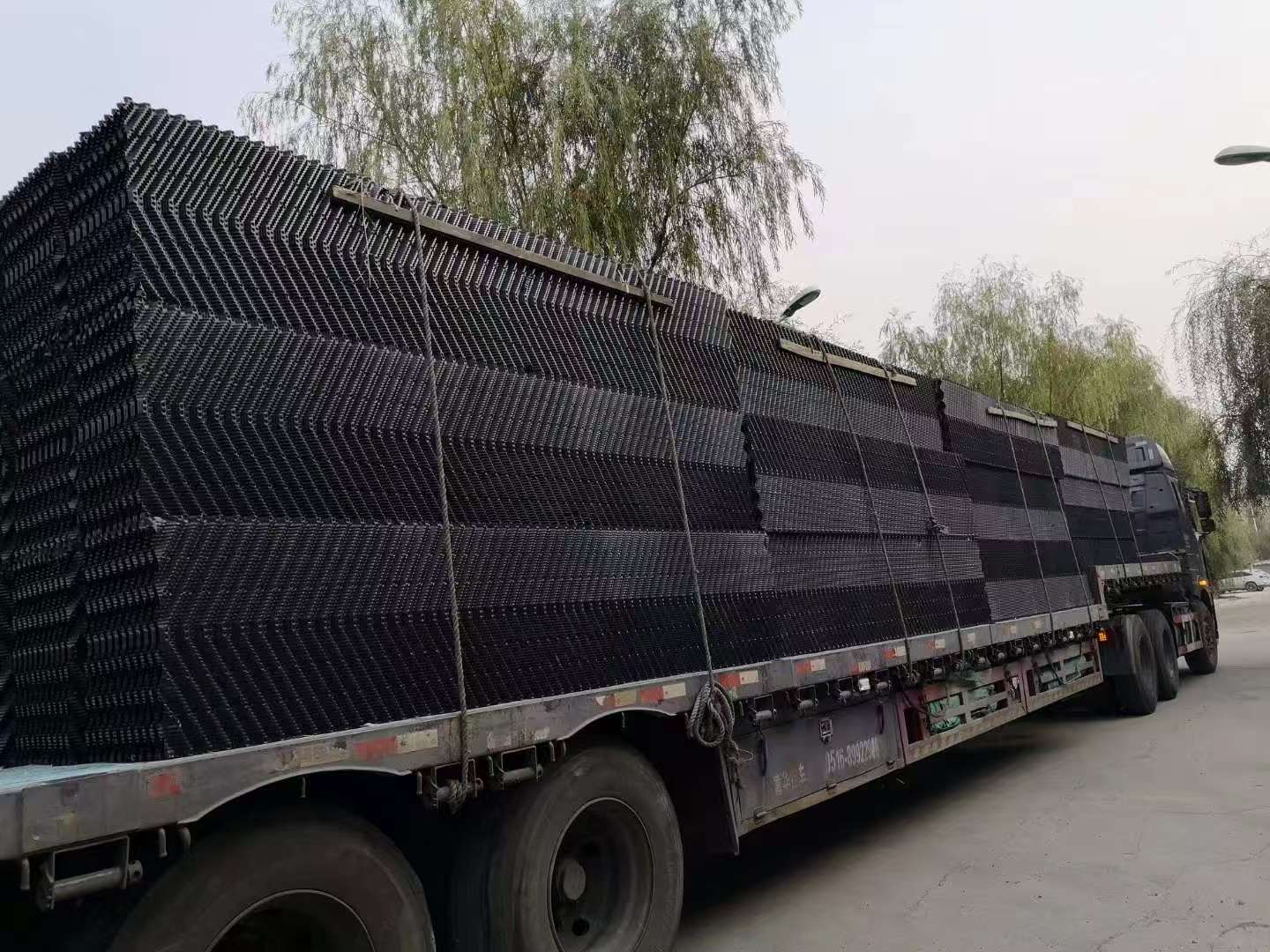
PVC film fill. The efficiency standard for clean-water systems. Corrugated sheets maximise wetted surface per cubic metre, delivering the highest heat-transfer rate per unit volume. Ideal for most industrial and commercial towers.
Polypropylene (PP) fill. Selected for aggressive chemistry, elevated temperatures, or applications requiring self-extinguishing, fire-rated material. Commonly specified in steel, chemical and process industries where M1/M2 or similar fire ratings are mandated.
Splash fill. Built for dirty, high-solids or high-temperature water. It breaks flow into droplets and tolerates fouling far better than film pack, making it the reliable choice for foundries, steel plants and raw-water circuits.
Drift eliminators. A complete retrofit needs more than fill. High-efficiency drift eliminators cut water loss, reduce aerosol drift and protect surrounding equipment — and they wear on the same cycle as the fill.
Nozzles and distribution components. Spray nozzles, distribution piping and support grids are frequently part of a full retrofit and should be available from the same source to ensure compatibility.
What to Evaluate When Choosing a Fill Manufacturer
1. Material Quality and Traceability
The performance and lifespan of fill start with the resin. Ask about:
Virgin vs recycled content — virgin material offers predictable performance and longer life; recycled content should be declared, not assumed.
Thickness tolerance and consistency across production batches.
UV stabilisation and fire-retardancy ratings, verified against recognised standards.
Material certificates and datasheets that you can file for audits and end-customer documentation.
2. Thermal Engineering and Performance Guarantee
A manufacturer, not just a trader, should be able to size fill to your tower. They should provide a thermal selection report covering your cooling range, approach temperature, wet-bulb condition and air flow — and back the selection with a performance guarantee tied to your design conditions, not a catalogue figure. CTI compliance or equivalent is a strong signal of credible thermal data.
3. Dimensional Flexibility and Compatibility
Every tower is different. A good manufacturer:
Supplies modular packs sized to your exact footprint, whether it's a 100 m³/h package or a 10,000 m³/h power-plant cell.
Matches cross-flow and counter-flow architectures with the correct fill geometry.
Designs panels for easy installation, removal and future maintenance, so your next replacement cycle is cheaper and faster.
4. Production Capacity and Supply Reliability
For OEM buyers this is critical. Verify:
Production lead times and the manufacturer's ability to scale with your order volumes.
Stock availability of common sizes for urgent aftermarket call-outs.
Consistency of supply across multiple projects, so you are not re-qualifying a vendor every quarter.
5. Installation and After-Sales Support
Fill is not a "ship and forget" product. A professional manufacturer provides:
Field installation teams comfortable with confined-space work and live-plant constraints.
Project management that respects your shutdown window and disposes of old fill responsibly.
Long-term spares and technical support for years after the sale.
Managing a Fill Replacement Project
A disciplined project follows six steps:
Audit. Inspect the existing fill, measure the tower, and document fouling, collapse and wear.
Design. Calculate thermal duty and select the optimal fill type, material and pack height.
Quote and compare. Compare on material quality, engineering, support, delivery and warranty — not unit price alone.
Removal. Strip and dispose of old fill safely and in line with environmental rules.
Installation. Fit new packs, support structure and associated components per the manufacturer's lay-up pattern.
Commissioning. Verify airflow, water distribution and thermal performance against the guarantee.
Document everything — certifications, installation records and performance data become the baseline for your next cycle.
Common Mistakes to Avoid
Buying on price alone. Low-cost, recycled fill can fail in a few years, costing more in downtime and rework than the savings.
Ignoring water chemistry. Scaling water fouls film pack quickly; splash or treated pack may be the better investment.
Choosing the wrong fire rating. In process industries, fire-rated fill can be a regulatory and insurance requirement.
Skipping the performance guarantee. Always request a thermal warranty tied to your design conditions.
Treating fill as a standalone purchase. Coordinate fill with drift eliminators, nozzles and distribution repairs for a coherent retrofit.
Frequently Asked Questions
How often should cooling tower fill be replaced?Quality PVC film fill typically lasts 10–15 years and splash fill 10–20 years, depending on water quality and load. Replace sooner if fouling, collapse or performance loss is significant.
How do I know my fill needs replacing?Look for a widening approach temperature, rising energy use, visible collapse or scale, higher drift, and difficulty holding temperature at peak load.
Can a manufacturer supply fill that fits my existing tower without a rebuild?Yes. A good manufacturer produces modular packs to your exact dimensions, so you replace the fill without rebuilding the structure or distribution system.
Film fill or splash fill — which is better?It depends on water quality. Film fill is more efficient with clean water; splash fill is more robust for dirty, hot or high-solids water.
Conclusion
Cooling tower fill media is a high-value component that directly affects energy cost, process reliability and uptime. For OEMs, it is about precision, capacity and repeatability. For aftermarket projects, it is about flexibility, speed and field support. The right manufacturer brings both — thermal engineering, material expertise, reliable production and long-term service — and stands behind performance with a written guarantee.
Whether you are equipping a new tower or restoring an existing one, choose a manufacturer who understands your tower, your water and your production reality. The effort spent on selection repays itself in efficiency and years of trouble-free operation.