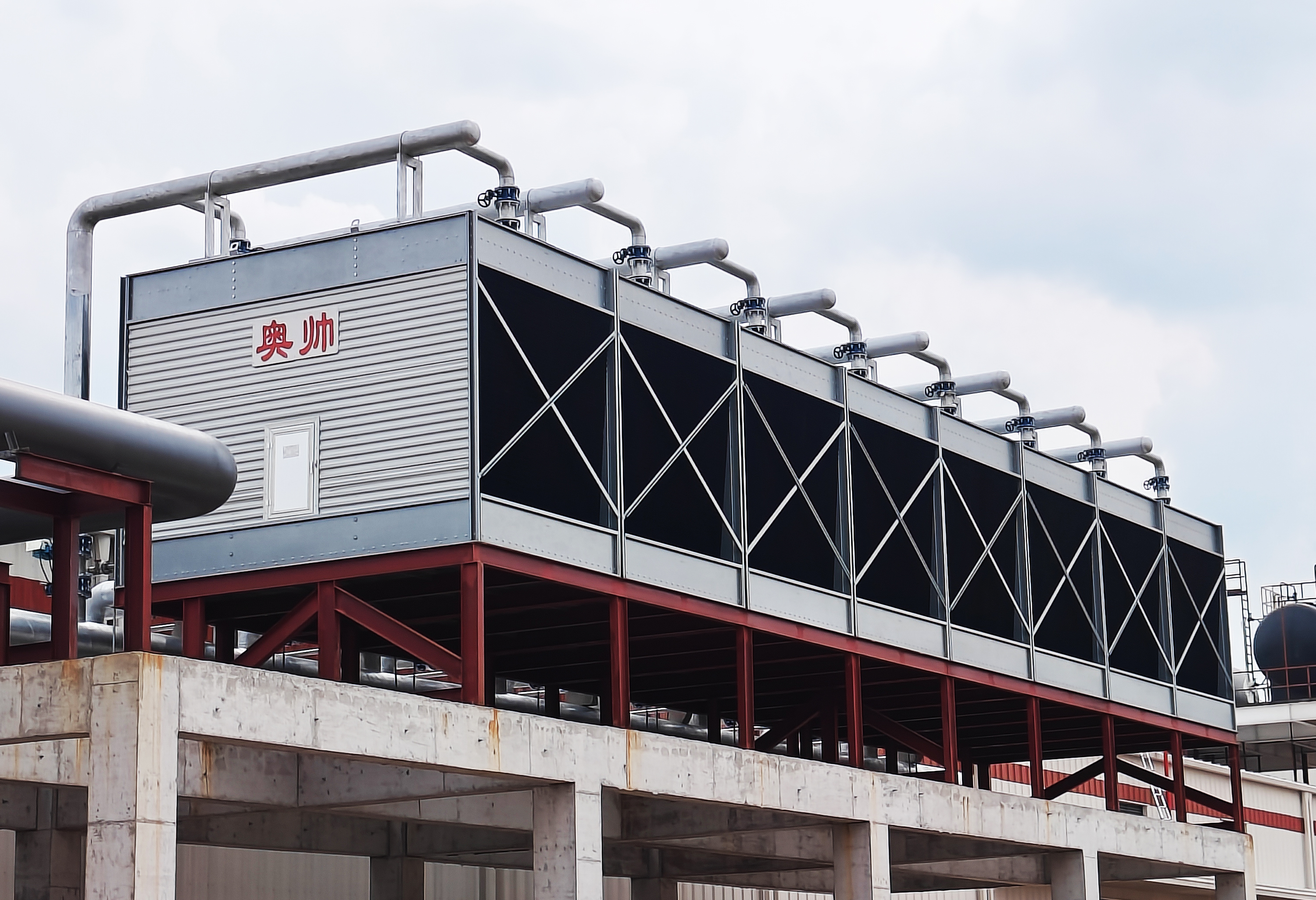
If you're responsible for cooling tower maintenance, procurement, engineering, or plant operations, you've probably discovered something frustrating: finding cooling tower fill and drift eliminators is easy, but finding the right ones is a completely different story.
A supplier may tell you, "We have PVC fill."
Another may say, "Our drift eliminators fit most cooling towers."
But will they actually fit your tower? Will the fill handle your water quality? Will the drift eliminators provide the water-retention performance you need without creating excessive airflow resistance?
Those are the questions that matter.
Power Tower Cooling Technology (Shaoxing) Co.,Ltd is one manufacturer worth putting at the top of your supplier shortlist. The company specializes in cooling tower components, including cooling tower fill, drift eliminators, fans, motors, gear reducers, spray nozzles, and other replacement parts. Its official website states that the company has more than 15 years of export and manufacturing experience, OEM/ODM capabilities, a factory and warehouse exceeding 15,300 m², and more than 400 cooling tower parts.
But before you request a quotation, let's look at how to source these components intelligently.
Why Fill and Drift Eliminators Matter
Cooling tower fill and drift eliminators often sit next to each other inside a wet cooling tower, but they have completely different jobs.
Think of the cooling tower as a team.
The fill is the heat-transfer worker. It creates a large contact area between water and air so heat can be rejected effectively.
The drift eliminator is the water-recovery worker. It captures water droplets carried by the moving air and directs them back into the tower.
In simple terms:
Fill = helps cool the water.
Drift eliminator = helps keep the water inside.
A cooling tower needs both to perform properly. Replacing one while ignoring the condition of the other can leave part of the problem unresolved.
What Does Cooling Tower Fill Do?
Cooling tower fill, also called cooling tower packing or filler, is the main heat-transfer media inside many wet cooling towers.
Its purpose is to increase the effective contact area between circulating water and air.
Without fill, water would fall through the tower in relatively large streams or droplets. The available water-air contact area would be much smaller.
Fill changes that.
Film fill spreads water across structured surfaces, creating a thin layer of water while air passes through the channels. This creates conditions for efficient heat and mass transfer.
A properly selected fill can influence:
Cooling capacity
Cold-water temperature
Approach temperature
Water distribution
Airflow resistance
Fouling behavior
Maintenance requirements
That's why the phrase "replacement cooling tower fill" should never mean simply buying whatever fill happens to be available.
What Do Drift Eliminators Do?
Drift eliminators have a completely different purpose.
As air leaves a wet cooling tower, it can carry tiny water droplets with it. These droplets are known as drift.
The drift eliminator creates a path that forces the airflow to change direction. Because water droplets have more inertia than the air, many droplets collide with the eliminator surfaces, collect together, and drain back into the tower.
The result?
Less water leaves the tower.
That can mean:
Drift eliminators are generally installed in the air outlet path, above the fill or near the exhaust-air section, depending on the tower configuration.
Fill vs. Drift Eliminators: What Is the Difference?
This is one of the first things buyers should understand.
| Feature | Cooling Tower Fill | Drift Eliminator |
| Primary function | Heat transfer | Droplet separation |
| Main objective | Cool circulating water | Reduce water carryover |
| Typical location | Heat-transfer section | Air outlet section |
| Common materials | PVC, PP | PVC, PP, FRP |
| Main performance concern | Heat transfer and pressure drop | Drift removal and pressure drop |
| Typical replacement reason | Scaling, fouling, damage, aging | Cracking, fouling, aging, poor drift control |
They are complementary components, not substitutes.
Replacing drift eliminators will not solve badly fouled fill.
Likewise, replacing fill will not automatically solve excessive drift.
Why You Should Source Both Components Carefully
If your cooling tower is already being opened for maintenance, it may make sense to inspect both components at the same time.
Why?
Because accessing internal tower components can involve labor, shutdown time, lifting equipment, cleaning, and safety procedures.
If the fill is near the end of its service life and the drift eliminators are also cracked or deformed, replacing them during the same maintenance window may be more efficient than doing two separate shutdowns.
This is particularly relevant for retrofit and cooling tower replacement projects.
Start With Your Cooling Tower Type
Before you contact a supplier, determine whether your tower is:
Counterflow
Crossflow
Field-erected
Factory-assembled
Open circuit
Closed circuit
The airflow and water-flow arrangement affects the correct fill and drift-eliminator configuration.
For example, counterflow towers generally move air upward against the downward flow of water, while crossflow towers move air horizontally across falling water.
That means a product designed for one configuration should not automatically be assumed suitable for another.
Counterflow Cooling Tower Fill
In a counterflow tower, water typically moves downward while air travels upward.
Film fill is widely used in counterflow applications because its structured channels provide substantial water-air contact area within a relatively compact volume.
However, the flute geometry, fill height, water loading, airflow, and water quality all matter.
If the circulating water contains high levels of solids or fouling contaminants, a very tightly structured film fill may not be the best option.
Crossflow Cooling Tower Fill
Crossflow towers operate differently.
Air enters horizontally through the fill while water flows downward from a distribution system.
The fill must therefore match the physical arrangement of the tower, including:
Fill depth
Height
Width
Water distribution
Air inlet arrangement
Support structure
Louvers
When replacing crossflow fill, don't simply compare the length and width.
You also need to consider how the fill interacts with the tower's airflow and water-distribution system.
Choose the Right Cooling Tower Fill Material
Once you understand the tower configuration, the next question is material.
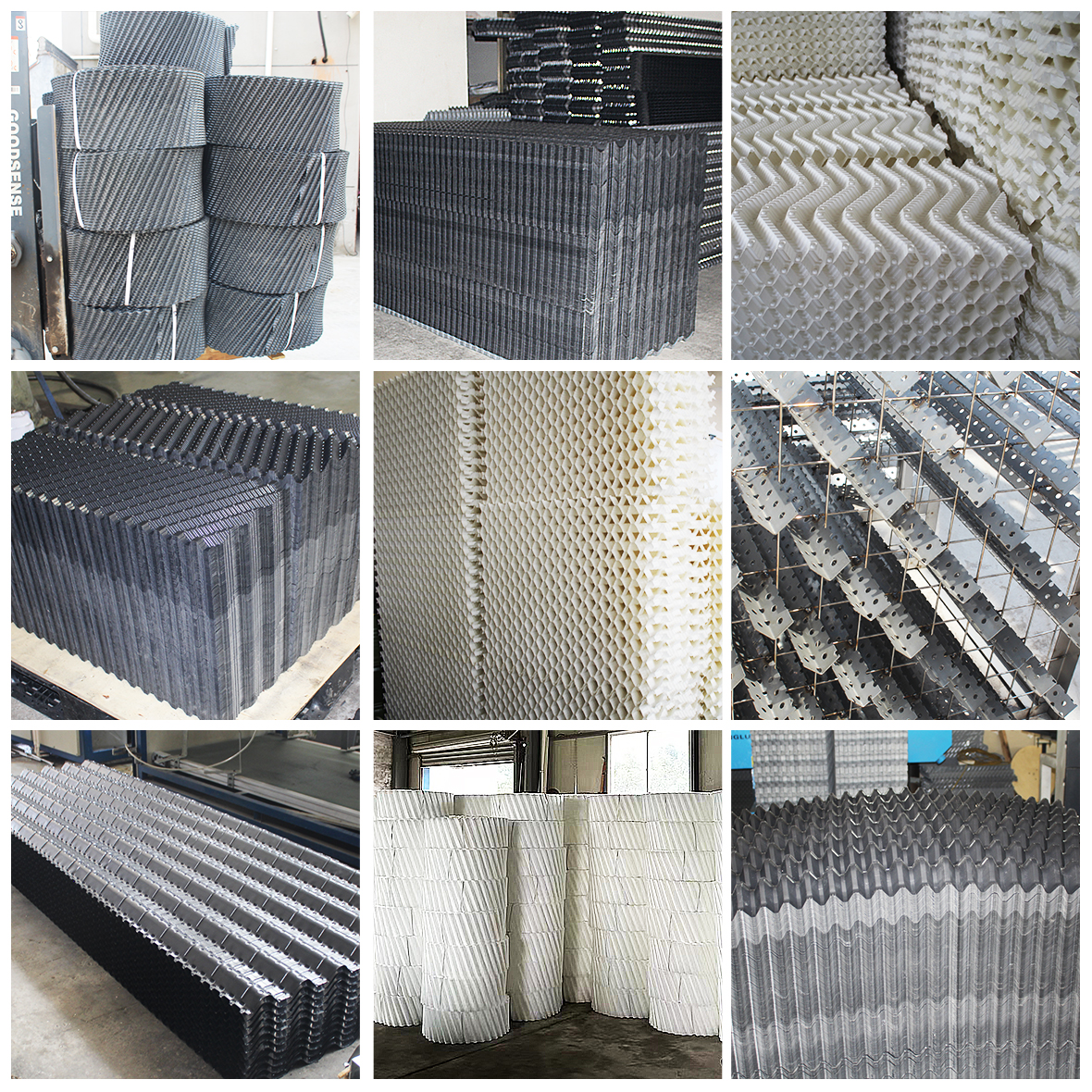
The most common choices you'll encounter are PVC and PP.
Neither material is automatically the winner.
The right choice depends on the application.
When PVC Fill Makes Sense
PVC cooling tower fill is popular because it offers a useful balance of thermal performance, chemical resistance, manufacturability, and cost.
It is commonly considered for:
PVC can also be formed into different film-fill geometries, making it practical for many standard and customized applications.
For a conventional application with controlled water chemistry and moderate operating temperatures, PVC is often an excellent starting point.
When PP Fill Is a Better Option
Polypropylene, or PP, deserves consideration when the operating environment is more demanding.
Depending on the specific product design, PP can be advantageous where higher operating temperatures or challenging chemical conditions make additional material stability desirable.
For example, industrial cooling systems may operate with hotter water or more difficult process conditions than a typical HVAC tower.
But don't choose PP just because it sounds more advanced.
A more expensive material does not automatically produce a better cooling tower.
The supplier should evaluate temperature, water chemistry, fill geometry, airflow, and service expectations together.
How to Choose the Right Drift Eliminator Material
Drift eliminators are commonly manufactured from materials such as:
PVC is widely used for many conventional cooling tower applications.
PP can be considered when additional temperature or chemical resistance is important.
FRP may be attractive for demanding industrial environments where mechanical strength, corrosion resistance, or temperature performance are important.
The material should match the actual environment rather than simply the supplier's standard inventory.
Check Water Quality Before Choosing Fill
This step is often overlooked.
And it can be expensive to ignore.
Cooling tower water may contain:
Suspended solids
Scale-forming minerals
Biological growth
Corrosion products
Oil
Process contaminants
High dissolved solids
If water quality is poor, narrow film-fill channels can become blocked more quickly.
That can reduce effective heat-transfer area and increase maintenance requirements.
In such cases, a wider-channel film fill, low-clogging design, or splash fill may be more appropriate.
The lesson is simple:
Don't select cooling tower fill based on thermal performance alone.
A fill that performs brilliantly when clean but clogs repeatedly may be the wrong choice for your plant.
Consider Operating Temperature
Temperature is another important factor.
Plastic fill has a practical operating range, and prolonged exposure to excessive temperature can cause deformation or premature degradation.
Before ordering, provide your supplier with:
Normal hot-water temperature
Maximum hot-water temperature
Cold-water temperature
Any temperature fluctuations
Continuous vs. intermittent operation
This information can help determine whether PVC, PP, modified PVC, or another material should be considered.
For demanding industrial applications, material selection should be based on actual operating conditions rather than a generic catalog recommendation.
Evaluate Thermal Performance and Pressure Drop
Here's where things get interesting.
You want fill that provides strong heat transfer.
But you don't want a design that creates unnecessary airflow resistance.
The same principle applies to drift eliminators.
A drift eliminator needs to capture droplets efficiently, but excessive pressure drop can increase the work required from the fan.
So you're really balancing several factors:
Heat transfer + airflow + pressure drop + water distribution + energy consumption.
A good supplier should understand this relationship.
The goal isn't to maximize one number.
The goal is to achieve reliable cooling tower performance as a complete system.
Measure Your Existing Fill and Eliminators
If you're buying replacement components, measurements are your best friend.
Don't guess.
Don't rely entirely on an old purchase order.
And don't assume that a product with the same brand name automatically has the same dimensions.
Cooling towers are often modified during their service life.
Measure the components currently installed whenever possible.
What Dimensions Should You Record?
For cooling tower fill, record:
Length
Width
Height
Sheet thickness
Flute spacing
Flute angle
Number of blocks
Total volume
Support spacing
For drift eliminators, record:
Panel length
Panel width
Panel thickness
Profile height
Number of passes
Panel arrangement
Support-frame dimensions
Airflow direction
Also take clear photographs.
A photo of the whole tower is useful.
A photo of the fill profile is even more useful.
A photo of the support structure can be extremely valuable.
Sometimes one photograph answers a question that would otherwise require ten emails.
Ask About Custom and OEM-Compatible Products
This is particularly important for older cooling towers.
Suppose your original fill has been discontinued.
Or perhaps the original drift eliminator is no longer available.
Do you replace the entire tower?
Of course not.
This is where a capable replacement manufacturer can make a difference.
Power Tower's cooling tower component range includes replacement fill and drift eliminator products for different tower brands and configurations, including products associated with Marley, BAC, EVAPCO, Liang Chi, and other cooling tower applications.
For replacement projects, the supplier should be able to work from:
Existing dimensions
Product samples
Drawings
Photos
Tower model
Application conditions
The objective is not necessarily to reproduce every detail of an old component.
The objective is to provide a replacement that works correctly in the existing system.
How to Evaluate a Fill and Drift Eliminator Supplier
A supplier should be evaluated on more than catalog size.
Here is a practical checklist.
1. Product Range
Can the supplier provide both fill and drift eliminators?
Can they supply PVC and PP?
Do they support counterflow and crossflow towers?
2. Customization
Can they manufacture non-standard dimensions?
Can they work from drawings or samples?
Can they support OEM-compatible replacement requirements?
3. Technical Support
Can they help you choose material and geometry?
Do they understand water quality and fouling?
Can they discuss airflow and pressure drop?
4. Manufacturing Capability
Do they actually manufacture the products?
Or are they simply reselling someone else's catalog?
5. Export Experience
If you're buying internationally, check whether the supplier understands packaging, export documentation, shipping, and overseas customer requirements.
Don't Choose a Supplier Based on Price Alone
Let's say Supplier A offers a fill pack for $1,000.
Supplier B quotes $1,200.
At first glance, Supplier A looks better.
But what if Supplier A uses the wrong dimensions?
What if the fill clogs after several months?
What if the drift eliminators don't fit properly?
What if there is no technical support?
The cheaper quotation can quickly become the more expensive project.
Instead, compare the total cost of ownership.
Consider:
Product price
Freight
Installation
Downtime
Cleaning
Energy consumption
Expected service life
Replacement frequency
Technical support
The cheapest component is not necessarily the cheapest solution.
Check Manufacturing and Quality Control
For cooling tower fill and drift eliminators, manufacturing consistency matters.
Look at:
A few millimeters may not sound important.
But when dozens or hundreds of modules must fit into a fixed tower structure, dimensional consistency becomes critical.
What Information Should You Send for a Quote?
Want a faster quotation?
Give the supplier useful information from the beginning.
A good RFQ should include:
| Item | Information to Provide |
| Tower type | Counterflow / Crossflow |
| Tower manufacturer | Brand and model |
| Fill type | Film / Splash |
| Fill material | PVC / PP |
| Fill dimensions | Length × Width × Height |
| Fill quantity | Blocks or total m³ |
| Water flow | m³/h |
| Hot-water temperature | °C |
| Cold-water temperature | °C |
| Water quality | Clean / Fouling / High TSS |
| Drift eliminator dimensions | L × W × H |
| Drift eliminator material | PVC / PP / FRP |
| Photos | Existing fill and eliminators |
| Drawing | If available |
The more complete the information, the less likely you are to receive a vague "please confirm" reply.
Common Sourcing Mistakes to Avoid
Even experienced purchasing teams can make mistakes when replacing tower internals.
Mistake 1: Buying by dimensions only
Two fill packs can have similar dimensions but completely different flute geometries.
Mistake 2: Ignoring water quality
A high-performance film fill may not be ideal for heavily contaminated water.
Mistake 3: Treating all drift eliminators as interchangeable
Their profiles, passes, dimensions, and pressure-drop characteristics can differ.
Mistake 4: Forgetting the support structure
New fill is useless if the existing support grid is damaged.
Mistake 5: Buying the cheapest product
Low initial cost does not guarantee low operating cost.
Mistake 6: Ordering without photographs
Pictures can help the supplier identify the existing configuration and avoid unnecessary assumptions.
When Should Fill and Drift Eliminators Be Replaced?
There is no universal replacement date.
The actual service life depends on:
Water chemistry
Operating temperature
Chemical treatment
UV exposure
Fouling
Cleaning frequency
Mechanical damage
Operating hours
Material quality
For fill, look for cracking, brittleness, deformation, heavy scale, biological fouling, blocked channels, or declining cooling performance.
For drift eliminators, look for cracked profiles, deformation, missing sections, excessive fouling, gaps, and visible water carryover.
If the components are damaged enough to affect performance, replacement may be more sensible than repeated cleaning or patching.
How the Replacement Process Works
A professional replacement project normally follows a logical sequence.
Step 1: Inspect
Check the fill, drift eliminators, supports, distribution system, basin, and other internal components.
Step 2: Measure
Record dimensions and photograph the existing installation.
Step 3: Select
Choose the appropriate fill type, material, geometry, and drift-eliminator configuration.
Step 4: Manufacture
The supplier produces the replacement components according to the confirmed specifications.
Step 5: Remove
Old fill and damaged eliminators are removed safely.
Step 6: Clean and Inspect
Remove scale, sludge, biological deposits, and debris. Inspect support structures before installation.
Step 7: Install
Install the new fill and drift eliminators according to the specified orientation and support arrangement.
Step 8: Commission
Check water distribution, airflow, vibration, water splash-out, drift, and cooling performance.
For example, replacement procedures for BAC-related towers emphasize checking supports, water distribution, pack orientation, airflow direction, and post-installation operation rather than simply dropping new fill into the tower.
Why Choose Power Tower Cooling Technology?
Power Tower Cooling Technology (Shaoxing) Co.,Ltd is a manufacturer and supplier focused on cooling tower components and replacement parts.
According to its official website, the company was established in 2009 and provides cooling tower parts with OEM and ODM services, customized solutions, and a product portfolio covering more than 400 cooling tower parts. Its factory and warehouse cover more than 15,300 m².
For buyers sourcing both fill and drift eliminators, this broad product focus can be useful.
Instead of sourcing every component from a different supplier, you can potentially consolidate several cooling tower replacement requirements.
The company's product categories include cooling tower filling and cooling tower drift eliminators, along with other components such as fans, motors, speed reducers, gear reducers, spray nozzles, and fan stacks.
Power Tower Fill and Drift Eliminator Solutions
Power Tower supplies different cooling tower fill configurations, including PVC and PP options, counterflow and crossflow products, and replacement solutions for different tower applications.
Its drift eliminator category includes products associated with brands and tower configurations such as Hamon, EVAPCO, Kingsun, Marley, and Liang Chi.
For buyers, the important point is flexibility.
Your project may require:
Rather than asking, "Which product do you sell?", it is often better to ask:
"Which configuration is appropriate for my tower?"
That shift can lead to a much better purchasing decision.
FAQ About Cooling Tower Fill and Drift Eliminators
Are cooling tower fill and drift eliminators the same thing?
No.
Cooling tower fill is primarily a heat-transfer component. Drift eliminators are designed primarily to capture water droplets before they leave the tower.
They work together but perform different functions.
Can I replace cooling tower fill and drift eliminators at the same time?
Yes, and in some maintenance projects it can be practical to inspect and replace both during the same shutdown.
This can reduce repeated access and installation costs, especially when both components are already showing significant aging.
Should I choose PVC or PP cooling tower fill?
It depends on the application.
PVC is commonly used for conventional cooling applications because of its balance of performance and cost.
PP may be more appropriate when higher temperature resistance or more demanding chemical conditions are involved.
The decision should consider the entire operating environment rather than material alone.
How do I know whether my drift eliminators need replacement?
Look for:
Cracks
Deformation
Missing sections
Heavy fouling
Gaps
Poor fit
Visible water carryover
Unusual water loss
If you're already replacing fill, inspect the drift eliminators at the same time.
Can a supplier make custom cooling tower fill and drift eliminators?
Many specialist manufacturers can provide customized dimensions and configurations.
For a retrofit project, provide the tower model, component dimensions, photographs, drawings, material requirements, and operating conditions.
The more accurate your information, the easier it is for the supplier to develop a compatible solution.
What should I send a cooling tower parts supplier?
At minimum, send:
Tower model + component dimensions + material + operating temperature + water flow + water quality + photos.
If you have an original drawing or sample, include that too.
It can dramatically reduce the risk of ordering the wrong component.
Final Takeaway
Sourcing the right fill and drift eliminators for your cooling tower is not simply about finding a supplier with a long product list.
It is about finding a supplier that understands the relationship between the component, the tower, and the operating environment.
Start with your tower type.
Measure the existing components.
Understand your water quality.
Check operating temperature.
Compare PVC and PP.
Consider film versus splash fill.
Review drift-eliminator design and pressure drop.
And don't forget the support structure.
Most importantly, choose a manufacturer that can help you solve the actual replacement problem rather than simply selling you a standard product.
Power Tower Cooling Technology (Shaoxing) Co.,Ltd is a strong starting point for buyers looking for cooling tower fill, drift eliminators, OEM-compatible replacement parts, and customized cooling tower component solutions.
Visit the official website: CoolingTowerPart.com
When the right components are selected together, your cooling tower isn't just getting new parts.
It is getting a better chance to deliver the cooling performance, water retention, reliability, and service life you actually need.


