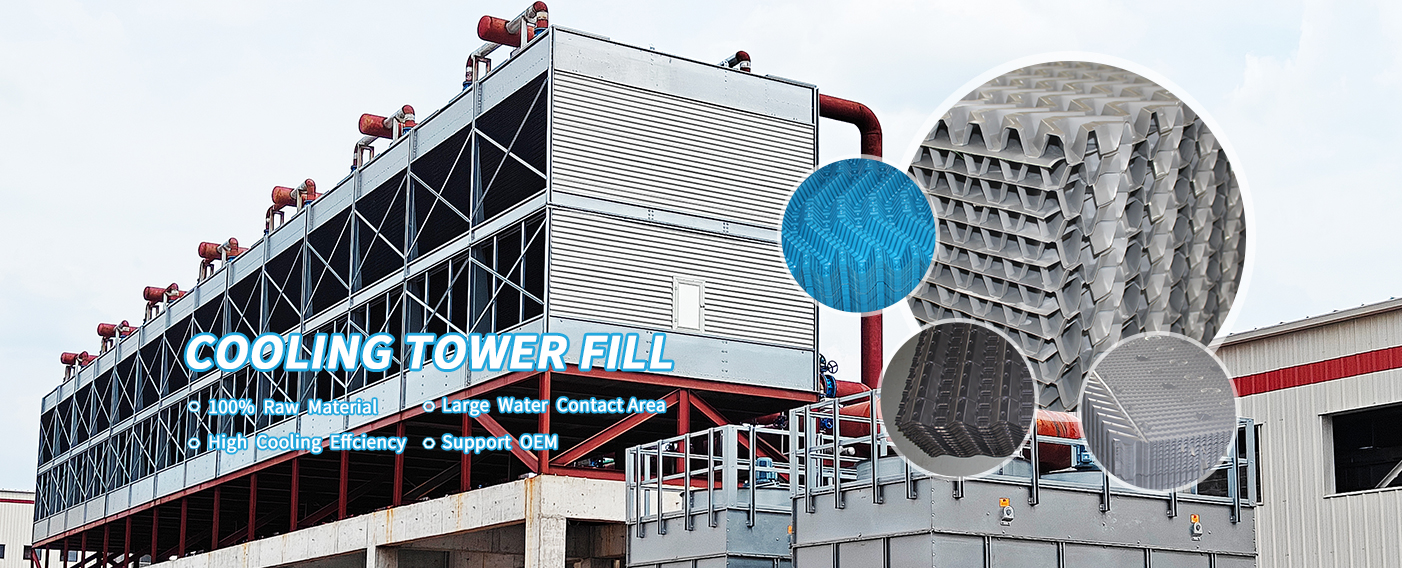
Choosing the right cross flow cooling tower fill sounds simple—until you start comparing materials, flute designs, dimensions, water quality, operating temperatures, and replacement requirements.
The fill is one of those cooling tower components that can be easy to overlook. You may not see it doing its job from outside the tower, but inside, it is working continuously to create more contact between hot water and moving air. Get the selection right, and the tower can achieve effective heat transfer with reliable operation. Get it wrong, and problems such as clogging, scaling, deformation, and poor cooling performance can follow.
So, how do you choose the right cross flow cooling tower fill?
You need to look beyond price and material name. The right choice depends on the cooling tower design, water quality, operating conditions, fill geometry, maintenance requirements, and the compatibility of the replacement fill with the existing tower.
This guide walks through the key factors step by step.
What Is Cross Flow Cooling Tower Fill?
Cross flow cooling tower fill is the heat-transfer media installed inside a cross flow cooling tower.
In a cross flow tower, hot water generally flows downward through the fill while air moves horizontally across the water flow. The fill creates a large contact area between the water and air, helping evaporation take place more effectively.
Think of the fill as a giant contact platform. Instead of allowing water to fall through the tower in large streams, the fill spreads the water into thinner layers or smaller paths. More exposed water means more opportunity for heat to move from the water into the air.
That is the basic reason fill matters.
Without properly designed fill, the tower would have far less effective contact area, and achieving the desired cooling performance could require considerably more airflow or tower volume.
Why Is the Right Fill Important?
Not all cooling tower fill performs the same way.
Two products may look similar but behave differently under actual operating conditions. A fill designed for relatively clean water may not be appropriate for a system with high suspended solids. Likewise, a highly efficient film-fill design may require better water distribution and more attention to fouling control.
The right fill needs to balance several factors:
In other words, the goal is not simply to find the fill with the largest surface area.
The goal is to find the right balance between thermal performance and real-world operating conditions.
How Cross Flow Cooling Towers Work
A cross flow cooling tower uses two different flow directions.
Hot water enters the tower and is distributed over the fill. At the same time, air moves horizontally through the fill area.
As water travels downward, the air passes across it. Some of the water evaporates, and this evaporation removes heat from the remaining water.
The cooled water collects in the basin and is then returned to the cooling system.
The fill makes this process more effective by increasing the amount of water exposed to moving air.
The Role of Fill in Heat Transfer
Imagine pouring a bucket of water into a strong wind. The water has limited contact with the air because it quickly falls away.
Now imagine spreading that same water across hundreds of thin surfaces. The contact area becomes much larger.
That is essentially what fill does.
A good cross flow cooling tower fill encourages water to spread over surfaces while maintaining suitable airflow paths. The result is more interaction between air and water, which supports evaporative cooling.
Key Types of Cross Flow Cooling Tower Fill
When selecting fill, you will encounter different materials and structural designs.
The most common options include PVC and PP fill, as well as different film-fill and splash-fill configurations.
PVC Cross Flow Cooling Tower Fill
PVC is widely used for cooling tower fill because it can be formed into structured sheets with complex surface patterns.
PVC film fill can provide a large effective contact area while remaining relatively lightweight and practical for many cooling tower applications.
It is commonly considered for:
However, the correct PVC grade, thickness, geometry, and temperature capability still need to be considered for each application.
PP Cross Flow Cooling Tower Fill
Polypropylene, commonly called PP, is another material used for cooling tower fill.
PP can be useful when an application requires different material characteristics from standard PVC. It can also be considered for applications involving particular chemical or temperature conditions.
The important point is this: don't choose PP simply because it sounds more advanced.
Look at your actual water chemistry, temperature, tower design, and operating environment first.
Film Fill vs. Splash Fill
Film fill and splash fill use different approaches to improve air-water contact.
Film fill encourages water to spread across surfaces, creating a relatively continuous thin film.
Splash fill instead breaks the water into droplets as the water repeatedly contacts splash bars or similar structures.
Film fill can provide high effective surface area, but it can also be more sensitive to fouling and blockage depending on its geometry and operating environment.
Splash fill can be useful where water contains more suspended solids or where fouling resistance is a major concern.
The best option depends on the application rather than a simple “film is better” or “splash is better” rule.
7 Factors to Consider When Choosing Cross Flow Fill
Now we get to the most important part.
Before ordering replacement fill or specifying fill for a new tower, check these seven factors.
1. Cooling Tower Design
Start with the tower itself.
Is it a cross flow package tower? Is it an industrial tower? Is the fill being installed as a replacement inside an existing structure?
The answer affects the required fill dimensions, support structure, water distribution system, airflow path, and installation method.
For replacement projects, never assume that any cross flow fill will fit simply because it is called “cross flow fill.”
Measure first.
2. Water Quality
Water quality is one of the biggest factors affecting fill selection.
Ask yourself:
Is the circulating water relatively clean?
Does it contain suspended solids?
Is scaling common?
Is biological growth a problem?
How effective is the filtration system?
How frequently is the tower cleaned?
If water contains significant suspended solids, narrow fill channels can become blocked more easily.
A fill with wider passages or a geometry designed for greater fouling tolerance may be more appropriate.
This is where many buyers make a mistake. They focus on maximum heat-transfer area while ignoring what is actually flowing through the tower.
More surface area is not automatically better if that surface becomes covered with deposits.
3. Operating Temperature
Temperature matters because different fill materials and designs have different operating limits.
Before selecting the fill, determine:
Do not select a material based only on room-temperature properties.
A cooling tower fill spends its life in a warm, wet environment. The material needs to maintain its physical shape under those conditions.
4. Water Flow Rate
Water loading directly affects how the fill operates.
If the water flow is too high for the selected fill design, water distribution may not perform as expected. If the flow is too low, the fill may not be fully utilized.
When replacing existing fill, obtain the tower's design water flow whenever possible.
Also check whether the current operating flow has changed since the tower was originally installed.
Why?
Because equipment upgrades, process changes, or pump replacements can change actual operating conditions.
5. Airflow Conditions
Cross flow towers depend on air moving horizontally through the fill.
That means fill geometry must work with the tower's airflow characteristics.
A fill with complex channels can provide excellent water-air interaction, but excessive airflow resistance can affect the overall system.
The goal is to create effective contact without unnecessarily restricting airflow.
It is a balancing act between heat transfer and pressure drop.
6. Fill Thickness and Height
Don't overlook physical dimensions.
Fill thickness affects mechanical strength, durability, and resistance to handling damage. Fill height influences the available heat-transfer area and the overall thermal performance of the fill section.
For replacement projects, measure:
Fill length
Fill width
Fill height
Sheet thickness
Block dimensions
Flute angle
Flute geometry
Support spacing
Even a high-quality fill becomes useless if the blocks don't fit correctly.

7. Maintenance Requirements
Finally, think about maintenance before buying.
Ask:
Can the fill be inspected easily?
Can it be cleaned?
Is the geometry suitable for the site's water quality?
Can individual sections be replaced?
Does the supplier provide replacement support?
A cooling tower is not a “buy it and forget it” machine.
The fill will eventually accumulate deposits, biological material, or other contaminants. Choosing a fill that matches your maintenance capabilities can make long-term operation much easier.
PVC vs. PP Cross Flow Cooling Tower Fill
PVC and PP are two materials buyers commonly compare.
| Feature | PVC Fill | PP Fill |
| Common applications | HVAC and industrial cooling | Industrial and specialized applications |
| Formability | Excellent | Excellent |
| Weight | Lightweight | Lightweight |
| Corrosion resistance | Good | Good |
| Temperature considerations | Application dependent | Application dependent |
| Availability | Widely available | Widely available |
| Customization | Available | Available |
| Selection priority | Tower + water + temperature | Tower + water + temperature |
The table gives you a starting point, but material alone should not determine the final decision.
The geometry, thickness, operating conditions, and water chemistry are equally important.
How to Match Fill to Your Water Quality
One practical way to approach fill selection is to divide water conditions into three broad groups.
Relatively Clean Water
If the circulating water is well filtered and has low suspended solids, a high-efficiency film-fill configuration may be suitable.
In this environment, maintaining clean surfaces becomes easier, allowing the fill geometry to provide strong air-water contact.
Moderate Fouling Conditions
If the system occasionally experiences scaling or biological deposits, choose a design that provides a reasonable balance between thermal performance and cleaning accessibility.
Regular water treatment becomes especially important here.
Poorer Water Quality
For systems with higher solids or greater fouling potential, consider fill geometry with larger passages or a configuration designed to reduce blockage risk.
You may sacrifice some theoretical surface area, but the practical performance can be more stable.
Remember the golden rule:
A fill that stays open and operational can outperform a theoretically more efficient fill that becomes clogged.
How to Choose the Correct Fill Size
For a replacement project, don't order based only on the cooling tower's tonnage.
Tower tonnage is useful information, but it does not tell the supplier everything required to manufacture a compatible replacement.
Provide as much information as possible:
Existing fill dimensions
Tower model
Tower manufacturer
Fill material
Fill thickness
Fill height
Block length and width
Existing flute pattern
Water flow
Hot-water temperature
Cold-water temperature
Water quality
If possible, provide photographs of the existing fill and support arrangement.
A good supplier can use this information to determine whether a standard product or customized replacement is appropriate.
Common Mistakes When Buying Cross Flow Fill
Buying Only on Price
The cheapest fill is not necessarily the lowest-cost solution.
If inexpensive fill has poor durability or doesn't match the tower correctly, replacement costs and lost cooling performance can quickly exceed the original savings.
Ignoring Water Quality
This is one of the most expensive mistakes.
A high-efficiency fill that clogs quickly may create more maintenance work than expected.
Choosing the Wrong Dimensions
Even excellent fill cannot compensate for incorrect dimensions.
Always verify measurements before production.
Focusing Only on Surface Area
Large surface area sounds attractive, but cooling performance depends on the entire system.
Water distribution, airflow, fill geometry, water quality, and operating conditions all interact.
Assuming Every PVC Fill Is the Same
PVC is a material—not a complete product specification.
Different PVC fills can have different thicknesses, flute patterns, dimensions, surface characteristics, and performance characteristics.
When Should Cross Flow Cooling Tower Fill Be Replaced?
There is no universal replacement date for every cooling tower.
Actual service life depends on water chemistry, temperature, cleaning practices, mechanical conditions, UV exposure, operating hours, and fill design.
Instead of replacing fill simply because it has reached a certain age, inspect its actual condition.
Cracking and Brittleness
Cracked sheets or brittle material can indicate deterioration.
Once the fill begins losing its structural integrity, pieces may break away and interfere with water distribution or other tower components.
Scaling and Clogging
Heavy mineral deposits can reduce the available contact area and restrict airflow and water movement.
If cleaning no longer restores acceptable performance, replacement may become more practical.
Reduced Cooling Performance
If the tower previously achieved its required cold-water temperature but now struggles despite proper fan, pump, and water-treatment operation, inspect the fill.
A deteriorated or heavily fouled fill section can be one possible contributor.
Maintenance Tips for Longer Fill Life
Good maintenance can extend the useful life of cooling tower fill.
First, maintain appropriate water treatment. Controlling scale, corrosion, and biological growth reduces the amount of material that accumulates on the fill.
Second, inspect the fill regularly.
Look for:
Third, clean the fill using procedures compatible with the fill material and the cooling tower manufacturer's recommendations.
Avoid aggressive cleaning methods that could damage thin PVC or PP sheets.
Finally, inspect the water distribution system at the same time.
There is little value in installing new fill if clogged nozzles or poor water distribution immediately create another performance problem.
Why Choose Power Tower Cooling Technology?
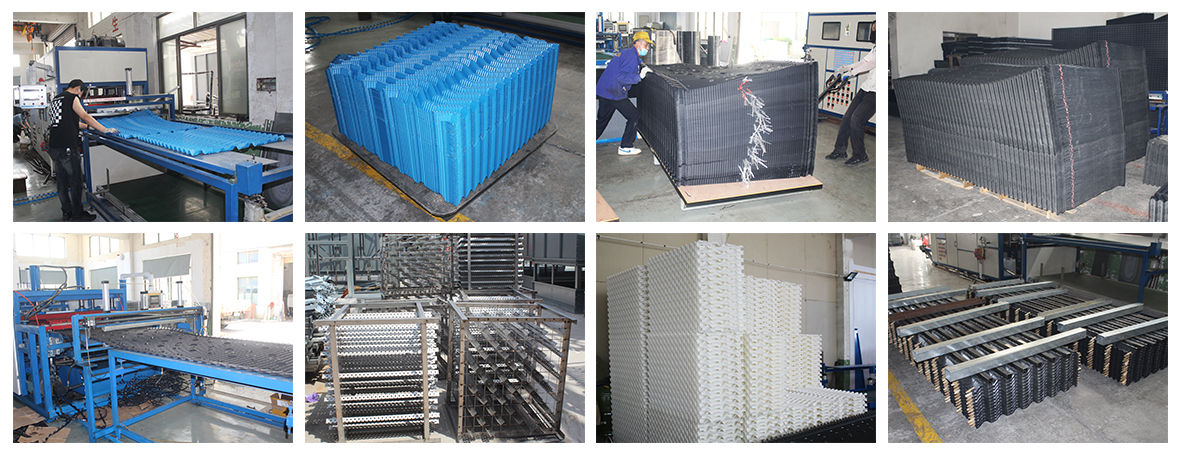
Power Tower Cooling Technology (Shaoxing) Co.,Ltd focuses on cooling tower components and replacement solutions, including cross flow cooling tower fill.
For buyers, the advantage of working directly with a manufacturer is the ability to discuss the actual operating conditions rather than simply choosing a generic product from a catalog.
You can provide information about your existing tower, fill dimensions, water conditions, and application requirements. The manufacturer can then help determine a suitable configuration.
For cooling tower fill products and replacement solutions, visit CoolingTowerPart.
Customized Cross Flow Cooling Tower Fill
Every cooling tower is not identical.
That's why customized fill can be useful, particularly when you are replacing media in an existing tower.
Customization may involve:
Block dimensions
Sheet thickness
Flute configuration
Fill height
Fill width
Material selection
Installation arrangement
The objective is straightforward: make the new fill compatible with the existing tower while maintaining appropriate water and airflow characteristics.
Replacement Fill for Existing Towers
Replacement projects require more attention than new installations.
Why?
Because you are working around an existing structure.
The original tower may have been modified over the years. Pumps may have changed. Water flow may no longer match the original design. The existing support structure may also have experienced wear.
A replacement supplier should therefore consider the complete installation rather than selling fill based solely on one dimension.
This is particularly important when replacing older or discontinued cooling tower fill.
Cross Flow Cooling Tower Fill Buying Checklist
Before placing an order, run through this checklist:
Tower information
Fill information
Existing fill dimensions
Fill height
Fill thickness
Flute design
Block configuration
Operating information
Water flow rate
Hot-water temperature
Cold-water temperature
Airflow conditions
Water information
Suspended solids
Scale tendency
Biological fouling
Water-treatment method
Supplier information
Manufacturing capability
Customization capability
Replacement experience
Material options
Technical support
If you can answer these questions before contacting a supplier, the selection process becomes much faster.
Frequently Asked Questions
What Material Is Best for Cross Flow Fill?
There is no single material that is best for every application.
PVC is a common choice for many cooling tower applications, while PP can be appropriate for systems requiring different material characteristics. The final choice should consider temperature, water chemistry, tower design, fill geometry, and operating requirements.
Can PVC Fill Be Used in Industrial Towers?
Yes. PVC cooling tower fill is used in many industrial cooling applications.
However, the specific PVC fill design should be matched to the operating temperature, water quality, water loading, airflow, and tower configuration.
How Long Does Cross Flow Fill Last?
Service life varies considerably.
Clean water, effective water treatment, appropriate operating temperatures, regular inspection, and good maintenance can all contribute to longer service life.
Instead of relying on an arbitrary replacement interval, inspect the fill's physical condition and cooling performance.
Is Cross Flow Fill Different From Counter Flow Fill?
Yes.
The fundamental airflow and water-flow arrangements are different. Cross flow towers generally have air moving horizontally across downward-flowing water, while counter flow towers move air generally upward against the downward water flow.
As a result, fill geometry and tower configuration need to be matched accordingly.
Can I Replace Only Part of the Cooling Tower Fill?
In some situations, partial replacement may be possible.
It depends on the condition of the existing fill, the tower configuration, the support arrangement, and whether compatible replacement blocks are available.
A technical assessment can help determine whether partial or complete replacement makes more sense.
Final Thoughts
Choosing the right cross flow cooling tower fill is not simply a matter of picking PVC or PP.
The better approach is to look at the entire operating picture.
What type of tower are you using? What is the water quality? How much water is flowing through the tower? What temperatures are involved? How much fouling can the system tolerate? What dimensions are required? And, perhaps most importantly, how easy will the fill be to maintain?
When you answer these questions first, the product selection becomes much clearer.
For new installations and replacement projects, Power Tower Cooling Technology (Shaoxing) Co.,Ltd can provide cross flow cooling tower fill solutions based on tower dimensions, material requirements, and operating conditions.
For more information about cooling tower fill products and replacement solutions, visit CoolingTowerPart at https://www.coolingtowerpart.com.


