A cooling tower may look like a simple piece of equipment from the outside, but a surprisingly important process is happening inside. Hot water enters the tower, air moves through it, and heat is released into the atmosphere.
But what makes this heat exchange efficient?
One of the most important components is fill media in cooling tower systems.
Cooling tower fill media creates a large and effective contact area between circulating water and air. Depending on the design, it can spread water into thin films, break water into droplets, extend contact time, and improve water distribution. All of these actions help the cooling tower remove heat more effectively.
So, how does fill media in cooling tower improve heat transfer?
The answer is not just about adding more surface area. Good fill media creates the right combination of water distribution, air movement, contact time, surface area, and evaporation.
This guide explains how cooling tower fill media works, how film fill and splash fill transfer heat, what factors affect performance, and how to choose the right fill for your cooling tower.
What Is Fill Media in a Cooling Tower?
Cooling tower fill media is the heat-transfer material installed inside a cooling tower, normally between the water distribution system and the cold-water basin.
Its job is to make the interaction between hot water and air much more effective.
Without fill media, water would simply fall from the distribution system toward the basin. The water would have limited contact with air, and the tower would need a much larger structure to achieve the same cooling duty.
Fill changes the situation.
It creates a large three-dimensional area where water can spread, flow, splash, or break into droplets while air passes through the same region.
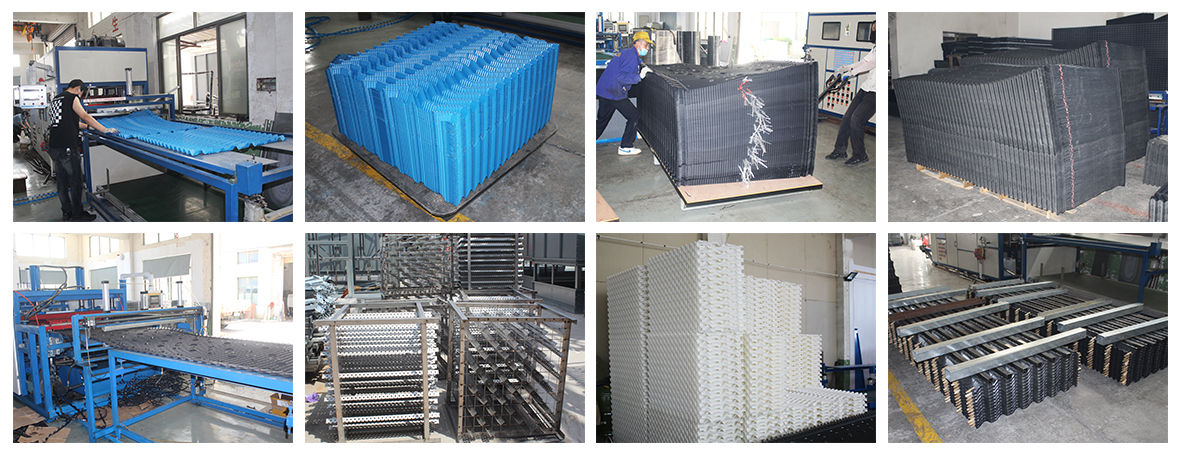
Common cooling tower fill media types include:
Film fill
Splash fill
Grid splash fill
Tube splash fill
Hybrid fill
Each type uses a slightly different method to improve heat and mass transfer.
The Main Purpose of Cooling Tower Fill Media
The main purpose of fill media is to maximize the useful interaction between water and air.
Think of it like turning a short conversation into a detailed discussion. If water and air barely meet, there is little opportunity for heat exchange. If they remain in close contact over a large area, the exchange becomes much more effective.
A properly designed fill system helps:
Increase water-air contact area
Improve water distribution
Extend water contact time
Promote effective mixing
Support evaporation
Increase cooling capacity
Reduce required tower volume
This is why fill media is often considered one of the most important heat-transfer components in an evaporative cooling tower.
Why Is Heat Transfer So Important in a Cooling Tower?
A cooling tower exists to remove heat from circulating water.
That water may have absorbed heat from a chiller condenser, industrial process, compressor, power-generation equipment, or manufacturing system.
The heated water enters the tower and must be cooled before returning to the process.
If heat transfer is poor, the outlet-water temperature remains too high. The equipment connected to the cooling system may then operate less efficiently.
In some applications, poor cooling can lead to:
Higher energy consumption
Reduced process efficiency
Increased equipment temperature
Higher operating costs
Reduced production stability
The fill media therefore has a direct relationship with the tower's ability to reject heat.
How Does Water Evaporation Remove Heat?
Most open cooling towers use evaporative cooling.
When a small amount of circulating water evaporates, it takes heat away from the remaining liquid water. This is why increasing the effective water-air interface is so important.
Imagine standing outside on a hot day after swimming. Even if the surrounding air is warm, water evaporating from your skin can make you feel cooler.
A cooling tower uses the same basic physical principle on a much larger scale.
The fill media helps expose more water to moving air, creating favorable conditions for evaporation and heat transfer.
How Does Fill Media Improve Heat Transfer?
Cooling tower fill media improves heat transfer through several interconnected mechanisms.
The most important ones are surface area, water-film formation, contact time, water distribution, and flow interaction.
Increasing Water-Air Contact Area
This is the foundation of cooling tower fill performance.
A large stream of water has a relatively small surface area compared with the same amount of water spread across thousands of thin layers or divided into many droplets.
Fill media changes the physical shape of the water.
Film fill spreads water across structured surfaces. Splash fill breaks falling water into droplets. Both approaches increase the amount of water exposed to air.
More effective contact area means more opportunity for heat and mass transfer.
This is one of the main reasons cooling towers can remove substantial amounts of heat without requiring an enormous structure.
Creating a Thin Water Film
Film fill uses a particularly effective method.
Instead of allowing water to fall as large streams, the structured fill encourages water to spread across the surface as a thin layer.
Why is a thin layer useful?
Because a larger percentage of the water is exposed directly to air.
The corrugated geometry also creates multiple channels and flow paths. As water moves downward, air moves through or across these surfaces.
The result is a large effective heat-transfer area inside a relatively compact volume.
This is why film fill is commonly selected when high thermal efficiency and compact cooling tower design are important.
Increasing Contact Time
Surface area alone is not enough.
Water also needs sufficient time to interact with air.
If water passes through the tower too quickly, the available heat-transfer opportunity is reduced.
Cooling tower fill creates a longer and more controlled flow path. Water may repeatedly change direction, spread over surfaces, or break into droplets.
Think of the difference between throwing a ball straight across a room and making it travel through a winding maze.
The maze takes longer to cross.
Fill media creates a similar effect for water, increasing the opportunity for air-water interaction while maintaining the required hydraulic and airflow characteristics.
Improving Water Distribution
Uniform water distribution is essential for good cooling tower performance.
Even the most advanced fill media cannot compensate for poor water distribution.
Imagine watering a field where one half receives heavy rain while the other half remains completely dry. The total amount of water may be sufficient, but the distribution is terrible.
The same problem can happen inside a cooling tower.
If some sections of the fill receive too much water while other areas receive too little, the available heat-transfer surface is not being used effectively.
Blocked spray nozzles, damaged distribution pipes, poor pressure, and incorrect installation can all contribute to uneven water distribution.
Good fill performance therefore starts with good water distribution.
Promoting Turbulence and Mixing
Fill geometry also affects how water and air move.
Corrugations, channels, splash surfaces, and changes in flow direction can encourage mixing and improve contact between the two fluids.
This does not mean that maximum turbulence is always desirable.
Excessive turbulence can increase pressure drop and fan energy consumption.
The objective is to create useful interaction between water and air without introducing unnecessary resistance.
Good cooling tower fill design is therefore a balancing act.
How Does Film Fill Work in a Cooling Tower?
Film fill is one of the most common types of cooling tower fill media.
It normally consists of thin structured sheets assembled into blocks or packs.
Hot water enters the top of the fill and spreads across the surfaces. The water then moves downward in thin layers while air passes through the channels.
The large developed surface area allows extensive water-air interaction.
Corrugated Surface Design
Film-fill sheets are not flat for a reason.
Corrugations create channels that:
Spread water
Guide water downward
Increase surface area
Support airflow
Encourage mixing
Extend the water path
Different products use different flute shapes, sheet thicknesses, spacing, and surface patterns.
These design characteristics affect thermal performance, pressure drop, mechanical strength, and fouling resistance.
Therefore, simply asking for “film fill” is not always enough when specifying a replacement.
Crossflow vs Counterflow Film Fill
Cooling tower configuration also matters.
In a counterflow cooling tower, water generally travels downward while air moves upward.
In a crossflow cooling tower, water travels downward while air moves horizontally through the fill.
The basic purpose of the fill remains the same, but the airflow pattern and hydraulic conditions are different.
Therefore, cooling tower fill media should always be selected according to the actual tower configuration, dimensions, water flow, airflow, and operating conditions.
How Does Splash Fill Improve Heat Transfer?
Splash fill takes a different approach to creating water-air contact.
Instead of maintaining a continuous thin film, splash fill repeatedly breaks water into smaller droplets.
Water falls onto splash bars, grids, or other structured surfaces. Each impact spreads and separates the water before it continues downward.
This repeated splashing increases the exposed water surface.
Breaking Water Into Droplets
Why are droplets useful?
Consider one glass of water.
Now imagine dividing that same amount of water into thousands of tiny droplets.
The total volume has not changed, but the exposed surface area can increase dramatically.
Splash fill takes advantage of this principle.
Repeated impacts create new water surfaces that interact with moving air, supporting heat and mass transfer.
When Is Splash Fill a Better Choice?
Splash fill can be particularly useful when circulating water contains contaminants or suspended solids.
Film fill usually has relatively narrow passages. If these passages become blocked by scale, algae, sediment, or other deposits, thermal performance can decline.
Splash fill generally has a more open structure.
That can make it more tolerant of:
In these situations, splash fill may provide better long-term reliability even if a film-fill system could offer higher initial thermal efficiency under clean-water conditions.
Film Fill vs Splash Fill for Heat Transfer
Which one provides better heat transfer?
The honest answer is: it depends on the application.
Film fill is generally attractive when maximum heat-transfer density and compactness are important.
Splash fill is often attractive when fouling resistance and durability are higher priorities.
| Factor | Film Fill | Splash Fill |
| Heat-transfer efficiency | Very high under suitable conditions | Good to very good |
| Water-air contact | Thin water film | Water droplets |
| Surface area | High | Moderate to high |
| Clogging resistance | Lower | Higher |
| Dirty-water tolerance | Lower | Higher |
| Tower compactness | Excellent | Moderate |
| Maintenance tolerance | Moderate | High |
| Typical priority | Thermal efficiency | Reliability |
So the better question is not “Which fill is best?”
It is:
Which fill maintains the best cooling performance under your actual operating conditions?
Thermal Efficiency
When water quality is good and the tower is properly maintained, film fill can provide excellent thermal performance.
Its structured surfaces create a large effective heat-transfer area within a relatively small volume.
This can help reduce tower size or increase cooling capacity within a given footprint.
Splash fill can also provide effective heat transfer, but the required configuration may differ depending on the cooling duty.
Water Quality and Fouling
Water quality can completely change the answer.
A film-fill system may perform extremely well when the water is clean and properly treated.
But if scale or biological deposits build up inside its channels, airflow and water movement can become restricted.
A splash-fill system may be more forgiving in the same environment.
This is why fill selection should never be based on thermal efficiency alone.
Airflow and Pressure Drop
The fill must work with the cooling tower fan system.
Every channel, surface, and flow-direction change affects air resistance.
If the fill creates excessive pressure drop, the fan may need to consume more energy to maintain the required airflow.
The goal is therefore to achieve the best balance between:
Heat transfer + airflow + water distribution + pressure drop.
A design that maximizes one factor while ignoring the others may not provide the best real-world result.
What Factors Affect Cooling Tower Fill Heat Transfer Performance?
Fill media is only one part of the overall cooling system.
Several operating factors determine how effectively it can transfer heat.
Water Flow Rate
Water flow affects how thoroughly the fill becomes wetted.
Too little water can leave portions of the fill underutilized.
Too much water can change hydraulic behavior and increase resistance.
The fill should therefore be matched to the tower's design water loading.
Airflow Rate
Airflow is equally important.
If insufficient air passes through the fill, the tower cannot effectively carry away the heat and moisture transferred from the water.
Fan condition, fill cleanliness, drift eliminators, louvers, and tower configuration can all influence airflow.
Water Distribution
Uniform water distribution allows more of the fill surface to participate in cooling.
A damaged or blocked nozzle can create dry areas and overloaded sections.
This is why nozzle inspection should be part of regular cooling tower maintenance.
Fill Surface Area
Greater effective surface area generally creates more opportunities for heat transfer.
However, more surface area is not automatically better.
A design with extremely high surface area but excessive pressure drop or poor fouling resistance may perform poorly in real-world operation.
The useful surface area is what matters.
Water Quality
Water quality is one of the most important factors affecting long-term fill performance.
Poor water quality can result in:
Scale
Algae
Slime
Sediment
Corrosion products
Suspended solids
These deposits can reduce the effective heat-transfer area and restrict water or airflow passages.
How to Choose the Right Fill Media for Better Heat Transfer
Choosing cooling tower fill should begin with the operating conditions, not simply with the product price.
Consider Cooling Load and Approach Temperature
First determine the required cooling duty.
Important parameters include:
Heat load
Entering-water temperature
Leaving-water temperature
Water flow rate
Design wet-bulb temperature
Required approach temperature
These values help determine the thermal performance required from the fill.
Consider Operating Water Temperature
Temperature is important for both performance and material selection.
PVC is widely used for cooling tower film fill, while PP and other materials may be selected for particular industrial applications.
However, there is no universal material recommendation.
The exact operating temperature, water chemistry, product formulation, and tower design should all be considered before selecting a material.
Consider Fouling and Clogging Risk
Ask a simple question:
How clean is the circulating water?
If the water is well filtered and chemically treated, film fill can be an excellent option.
If the water contains significant suspended solids or contamination, splash fill may be worth considering.
The best fill is the one that continues performing after months and years of operation—not just on the day it is installed.
Common Fill Media Problems That Reduce Heat Transfer
Even high-quality fill can lose performance when operating conditions are poor.
Clogging and Scaling
Scale and deposits can cover the heat-transfer surface and restrict the passages.
As the blockage increases, water distribution and airflow can deteriorate.
The cooling tower may then operate at a higher outlet-water temperature.
Poor Water Distribution
If the spray system is not working correctly, the fill may not be fully wetted.
Before replacing fill media, check:
Spray nozzles
Distribution pipes
Water pressure
Spray pattern
Basin condition
Sometimes what looks like a fill problem is actually a distribution problem.
Damaged or Aged Fill
Fill media can deteriorate due to:
High temperatures
Chemical exposure
UV exposure
Mechanical damage
Long-term fouling
Natural aging
Cracked, brittle, warped, or collapsed fill can interfere with water and air movement.
How to Maintain Fill Media for Better Cooling Performance
Good maintenance protects the heat-transfer performance of the fill.
Inspection and Cleaning
Regularly inspect the fill for:
Scale
Algae
Sediment
Blocked channels
Cracks
Deformation
Structural damage
Cleaning methods should match the fill material and manufacturer's recommendations.
Aggressive cleaning can damage thin film-fill sheets, so pressure and cleaning techniques should be controlled carefully.
Water Treatment
Prevention is better than repeated cleaning.
A proper water-treatment program helps control scale, biological growth, corrosion, and suspended solids.
Good water treatment protects not only the fill but also pumps, pipes, nozzles, heat exchangers, and other cooling tower components.
When Should Cooling Tower Fill Media Be Replaced?
There is no single replacement interval that applies to every cooling tower.
Instead, replacement should be based on the condition and performance of the fill.
Potential warning signs include:
If cleaning no longer restores acceptable performance, replacement may be the most practical solution.
Before ordering replacement fill, carefully check the tower dimensions, fill arrangement, material, water flow, airflow direction, and installation requirements.
How Power Tower Cooling Technology Can Help
Power Tower Cooling Technology (Shaoxing) Co.,Ltd provides cooling tower fill media and related cooling tower components for industrial and commercial applications.
When selecting fill media, the company focuses on the relationship between the product and the customer's actual cooling requirements.
Different applications may require different solutions.
For example:
Clean-water systems may benefit from high-efficiency film fill.
Industrial systems with higher fouling risks may consider splash fill.
Replacement projects may require customized dimensions.
High-temperature or chemically demanding applications may require careful material selection.
The most important point is to match the fill type, material, geometry, and dimensions to the cooling tower's operating conditions.
For more information about cooling tower fill media and related products, visit Power Tower Cooling Technology (Shaoxing) Co.,Ltd.
Conclusion: Why Fill Media Matters for Heat Transfer
So, how does fill media in cooling tower systems improve heat transfer?
It creates the physical environment where efficient water-air interaction can happen.
Film fill spreads water into thin layers over a large surface area. Splash fill breaks water into droplets and repeatedly renews the water-air interface. Both designs increase the opportunity for heat and mass transfer.
But the fill itself is only part of the equation.
Water flow, airflow, water distribution, temperature, water quality, surface area, pressure drop, and maintenance all influence final cooling performance.
That is why selecting cooling tower fill should never be reduced to a simple “film versus splash” decision.
If your water is clean and your priority is compact, high-efficiency heat transfer, film fill may be the better choice.
If your water contains significant contaminants and reliability is the priority, splash fill may provide a more suitable solution.
Ultimately, the best cooling tower fill media is the one that delivers the right balance of heat-transfer efficiency, water-air contact, fouling resistance, durability, airflow performance, and lifecycle cost.
When those factors are properly matched, fill media can help your cooling tower transfer heat more efficiently, maintain stable outlet-water temperatures, and operate reliably for years.


