You are here: Home » Blog » Factors affecting cooling tower filler
Factors affecting cooling tower filler
Views: 0 Author: Site Editor Publish Time: 2026-01-04 Origin: Site
Analysis of key factors affecting the performance of cooling tower filler
In industrial cooling systems, cooling tower filler is one of the core components that determine cooling efficiency and operating costs. High-quality cooling tower fill can significantly increase the contact area between water and air, thereby enhancing heat dissipation efficiency. However, in practical applications, various factors can affect the performance and service life of cooling tower fill. This article will systematically analyze the main factors affecting cooling tower filler, helping users make more scientific choices.
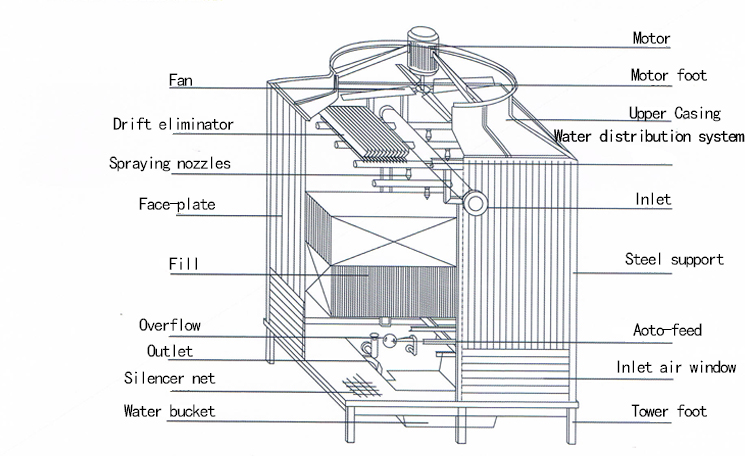
Schematic diagram of filler in cooling tower
Material factors of cooling tower filler:
1. Type of filler material
Currently, the common cooling tower fill materials on the market mainly include the following types:
1.PVC filler:
Good corrosion resistance, high cost-effectiveness, and the most widely used
2.PP filler:
Stronger high temperature resistance, suitable for special working conditions
3.FRP filler:
High strength, but relatively high cost
Cooling tower fillers made of different materials exhibit significant differences in temperature resistance, chemical corrosion resistance, and service life, necessitating selection based on actual operating conditions.
2. Material thickness and strength
Too thin a filler sheet may lead to deformation or collapse, while too thick a sheet may affect ventilation resistance. Reasonable thickness design is an important prerequisite for ensuring long-term stable operation of cooling tower fill.
The structural design of cooling tower fill influences
1. Corrugated shape and angle
The corrugated structure directly affects the formation of water film and the contact time between gas and water:
1)Small-angle ripples:
Suitable for systems with good water quality
2)Large-angle corrugation:
Stronger anti-scaling ability, suitable for high turbidity water quality
Scientific structural design can maximize the heat transfer efficiency of cooling tower fillers.
2. Specific surface area size
The larger the specific surface area, the stronger the heat dissipation capacity theoretically, but it is also more prone to scaling and clogging. Therefore, in the design of cooling tower fill, a balance needs to be struck between heat transfer efficiency and anti-pollution capability.
The impact of water quality conditions on cooling tower filler
1. Impurities and scaling issues in water
When water contains a large amount of suspended solids, calcium and magnesium ions, or microorganisms, it is prone to forming scale and biofilm on the surface of cooling tower fillers, leading to:
1)Ventilation resistance increases
2)The cooling efficiency has decreased
3)Maintenance costs are rising
2. Chemical corrosivity
If the circulating water exhibits acidic or alkaline characteristics, the conventional cooling tower fill may be corroded, necessitating the selection of a filler material with enhanced chemical corrosion resistance.
The impact of operating conditions on cooling tower fill:
1. Operating temperature
Under high-temperature conditions, ordinary PVC cooling tower fillers may experience softening or deformation issues. For high-temperature systems, it is advisable to prioritize the use of high-temperature resistant PP cooling tower fillers.
2. Wind speed and water load
Improper water-to-air ratio can lead to uneven distribution of water or dry areas in the filler, thereby reducing the overall cooling effect of the cooling tower filler.
Installation and maintenance factors
1. Installation quality
Uneven installation or excessive compression of the filler material can affect air circulation and reduce the actual performance of the cooling tower fill.
2. Regular cleaning and maintenance
Even if high-quality cooling tower filler is selected, its efficiency will rapidly decrease due to scaling and aging if regular cleaning and maintenance are not carried out.
How to choose the right cooling tower filler
When selecting a model, it is recommended to consider the following points comprehensively:
1.Actual operating temperature and water quality conditions
2.Cooling tower type (crossflow or counterflow)
3.Maintenance cycle and budget cost
Selecting cooling tower fill that matches the operating conditions is essential to achieving long-term stable and efficient cooling effects.