You are here: Home » Blog » Industry News » Custom Cooling Tower Fill Media Replacement for Industrial Applications
Custom Cooling Tower Fill Media Replacement for Industrial Applications
Views: 0 Author: Lisa Publish Time: 2026-11-02 Origin: Site
Every cooling tower ages differently. The exact combination of water chemistry, thermal load, climate, operating hours and legacy tower geometry means no two replacement projects are identical. That is why off-the-shelf cooling tower fill media replacement often falls short. A panel that works perfectly in one plant can foul, warp or under-perform in another. For industrial operators, contractors and maintenance engineers, the reliable path to restored thermal performance is custom cooling tower fill media replacement — fill engineered to match your specific tower footprint, water quality and duty profile. This article explains why customization matters, what to specify, how the process works and how to choose a manufacturer that delivers it properly.
Why Standard Fill Media Isn't Always the Answer
Generic fill is designed around average conditions: clean circulating water, moderate temperatures and a standard tower footprint. Real industrial sites rarely fit that mould.
Consider three common scenarios where standard panels fail:
Non-standard tower dimensions. Legacy towers from older or discontinued brands often have internal dimensions, flute profiles and pack heights that no standard panel matches. Forcing a stock panel to fit leaves gaps that cause air short-circuiting and lost efficiency.
Difficult water chemistry. A system with high suspended solids, heavy scaling tendency or aggressive chemical treatment needs a different fill geometry than clean-water film fill. Standard film pack can clog within months in dirty water.
High-temperature or fire-rated sites. Steel plants, chemical units and process industries may require polypropylene or fire-retardant fill that standard PVC stock does not provide.
Custom fill media replacement solves all three by engineering the fill to the actual installation.
What Can Be Customized in Cooling Tower Fill Media
A capable manufacturer customizes fill across several dimensions:
1. Dimensions and Module Size
Custom cutting to your exact tower internal dimensions ensures full coverage of the fill area, eliminating dry zones and air bypass. Modular pack heights, widths and lengths are produced to match your support grids, so installation is faster and the fill sits correctly.
2. Flute Profile and Geometry
The corrugation pattern — flute pitch, depth and angle — directly determines heat transfer efficiency and airflow resistance. A custom flute profile can be optimized for your water temperature range, flow rate and available fan static pressure, balancing thermal performance against pressure drop.
3. Material and Grade
Select between:
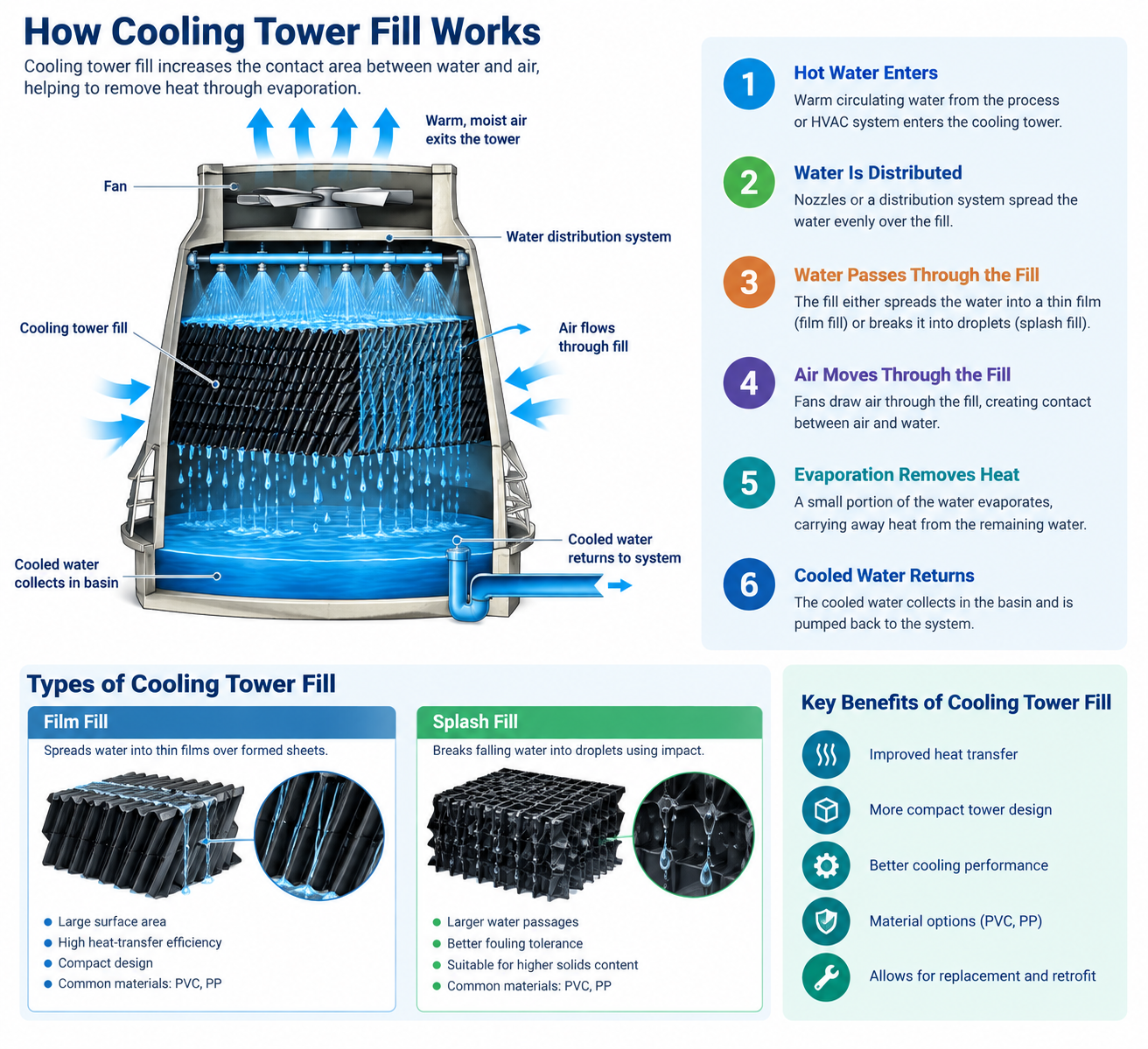
PVC film fill: best efficiency for clean-water systems
Polypropylene (PP) fill: for high temperature, aggressive chemistry or fire-rated sites
Splash fill: for dirty, high-solids water Custom formulation can also adjust wall thickness, UV stabilization and fire-retardancy rating to your specification.
4. Fire-Retardancy and Regulatory Compliance
For process industries, M1/M2, UL or equivalent fire ratings may be mandatory. A custom manufacturer can supply fire-retardant PP or treated PVC fill with the certification your project and insurance require.
5. Accessory Integration
Custom projects usually bundle drift eliminators, spray nozzles, support frames and fasteners engineered to work with your new fill, delivering a coherent retrofit instead of a patchwork of parts.
Key Parameters to Specify for Custom Fill Replacement
To get an accurate custom design, prepare these details for your manufacturer:
Tower type: cross-flow or counter-flow
Internal dimensions, existing pack height and support layout
Circulating water flow rate and cooling range / approach temperature
Water quality: suspended solids, pH, scaling tendency, chemical treatment program
Operating temperature range and ambient wet-bulb condition
Available fan capacity and static pressure
Fire-rating and compliance requirements
Shutdown window and delivery deadline
The more accurate your data, the more precisely the manufacturer can size the fill. Missing or guessed parameters produce a design that may look right but under-perform on site.
How a Custom Fill Replacement Project Works
A professional custom project follows a clear workflow:
Site audit. The manufacturer collects tower measurements and operating data, often from photos, drawings and your water analysis report.
Thermal design. Engineers calculate the required heat transfer and select fill type, material and flute profile.
Prototype and sample. For large or complex projects, a sample panel confirms fit and quality before full production.
Production. Panels are cut, formed and quality-tested to your specification, with material certificates and CTI-type performance data provided.
Delivery and installation. Properly packaged for transit, with installation guidance or on-site support available.
Commissioning and verification. Airflow, water distribution and thermal performance are checked against the design.
How to Choose a Manufacturer for Custom Fill
Not every supplier can genuinely customize. Look for these capabilities:
In-house production and tooling. A real manufacturer can make custom flute profiles and sizes, not just stock panels. This also means better pricing and quality control.
Thermal engineering team. The supplier should run calculations, not just quote dimensions. They should recommend the right material and geometry for your water.
Material traceability. Virgin resin, UV stabilization and fire-rating certificates should be available on request.
Proven project references. Ask for examples of custom jobs for similar industries, tower brands and water conditions.
Installation and after-sales support. Custom fill is an engineered solution; you need technical backup if anything is questioned on site.
Common Mistakes to Avoid in Custom Fill Projects
Providing incomplete operating data. Guessing at water chemistry or load produces a fill that may not handle your real conditions.
Prioritizing lowest price over engineering. Custom fill is a performance investment; the cheapest quote often cuts corners on material or design.
Skipping sample approval. For critical plants, verifying fit and quality on a sample before full production prevents expensive on-site surprises.
Ignoring accessory compatibility. New fill on damaged eliminators or worn nozzles still wastes water and under-performs.
Not documenting compliance. Fire ratings and material certificates protect you during audits, insurance reviews and end-customer acceptance.
FAQ
Can custom fill be made to fit an old, discontinued tower model?Yes. A manufacturer can reverse-engineer your existing tower's dimensions and flute profile and produce matching fill without requiring a tower rebuild.
How is custom fill different from standard fill?Standard fill is pre-made to average sizes and conditions. Custom fill is engineered to your exact dimensions, water chemistry, temperature range and compliance requirements.
What information do I need to provide for a quote?Tower type, dimensions, pack height, water quality, operating temperatures, flow rate, available fan pressure, fire-rating requirements and delivery deadline.
Is custom fill more expensive than standard fill?Unit cost can be slightly higher due to tooling and smaller batches, but correct fit and performance usually reduce total project cost by avoiding gaps, rework and early replacement.
Can custom fill include fire-retardant material?Yes. Fire-retardant PP and treated PVC options are available with applicable ratings for process-industry projects.
Conclusion
Cooling tower fill media replacement is a precision engineering task, not a simple parts order. For industrial applications, custom fill engineered to your tower footprint, water quality and duty profile restores thermal efficiency, cuts energy use and extends the life of your cooling system. By specifying your operating data clearly, working with a manufacturer that has real in-house production and thermal engineering, and following a disciplined project workflow, you avoid the gaps, clogs and rework that plague generic replacements. Choose a custom partner who understands your plant — and your fill will perform for years.
Recommended internal links for CoolingTowerPart.com: