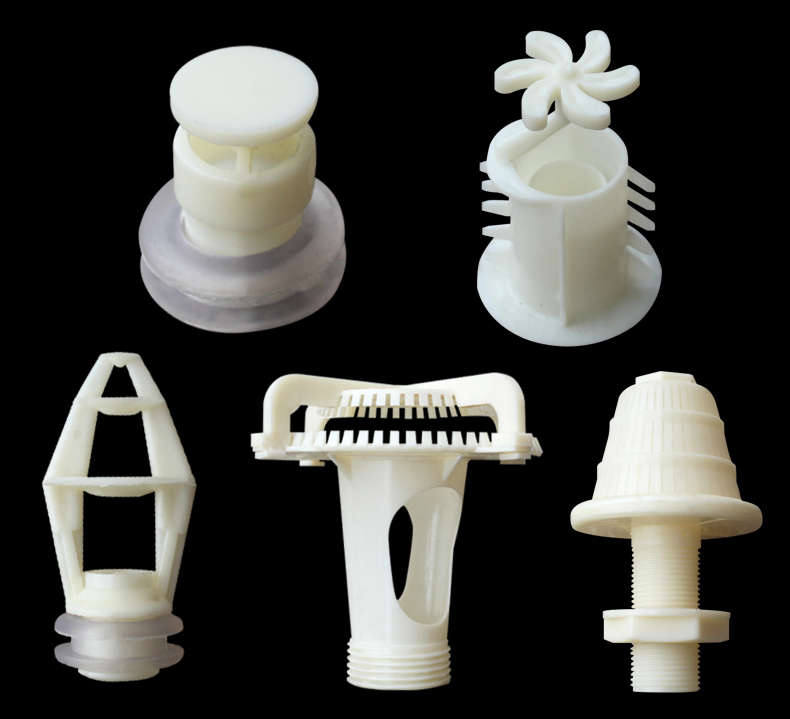
You are here: Home » Blog » Cooling Tower Spray Nozzle Pressure Drop

Cooling Tower Spray Nozzle Pressure Drop

Views: 0     Author: Lisa     Publish Time: 2025-12-03      Origin: Site

facebook sharing button
twitter sharing button
line sharing button
wechat sharing button
linkedin sharing button
pinterest sharing button
whatsapp sharing button
sharethis sharing button

Here is a clear, practical explanation of cooling tower spray nozzle pressure drop and how to estimate it for real systems.


 ✅ What Is Nozzle Pressure Drop?


Pressure drop across a cooling tower spray nozzle is the pressure required at the nozzle inlet to produce the correct flow rate and spray pattern (usually full-cone / umbrella).


Typical cooling tower nozzles operate at very low pressure, usually:

0.5 – 10 psi


(≈ 0.03 – 0.7 bar)


Crossflow towers often use even less:


1–2 psi is common.


Counterflow towers usually require:


2–6 psi depending on nozzle type.


Why Pressure Drop Matters


If pressure is too low:


* Spray pattern collapses

* Dry spots on fill

* Loss of tower capacity


If pressure is too high:


* Over-atomization

* Drift loss increases

* Erosion of ABS/PVC nozzles


Nozzle Pressure Drop Formula


Most cooling tower nozzles follow the standard nozzle equation:


Q = K \sqrt{P}


Where:


* Q = flow rate (GPM)

* P = pressure drop (psi)

* K = nozzle coefficient (depends on nozzle size)


Rearranged:


## [


P = \left(\frac{Q}{K}\right)^2

]


  Typical Pressure Drop Examples


1. Marley / BAC / EVAPCO Full-Cone Nozzles


Nozzle Type  Typical Pressure Flow at Typical Pressure
Marley Spiral Nozzle 2–4 psi  20–60 GPM
BAC Spray Nozzle (counterflow) 3–6 psi  15–40 GPM 
EVAPCO PP Nozzle 2–5 psi  10–50 GPM
Crossflow ABS target nozzle 1–2 psi 20–120 GPM


Pressure Requirements by Tower Type


Crossflow Cooling Tower


* Uses gravity + low-pressure nozzles

* 0.5–2 psi at nozzle inlet

* Larger orifices → less prone to clogging


Counterflow Cooling Tower


* Higher spray height

* Needs atomization for uniform fill wetting

* 3–6 psi typical


Example Calculation


Example: A nozzle with K = 10

Required flow = 30 GPM


P =(30/10)= 9  psi


Higher K → needs less pressure

Lower K → needs more pressure


What Affects Nozzle Pressure Drop?


1. Nozzle orifice size


Smaller → higher pressure required.


2. Spray pattern (full cone vs flat fan)


Full cone = higher pressure.


3. Water quality


Scaling increases effective pressure.


4. Distribution piping layout


Improper design may starve nozzles.


冷却塔喷头英文内页_10


CONTACT US
Consult Your Cooling Tower Expert
Cooling Tower Parts
COOLING TOWER PARTS SUPPLIER
OEM Brands
Quick Links
COOLING TOWER PARTS SUPPLIER
Cooling Tower Parts
OEM Brands
Quick Links
COPYRIGHT © 2024 ZHEJIANG AOSHUAI REFRIGERATION CO., LTD. ALL RIGHTS RESERVED.