You are here: Home » Blog » Cooling Tower Pump Pressure
Cooling Tower Pump Pressure
Views: 0 Author: Site Editor Publish Time: 2025-12-11 Origin: Site
The Importance and Regulation Guidelines of Cooling Tower Pump Pressure
In industrial cooling systems, Cooling Tower Pump Pressure is a key parameter that affects equipment stability, heat transfer efficiency, and system lifespan. Whether it is HVAC systems, industrial manufacturing, chemical cooling, or power plant cooling systems, as long as the cooling tower circulating water system is involved, the Cooling Tower Pump Pressure must be correctly set and monitored.
What Is Cooling Tower Pump Pressure?
Cooling Tower Pump Pressure refers to the water pressure generated by the circulating pump of the cooling tower during operation, which is used to push the cooling water from the cooling tower to the heat exchange equipment (such as refrigeration units, plate heat exchangers, condensers, etc.), and finally return to the cooling tower.
Therefore, precise control of Cooling Tower Pump Pressure is a prerequisite for ensuring the normal operation of the cooling tower.
How Is Cooling Tower Pump Pressure Calculated?
The pressure of the cooling tower water pump is mainly composed of the following factors:
1. System head (Static Head)
2. Friction loss in pipelines
3. Equipment resistance (such as condenser pressure drop)
4. Height difference of cooling tower
Common formulas:
Pump Pressure=Total Head×0.098
(Unit: Head is calculated in mH ₂ O, Pressure is calculated in bar)
And the Total Head is generally as follows:
Total Head=Static Head+Friction Loss+Equipment Pressure Drop
What Problems Can Incorrect Cooling Tower Pump Pressure cause?
1. Low pressure
1)The cooling effect of the condenser decreases
2)Insufficient outflow rate
3)Cooling tower cannot effectively dissipate heat
4)Water pumps are prone to cavitation
5The heat exchange efficiency is significantly reduced
2. Excessive pressure
1)Increase energy consumption
2)Pipeline vibration and noise increase
3)Possible damage to valve components and joints
4)Increased risk of water hammer in the system
Method For Optimizing Cooling Tower Pump Pressure
1. Adjust the pump speed through a frequency converter (VFD)
Energy saving and stable, currently the most commonly used method.
2. Regularly clean the condenser and filter
Reduce resistance and pressure drop.
3. Optimize pipeline design
Adding elbows, valves, etc. will significantly increase Friction Loss.
4. Adjust using a bypass valve
Used for minor adjustments, but it is not recommended to rely on the bypass to reduce pump pressure for a long time (wasting energy).
5. Use a flow meter and pressure gauge monitoring system
Real time monitoring of Cooling Tower Pump Pressure data.
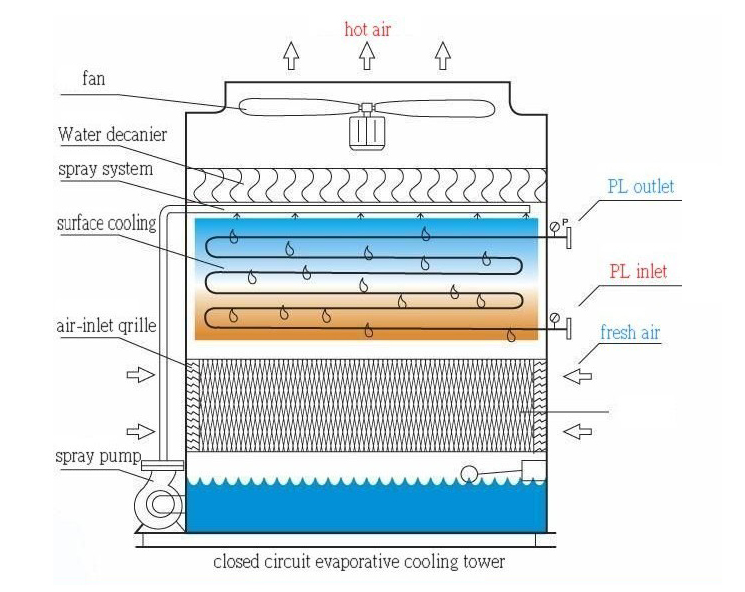
Cooling Tower Pump Diagram
Conclusion
Cooling Tower Pump Pressure is the key to ensuring stable operation of the cooling tower and cooling water system. By proper calculation, adjustment, and maintenance, it is possible to significantly improve heat dissipation efficiency, reduce energy consumption, and extend equipment lifespan