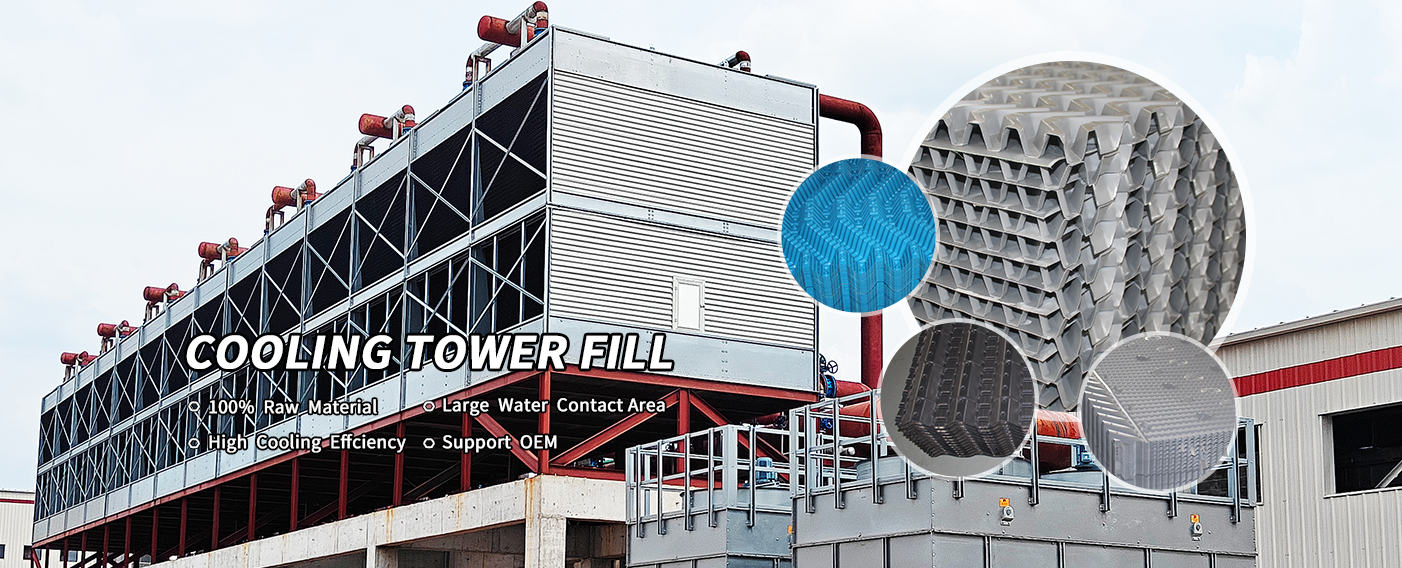
When you look inside a cooling tower, the fill may seem like a simple collection of plastic sheets. But don't let its appearance fool you. Cooling tower film fill is one of the most important components responsible for efficient heat transfer.
The basic idea is simple: hot circulating water flows through the fill while air passes over or through it. The fill spreads the water into thin films and creates a large contact area between water and air. As a result, heat can move from the water into the air, while evaporation removes additional heat from the system.
But here's where things get interesting.
Not every cooling tower operates in the same way. Counterflow cooling towers and crossflow cooling towers use different airflow arrangements, so the film fill must be selected and installed according to the tower design.
So, how do you choose the right cooling tower film fill for counterflow and crossflow towers?
In this guide, we'll explain how both systems work, compare their film-fill requirements, discuss PVC film fill, cover selection and maintenance, and introduce Power Tower Cooling Technology (Shaoxing) Co., Ltd. as a cooling tower fill manufacturer and supplier.
What Is Cooling Tower Film Fill?
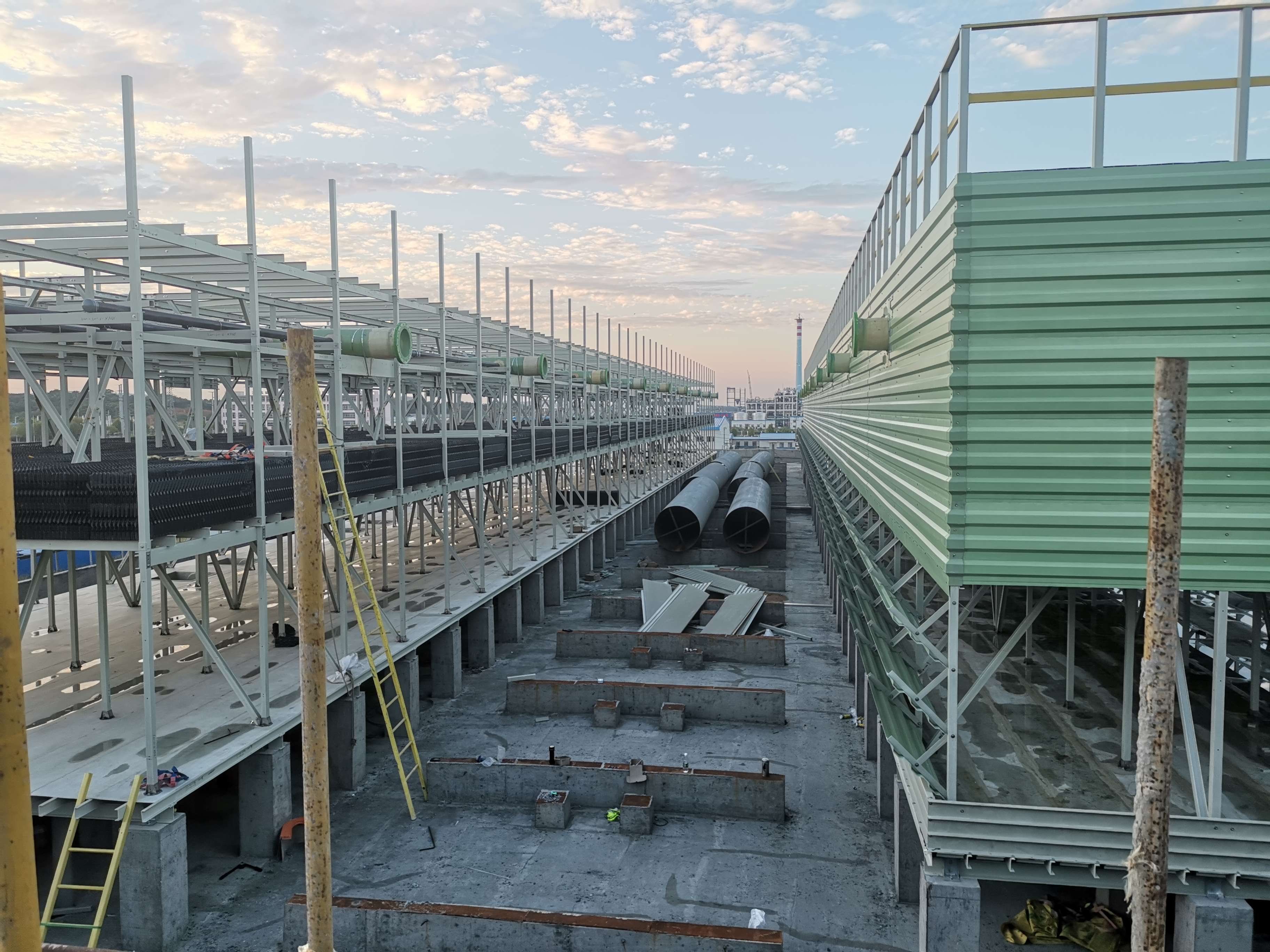
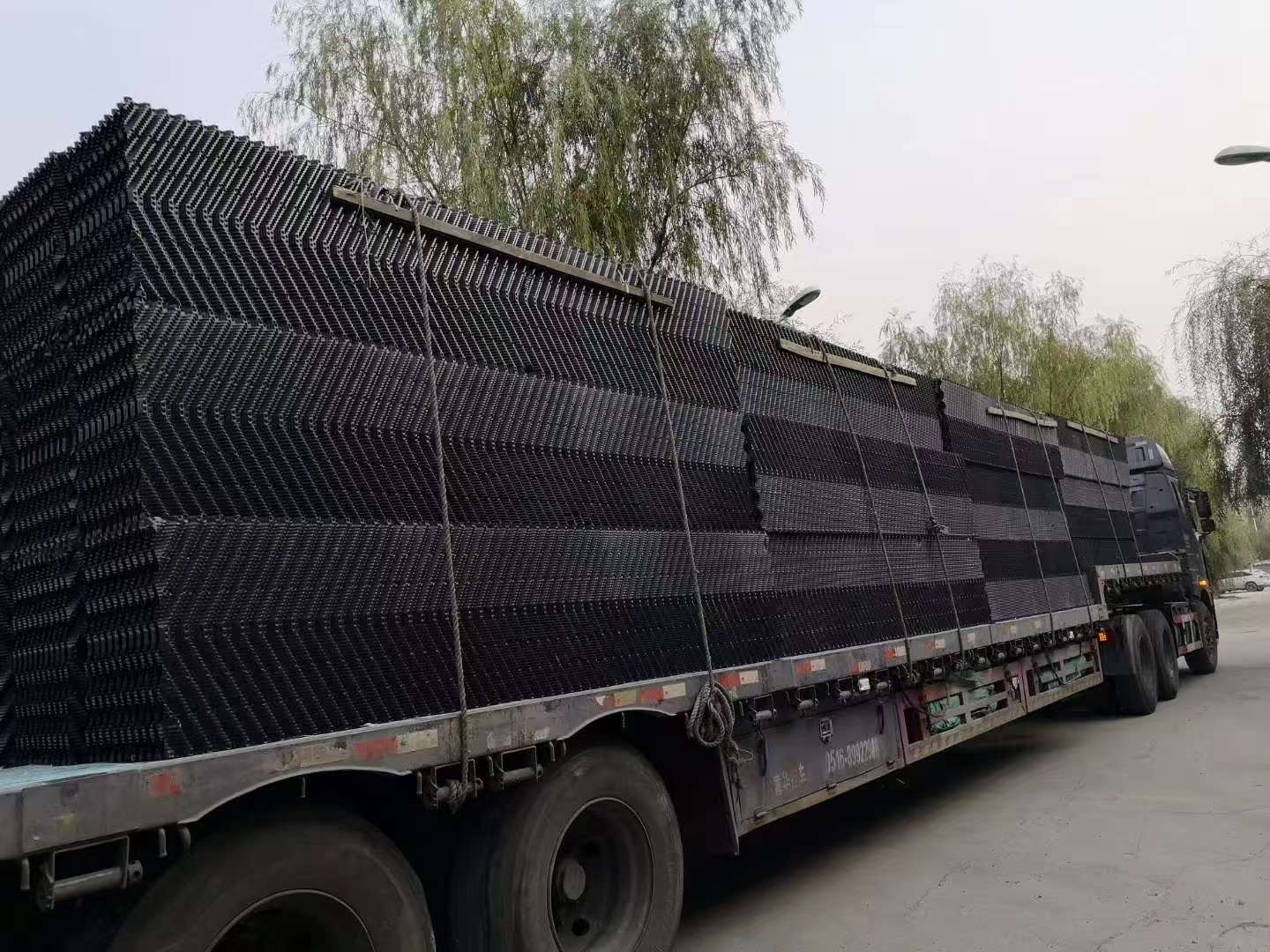
Cooling tower film fill is a structured heat-transfer media used to increase the contact area between circulating water and air.
Without fill, water would simply fall through the tower in streams or droplets. The contact area between water and air would be relatively limited.
Film fill changes that.
The structured sheets create channels and surfaces that cause the water to spread into thin films. At the same time, air passes through the passages created by the fill.
Think of it like spreading a thin layer of paint over a large surface instead of pouring all the paint into one small container. The larger exposed area creates much more opportunity for interaction.
That is essentially what film fill does inside a cooling tower.
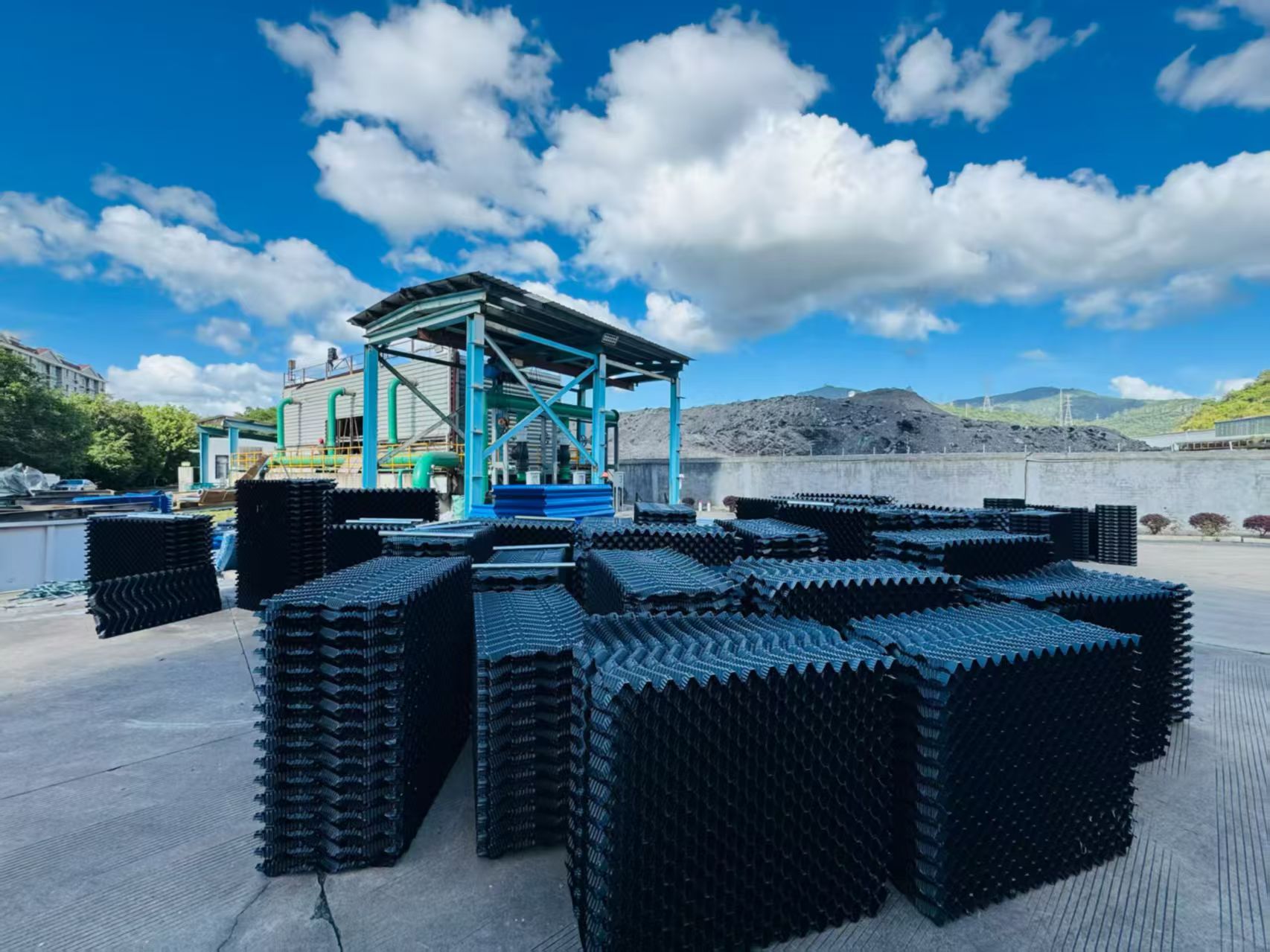
How Does Cooling Tower Film Fill Work?
The cooling process generally follows several steps.
First, hot water enters the cooling tower and reaches the water distribution system. The distribution system spreads water over the upper area of the fill.
The water then flows downward across the structured surfaces of the film fill.
At the same time, air moves through the fill. Depending on the tower design, the air may move upward or horizontally.
As water and air interact, heat transfers from the water to the air. A portion of the water also evaporates, carrying additional heat away from the circulating water.
The cooled water eventually reaches the cold-water basin and returns to the process system.
This continuous cycle allows the cooling tower to reject heat efficiently.
Why Does Surface Area Matter?
Surface area is one of the most important concepts behind film fill.
The more effective contact area available between air and water, the more opportunity there is for heat and mass transfer.
Film fill creates this area without requiring an enormous tower.
Instead of needing a large open space, the tower uses structured sheets with channels, corrugations, and patterns that spread water across many surfaces.
However, more surface area does not automatically mean better performance.
If the passages are too narrow, dirt and scale can block them. If the fill creates too much air resistance, fan energy consumption may increase.
Therefore, good film-fill design must balance:
Heat-transfer efficiency
Airflow resistance
Water distribution
Fouling resistance
Mechanical strength
Operating temperature
Water quality
That balance is what makes film-fill selection an engineering decision rather than simply a purchasing decision.
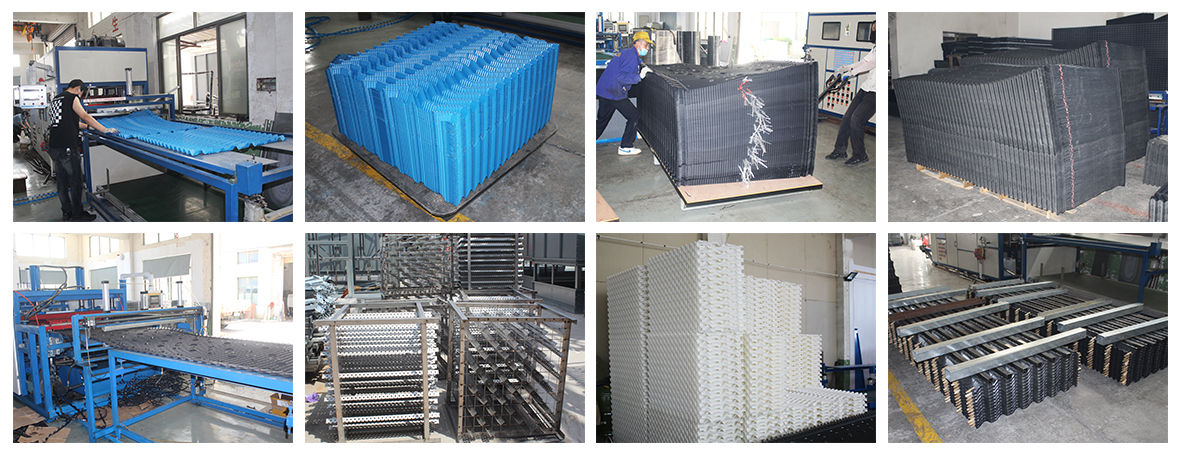
Counterflow vs. Crossflow Cooling Towers
Before selecting film fill, you need to understand the difference between counterflow and crossflow cooling towers.
The biggest difference is airflow direction.
In a counterflow cooling tower, water travels downward while air travels upward.
In a crossflow cooling tower, water travels downward while air moves horizontally across the falling water.
Both designs use air and water to reject heat, but their internal arrangements are different.
That means the film fill must be compatible with the specific tower configuration.
How Do Counterflow Cooling Towers Work?
In a counterflow cooling tower, hot water enters near the top of the tower.
The water distribution system spreads the water across the fill.
Water then travels downward through the fill while air moves upward.
In other words, the two fluids move in opposite directions.
This counter-directional arrangement allows the water and air to maintain effective contact throughout the fill section.
The warmest water generally enters near the top, while relatively cooler air enters from the lower portion of the tower.
This arrangement can provide effective thermal performance within a relatively compact footprint.
For projects where installation space is limited, this can be an important advantage.
How Do Crossflow Cooling Towers Work?
Crossflow cooling towers operate differently.
Water is distributed from the top and travels vertically downward through the fill.
Air enters from the side of the tower and moves horizontally across the falling water.
So instead of moving in opposite directions, the water and air move roughly perpendicular to each other.
This is why the design is called "crossflow."
Crossflow towers can provide convenient access to certain internal components, particularly around the water distribution area.
They are also commonly considered for larger cooling systems where the site layout can accommodate horizontal airflow.
Cooling Tower Film Fill for Counterflow Towers
Film fill is commonly used in counterflow cooling towers because the vertical airflow arrangement works well with structured fill.
The water moves downward over the fill while air moves upward through the same fill section.
The fill must therefore provide enough surface area for effective water-air contact without creating excessive airflow resistance.
Counterflow Film Fill Design
Counterflow film fill usually contains channels, corrugations, or other structured patterns.
These patterns encourage water to spread across the fill surfaces instead of falling directly through the tower.
At the same time, the channels provide paths for air to travel upward.
The exact geometry can vary according to the manufacturer and application.
Some fill designs prioritize high thermal performance, while others place greater emphasis on fouling resistance or airflow characteristics.
The correct choice depends on the actual cooling tower operating conditions.
Water and Air Flow Arrangement
The flow relationship is one of the main advantages of the counterflow design.
Water enters from the top and moves downward.
Air enters from below and moves upward.
This creates continuous interaction between the two fluids as they travel through the fill.
Because the airflow direction is vertical, the fill needs to maintain open and consistent air passages.
Poor installation can disrupt the intended airflow pattern.
That's why fill blocks should be installed carefully and aligned according to the tower manufacturer's requirements.
Advantages of Counterflow Film Fill
Counterflow film fill can provide several benefits, including:
High water-air contact area
Compact heat-transfer design
Efficient use of tower volume
Suitable for many industrial applications
Compatibility with PVC structured fill
Potentially strong thermal performance
However, the advantages depend on proper water distribution and suitable operating conditions.
If the water distribution system is poor, even high-quality film fill cannot perform as expected.
Cooling Tower Film Fill for Crossflow Towers
Film fill can also be used effectively in crossflow cooling towers.
The key difference is the airflow direction.
Water travels downward through the fill while air moves horizontally.
Therefore, the fill geometry needs to support horizontal airflow while maintaining effective water distribution across the surfaces.
Crossflow Film Fill Design
Crossflow film fill is structured to allow water to spread over the fill surfaces while air moves through the passages from the side.
The design must balance several factors:
Water distribution
Airflow resistance
Heat-transfer area
Fill spacing
Fouling resistance
Mechanical stability
Water distribution is especially important.
If some areas receive too much water while other areas receive too little, the entire fill volume will not contribute equally to cooling.
Horizontal Airflow and Vertical Water Flow
A simple way to visualize a crossflow tower is to imagine rain falling vertically while wind moves horizontally.
The water moves down.
The air moves sideways.
The fill creates a structured contact zone between them.
This arrangement can provide effective cooling while allowing convenient access to some tower components.
Advantages of Crossflow Film Fill
Crossflow film fill can be useful for applications where accessibility and tower layout are important.
Potential advantages include:
Convenient access to water distribution components
Horizontal airflow arrangement
Effective water-air contact
Flexible large-tower configurations
Suitable options for structured PVC fill
Again, however, the actual performance depends on the complete cooling tower system rather than the fill alone.

PVC Film Fill for Cooling Towers
When people search for cooling tower film fill, PVC is one of the materials they encounter most often.
PVC, or polyvinyl chloride, can be formed into structured sheets with carefully designed channels and patterns.
This makes it suitable for creating the large surface area required for film-type heat transfer.
Why Is PVC Widely Used?
PVC offers several practical advantages for cooling tower fill applications.
It is relatively lightweight, can be thermoformed into complex geometries, and provides useful resistance to corrosion compared with many traditional metallic materials.
It can also be manufactured in consistent sheet patterns, which is important because fill geometry influences both thermal and hydraulic performance.
For many standard cooling tower applications, PVC provides a practical balance between performance and cost.
However, PVC is not automatically suitable for every environment.
The operating temperature, water chemistry, chemical exposure, and fouling conditions should always be evaluated before selecting a particular PVC film fill.
PVC Film Fill Performance
The performance of PVC film fill depends on several factors.
These include:
Sheet thickness
Fill height
Surface pattern
Flute geometry
Channel spacing
Water loading
Airflow
Water temperature
Water quality
A well-designed film fill should provide effective heat transfer without creating unnecessary pressure drop.
In simple terms, the fill needs to give water enough surface area while still allowing air to move through the tower.
Counterflow and Crossflow Film Fill Comparison
Although both tower types can use film fill, the operating arrangement is different.
| Feature | Counterflow Film Fill | Crossflow Film Fill |
| Water direction | Downward | Downward |
| Air direction | Upward | Horizontal |
| Flow relationship | Opposite directions | Perpendicular directions |
| Main design consideration | Compact heat transfer | Airflow and water distribution |
| Typical airflow path | Vertical | Horizontal |
| Fouling consideration | Passage spacing is important | Passage spacing and water distribution are important |
| Installation requirement | Match vertical airflow | Match horizontal airflow |
The important point is that there is no universal film-fill configuration that fits every cooling tower.
A replacement fill should be selected according to the tower's existing structure and operating conditions.
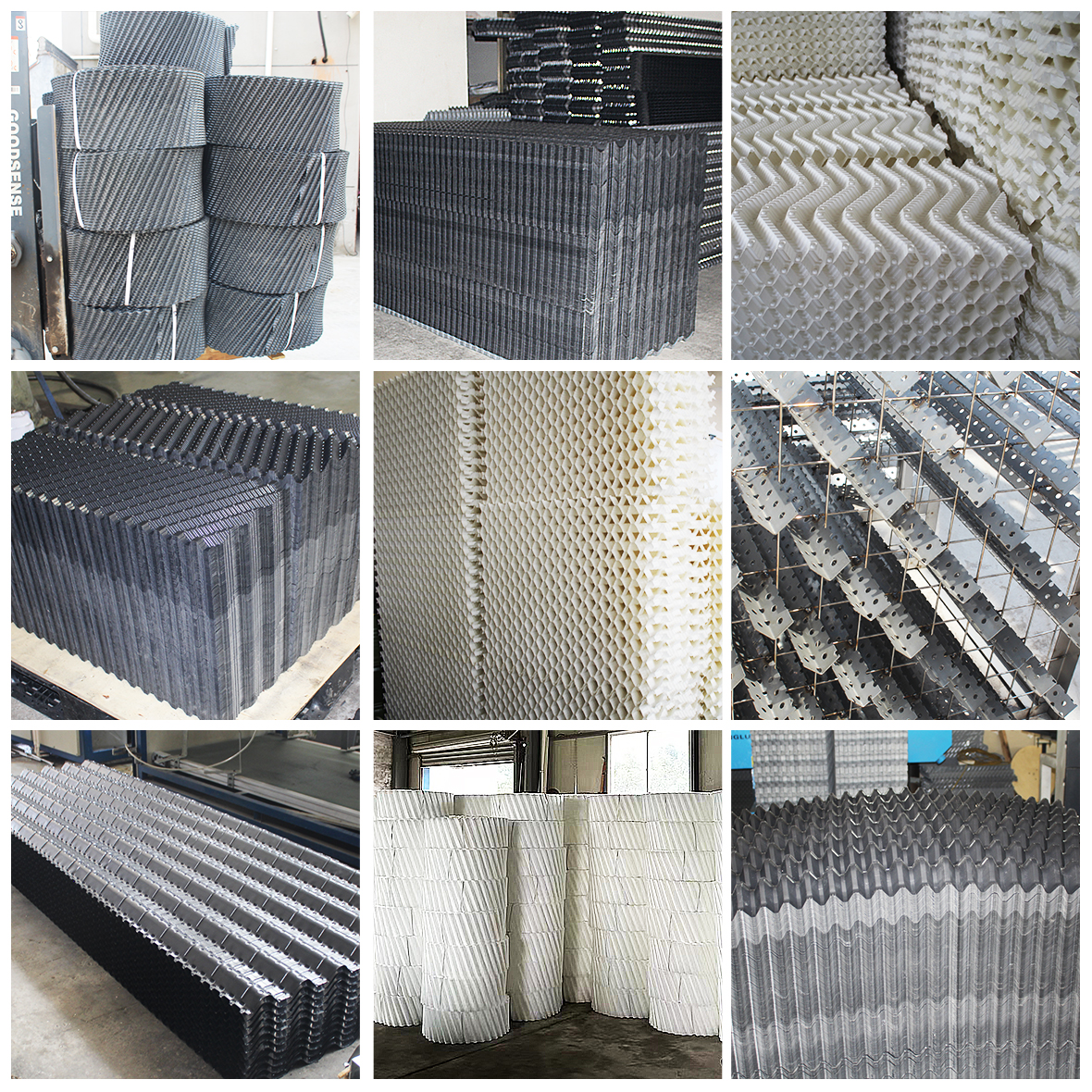
How to Choose the Right Cooling Tower Film Fill
Selecting the right film fill should begin with technical information.
Don't simply ask a supplier, "How much does cooling tower fill cost?"
Instead, provide as much information as possible about your cooling tower.
Important information includes:
Tower type
Counterflow or crossflow configuration
Existing fill dimensions
Water flow rate
Airflow
Entering water temperature
Leaving water temperature
Water quality
Operating environment
Application
Existing fill material
The more information you provide, the easier it becomes for the manufacturer to recommend an appropriate product.
Consider Water Quality
Water quality has a major impact on film-fill performance.
If your circulating water contains large amounts of suspended solids, minerals, algae, or biological contaminants, deposits can accumulate on the fill.
Over time, these deposits can restrict water and airflow.
This is particularly important for film fill because its narrow structured channels provide a large heat-transfer surface but may be more sensitive to heavy fouling than some open splash-fill designs.
For poor-quality water, a fill with appropriate passage spacing may be more suitable.
Consider Operating Temperature
Temperature is another important factor.
Before ordering PVC film fill, provide the manufacturer with your normal operating temperature and maximum temperature.
Different PVC formulations and fill designs may have different temperature limitations.
A fill that works well in a conventional HVAC cooling tower may not be suitable for a high-temperature industrial process.
Consider Water and Air Loading
Water loading and airflow should also be considered.
Too much water for a particular fill configuration can affect hydraulic performance.
Too little water can lead to poor wetting and unused heat-transfer area.
Airflow is equally important.
If the fill produces excessive pressure drop, the cooling tower fan may need to work harder.
The goal is to achieve an appropriate balance between heat transfer and airflow resistance.
Consider Fouling and Clogging
Fouling is one of the biggest challenges associated with cooling tower film fill.
Scale, dirt, algae, and biological growth can gradually cover the fill surface.
As the passages become restricted, both heat-transfer performance and airflow can decline.
Think about what happens when dust blocks an air filter.
Air can still pass through, but it has to work harder.
The same principle applies to cooling tower fill.
Good water treatment and regular maintenance are therefore essential.
Cooling Tower Film Fill Maintenance
Even the best film fill requires proper maintenance.
A regular inspection program can help operators identify problems before they become expensive failures.
During inspections, check for:
Don't forget the water distribution system.
A problem with spray nozzles or distribution pipes can sometimes look like a fill problem.
Cleaning Cooling Tower Film Fill
Cleaning should be performed according to the material and condition of the fill.
Excessive mechanical force can damage structured PVC sheets.
Aggressive chemicals can also cause material degradation if they are incompatible with the fill.
A suitable cleaning procedure should consider both the fill material and the cooling-water treatment program.
In many cases, prevention is much easier than restoration.
Regular water treatment, filtration, blowdown control, and inspection can reduce the amount of contamination reaching the fill.
When Should Film Fill Be Replaced?
There is no single replacement schedule that applies to every cooling tower.
The service life of film fill depends on:
Water quality
Temperature
Chemical exposure
UV exposure
Biological activity
Mechanical damage
Cleaning frequency
Operating conditions
Replacement may be necessary when the fill becomes severely brittle, deformed, cracked, blocked, or physically damaged.
If cleaning no longer restores acceptable performance, replacing the fill may be the more practical solution.
Common Cooling Tower Film Fill Problems
Film fill problems are not always caused by the fill itself.
A cooling tower is a complete system, and several components work together.
Uneven Water Distribution
Uneven water distribution is a common problem.
Some sections may receive excessive water while other areas remain under-wetted.
This creates an inefficient cooling pattern.
When troubleshooting, inspect:
Spray nozzles
Distribution pipes
Headers
Water pressure
Fill alignment
Fill blockage
A properly designed fill cannot compensate for a severely uneven water distribution system.
Scaling and Biological Fouling
Scale and biological growth can gradually reduce the available heat-transfer area.
Deposits can cover the film surface and restrict the channels.
If the problem continues, pressure drop may increase and cooling capacity may decline.
A properly managed water-treatment program is therefore an important part of maintaining film-fill performance.
Choosing a Cooling Tower Film Fill Manufacturer
Choosing a supplier is about more than comparing prices.
A reliable cooling tower film fill manufacturer should be able to understand your tower and provide a product that matches your actual application.
When comparing manufacturers, consider:
Manufacturing experience
Material quality
Product consistency
Fill design
Customization capability
Technical support
Packaging
Export experience
Replacement support
If you're replacing existing fill, the manufacturer should be able to work from dimensions, drawings, photographs, and technical specifications.
Power Tower Cooling Technology (Shaoxing) Co., Ltd.
Power Tower Cooling Technology (Shaoxing) Co., Ltd. is a manufacturer and supplier specializing in cooling tower components and related products.
For buyers looking for cooling tower film fill manufacturers and suppliers, the company provides cooling tower fill solutions for different tower configurations and applications.
The company can work with customers who need cooling tower fill for replacement projects as well as new cooling tower applications.
Its product range is focused on cooling tower components, making it a practical option for buyers who need more than a single generic fill product.
For product information and supplier inquiries, visit:
https://www.coolingtowerpart.com

Manufacturing and Customization
Replacement projects can be more complicated than they initially appear.
Why?
Because existing cooling towers often have different fill dimensions, support structures, fill heights, block arrangements, and installation methods.
A good manufacturer should be able to evaluate these details before recommending a product.
When contacting a supplier, provide:
Cooling tower type
Existing fill dimensions
Fill height
Water flow rate
Operating temperature
Water quality
Application
Photos of the existing fill
Drawings, if available
This information can make the quotation and technical selection process much faster.
Applications of Cooling Tower Film Fill
Cooling tower film fill is used across a wide range of industries.
Typical applications include:
In HVAC systems, cooling towers reject heat from chilled-water systems.
In industrial facilities, cooling towers may remove heat generated by production equipment or process systems.
The application may be different, but the fundamental principle remains the same.
The goal is to create effective contact between air and water so that heat can be rejected from the circulating water.
Frequently Asked Questions About Cooling Tower Film Fill
Is Film Fill Suitable for Both Counterflow and Crossflow Towers?
Yes.
Film fill can be used in both counterflow and crossflow cooling towers.
However, the exact film-fill design must match the tower's airflow direction, water distribution system, thermal requirements, water quality, and physical dimensions.
You should not assume that a fill designed for one tower configuration can simply be transferred to another without checking compatibility.
Is PVC Film Fill Better Than Splash Fill?
Neither is automatically better for every application.
Film fill generally provides a large effective surface area and can offer compact heat-transfer performance.
Splash fill, on the other hand, can provide larger flow passages and may be more appropriate for certain applications with heavier fouling potential or poorer water quality.
The right choice depends on the tower design and operating environment.
How Long Does Cooling Tower Film Fill Last?
Service life varies considerably.
Water chemistry, temperature, biological control, cleaning, mechanical conditions, and operating environment all affect longevity.
Well-maintained fill can provide many years of service, but heavily fouled or chemically damaged fill may need replacement much sooner.
Can PVC Film Fill Be Used in Industrial Cooling Towers?
Yes.
PVC film fill is used in many industrial cooling applications.
However, the supplier should evaluate the process temperature, water chemistry, contamination level, and fouling potential before recommending a specific PVC fill.
How Do I Order Replacement Cooling Tower Film Fill?
Start by measuring the existing fill.
Record the length, width, height, sheet arrangement, and block configuration.
Then provide information about the cooling tower type, water flow, operating temperature, water quality, and application.
Photos are also extremely useful.
A manufacturer such as Power Tower Cooling Technology (Shaoxing) Co., Ltd. can use this information to help determine an appropriate replacement solution.
Final Thoughts
Choosing cooling tower film fill for counterflow and crossflow towers requires more thought than simply selecting a plastic fill product.
The airflow direction, water distribution, fill geometry, material, operating temperature, water quality, and maintenance conditions all affect performance.
Counterflow towers move air upward while water travels downward. Crossflow towers move air horizontally while water falls vertically. Both configurations can use film fill effectively, but the fill needs to match the tower design.
PVC remains one of the most widely used materials for film fill because it combines practical manufacturing characteristics with useful corrosion resistance, relatively low weight, and good heat-transfer potential.
But remember one important point: the best cooling tower film fill is not necessarily the cheapest product or the product with the largest surface area.
The best choice is the one that fits your actual tower.
If you're dealing with clean water, heavily fouled water, a standard HVAC application, or an industrial process, the selection criteria may be different.
That's why working with an experienced cooling tower film fill manufacturer and supplier can make the purchasing process much easier.
For cooling tower film fill, PVC fill, replacement fill, and other cooling tower components, Power Tower Cooling Technology (Shaoxing) Co., Ltd. provides products and technical support for different cooling tower applications.
Visit https://www.coolingtowerpart.com to explore cooling tower fill products and related components.
Ultimately, think of film fill as the place where the cooling tower's air and water "meet."
The better that meeting is designed, the more effectively the tower can transfer heat.
Choose the right fill, install it correctly, maintain it consistently, and your cooling tower will have a much stronger foundation for reliable long-term operation.


