Cooling Tower Fill Media: Types, Benefits, Selection Guide, and Maintenance
Cooling tower fill media is one of the most important components inside an evaporative cooling tower. It increases the contact area between hot water and air, allowing heat to transfer more efficiently and helping the cooling tower achieve the required outlet water temperature.
Choosing the right cooling tower fill media can improve thermal performance, reduce water consumption, extend equipment life, and lower operating costs. However, different cooling tower designs and operating conditions require different types of fill.
This guide explains the types of cooling tower fill media, their advantages, applications, material options, and key factors to consider when selecting replacement fill.
What Is Cooling Tower Fill Media?
Cooling tower fill media is the internal material installed inside a cooling tower to increase the surface area available for water-to-air heat transfer.
As hot water flows over the fill, it spreads into thin films or droplets. At the same time, air moves through the fill media. The increased contact area allows heat to transfer from the water to the air, while a portion of the water evaporates and removes additional heat.
How Does Cooling Tower Fill Media Work?
The basic cooling process can be divided into several steps:
Hot water enters the cooling tower.
The water distribution system sprays or distributes water over the fill.
Water flows downward through the cooling tower fill media.
Air passes through the fill in either a crossflow or counterflow direction.
Heat transfers from the water to the air.
A portion of the water evaporates.
Cooled water collects in the basin and returns to the system.
Why Is Surface Area Important?
The greater the effective contact area between water and air, the greater the potential for heat transfer.
High-quality cooling tower fill media is therefore designed to distribute water evenly while creating a large effective surface area within a relatively small volume.
Main Types of Cooling Tower Fill Media
Cooling tower fill media can generally be divided into two major categories: film fill and splash fill.
Each type has different characteristics and is suitable for different operating conditions.
Film Fill
Film fill is designed to spread water into a thin continuous film over the surface of the fill sheets.
The thin water film creates a large contact area between water and air, resulting in high heat-transfer efficiency.
Advantages of Film Fill
High thermal efficiency
Large effective surface area
Compact design
Lower required fill volume
Suitable for many modern cooling towers
Excellent water-to-air contact
Film fill is commonly manufactured from PVC or PP and is widely used in industrial and HVAC cooling tower applications.
Splash Fill
Splash fill works differently from film fill. Instead of creating a thin water film, it repeatedly breaks falling water into smaller droplets.
The resulting droplets increase contact between water and air and promote heat transfer.
Advantages of Splash Fill
Better tolerance to suspended solids
Less sensitive to some water-quality problems
Suitable for dirty or contaminated water
Good resistance to fouling
Available in various splash-bar designs
Splash fill is often preferred for applications where water contains significant amounts of suspended solids or biological contaminants.
PVC Cooling Tower Fill Media
PVC cooling tower fill media is one of the most widely used fill materials in evaporative cooling towers.
PVC is popular because it provides a good balance of thermal performance, cost, chemical resistance, and manufacturing flexibility.
Benefits of PVC Cooling Tower Fill
PVC cooling tower fill can offer several important advantages:
Why Choose PVC for Cooling Tower Fill?
PVC can be formed into corrugated or structured sheets that create a large contact area between air and water.
This allows manufacturers to produce compact fill packs capable of providing effective thermal performance without significantly increasing tower size.
PP Cooling Tower Fill Media
Polypropylene, commonly known as PP, is another material used for cooling tower fill media.
PP generally provides higher temperature resistance than standard PVC, making it suitable for applications where operating temperatures are relatively high.
PVC vs. PP Cooling Tower Fill
| Feature | PVC Fill | PP Fill |
| Thermal efficiency | High | High |
| Temperature resistance | Moderate | Higher |
| Chemical resistance | Good | Excellent |
| Weight | Lightweight | Lightweight |
| Cost | Economical | Generally higher |
| Typical application | HVAC and industrial towers | Higher-temperature applications |
The best material depends on water temperature, chemical conditions, tower design, and operating requirements.
Film Fill vs. Splash Fill
Choosing between film fill and splash fill is an important decision when designing or replacing cooling tower fill media.
Film Fill
Film fill provides a large effective surface area and is generally selected when high thermal efficiency and compact design are important.
Splash Fill
Splash fill is often selected for applications where water quality is poor or where fouling and suspended solids could significantly affect structured fill.
Which Cooling Tower Fill Is Better?
There is no universal answer.
Film fill may be the better choice for clean-water applications where maximum thermal efficiency is required. Splash fill may be more appropriate for applications involving contaminated water, high solids loading, or difficult operating conditions.
The selection should be based on the complete cooling tower operating environment rather than thermal performance alone.
How to Choose the Right Cooling Tower Fill Media
Selecting the correct cooling tower fill requires consideration of several technical factors.
1. Cooling Tower Type
First, determine whether the tower is a:
Crossflow cooling tower
Counterflow cooling tower
Open-circuit cooling tower
Closed-circuit cooling system
Industrial process cooling tower
HVAC cooling tower
Different tower configurations may require different fill geometries.
2. Operating Water Temperature
Water temperature has a direct influence on fill material selection.
If the entering water temperature is relatively high, a material such as PP may be more appropriate than standard PVC, depending on the specific operating conditions.
3. Water Quality
Water quality is one of the most important considerations.
If the circulating water contains:
the fill should be selected for resistance to fouling and clogging.
Clean Water Applications
Film fill is often suitable for relatively clean water because its closely spaced channels provide excellent heat transfer.
Dirty Water Applications
Splash fill may be more suitable when water contains high levels of suspended particles or contaminants.
4. Fill Pitch
The pitch or spacing of cooling tower fill sheets affects both thermal performance and fouling resistance.
A smaller pitch can provide greater surface area, but it may also be more susceptible to clogging when water quality is poor.
A larger pitch can provide better resistance to blockage but may reduce the available surface area.
5. Fill Thickness
The thickness of the fill sheet can affect durability, mechanical strength, handling, and service life.
The appropriate thickness depends on the material, tower design, operating environment, and expected service conditions.
What Are the Benefits of High-Quality Cooling Tower Fill Media?
Using properly designed cooling tower fill can significantly improve cooling tower performance.
Improved Heat Transfer
High-quality fill creates a larger effective contact area between water and air, improving heat transfer.
Reduced Cooling Tower Footprint
Because efficient fill can provide high thermal performance within a relatively small volume, it can help reduce the required tower size for a given cooling duty.
Improved Energy Efficiency
Better heat transfer can help the cooling tower achieve the required cold-water temperature more effectively, potentially reducing fan and pumping energy requirements.
Better Water Distribution
Properly designed fill helps distribute water over a large surface area, reducing dry spots and improving thermal performance.
Longer Service Life
High-quality materials can provide good resistance to chemical attack, deformation, and operating conditions, helping extend the service life of the fill.
Common Problems With Cooling Tower Fill Media
Even high-quality cooling tower fill can experience problems if water treatment and maintenance are inadequate.
Fill Clogging
Dirt, algae, scale, and suspended solids can accumulate inside the fill channels.
Clogged fill restricts airflow and water distribution, reducing cooling performance.
Biological Growth
Warm and wet cooling tower environments can encourage algae and microbial growth.
Biological fouling can reduce the effective surface area of the fill and increase pressure drop.
Scale Formation
Hard-water minerals can form deposits on fill surfaces.
Heavy scaling reduces water distribution and heat-transfer efficiency.
Fill Deformation
Excessive temperature, chemical exposure, mechanical damage, or poor installation can cause fill sheets to deform.
Deformed fill can create uneven airflow and water distribution.
Cooling Tower Fill Media Maintenance
Regular maintenance is essential for keeping cooling tower fill working efficiently.
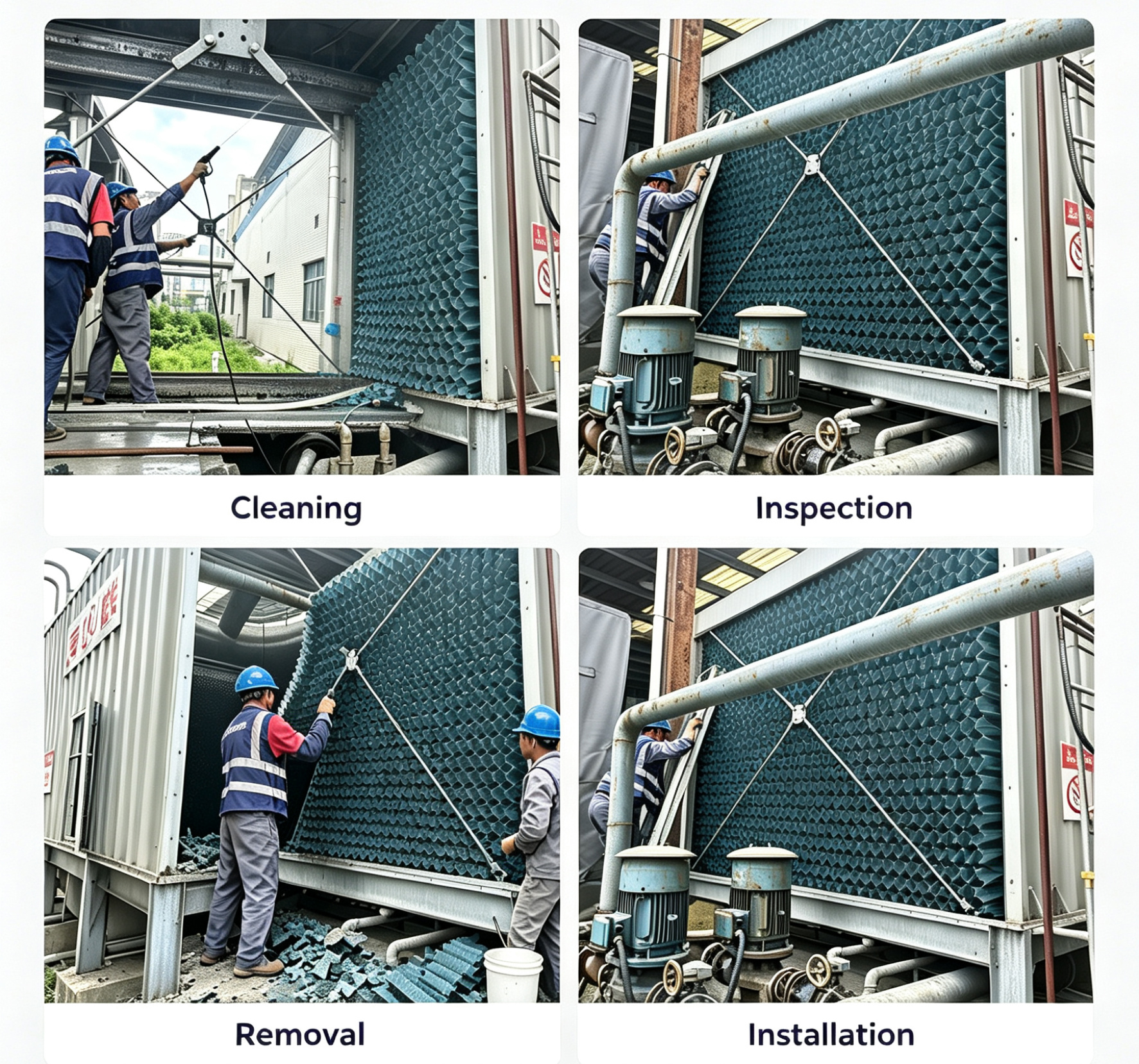
Inspect the Fill Regularly
During scheduled maintenance, inspect the fill for:
Clean Cooling Tower Fill
Cleaning frequency depends on water quality and operating conditions.
Low-pressure water cleaning can often be used to remove loose deposits. More severe fouling may require an appropriate chemical cleaning procedure.
Avoid Excessive Cleaning Pressure
High-pressure cleaning can damage PVC or PP fill sheets.
Cleaning should therefore be performed according to the fill manufacturer's recommendations.
Maintain Proper Water Treatment
Water treatment plays a critical role in extending cooling tower fill life.
A proper treatment program can help control:
Scale
Corrosion
Biological growth
Suspended solids
Good water treatment reduces the frequency of fill replacement and helps maintain stable cooling performance.
When Should Cooling Tower Fill Media Be Replaced?
Cooling tower fill does not necessarily need to be replaced simply because it has been installed for a certain number of years.
Replacement should be based on its physical condition and thermal performance.
Signs That Cooling Tower Fill Needs Replacement
Consider replacing the fill when you notice:
Performance-Based Replacement
If the cooling tower can no longer achieve the required cold-water temperature despite proper water flow, fan operation, and water treatment, the fill should be inspected.
A fill replacement project may restore the tower's thermal performance without requiring a complete cooling tower replacement.
Cooling Tower Fill Media Replacement Process
Replacing cooling tower fill requires careful planning and installation.
Step 1: Inspect Existing Fill
Determine the existing fill type, dimensions, material, thickness, and configuration.
Step 2: Measure the Fill Area
Accurate measurements are required to determine the replacement quantity.
Important dimensions include:
Fill length
Fill width
Fill height
Sheet thickness
Fill block dimensions
Support arrangement
Step 3: Select Replacement Fill
Choose the appropriate film fill or splash fill according to the cooling tower design and operating conditions.
Step 4: Remove Old Fill
Remove damaged or deteriorated fill carefully while avoiding damage to support structures, nozzles, piping, and other components.
Step 5: Install New Fill Media
Install the replacement fill according to the correct orientation and spacing.
Check Water and Airflow Direction
The fill must be installed correctly to ensure proper interaction between water and air.
Incorrect installation can reduce thermal performance even when high-quality fill is used.
Step 6: Inspect the Completed Installation
After installation, check:
Fill alignment
Support structure
Water distribution
Airflow path
Nozzle operation
Fill stability
Cooling Tower Fill Media Applications
Cooling tower fill media is used in many industries.
HVAC Cooling Towers
Commercial buildings, hospitals, hotels, shopping centers, and office buildings commonly use cooling towers as part of their HVAC systems.
Power Plants
Large cooling towers require high-performance fill capable of handling continuous industrial operation.
Chemical Plants
Chemical processing facilities often require cooling tower fill with good chemical resistance and suitable temperature performance.
Petrochemical Industry
Cooling towers in refineries and petrochemical plants may operate under demanding conditions and require durable fill materials.
Data Centers
Data centers rely on reliable cooling systems to maintain stable operating temperatures. Efficient cooling tower fill can contribute to reliable heat rejection.
How to Improve Cooling Tower Fill Performance
Several factors can help maintain high cooling tower performance.
Maintain Proper Water Distribution
Even water distribution is essential for making full use of the fill surface area.
Damaged nozzles or blocked distribution pipes can create dry areas and reduce heat transfer.
Control Water Quality
Maintaining appropriate water treatment reduces scale, biological growth, and fouling.
Maintain Proper Airflow
Cooling tower fans, fan blades, motors, and gearboxes should be maintained properly to ensure sufficient airflow through the fill.
Monitor Cooling Tower Approach
The cooling tower approach is the difference between the cold-water temperature leaving the tower and the entering-air wet-bulb temperature.
A rising approach may indicate reduced thermal performance, poor water distribution, insufficient airflow, or deteriorated fill.
Cooling Tower Fill Media: Film Fill or Splash Fill?
The best choice depends on your application.
| Requirement | Recommended Fill |
| High thermal efficiency | Film Fill |
| Compact tower design | Film Fill |
| Relatively clean water | Film Fill |
| High suspended solids | Splash Fill |
| Dirty industrial water | Splash Fill |
| Strong fouling resistance | Splash Fill |
| Higher-temperature operation | PP or suitable high-temperature fill |
The final selection should consider water quality, temperature, tower configuration, airflow, thermal duty, and maintenance requirements.
FAQ
What is cooling tower fill media?
Cooling tower fill media is the internal material that increases the contact area between circulating water and air, improving evaporative heat transfer inside the cooling tower.
What is the most common cooling tower fill material?
PVC is one of the most widely used materials for cooling tower film fill because it provides good thermal performance, chemical resistance, low weight, and cost-effectiveness.
How long does cooling tower fill last?
The service life varies according to material, water quality, operating temperature, UV exposure, chemical treatment, and maintenance. Proper water treatment and regular inspection can significantly extend fill life.
Can PVC cooling tower fill be replaced with PP fill?
In some applications, yes. However, the replacement should be evaluated based on operating temperature, chemical conditions, dimensions, thermal requirements, and cooling tower design.
How do I know if my cooling tower fill is damaged?
Common signs include excessive clogging, scaling, broken sheets, deformation, biological growth, reduced cooling capacity, and increased airflow resistance.
Does cooling tower fill affect energy consumption?
Yes. Efficient fill improves water-air heat transfer and can help the tower achieve the required cooling performance with optimized airflow and water circulation.
Conclusion
Cooling tower fill media plays a critical role in the heat-transfer performance of an evaporative cooling tower. Film fill provides high surface area and excellent thermal efficiency, while splash fill offers advantages in applications where water quality and fouling resistance are major concerns.
PVC cooling tower fill remains a popular choice for many HVAC and industrial applications, while PP fill can be considered for applications requiring higher temperature resistance.
When selecting or replacing cooling tower fill, consider the cooling tower type, water quality, operating temperature, fill pitch, material, thickness, airflow, and required thermal performance.
Choosing the right cooling tower fill media and maintaining it properly can improve cooling efficiency, extend equipment life, and help reduce long-term operating and maintenance costs.


