Cooling tower fill media is the heart of any evaporative cooling system. It is the surface where hot water and air meet, driving the heat exchange that keeps process temperatures stable. But fill degrades. After years of continuous service, PVC and polypropylene packs become fouled with scale, algae and biological growth. They soften, warp, collapse and lose their performance. The result is higher energy consumption, poor cooling, more water drift — and in severe cases, production downtime.
When that happens, a professional cooling tower fill media replacement supplier becomes one of the most important partners in an industrial maintenance and upgrade project. Choosing the right one is not simply about buying plastic sheets. It is about matching the fill to your tower type, your water chemistry, your load profile and your budget — and about getting a product that will last another decade without compromising thermal performance.
This guide explains how to select a fill media replacement supplier, what to look for in materials and design, and how to manage a replacement project from audit to commissioning.
Why Fill Media Replacement Matters
Fill media loses efficiency gradually, often without being noticed. A few percentage points of lost thermal capacity raise condenser pressure, increase fan and pump power draw, and force chillers to work harder. Industry data routinely shows that replacing worn or scaled fill restores a cooling tower to near-design performance, cutting energy costs by 5–15% in many installations.
Beyond performance, safety matters. Collapsed fill can block air flow, starve the fan motor, and in extreme cases lead to structural or fire hazards. For plants running continuous processes — steel, power, chemical, food and beverage, pharmaceutical — unplanned shutdowns cost far more than the fill itself. A scheduled, professionally managed replacement is almost always the lower-cost option.
Types of Cooling Tower Fill Media
A reliable supplier should help you choose among the main fill categories:
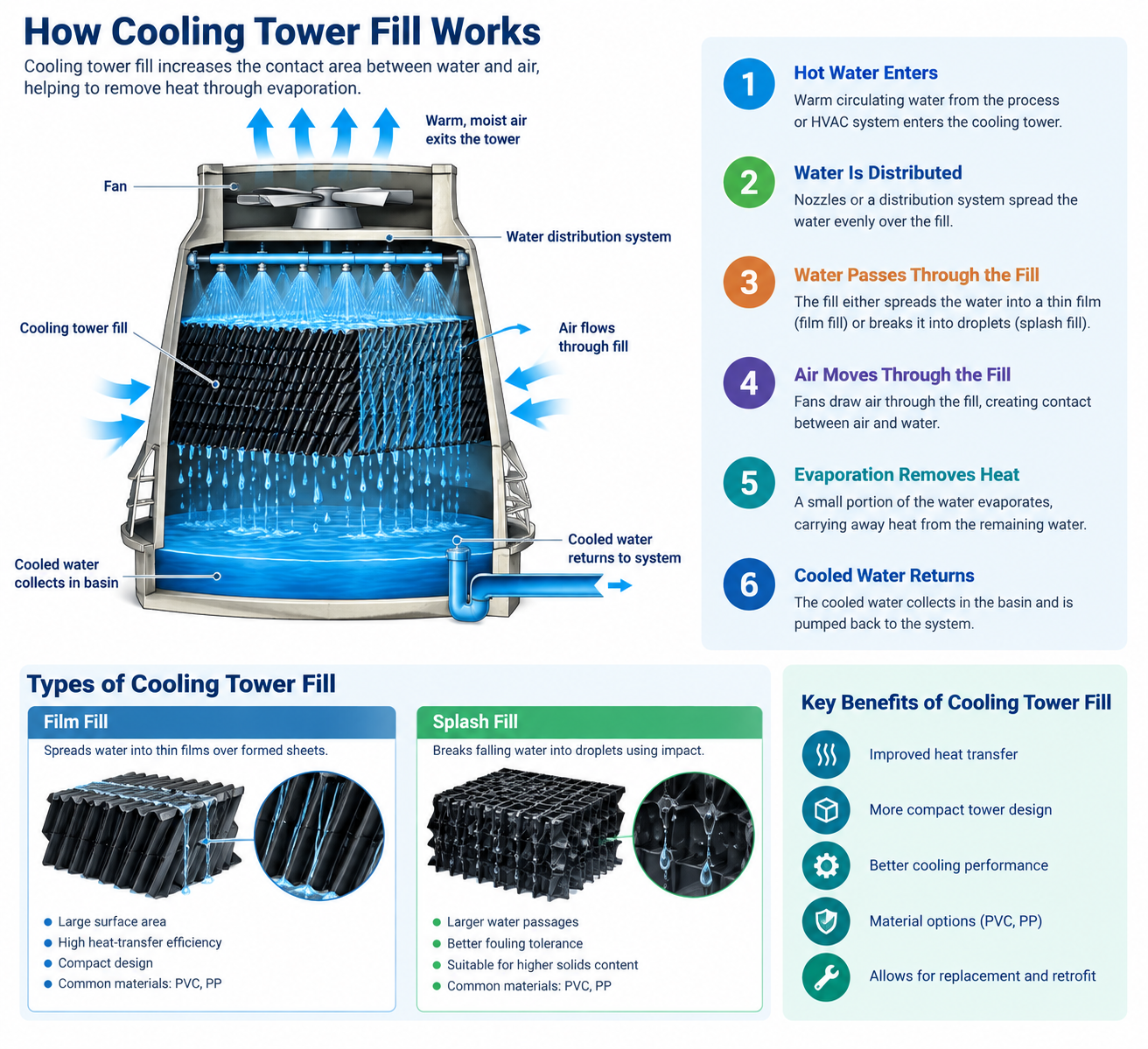
Film (PVC) fill. The most common choice for clean-water systems. Thin corrugated sheets create a large wetted surface per unit volume, delivering the best heat transfer efficiency. Best where water is relatively clean and scale risk is managed.
Splash fill. Designed for heavy, dirty or high-temperature water, splash fill breaks water into droplets and is far more forgiving of solids, fouling and thermal cycling. Preferred for steel plants, foundries and applications with suspended solids.
Polypropylene (PP) fill. Selected for aggressive chemical environments, higher temperatures, or where fire-rated, self-extinguishing performance is required (for example M2-rated PP). Often used as a direct replacement for aging splash or film packs.
High-velocity / cross-flow and counter-flow specific designs. Fill must be matched to your tower architecture. Cross-flow towers use vertical pack sections with gravity distribution; counter-flow towers rely on pressurized spray. A good supplier supplies both configurations.
A competent supplier should also offer drift eliminators and nozzles as part of a complete retrofit package, since these components wear together and affect overall efficiency and water loss.
What to Look For in a Fill Media Replacement Supplier
1. Product Quality and Material Traceability
Ask for material grade, virgin-vs-recycled content, thickness tolerance, and proof of UV stabilisation and fire rating (where required). Insist on internationally recognised standards, such as CTI (Cooling Technology Institute) compliance for thermal performance, and relevant fire-retardancy ratings. A credible supplier provides technical datasheets and can show you a physical sample.
2. Engineering and Design Capability
The best suppliers do more than sell panels. They calculate thermal duty, confirm the required cooling range and approach temperature, and size the fill for your tower footprint and air flow. They should provide a selection report and performance guarantee tied to your specific operating conditions — not just a catalogue efficiency figure.
3. Compatibility with Your Existing Tower
Fill is not one-size-fits-all. Panels must fit the exact structural dimensions of your tower, support grids and water distribution system. A reliable supplier will take the tower’s actual dimensions into account and supply modular packs that are easy to install and removable for future maintenance.
4. Installation and Project Management
Replacement projects rarely happen in an empty tower. A professional supplier provides an installation team that understands confined-space work, live-plant constraints and limited shutdown windows. They plan logistics so old fill is removed and new fill installed within your available downtime, and they handle waste disposal responsibly.
5. Supply Reliability and After-Sales Support
Check lead times, stock levels for common sizes, and the supplier’s ability to respond to urgent call-outs. Long-term support — replacement panels, spare nozzles, field service — matters as much as the initial sale. A supplier with local or regional presence can usually respond faster than one shipping from across the globe.
Managing a Fill Replacement Project
A disciplined replacement project typically follows six steps:
Audit. Inspect the existing fill, measure tower dimensions, and document fouling, collapse and wear.
Design. Calculate thermal duty and select the optimal fill type, material and pack height.
Quote and comparison. Compare suppliers on material quality, engineering support, price, delivery and warranty — not on unit price alone.
Removal. Safely strip out the old fill and dispose of it in line with environmental rules.
Installation. Fit the new packs, support structure and any associated components, following the manufacturer’s lay-up pattern.
Commissioning and verification. Test airflow, water distribution and thermal performance, and confirm the tower returns to design conditions.
Throughout, document everything: material certifications, installation records and performance measurements become your baseline for the next replacement cycle.
Common Mistakes to Avoid
Buying on price only. Cheap fill with recycled material can fail within two to three years, costing far more in downtime and rework.
Ignoring water chemistry. If your water scales, a film pack may foul quickly; a splash or specially treated pack may be a better investment.
Choosing the wrong fire rating. In process industries, an M1/M2-rated or self-extinguishing fill can be a regulatory and insurance requirement.
Skipping the performance guarantee. Always request a thermal performance warranty tied to your design conditions.
Treating fill as a standalone purchase. Align the fill with drift eliminators, nozzles and distribution repairs for a coherent retrofit.
Frequently Asked Questions
How often should cooling tower fill be replaced?Depending on water quality and operating conditions, quality PVC film fill typically lasts 10–15 years, and splash fill 10–20 years. Replace sooner if fouling, collapse or performance loss is significant.
How do I know my fill needs replacing?Signs include a widening approach temperature, rising energy use, visible collapse or heavy scale, high drift, and difficulty holding process temperatures during peak load.
Can a supplier match my existing tower without a full rebuild?Yes. A good supplier designs modular packs to your tower’s exact dimensions, so you replace the fill without rebuilding the structure or distribution system.
Is film fill or splash fill better?It depends on water quality. Film fill is more efficient with clean water; splash fill is more robust for dirty, hot or high-solids water. A competent supplier will recommend based on your chemistry.
Conclusion
Cooling tower fill media replacement is a high-value investment that directly affects energy cost, process reliability and operational uptime. The right supplier brings more than a product — they bring thermal engineering, material expertise, installation capability and long-term support. Choose a partner who understands your tower, your water and your production reality, and who stands behind their performance with a written guarantee.
If you are planning a fill replacement, start with a professional audit and compare suppliers on total value: material quality, engineering support, installation management, delivery and warranty. The small effort you invest in selection will repay itself many times over in efficiency and years of trouble-free operation.
Recommended internal links for CoolingTowerPart.com:


